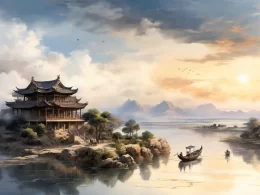

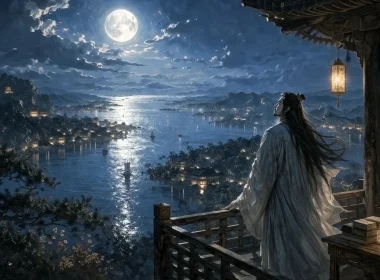
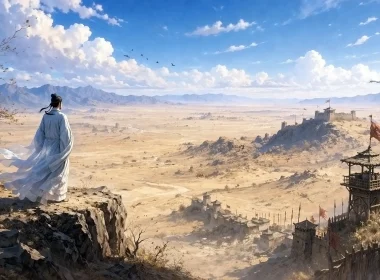
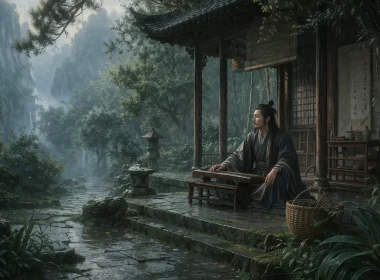
A sense so fine is but a sign of lack of might;
I love the cloud at leisure, the monk in silent light.
Now southward with my flag I'll go by riverside;
On the Pleasure-Giving Plain I gaze north where the great emperor died.
Original Poem
「将赴吴兴登乐游原」
杜牧
清时有味是无能,闲爱孤云静爱僧。
欲把一麾江海去,乐游原上望昭陵。
Interpretation
This poem was composed in the autumn of 850 AD, as Du Mu was about to leave the capital to assume the post of Regional Governor of Huzhou. At the time, he served in Chang'an as a Vice Director in the Ministry of Personnel—a respectable position within the bureaucratic system, yet one that offered little scope for realizing his substantial political ambitions amidst the complex factional strife (between the Niu and Li parties) that characterized late Tang court politics. His request for this provincial assignment, while ostensibly a routine transfer, was in essence a clear-sighted yet resigned act of distancing himself from the central political arena—a conscious retreat following the frustration of his aspirations.
The Pleasurable Plateau (Leyou Yuan) which the poet ascends was the highest vantage point south of Chang'an, offering a panoramic view of the city and serving as a traditional site for literati to climb and express their sentiments. The "Zhaoling Mausoleum" (the tomb of Emperor Taizong, located northwest of Chang'an) mentioned in the poem is not a randomly chosen landmark. It stands as a symbol of a golden age for the empire: the Zhenguan Reign, representing enlightened rule, national strength, and the effective employment of talent. On the brink of departing the political center for a posting by the "rivers and lakes," Du Mu's act of turning his gaze toward Zhaoling from this height is itself laden with complex political metaphor and personal emotion. The poem thus becomes a deeply poignant political lyric, using the form of a landscape poem, the reality of leaving the capital as its structural core, and the act of historical reflection as its animating spirit. Beneath a surface tone of leisurely self-deprecation surges a profound lament for both personal circumstance and the fate of the era.
First Couplet: 清时有味是无能,闲爱孤云静爱僧。
Qīng shí yǒu wèi shì wú néng, xián ài gū yún jìng ài sēng.
In times of peace, a taste for leisure marks the unskilled, they say; I love the lone cloud in my idleness, the monk in stillness far away.
The couplet opens with irony, establishing the poem's sardonic and somber tone. "Times of peace" refers to an era of tranquility and prosperity—a phrase of apparent praise that is deeply ironic. The late Tang, plagued by internal troubles and external threats, was far from genuinely peaceful. The poet claims that "a taste for leisure" defines him and attributes it to being "unskilled." This is a piercing self-directed irony and, more sharply, a critique of an age where capable individuals are sidelined and the ambitious find no path forward, despite its claim to be "peaceful." The next line, "I love the lone cloud… the monk in stillness," gives concrete form to this enforced idleness and quietude: the lone cloud drifts rootlessly; the monk dwells apart from worldly dust. When the poet professes to "love" these, he is in truth sketching his own predicament—as adrift as a lone cloud, his state of mind aspiring to the monk's detachment yet unable to mask its underlying loneliness. This is a leisure fraught with tension, its calm surface hiding turbulent depths.
Final Couplet: 欲把一麾江海去,乐游原上望昭陵。
Yù bǎ yī huī jiāng hǎi qù, Lèyóu yuán shàng wàng Zhāolíng.
Soon, bearing my insignia, to distant lakes and seas I go; On Pleasurable Plateau, I gaze toward Zhaoling ere I go.
This couplet releases and crystallizes the poem's pent-up emotion. "Soon, bearing my insignia, to distant lakes and seas I go" confirms the journey as an official posting away from the center; "lakes and seas" refers to Huzhou, far from the seat of power. The word "go" carries a sense of both decision and resignation. The act of climbing high to "gaze toward Zhaoling" is the soul of the entire poem. Why gaze toward Zhaoling Mausoleum, and not the imperial palace or the city itself? Because Emperor Taizong, resting at Zhaoling, embodies an ideal epoch of wise governance, national vigor, and the full utilization of talent. This "gaze" is a farewell, an act of admiration, and, more profoundly, a silent interrogation and comparison. In the poet's mind, the true "times of peace" reside there (in the past symbolized by Zhaoling), not here (in present-day Chang'an). This final look back at the moment of departure elevates personal disappointment into a poignant remembrance of a historical golden age and a deep-seated sorrow and indignation at the present era's deviation from that ideal path. The perspective suddenly broadens, imbuing the lament with a vast, historical desolation.
Holistic Appreciation
This heptasyllabic quatrain is a masterful fusion of personal circumstance with historical and national reflection. It employs a distinctive structure of "saying the opposite of what is meant, then casting a final, revealing glance." Emotion builds under constraint and finds its outlet in that backward look.
The first two lines, adopting a tone of self-mockery and leisurely reflection, establish a state of mind that seems detached but is inwardly knotted; the language is restrained yet incisive. The final two lines shift to the narration of action and the direction of a gaze, creating distance both spatially (leaving the capital) and temporally (looking back to history). The concluding line, "gaze toward Zhaoling," functions like a cinematic freeze-frame, concentrating the poet's complex emotions—longing for a prosperous age, disappointment with the present, lament for his own fate, and a lingering sense of scholarly-official duty—into this silent, profoundly significant look. The poem contains no direct political criticism. Yet, through its ironic use of "times of peace" and its focused gaze upon "Zhaoling," it delivers a political and historical judgment more potent than any explicit condemnation.
Artistic Merits
- Supreme Employment of Irony: The line "In times of peace, a taste for leisure marks the unskilled" forms the ironic core of the poem. Through self-deprecation ("unskilled"), it launches a dual critique—of the era (is it truly peaceful?) and of his own situation (is this taste for leisure genuine?). This technique of saying one thing while meaning another, appearing modest while conveying self-respect and self-pity, is indirect yet trenchant, a hallmark of Du Mu's satirical artistry.
- Symbolic and Contrastive Imagery: The images of the "lone cloud" and the "monk" symbolize the posture of detachment and solitude the poet is compelled to assume, forming an implicit connection with the distant "lakes and seas" (his destination) mentioned later. The central historical image of "Zhaoling Mausoleum," together with "Pleasurable Plateau" (the present vantage point) and "lakes and seas" (the future destination), creates a triangulated dialogue across time and space, vastly expanding the poem's historical resonance and emotional depth.
- The Profound Connotation of a Simple Action: The key action is "to gaze." This simple verb links the intention to depart (the future) with Zhaoling (the past), crystallizing the poet's entire complex mindset before leaving the capital. It is not a sightseer's glance but a ritualistic gesture, rich in historical consciousness and political allegory, essential for understanding the poem.
- Undulating and Sublime Emotional Architecture: The poem's emotion follows a pattern of "restraint — apparent release — deeper restraint — sublimation." The opening line is self-mocking (restraint); the second describes leisure (seemingly a release, but actually restrained); the third speaks of departure (an active step, yet emotionally a form of withdrawal); the final line, "gaze toward Zhaoling," sublimates all preceding personal melancholy into a grand lament for history and the age, lending private sorrow a public, historical weight and dignity.
Insights
This work reveals the classic spiritual dilemma and path to transcendence for an idealistic scholar-official in a flawed era. It first illustrates the profound discord between the individual and his age. When personal values (such as applying one's talents to state service) find no alignment with the paths offered by reality, how does one conduct oneself? Du Mu's response is to use self-irony ("unskilled") to preserve spiritual integrity, and to actively seek physical distance ("to lakes and seas I go"). Ultimately, however, his spiritual anchor is to "gaze toward Zhaoling"—to look back to and hold fast to a higher historical standard and set of values. This reminds us that in facing real-world frustration, true sustenance often comes from inwardly cherishing a transcendent ideal or historical exemplar.
Secondly, it embodies the complex psychology within the scholar-official's dynamic of "advancement and retreat, service and withdrawal." "Withdrawal" (leaving the capital) constituted a career setback, yet the poem betrays no despondency. Instead, the act of "gazing toward Zhaoling" reveals an unyielding spirit and profound concern. This suggests that physical "retreat" and spatial "departure" do not necessarily equate to spiritual "surrender" or a compromise of values. Departing the center might, in fact, grant a clearer vantage point and a firmer personal stance.
Finally, the poem offers a model for maintaining spiritual stature amidst adversity. Du Mu does not indulge in personal complaint but situates his experience within the sweep of history. That figure gazing toward Zhaoling upon departure embodies one who, amid disappointment, retains hope; who, while leaving the capital, does not abandon concern for the state; who, on his personal "journey to lakes and seas," keeps his mind fixed on the ideal realm symbolized by "Zhaoling." It reminds us that regardless of circumstance, we should hold within us a "Zhaoling" worthy of contemplation—an eternal wellspring of strength to counter the disillusionments of reality and nurture an upward-reaching spirit.
Poem translator
Kiang Kanghu
About the poet

Du Mu (杜牧), 803 - 853 AD, was a native of Xi'an, Shaanxi Province. Among the poets of the Late Tang Dynasty, he was one of those who had his own characteristics, and later people called Li Shangyin and Du Mu as "Little Li and Du". His poems are bright and colorful.