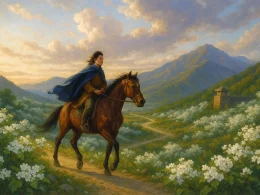

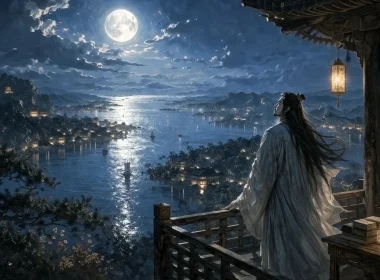



From the walls of Baidi high in the coloured dawn
To Jiangling by night-fall is three hundred miles,
Yet monkeys are still calling on both banks behind me
To my boat these ten thousand mountains away.
Original Poem
「早发白帝城」
李白
朝辞白帝彩云间, 千里江陵一日还。
两岸猿声啼不住, 轻舟已过万重山。
Interpretation
Composed in the spring of 759 CE during Emperor Suzong's Qianyuan era, this poem is a song of liberation at a pivotal moment in Li Bai's life. At fifty-nine, having been exiled to Yelang for his association with Prince Yong, Li Li, he was traveling through Baidi City (present-day Fengjie, Chongqing) when he suddenly received news of a general amnesty declared due to a severe drought in the Guanzhong region. The ecstatic joy of this unexpected reprieve transformed into this swift, wind-borne verse, which stands as the most vibrantly passionate work of his later years.
First Couplet: “朝辞白帝彩云间,千里江陵一日还。”
Zhāo cí Báidì cǎiyún jiān, qiān lǐ Jiānglíng yī rì huán.
At dawn I leave Baidi, in its rainbow-lit domain; A thousand li to Jiangling—returning in a day’s span.
The opening surges forth with dramatic tension. “Rainbow-lit” describes both the physical reality of Baidi City’s lofty height shrouded in morning mist and, more metaphorically, the dreamlike, sublime feeling of being released from this “fairyland” and returning to the human world. “At dawn I leave” marks the time, aligning with the title “Departing Early,” and symbolizes a new beginning, a rebirth. The following line, “A thousand li to Jiangling—returning in a day’s span,” is a masterpiece of temporal-spatial compression. The hyperbolic contrast between “a thousand li” and “a day” is not literal but reflects the poet’s intensely lighthearted, unimpeded subjective feeling—a heart racing homeward, turning perilous roads into smooth paths. The word “returning” conveys all the relief and fond familiarity of coming back from tribulation, as if all suffering has been cast behind by this swift journey.
Second Couplet: “两岸猿声啼不住,轻舟已过万重山。”
Liǎng'àn yuán shēng tí bú zhù, qīng zhōu yǐ guò wàn chóng shān.
From shores left and right, apes’ cries echo unbroken; My light boat has left behind ten thousand mountain chains.
This couplet uses the juxtaposition of sound and sight to push the boat’s speed and the heart’s elation to their peak. The ape cries of the Three Gorges traditionally symbolize sorrow and desolation (as in “three ape cries soak the traveler’s gown with tears”), but here, the “unbroken” ape cries become a reference for speed—not that the boat is slow, but that it is so fast the cries seem stretched and fused into a continuous backdrop. The “light” of the light boat is both the vessel’s physical lightness and, more importantly, the lightness of spirit after the burden of accusation and punishment is lifted. “Has left behind ten thousand mountain chains”—the word “has left behind” brims with unexpected delight and a sense of triumph. Layer upon layer of obstacles vanish instantly before the power of freedom and joy.
Holistic Appreciation
Hailed as a strong contender for the title of “finest quatrain of the Tang Dynasty,” this poem’s artistic charm lies in its unique expression of “conveying passion through speed, trading space for time.” Not a single word directly expresses emotion, yet through the high starting point of “rainbow-lit,” the temporal sense of “returning in a day,” the flowing sound of “cries unbroken,” and the spatial traversal of “left behind ten thousand mountain chains,” it constructs a rapidly soaring emotional curve. This vividly captures the poet’s complex state of mind after the pardon—as if awakening to a new world, ecstatic yet slightly dazed.
The poem’s internal rhythm perfectly matches the boat’s motion: the first line gathers momentum for departure, the second dashes forward at full speed, the third transforms the passing scenery into waves of sound, and the fourth opens into sudden clarity after breaking through all barriers. The four lines are like a passionate, exuberant musical piece, filled with the unextinguished vitality and romantic spirit of High Tang poetry, even after enduring hardship.
Artistic Merits
- Perfect Fusion of Hyperbole and Reality: The extreme exaggerations of “a thousand li in a day” and “ten thousand mountain chains” feel utterly authentic and believable when combined with the geographical reality of the Three Gorges’ rapid currents and the poet’s ecstatic psychological state—this is Li Bai’s brand of romanticism.
- Multi-Dimensional Narrative Combining Sight and Sound: The poem contains the splendid visuals of “rainbow-lit,” the continuous auditory layer of “apes’ cries,” and the kinetic sensation and speed of “light boat has left behind,” collectively creating an immersive experience of passage.
- Emotional Recasting of Imagery: Traditional images like “apes’ cries” and “ten thousand mountain chains,” often associated with the sorrows of travel, are here entirely infused with new emotional color, becoming elements that contrast and highlight joyful feeling, showcasing the poet’s powerful subjective spirit.
- Highly Condensed, Lively Language: Twenty-eight characters, each perfectly chosen, with no superfluous word. Verbs like “leave,” “return,” and “left behind” are precise and forceful; adverbs like “at dawn,” “a thousand li,” “in a day,” and “has” intensify the sense of time and space. Reading it is like watching clouds and flowing water—smooth and continuous in a single breath.
Insights
This masterpiece is an eternal ode to “rebirth from despair” and “the soaring of a liberated spirit.” It teaches us that life may suddenly descend into valleys, confronting obstacles as layered as “a thousand mountain ranges,” yet as long as hope in the heart remains unquenched, fate can turn in the span of a single morning. Even more profoundly, it reveals the lightness and swiftness attainable by the human spirit—true freedom lies in transforming the weight of the past into forward momentum, facing those “thousand mountains” with the poise of a “light boat.” This poem inspires all who navigate adversity to hold fast to faith in the sudden arrival of light, and to an unceasing, surging passion for life.
Poem translator
About the poet
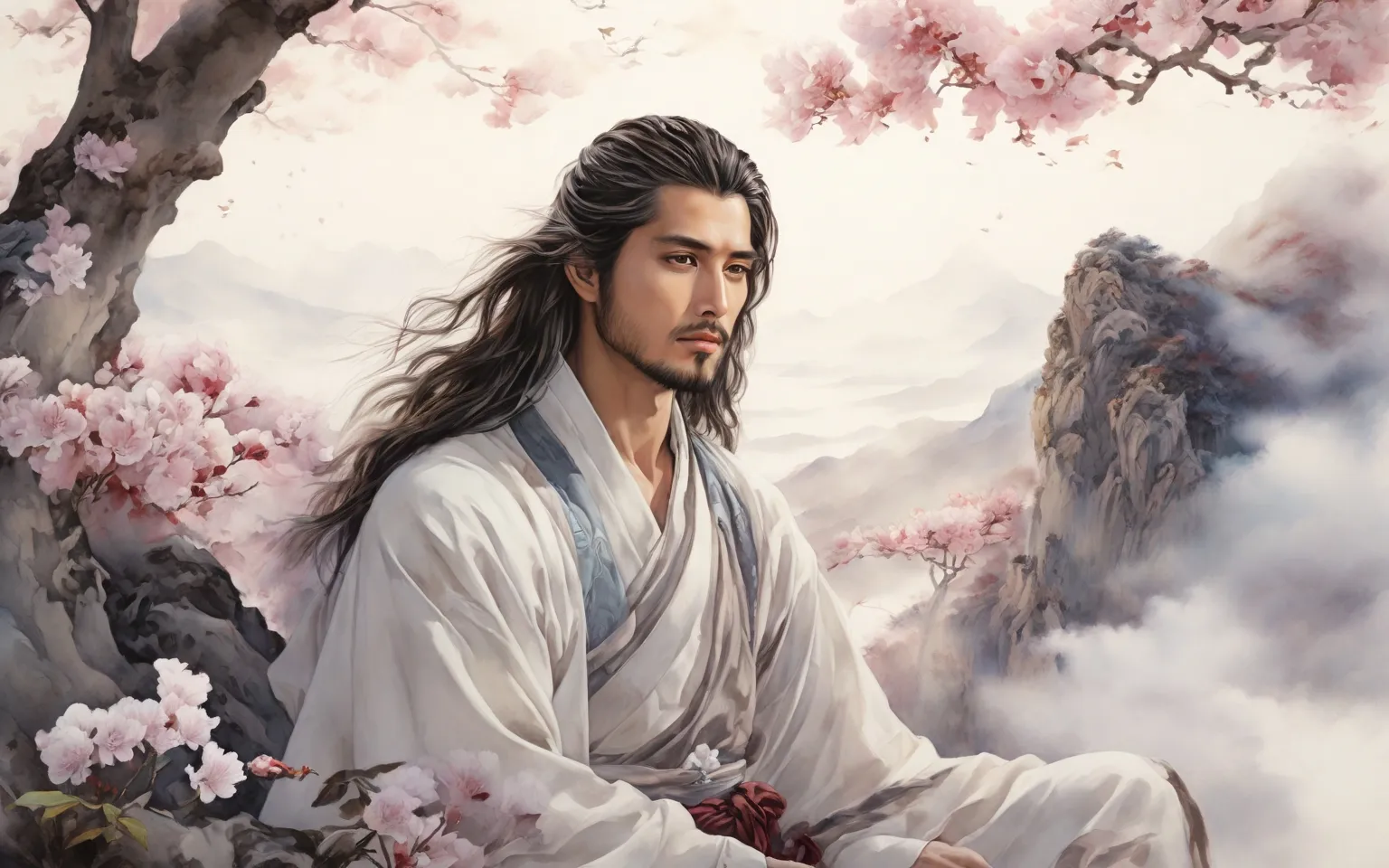
Li Bai (李白), 701 - 762 A.D., whose ancestral home was in Gansu, was preceded by Li Guang, a general of the Han Dynasty. Tang poetry is one of the brightest constellations in the history of Chinese literature, and one of the brightest stars is Li Bai.