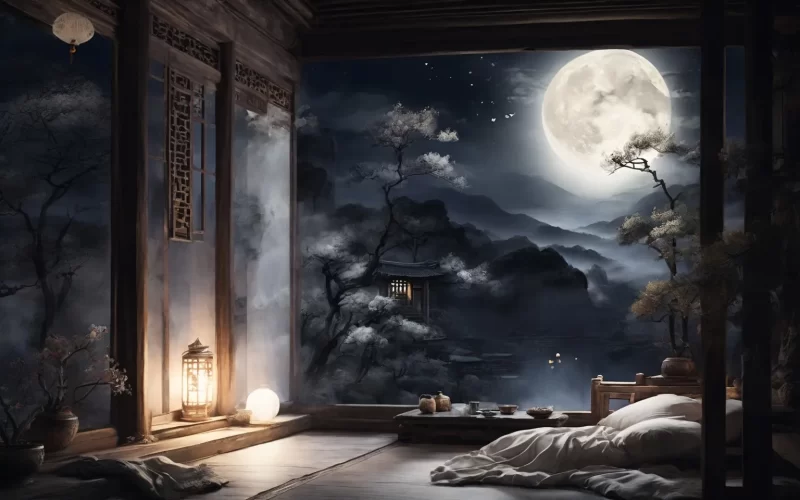

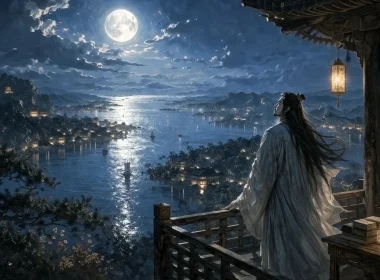
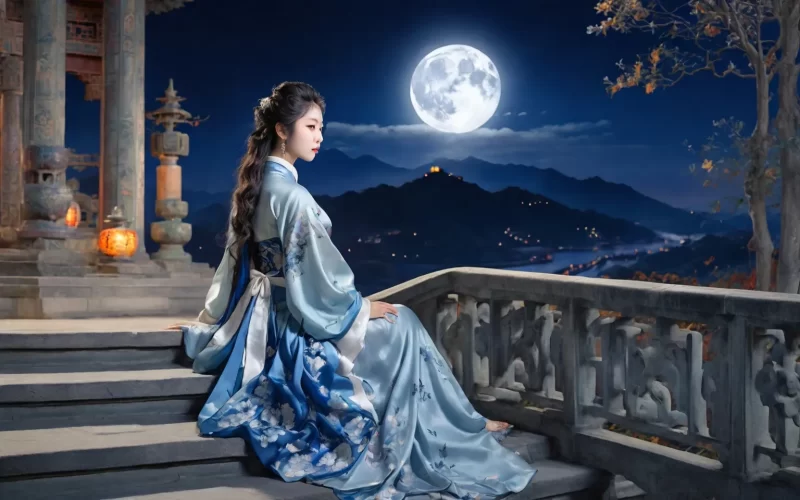
Her jade-white staircase is cold with dew;
Her silk soles are wet, she lingered there so long
Behind her closed casement, why is she still waiting,
Watching through its crystal pane the glow of the autumn moon?
Original Poem
「玉阶怨」
李白
玉阶生白露,夜久侵罗袜。
却下水晶帘,玲珑望秋月。
Interpretation
This poem is a palace sorrow poem composed by Li Bai using an old Music Bureau title. Though modeled on ancient works, it far surpasses the conventional scope of boudoir lament poetry. With his genius touch, Li Bai transforms the hopeless vigil of a palace woman into a symbol of a universal human condition through a static portrayal of waiting in the extreme, creating one of the purest and most condensed lyrical realms in Chinese poetry.
First Couplet: “玉阶生白露,夜久侵罗袜。”
Yù jiē shēng báilù, yè jiǔ qīn luó wà.
On the jade steps, white dew forms, chill and clear; Night deepens, seeps through her thin silken gear.
The opening establishes the poem’s tone through a sensation of penetrating cold. “Jade steps” indicate a place of luxury, which contrasts with the loneliness within. The word “forms” describes the quiet arrival of dew and the silent passage of time; “seeps through” subtly conveys the relentless penetration of chill from outside to inside—a physical coldness and, more profoundly, a metaphor for hope being eroded by despair. The duration of her standing and the intensity of her longing are fully conveyed in the phrase “night deepens” and the detail of the dew seeping through her silken stockings.
Second Couplet: “却下水晶帘,玲珑望秋月。”
Què xià shuǐjīng lián, línglóng wàng qiū yuè.
Yet she lowers the crystal blind, a glimmering sheet; And gazes at the autumn moon—luminescent, bittersweet.
“Yet she lowers” marks a shift in action. While appearing to relinquish her vigil, she in fact redirects it into a more secluded, more focused temporal and spatial realm. The “crystal blind” echoes the earlier “jade steps,” constructing an exquisite yet icy material world. The word “luminescent” carries a dual meaning: it describes both the limpid clarity of the autumn moon and the shimmering, illusory visual effect of viewing the moon through the translucent blind. Ultimately, she projects all her emotion onto the eternal autumn moon, achieving a spiritual sublimation—from waiting for a specific person to communing with an eternal symbol.
Holistic Appreciation
The artistic achievement of this poem lies in its use of absolute stillness to express extreme motion (the flow of emotion). In only twenty characters, with not a single word directly expressing feeling, the poem builds a poetic space that is visually and tactilely pure yet piercingly cold through a series of clear, transparent, and hard images: “jade steps,” “white dew,” “silken stockings,” “crystal blind,” and “autumn moon.” The woman’s figure remains half-hidden; we only see her silken stockings soaked by dew, her lowering the blind, her posture of gazing at the moon. Her hope, disappointment, solitude, and final perseverance are all condensed into these meticulously captured scenes.
The poem’s rhythm is perfectly aligned with its emotion: the first two lines are drawn out (“night deepens, seeps through”), conveying endurance; the latter two are lighter (“lowers,” “gazes”), representing a turn and a form of solace. The physical movement from standing outside to lowering and gazing inside corresponds to an emotional shift from external expectation to an internal坚守 of the spiritual world. The “autumn moon” she gazes upon becomes an eternal symbol, transcending worldly futility and carrying infinite, quiet longing.
Artistic Merits
- Crystalline Structure of Imagery: The “jade,” “dew,” “crystal,” and “moon” in the poem are all crystalline, clear, transient, or coldly distant objects. Together, they weave a system of imagery that glimmers with a cold light, untouched by worldly dust, mirroring the pure yet lofty soul of the palace woman.
- Subtle Synesthesia of Sensation: The poem emphasizes sensation—the visual whiteness of the jade, the tactile cold of the dew, the dampness of the silken stockings being seeped through, the visual transparency of the crystal blind, the clear radiance of the autumn moon. Multiple senses intertwine, creating an immersive atmosphere.
- Precision and Suggestiveness of Verbs: The four verbs—“forms,” “seeps through,” “lowers,” “gazes”—constitute the entire plot. They are extremely economical yet precisely drive the emotional development. The verb “gazes” in particular directs all unspoken words and unfathomed feelings toward the vast night sky, fully realizing the poetic conception.
- Pinnacle of the Art of Suggestion: The woman’s identity, her appearance, and the precise nature of her thoughts and grievances are all omitted. This extreme use of suggestion liberates the poem from the confines of a specific palace-sorrow scene, transforming it into a universal metaphor for waiting, solitude, and spiritual vigil, resonant across any era or culture.
Insights
This work shows us that the deepest solitude often dwells within the most splendid cages; the highest poetry can crystallize from the most hopeless waiting. It is not merely a palace sorrow poem but a philosophical poem about the human spiritual condition. The woman’s movement from the “jade steps” to behind the “crystal blind” symbolizes how, after hope is thwarted, one can shift their gaze from an external, changeable object (like imperial favor) to an internal, eternal spiritual solace (like the purity, beauty, and eternity represented by the bright moon).
It enlightens us that when the real world brings disappointment, even to the point of “dew seeping through silken gear,” one can still retain the capacity to “gaze at the luminescent autumn moon”—that is, to maintain a contemplative gaze and yearning for beauty and transcendence. This act of gazing itself is a noble posture that resists nihilism and anchors the soul. Li Bai’s greatness lies in making a specific lament shine with the light of universal humanity and ultimate concern.
Poem translator
Kiang Kanghu
About the poet
Li Bai (李白), 701 - 762 A.D., whose ancestral home was in Gansu, was preceded by Li Guang, a general of the Han Dynasty. Tang poetry is one of the brightest constellations in the history of Chinese literature, and one of the brightest stars is Li Bai.