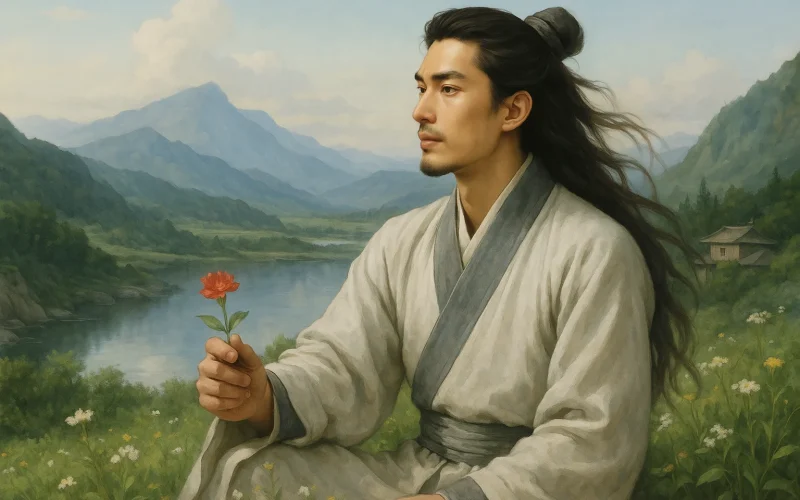

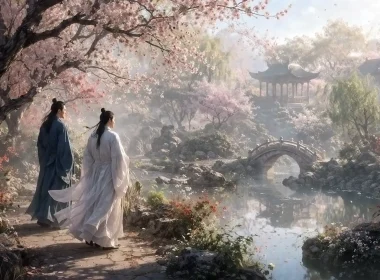
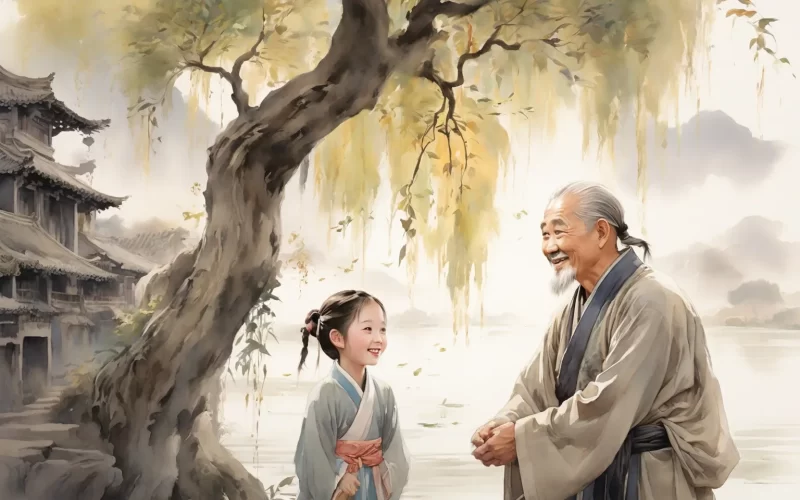
Old, I return to the homeland I left while young,
Thinner has grown my hair, though I speak the same tongue.

My children, whom I meet, do not know who am I.
“Where do you come from, sir?” they ask with beaming eye.
Original Poem
「回乡偶书」
贺知章
少小离家老大回,乡音无改鬓毛衰。
儿童相见不相识,笑问客从何处来。
Interpretation
This poem was composed in 744 AD, the third year of the Tianbao era during the reign of Emperor Xuanzong of the Tang Dynasty. The poet, He Zhizhang, was eighty-six years old at the time. Renowned for his literary talent from a young age, he achieved the prestigious jinshi (presented scholar) degree in 695 AD. He subsequently served in the capital for many years, holding various official posts and enjoying the deep trust of Emperor Xuanzong. In his later years, he was honored with the prestigious title of Yinqing Guanglu Dafu. In 744 AD, citing reasons of health, He Zhizhang petitioned to retire from official duty, become a Daoist priest, and return to his native home. The Emperor, bestowing a great honor, granted him a tract of land by Mirror Lake and saw him off in person along with the Crown Prince and numerous officials. However, when this elderly man, after an absence of more than five decades, finally returned to his hometown, he was met not with recognition, but with the poignant and awkward moment encapsulated in the lines: "儿童相见不相识,笑问客从何处来".
He Zhizhang had left his hometown in the full bloom of youth; he returned a frail old man. Over fifty years of life's vicissitudes, the rise and fall of an official's career, the fleeting glory of the capital—all were distilled in that instant into a single, artless question from a hometown child. This poem was an impromptu composition from that homeward journey. With the most economical brushstrokes, it expresses the deepest emotions of the human experience. The poem contains no tears, no lamentations; there is only the unchanged local accent, the hair at the temples now grown thin and white, and a child's innocent query. Yet it is precisely this simple question that draws forth the poet's profound sense of life's changes and poignant helplessness.
First Couplet: "少小离家老大回,乡音无改鬓毛衰。"
Shào xiǎo lí jiā lǎo dà huí, xiāng yīn wú gǎi bìn máo shuāi.
Old, I return to the homeland I left while young,
Thinner has grown my hair, though I speak the same tongue.
The opening line establishes a stark contrast: "young" versus "old." This juxtaposition spans a gulf of over fifty years. Between "left home" and "return" lies the length of an entire lifetime—from youthful vigor to elderly frailty, from ambitious departure to weary homecoming. A mere seven characters capture a whole life. The following line, "乡音无改鬓毛衰", presents another layer of contrast: "accent unchanged" versus "hair grown thin." The local accent is the indelible mark of home, the code of identity, the anchor of memory—it persists. Yet, the hair at the temples cannot withstand time's erosion; it has thinned and whitened. This juxtaposition of the "unchanged" and the "altered" mirrors the poet's inner world: in spirit, he remains the youth who left home; yet his body bears the honest record of time's passage.
Second Couplet: "儿童相见不相识,笑问客从何处来。"
Ér tóng xiāng jiàn bù xiāng shí, xiào wèn kè cóng hé chù lái.
The children, meeting me, do not know me;
They smile and ask: "Visitor, from where do you come?"
This couplet, celebrated through the ages, is masterful in its use of a child's innocent question to underscore the poet's own sense of life's immense changes. The children playing by the village path naturally do not recognize this old man who left more than five decades ago. Hence, they "smile and ask: 'Visitor, from where do you come?'" The word "smile" captures the children's artless, unconstrained cheerfulness. The word "visitor" (or "stranger"), however, falls like a blunt blade upon the poet's heart. This is his own homeland; he is the master returning. Yet, in the children's eyes, he is but a "visitor." This single question speaks to the common experience of countless wanderers returning home: the hometown remains, but its people have changed; old memories linger, but new faces show no recognition. The poet does not directly express the turmoil within; he merely records this light question as it was. And in that record, a world of emotion is left unspoken.
Holistic Appreciation
This impromptu verse, composed by He Zhizhang upon returning to his hometown in old age, stands as a paragon in Chinese literature for expressing the sorrow of displacement and the sentiments of a life lived. In just four lines and twenty-eight characters, with supreme concision, it conveys the deepest and most universal emotions of the homecoming wanderer.
Structurally, the poem presents clear, layered contrasts. The first line contrasts the temporal states of "young" and "old," stretching the canvas of a lifetime. The second line contrasts the physical states of "accent unchanged" and "hair grown thin," highlighting the disparity between inner constancy and outer decay. The final couplet sets the children's "smiling question" against the poet's silent response, a poignant emotional contrast that captures the complex bittersweetness of return. These three layers of contrast build upon one another, fully rendering the subtle shifts within the poet's heart—from poignant reflection, to helpless acceptance, to a profound, quiet desolation.
The central tension of the poem lies in the interplay between "return" and "estrangement." The poet's homecoming is a physical and emotional return. Yet, the children of his hometown see him as a "visitor." The potency of this word "visitor" lies in its revelation of a stark truth: time has erected an invisible wall between him and his native place. His accent remains, a tether to the past, but the hometown is no longer the one in his memory. He is of this place, yet here he has become a stranger. This sense of estrangement upon return cuts deeper and feels more desolate than the loneliness of exile in a foreign land.
Artistically, the poem's greatest power lies in its profound restraint. Not a single line directly voices the poet's joy or sorrow. It simply narrates, with calm objectivity: left young, return old; accent unchanged, hair grown thin; children don't know me; they smile, ask the visitor his origin. Yet, it is precisely this ostensibly dispassionate narration that allows emotion to flow naturally from the scene. The reader discerns the immense waves in the poet's heart within the children's "smiling question." This technique of "expressing the inexpressible, capturing the untold grace" represents the highest achievement of subtle, restrained beauty in classical Chinese poetry.
Artistic Merits
- Vivid Contrast, Profound Meaning: The temporal contrast of "young/old," the physical contrast of "accent unchanged/hair grown thin," and the emotional contrast of the children's "smiling question" versus the poet's silence—these three layers intensify the poem's emotional impact. Life's changes are revealed through contrast; deep feeling emerges from juxtaposition.
- The Large Revealed in the Small, Heavy Themes Lifted with Ease: A child's innocent, "smiling question" expresses the full, complex experience of the wanderer's return. A light query bears the weight of profound feeling.
- Plain Language, Sincere Emotion: The poem uses no difficult or obscure words, flowing as naturally as speech. Yet it articulates a universal human experience. Genuine feeling resides in plainness; depth is found in simplicity.
- Unadorned Description, Subtle and Reserved: The poet sketches the scene with plain description, using not a single directly emotive word. Yet the emotion is fully present within. Not a word of overt expression is used, yet its grace is perfectly captured.
- Exquisite Conception, Lingering Resonance: The poem closes on the word "visitor," embedding within it the poet's stark realization of his transformed status from master to stranger. It leaves the reader with a sigh that echoes long after. The words end, but the meaning resonates endlessly.
Insights
This poem, through the simple narrative of a homecoming, articulates the universal human experience of nostalgia and reflections on life's journey, offering profound insights.
First, it compels us to ponder the complex emotional ties between "hometown" and "wanderer." The poet departed with "少小离家" and returned only in old age. Over fifty years is sufficient to alter everything. His unaltered local accent signifies that he never forgot his roots; yet, the children of his hometown no longer recognize him, perceiving him only as a "客". This sense of estrangement upon return cuts deeper than the solitude of exile in a distant land. It teaches us: "Hometown" is not merely a geographical location; it is also a concept of time. A true "homecoming" is not just a physical return but a reunion with one's former self. However, when separated by too much time, neither that past self nor that remembered hometown can ever be fully reclaimed.
The children's "笑问" and the poet's silence reveal to us the continuity and succession of life. Those unrecognizing children are the new stewards of the hometown. Their artless inquiry confirms the poet's status as a "客" while simultaneously affirming the hometown's enduring vitality. The poet is both a returning native and a transient visitor; the hometown is both his destination and merely a waystation. It tells us: An individual life fades with age, but the life of a place persists. This intergenerational succession is the way of nature and a constant truth of human society.
This poem also leads us to contemplate the eternal questions of "identity" and "belonging." Though absent for over five decades, the poet clung to his unchanged accent—a final act of holding fast to his identity. Yet, confronted with the question "客从何处来", the anxious uncertainty of that moment is likely familiar to every long-term wanderer. It reminds us: No matter the distance traveled or the achievements gained elsewhere, when facing our hometown, we forever remain the one who "少小离家". Yet, whether that hometown will still acknowledge us is a question that requires a lifetime to answer.
In our modern era of unprecedented mobility, this poem retains potent relevance. It reminds us: Regardless of how far we roam, we must not forget the unchangeable local accent that roots us. No matter the duration of our absence, we must find the courage to face the potential unfamiliarity upon our return. The hometown may change; we may become the "客". But the profound attachment that lies at the very core of one's being—that, perhaps, endures unchanged.
About the poet
He Zhizhang (贺知章 c. 659 – c. 744), a native of Xiaoshan District, Hangzhou, Zhejiang Province, was a renowned poet and calligrapher of the Tang Dynasty. He became a jinshi (presented scholar) in the first year of the Zhengsheng era (695 AD) and rose to the position of Imperial Supervisor, earning him the sobriquet "Supervisor He." In the early Tianbao era, he petitioned the emperor to become a Taoist priest and retired to Jinghu Lake. Known for his literary talent from a young age, he was celebrated as one of the "Four Literary Masters of Wuzhong," along with Zhang Ruoxu, Zhang Xu, and Bao Rong. His poetry is fresh, simple, and rich in emotion. He excelled in cursive and clerical calligraphy, and together with Zhang Xu, they were renowned as the "He-Zhang Duo." With a broad-minded and uninhibited personality, He Zhizhang was also a passionate wine lover. His poetic style and character together exemplify the distinctive romance and unrestrained spirit of High Tang scholars.