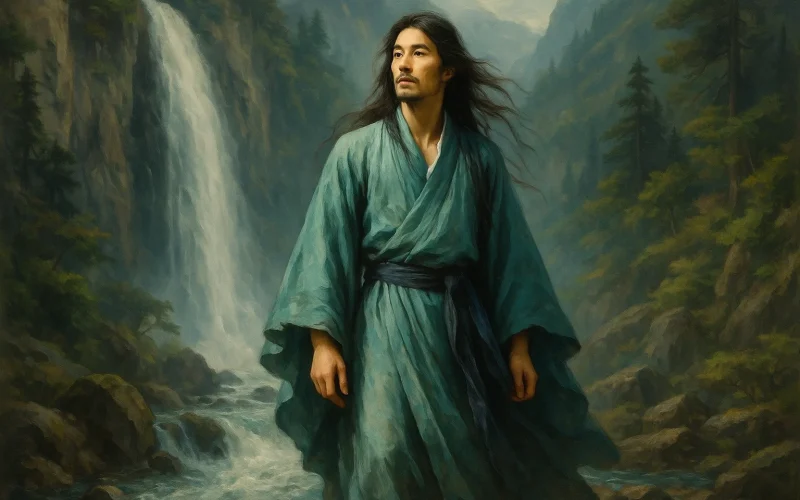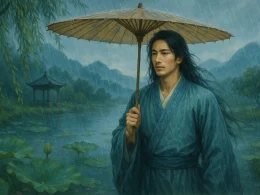



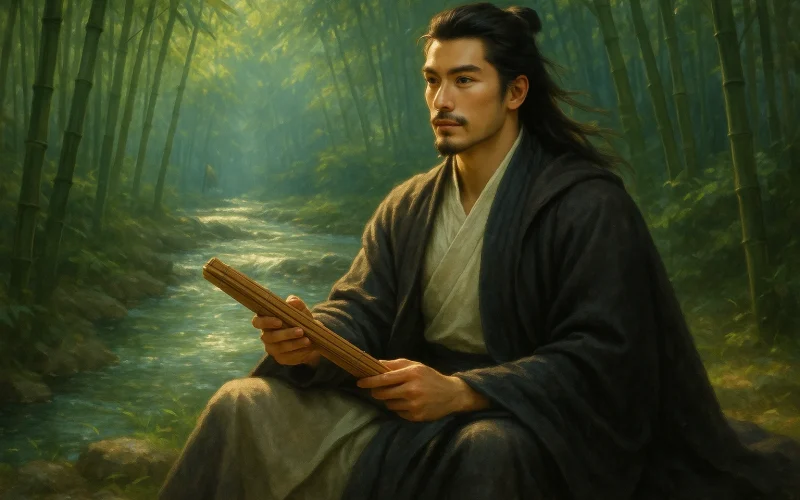
Zhang Jiuling (张九龄 678 - 740), a native of Shaoguan, Guangdong Province, was an outstanding statesman and literary figure during the transitional period from the Early Tang to the High Tang Dynasty. Born into a humble family in Lingnan, he rose to the position of Chancellor (Zhongshu Ling) during the Kaiyuan era, becoming the last virtuous chancellor of Emperor Xuanzong’s reign. He was renowned for his refined demeanor and his willingness to offer frank remonstrances. His poetic style is pure, natural, subtle, and profound, with particular excellence in five-character ancient verse. As a statesman with great vision, he mentored and promoted younger talents such as Wang Wei and Meng Haoran, holding a milestone position in the history of Tang poetry as a link between preceding and succeeding generations.
Major Works
Life
Zhang Jiuling was born into a family of Southern Lingnan scholar-officials that had served in government for generations. His great-grandfather, Zhang Junzheng, once served as Vice Prefect of Shaozhou; his grandfather, Zhang Zizhou, served as Military Advisor of Douzhou; his father, Zhang Hongyu, served as Assistant Magistrate of Suolu County in Xinzhou. Although not a family of the highest prominence, it was already a distinguished clan in Lingnan. Zhang Jiuling showed exceptional intelligence from a young age. He could write essays at seven, and when he was thirteen, Wang Fangqing, the Prefect of Guangzhou, read his compositions and exclaimed with admiration, "This child is surely destined to go far." This prophecy would later come true.
In the second year of the Chang'an era of Wu Zetian's reign (702 AD), the twenty-five-year-old Zhang Jiuling passed the Jinshi examination and was appointed Collator at the Imperial Library. Afterwards, he returned to Lingnan and briefly resigned from office to live in seclusion, devoting himself to study and self-cultivation. During this period, he associated with local literati and gradually gained renown. In the first year of the Jinglong era (707 AD), he took the special examination for "Tao Equaling Yi and Lu" and passed with highest distinction, receiving the appointment of Left Reminder. This marked the formal beginning of his official career.
During the Kaiyuan era, Zhang Jiuling's official career entered a period of rapid advancement. He successively held posts such as Left Drafter, Drafter of the Secretariat, and Vice Director of the Court of Imperial Sacrifices. In the tenth year of the Kaiyuan era (722 AD), he was entrusted with supervising the excavation of a new road through the Dayuling Mountains, improving communication between Lingnan and the Central Plains and facilitating trade between north and south. This endeavor earned him high praise from the court and won him the affection of the people of Lingnan. During his time at court, he became known for his uprightness, outspokenness, and diligence in government affairs, earning the deep appreciation of Emperor Xuanzong of Tang.
In the twenty-first year of the Kaiyuan era (733 AD), Zhang Jiuling was appointed Vice Director of the Secretariat and Chancellor of the Secretariat-Chancellery, and soon after was promoted to Director of the Secretariat (Chancellor). This was the pinnacle of his political career. As chancellor, he collaborated effectively with colleagues such as Zhang Shuo and Han Xiu, assisting Emperor Xuanzong in achieving the final brilliance of the "Kaiyuan Golden Age." He advocated for the selection of capable officials, curbing the power of the aristocracy, opposed military expansionism, and showed concern for the hardships of the people. He had a keen eye for talent, recommending Wang Wei as Left Reminder; Wang Wei later became the leader of the High Tang landscape and pastoral poetry school. He appointed people on their merits, promoting a number of literati such as Meng Haoran and Lu Xiang, thereby contributing to the flourishing of High Tang literature.
However, Zhang Jiuling's tenure as chancellor was not without difficulty. At that time, An Lushan was beginning to show promise; having been captured after a military defeat, Zhang Jiuling strongly advocated for his execution, predicting, "If he is not executed, he will surely become a future threat." But Emperor Xuanzong did not heed this advice and pardoned An Lushan. Later, when the An Lushan Rebellion broke out, Emperor Xuanzong fled to Shu. Recalling Zhang Jiuling's words, he wept bitterly and sent an emissary to offer a sacrifice at Qujiang.
In the twenty-fourth year of the Kaiyuan era (736 AD), Li Linfu, a man known for "honeyed words on the surface but a dagger beneath," gradually rose in favor. Zhang Jiuling, whose political views clashed with his, repeatedly remonstrated, incurring the emperor's displeasure. Moreover, Zhang Jiuling's upright and outspoken nature made him ill-suited to flattery. In the same year, he was dismissed from his post as chancellor and demoted to Chief Secretary of Jingzhou. During his time in Jingzhou, he was often melancholy, frequently ascending towers to gaze into the distance, reflecting on the political situation, and writing his famous "Twelve Poems of Emotion" (感遇十二首) and other works.
In the twenty-eighth year of the Kaiyuan era (740 AD), Zhang Jiuling died of illness at his home in Qujiang, at the age of sixty-three. He was posthumously awarded the title of Grand Governor of Jingzhou, with the posthumous name Wenxian. After the An Lushan Rebellion, Emperor Xuanzong often thought of his wisdom, using Zhang Jiuling's name as a benchmark when selecting chancellors.
Looking at his life as a whole, Zhang Jiuling rose from passing the Jinshi examination, became renowned as a wise chancellor, and achieved lasting fame through his poetry. He was both a founder of the Kaiyuan Golden Age and an important initiator of the High Tang literary style. His political career was marked by uprightness, outspokenness, and foresight; his poetry was praised for its refined elegance, subtlety, and profound allegorical meaning. Du Fu, in his "Eight Lamentations" (八哀诗), praised him, saying, "When his poem ends, the meaning still remains; the final words are pure and clear," and lamented, "A chancellor born in the southern lands, pure gold without dross." His character and his poetry became models admired by later generations.
Stylistic Characteristics
Zhang Jiuling's poetry achieved its highest distinction in five-character ancient-style verse, with the "Twelve Poems of Emotion" (感遇十二首) representing his allegorical poetry and "Gazing at the Moon, Longing for One Far Away" (望月怀远) representing his lyric poetry as his most famous works. His poetic style is characterized by refined elegance, purity, subtlety, and deep implication. He carried on the tradition of allegorical expression established by Chen Zi'ang and paved the way for the High Tang landscape and pastoral poetry of Wang Wei and Meng Haoran, occupying an important transitional position in the history of Tang poetry.
Allegorical Poems
Zhang Jiuling's "Twelve Poems of Emotion" is the representative work of his poetry and an outstanding example of Tang allegorical poetry. This group of poems was composed after his demotion to Jingzhou. In these poems, he uses descriptions of objects to express his emotions and convey his aspirations, articulating his reflections on life's vicissitudes and his pursuit of an ideal character.
In terms of artistic technique, Zhang Jiuling inherited the tradition of Chen Zi'ang's allegorical poems, using metaphor and analogy to express profound meanings. However, unlike Chen Zi'ang's impassioned vehemence, Zhang Jiuling's allegorical poems are more subtle and implicit, with a more refined and distant artistic conception. For example, the first poem reads: "兰叶春葳蕤,桂华秋皎洁。欣欣此生意,自尔为佳节。谁知林栖者,闻风坐相悦。草木有本心,何求美人折?" The poet uses orchids and cassia as metaphors for himself, expressing that he upholds his noble character not for recognition or fame, just as the fragrance of orchids and cassia arises from their own nature, not to please others. The poem uses plain language to convey lofty aspirations, with meaning beyond the words, inviting reflection.
The fourth poem: "孤鸿海上来,池潢不敢顾。侧见双翠鸟,巢在三珠树。矫矫珍木巅,得无金丸惧?美服患人指,高明逼神恶。今我游冥冥,弋者何所慕!" Here he uses a solitary swan goose as a metaphor for himself, expressing his determination to stay far from the court and its conflicts. The "paired kingfishers" symbolize the powerful at court, while "fear of the golden pellet" describes their precarious situation. The poem concludes with "Now I roam the vast skies, what can the hunter desire?" expressing a transcendent detachment.
Landscape Poetry
Although Zhang Jiuling's landscape poems are few in number, they achieved considerable distinction. He excelled at blending personal emotion with natural scenery, creating artistic realms where feeling and scene merge harmoniously. For example, in "Viewing the Waterfall at Mount Lu from Hukou" (湖口望庐山瀑布水), the lines "奔流下杂树,洒落出重云。日照虹霓似,天清风雨闻" use vigorous strokes to depict the spectacular sight of the waterfall at Mount Lu—majestic and powerful, yet fresh and natural.
Similarly, in "Night Journey on the Leiyang Stream" (耒阳溪夜行): "乘夕棹归舟,缘源路转幽。月明看岭树,风静听溪流。岚气船间入,霜华衣上浮。猿声虽此夜,不是别家愁." The poem describes the sights and feelings of a night journey on the Leiyang Stream: the moon shining on trees on the ridges, the still wind allowing one to hear the stream's flow, mist entering the boat, frost floating on clothes—the conception is quiet and serene. The final couplet juxtaposes the "sound of monkeys" with "sorrow of parting," blending a touch of homesickness into the quiet landscape with subtle implication.
Lyric Poetry
Zhang Jiuling's lyric poetry is most famous for "Gazing at the Moon, Longing for One Far Away." This poem, about longing for a loved one on a moonlit night, is characterized by sincere emotion and a profound, distant conception. It is a model of Tang lyric poetry.
"海上生明月,天涯共此时。情人怨遥夜,竟夕起相思。灭烛怜光满,披衣觉露滋。不堪盈手赠,还寝梦佳期." The poem opens with "海上生明月" (The moon rises over the vast sea), creating a broad, grand vision and lofty conception. It continues with "天涯共此时" (Though separated by the ends of the earth, we share this moment), elevating personal longing into a universal sentiment shared by all who are parted. The middle couplets depict the anguish of longing: "grieving the long night," "rising in longing," "cherishing the full moonlight," "feeling the dew"—layer upon layer, meticulously capturing the sleepless state of mind. The final couplet, "不堪盈手赠,还寝梦佳期" (I cannot offer you a handful of moonlight; I return to bed to dream of meeting you), uses the imaginative idea of offering the moon to convey unattainable longing, concluding with the resignation of hoping for a dream. Subtle and evocative, the aftertaste is endless. This poem has been recited for centuries and has become a classic in Chinese literature on moon-viewing and longing.
Language Style
Zhang Jiuling's poetic language is generally characterized by refinement, elegance, purity, and natural simplicity. He does not seek ornate diction or unusual syntax, but excels at using plain language to express deep emotion and lofty aspirations. This style is highly consistent with his character—upright, open-minded, and indifferent to fame and fortune.
For example, the line "草木有本心,何求美人折" from the first "Emotion" poem uses simple language to convey noble aspirations—the words are shallow, but the meaning is deep. Similarly, the five characters "海上生明月" from "Gazing at the Moon" use the simplest brushstroke to paint a vast scene, full of grandeur and vitality. This language style had a profound influence on later landscape and pastoral poets such as Wang Wei and Meng Haoran.
Literary Influence
Zhang Jiuling occupies an important place in the history of Tang literature. He was both a wise chancellor of the Kaiyuan Golden Age and an important initiator of the High Tang literary style. His poetry had a profound influence on later generations.
A Key Figure in Opening the High Tang Poetic Style
Zhang Jiuling was one of the key poets in the transition from the Early Tang to the High Tang. His poetry carried on the allegorical tradition of Chen Zi'ang and paved the way for the High Tang landscape and pastoral poets such as Wang Wei and Meng Haoran. Shen Deqian of the Qing dynasty, in his Tangshi Biecai (A Special Anthology of Tang Poetry), stated: "In the early Tang, five-character ancient verse was gradually moving toward regulated verse, its style not yet robust. Chen Zi'ang rose to reverse the decline, and the quality of poetry began to become upright; Zhang Jiuling followed, and the quality of poetry became refined." He argued that Chen Zi'ang initiated the "upright" style of Tang poetry, while Zhang Jiuling brought it to the stage of "refinement." This evaluation accurately points to Zhang Jiuling's important position in the history of Tang poetry.
The Tradition and Innovation of Allegorical Poems
Zhang Jiuling's "Twelve Poems of Emotion" inherited the tradition of Chen Zi'ang's allegorical poems but also developed it further. Chen Zi'ang's allegorical poems were impassioned and filled with political critique; Zhang Jiuling's are more subtle and implicit, using metaphor to express reflections on life. Fang Dongshu of the Qing dynasty, in his Zhaomei Zhanyan (Random Remarks from Zhaomei), commented: "Zhang Jiuling's 'Emotion' poems have profound metaphorical meanings and deep implications; together with Chen Zi'ang's 'Emotion' poems, they are unsurpassed masterpieces." This evaluation fully acknowledges Zhang Jiuling's achievements in allegorical poetry.
An Outstanding Representative of Lingnan Culture
Zhang Jiuling was the first native of Lingnan in the Tang dynasty to attain the rank of chancellor, and also an outstanding representative of Lingnan literature. His success greatly inspired the enterprising spirit of Lingnan scholars. Chen Tao, a poet of the late Tang, praised him: "The mountains and rivers of Qujiang have long been renowned; I fear I may not know their names, making the search doubly hard. I wish to borrow a map to guide me, and whenever I find a scenic spot, I shall open it and gaze." During the Ming and Qing dynasties, Lingnan literati regarded Zhang Jiuling as a native worthy of veneration, honoring him as the "First Man of Lingnan."
Influence on Later Poets
Zhang Jiuling's poetic style had a profound influence on later generations. Wang Wei, Meng Haoran, and other High Tang landscape and pastoral poets inherited his refined and elegant style. Du Fu held him in the highest esteem, fondly recalling him in his "Eight Lamentations." Although Li Bai was not a direct disciple, the fresh and natural style found in his poetry shares a common thread with Zhang Jiuling's. Su Shi, Huang Tingjian, and other Song dynasty poets were also deeply influenced by him. Even through the Ming and Qing dynasties, Zhang Jiuling's poems continued to be widely recited and served as models for literati.
The Cultural Symbol of "海上生明月"
The couplet "海上生明月,天涯共此时" from "Gazing at the Moon, Longing for One Far Away," with its grand vision and deep emotion, has become a classic expression of moon-viewing in Chinese literature. Every year during the Mid-Autumn Festival, these two lines are recited by countless people, forming a shared cultural memory of the Chinese nation. With this single poem alone, Zhang Jiuling's place in history is assured.
In summary, Zhang Jiuling was a renowned politician and literary figure of the High Tang dynasty, the last wise chancellor of the Kaiyuan Golden Age, and the first native of Lingnan to attain the rank of chancellor. His poetry is characterized by refined elegance, purity, subtlety, and deep implication. The "Twelve Poems of Emotion" convey aspirations through objects, with profound allegorical meaning; the line "海上生明月,天涯共此时" from "Gazing at the Moon, Longing for One Far Away" has become an eternal classic. He carried on the allegorical tradition of Chen Zi'ang and paved the way for the High Tang landscape and pastoral poetry of Wang Wei and Meng Haoran, occupying an important transitional position in the history of Tang poetry. Du Fu praised him, saying, "When his poem ends, the meaning still remains; the final words are pure and clear." Emperor Xuanzong remarked that his writings were "unsurpassed by any famous minister of the Tang." His character and his poetry, even after a thousand years, still allow us to envision his noble integrity and extraordinary talent.