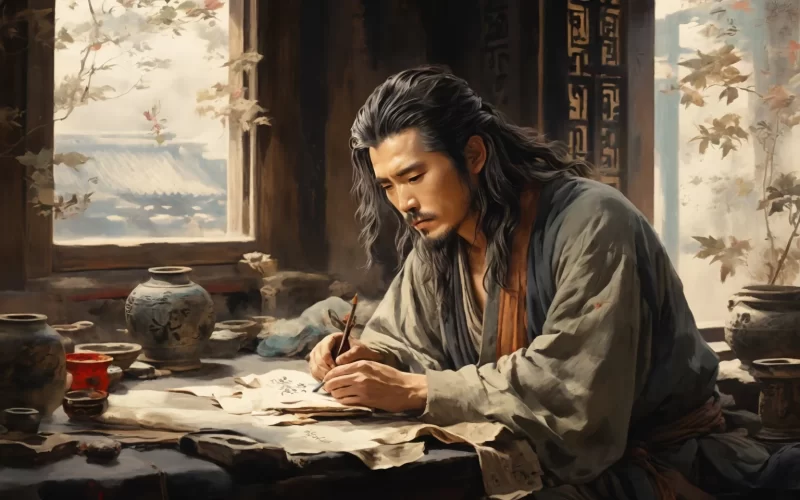



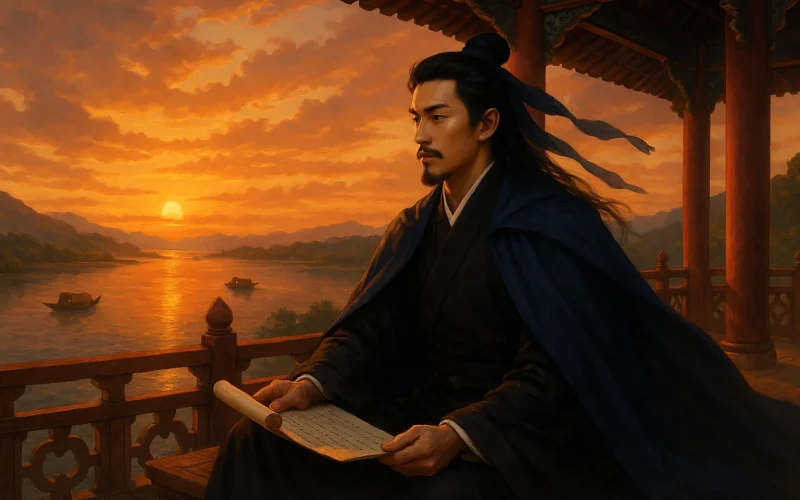
Wang Bo (王勃 c. 650 – 676), a native of Hejin, Shanxi Province, was a renowned writer of the Early Tang Dynasty and the foremost of the "Four Elites of the Early Tang." Exceptionally gifted from childhood, he could compose literary works at the age of six and passed the special imperial examination at sixteen, earning him the position of Gentleman for Court Service. Later, due to an incident, he was dismissed from office. In the third year of the Shangyuan era (676 AD), while crossing the sea to visit relatives, he fell into the water and died of fright at the young age of twenty-seven. His poetry and prose are celebrated for their abundant talent and grand vision. Wang Bo occupies a crucial position in the literary history of the Tang Dynasty. Together with Yang Jiong, Lu Zhaolin, and Luo Binwang, he collectively reversed the ornate and decadent literary style that had prevailed since the Qi and Liang dynasties, heralding the dawn of the resounding voice of the High Tang.
Major Works


Life
Wang Bo was born into a Confucian scholarly family with profound cultural heritage. His grandfather, Wang Tong, was a great Confucian scholar of the Sui dynasty, posthumously honored by his disciples with the private title "Master Wenzhong." He authored works such as Zhong Shuo (On the Mean), which had considerable influence during the Sui-Tang transition. His grand-uncle, Wang Ji, was a renowned poet of the early Tang, famous for poems like "Gazing into the Distance" (野望) and was one of the pioneers of the five-character regulated verse. His father, Wang Fuzhi, successively held positions such as Erudite of the Court of Imperial Sacrifices and Merit Official of Yongzhou, and was also known for his literary talent. Such an environment, rich in family scholarly tradition, laid a solid foundation for Wang Bo's early intellectual brilliance.
From a very young age, Wang Bo displayed astonishing literary talent. The Old Book of Tang records in his biography that "at the age of six he could compose essays, with unimpeded flow of thought and exceptionally heroic diction and sentiment." At nine, while reading Yan Shigu's annotated History of the Han, he was able to point out multiple errors and compiled them into a ten-volume work titled Pointing Out Flaws (指瑕), which became a celebrated tale at the time. By the age of ten, he had thoroughly studied the Six Classics and read widely. From twelve to fourteen, he studied medicine under the famous physician Cao Yuan, concurrently learning the Book of Changes (周易) and the Yellow Emperor's Inner Canon (黄帝内经), his knowledge becoming increasingly profound.
In the first year of the Qianfeng era (666 AD), Emperor Gaozong of Tang performed the Fengshan sacrifices at Mount Tai. Wang Bo, then seventeen years old, presented a piece titled "Eulogy on the Imperial Tour to Mount Tai" (宸游东岳颂), which earned him recognition from local officials and a recommendation to Chang'an. The same year, he took the special "You Su Ke" examination, passed with distinction, and was awarded the position of Court Gentleman for Ceremonials, becoming the youngest official at court. This marked the beginning of his official career and signified official recognition of his literary talent.
After entering officialdom, Wang Bo's outstanding literary skills led to his recruitment by Prince Pei, Li Xian, as a compiler in the Prince Pei's mansion, becoming the prince's literary attendant. During his time at the Prince Pei's mansion, he enjoyed deep trust, was able to extensively peruse the palace's book collections, and engaged in scholarly exchanges with the literati of the prince's entourage. However, an unexpected incident cut short his official prospects. At that time, cockfighting was a popular amusement at court. Prince Pei and Prince Ying, Li Xian (later Emperor Zhongzong of Tang), often entertained themselves with cockfights. Wang Bo playfully composed a piece titled "Proclamation Against Prince Ying's Rooster" (檄英王鸡), using jocular language to cheer on Prince Pei's rooster. When this piece reached the emperor, Gaozong was enraged, interpreting it as an attempt to sow discord and incite rivalry among the princes. He issued an edict expelling Wang Bo from the Prince Pei's mansion. Wang Bo was then only about twenty years old.
After being expelled from the capital, Wang Bo began several years of wandering. He first traveled through Shu (present-day Sichuan), finding solace in landscapes, visiting historical sites, and composing numerous poems and essays. During his time in Shu, he associated and exchanged verses with friends such as Xue Hua and Lu Zhaolin, writing a collection of thirty "Poems on the Journey to Shu" (入蜀纪行诗, now lost) and famous pieces like "Seeing Magistrate Du Off to His Post in Shu" (送杜少府之任蜀州). The magnificent mountains and rivers of Shu and its long history broadened his horizons and matured his poetic style.
Around the second year of the Shangyuan era (675 AD), Wang Bo was appointed Adjutant of Guozhou. In his post in Guozhou, his outstanding talent aroused jealousy. Soon, an even greater disaster befell him. He secretly harbored a convicted government slave, then, fearing exposure, killed him. When this was discovered, Wang Bo was sentenced to death for murder and imprisoned. Fortunately, a general amnesty was declared by the court; he was spared the death penalty but stripped of his official position, permanently ending his official career.
This calamity dealt Wang Bo a severe blow. Not only was he imprisoned, but his father, Wang Fuzhi, was also implicated. Wang Fuzhi, originally serving as Merit Official of Yongzhou, was demoted to Magistrate of Jiaozhi (in present-day northern Vietnam) because of Wang Bo's crime. After his release from prison, Wang Bo, filled with guilt, resolved to travel south to visit his father.
In the autumn of the third year of the Shangyuan era (676 AD), Wang Bo set out from Luoyang, traveling south along the Grand Canal through Yangzhou, Jiangning, and Lake Pengli (present-day Poyang Lake) to visit relatives and friends. In September of that year, while passing through Hongzhou (present-day Nanchang City, Jiangxi Province), he happened to be there when Yan Boyu, the Governor of Hongzhou, completed the reconstruction of the Prince Teng Pavilion and hosted a grand banquet to celebrate. Wang Bo was invited to the gathering. At the banquet, he composed a poem on the spot and wrote the timeless masterpiece "Preface to a Farewell Feast at the Prince Teng Pavilion on an Autumn Day" (秋日登洪府滕王阁饯别序), commonly known as the "Preface to the Prince Teng Pavilion." This parallel prose piece, with its magnificent diction, expansive vision, and profound emotion, astonished all present and became an immortal masterpiece in the history of Chinese literature.
That same winter, Wang Bo continued southward, finally reaching Jiaozhi and meeting his father, who had been demoted there. The reunion of father and son was bittersweet, filled with both joy and sorrow. However, fate was unkind. On his return journey from Jiaozhi, while crossing the sea, Wang Bo encountered a storm. Although he was rescued after falling overboard, the shock caused illness, and he died shortly thereafter at the age of only twenty-seven (some sources say twenty-six). A genius of his generation thus met his end.
Historical records vary slightly regarding the exact year of Wang Bo's death, but the fact of his untimely demise is undeniable. Although his life was short, his extraordinary literary achievements secured him an immortal reputation in the history of Chinese literature. Yang Jiong, in his "Preface to the Collected Works of Wang Bo" (王勃集序), wrote with deep emotion: "Alas! The transformations in the literary world culminate here. The genius born of heaven is sometimes exhausted. It is a pity he did not live long but perished midway."
Stylistic Characteristics
Wang Bo's literary achievements are mainly reflected in two aspects: poetry and parallel prose. As the foremost of the "Four Eminences of the Early Tang," he inherited the techniques of Six Dynasties literature while striving to break free from the florid poetic style prevalent since the Qi and Liang dynasties. He expanded the subject matter of poetry, infusing it with sincere emotion and robust vigor, thereby paving the way for the flourishing of High Tang poetry.
Poetic Style
Wang Bo's extant poetry comprises over eighty pieces, with his five-character regulated verse and quatrains achieving the highest distinction. His poetic style combines the ornate diction of Six Dynasties poetry with a new atmosphere of freshness, simplicity, robustness, and expansiveness.
Expansion of Subject Matter and Infusion of Emotion
The early Tang poetry scene was still pervaded by the lingering Qi-Liang style, with poetry largely confined to court life and amorous descriptions, lacking substantive content. Wang Bo, together with the other "Four Eminences," expanded the subject matter of poetry from the court to the marketplace, the frontiers, rivers and mountains, and the experiences of travel, broadening its scope to encompass wider social life. His poems convey the deep sentiments of farewell (as in "Seeing Magistrate Du Off to His Post in Shu"), the melancholy of wandering (as in "Farewell While Traveling"), the clear tones of landscapes (as in "In the Mountains"), and the reflections on the past (as in "Poem on the Prince Teng Pavilion"). Regardless of the subject, he infused his work with genuine emotion, giving his poetry a moving power.
Freshness of Language and Expansiveness of Conception
Wang Bo's poetic language is fresh and natural, avoiding excessive ornamentation. He often expresses profound meaning through simple words. For example, in "Seeing Magistrate Du Off to His Post in Shu," the lines "城阙辅三秦,风烟望五津" use the word "辅" (support) to convey the majesty of Chang'an and the word "望" (gaze towards) to evoke the distance of Shu. The language is concise, yet the conception is vast. Similarly, in "In the Mountains" (山中), the lines "长江悲已滞,万里念将归" imbue the Yangtze River with emotion through the word "悲" (grieve) and express the depth of homesickness with "万里" (ten thousand li). Scene and sentiment blend, deeply moving the reader.
His poems often display a broad-mindedness and grand vision. For instance, in "Poem on the Prince Teng Pavilion" (滕王阁诗), the lines "阁中帝子今何在?槛外长江空自流" juxtapose the prince with the Yangtze River, embedding profound reflections on history within the passage of time and the eternity of space.
Contribution to the Form of Regulated Verse
Wang Bo was an important pioneer of five-character regulated verse. His five-character regulated verses fully conform to the prosodic requirements of the form, with balanced parallelism, harmonious tonal patterns, and natural, fluent expression of emotion. His poem "Seeing Magistrate Du Off to His Post in Shu" has long been regarded as a model of Tang five-character regulated verse. Hu Yinglin, in his Sousou (Poetic Depths), commented: "Although works like Wang Bo's 'Seeing Magistrate Du Off' do not entirely conform to the prosodic rules, they already possess spirit and bone, serving as the forerunner of the Kaiyuan era." This affirms his pioneering position in the development of regulated verse.
Parallel Prose Style
Wang Bo was a great master of Tang parallel prose, and his parallel prose represents the highest achievement of early Tang parallel prose. The "Preface to the Prince Teng Pavilion" is an eternal masterpiece, hailed as the "number one parallel prose piece under heaven."
Meticulous Parallelism with Flowing Vitality
Parallel prose values balanced parallelism and ornate diction, but often suffers from rigidity. Wang Bo's parallel prose, while strictly adhering to parallelism, infuses the entire piece with充沛 emotion and expansive momentum, giving it vivid charm and avoiding any stagnation. For example, the opening of the "Preface to the Prince Teng Pavilion" — "豫章故郡,洪都新府。星分翼轸,地接衡庐" — exhibits meticulous parallelism yet reads with a flowing rhythm, powerful and sonorous.
Use of Allusions and Development of Conception
Wang Bo was erudite and made extensive use of allusions in his parallel prose, but always did so appropriately and naturally, integrating them seamlessly with the content. For example, in the "Preface to the Prince Teng Pavilion," lines such as "冯唐易老,李广难封" compare himself to historical figures, expressing the lament of unrecognized talent. The allusions are apt and the emotion profound. He was also skilled at using allusive imagery to create atmosphere. The line "落霞与孤鹜齐飞,秋水共长天一色" (Sunset clouds fly together with a solitary duck; autumn water merges with the vast sky into one color), though not an allusion, has become an eternal masterpiece through its exquisite parallelism and aesthetic conception.
Sincere Emotion and Profound Thought
Wang Bo's parallel prose does not merely pursue ornate diction; it is infused with sincere emotion and profound thought. The "Preface to the Prince Teng Pavilion" contains praise for the scenic beauty of the Prince Teng Pavilion, reflections on the vicissitudes of life, and expressions of ideals and aspirations. The emotions rise and fall, and the thoughts deepen layer by layer. Lines such as "天高地迥,觉宇宙之无穷;兴尽悲来,识盈虚之有数" (The sky is high, the earth is vast, realizing the infinity of the universe; joy exhausted, sorrow comes, recognizing that fullness and emptiness are governed by fate) elevate personal sentiment to the level of cosmic reflection, creating a profoundly deep conception.
Literary Influence
Wang Bo occupies an extremely important position in literary history. As the foremost of the "Four Eminences of the Early Tang," his brief creative career laid a solid foundation for the flourishing of Tang literature.
Foremost of the "Four Eminences of the Early Tang" and Pioneer of Poetic Reform
Wang Bo, together with Yang Jiong, Lu Zhaolin, and Luo Binwang, is known as one of the "Four Eminences of the Early Tang." They collectively strove to change the florid and decadent poetic style that had prevailed since the Six Dynasties, leading poetry from the confines of the court to the broad expanse of social life, thereby restoring poetry's function of expressing aspirations and emotions. Wang Bo was the youngest, most accomplished, and most influential among the four. Yang Jiong, in his "Preface to the Collected Works of Wang Bo," praised him, saying, "The eight extremities of the universe can be encompassed within his inch-wide pupils; the myriad things can be captured by his inch-long brush," extolling the height of his talent and the power of his writing.
Du Fu, in his "Six Quatrains Composed in Jest" (戏为六绝句), highly praised the Four Eminences: "王杨卢骆当时体,轻薄为文哂未休。尔曹身与名俱灭,不废江河万古流." (Wang, Yang, Lu, Luo — their style was of their time; frivolous critics mock them endlessly. But your bodies and names will perish together; they remain like rivers flowing for eternity.) This fully affirms their immortal status in literary history.
Contribution to the Development of Regulated Verse
Wang Bo's five-character regulated verses achieved maturity in prosody and natural fluency in emotional expression, preparing the way for the flourishing of regulated verse in the High Tang. His poem "Seeing Magistrate Du Off to His Post in Shu" has been regarded by later generations as a model of Tang five-character regulated verse, profoundly influencing the regulated verse compositions of later poets such as Wang Wei, Li Bai, and Du Fu. Hu Yinglin of the Ming dynasty, in his Sousou, stated: "Five-character regulated verse originated in the Liang and Chen dynasties. The four masters of the early Tang vied in ornate elegance, sometimes with awkward or rough passages, not yet attaining true excellence. After the Shenlong era, they achieved distinct maturity. However, works like Wang Bo's 'Seeing Magistrate Du Off,' though not entirely conforming to the rules, already possess spirit and bone, serving as the forerunner of the Kaiyuan era." This evaluation accurately points out Wang Bo's pioneering position in the history of regulated verse development.
A Model of Parallel Prose Composition
The "Preface to the Prince Teng Pavilion," with its extraordinary artistic achievement, became a model for later parallel prose composition. Literati throughout the ages have drawn nourishment from it. Although Ouyang Xiu and Su Shi of the Song dynasty advocated for ancient-style prose, they still held the "Preface to the Prince Teng Pavilion" in the highest esteem. Gui Youguang of the Ming dynasty and Fang Bao of the Qing dynasty, both masters of ancient-style prose, also highly praised its artistic merits. The influence of this parallel prose piece extends beyond literature, permeating the arts of calligraphy, painting, and drama, becoming a classic symbol within Chinese cultural tradition.
Family Scholarly Tradition and Literary Inheritance
Wang Bo was born into a renowned Confucian scholarly family. His grandfather Wang Tong, grand-uncle Wang Ji, and father Wang Fuzhi were all known for their literary talent. His literary achievements were both a manifestation of personal genius and a result of family scholarly inheritance. He and his elder brother Wang Ju and younger brother Wang Zhu were all renowned for their literary skills, known contemporaneously as the "Three Pearls of the Wang Family." This family scholarly tradition served as a model for the formation of literary families in the Tang dynasty.
In summary, Wang Bo was one of the most outstanding literary figures of the early Tang. His brief but brilliant creative career achieved extraordinary success in both poetry and parallel prose. His poetry is fresh, unadorned, robust, and expansive. The line "海内存知己,天涯若比邻" from "Seeing Magistrate Du Off to His Post in Shu" has become an eternal famous saying. His parallel prose is characterized by ornate diction and vivid charm; the "Preface to the Prince Teng Pavilion" is hailed as the "number one parallel prose piece under heaven." As the foremost of the "Four Eminences of the Early Tang," together with Yang Jiong, Lu Zhaolin, and Luo Binwang, he reversed the florid poetic style that had persisted since the Qi and Liang dynasties, paving the way for the flourishing of High Tang poetry. Though he died young, his literary achievements suffice to place him among the greatest writers in the history of Chinese literature. His works, even after a thousand years, continue to inspire admiration, just as Du Fu said: "They remain like rivers flowing for eternity."