
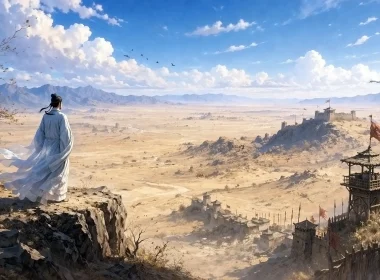
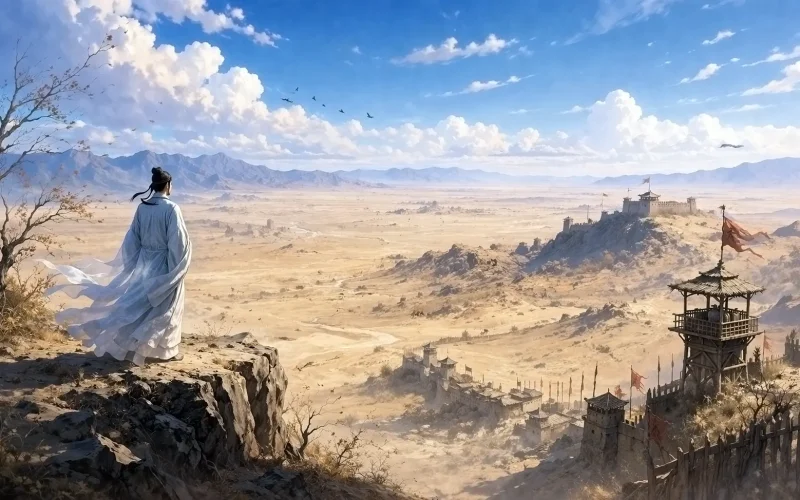
Westward from the Jade‑Gate Pass the Lintao road doth go,
Where the border‑wind drives in the grit, a sharp, unceasing foe,
That seeks the very mane of the steed. And as I ride,

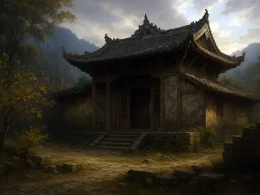
Temple on temple meets the eye, but in their courts denied
The solace of the bamboo‑grove; while on each wall within
The bow and sword are hung, a silent witness to the din

Of wars that were, or are to be. And we — we only prize
The warrior in his gilded mail, beneath these bitter skies;
The traveller in his peaceful white wins but a cold regard.

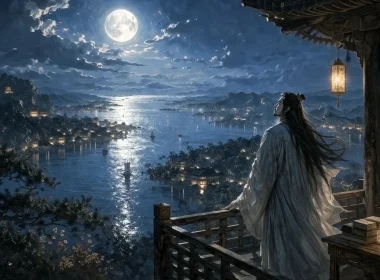
Now, in the autumn’s later light, alone, I keep my ward,
And sing my solitary song; while, over all the plain,
The watch‑towers lift their steadfast heads, and will not lift in vain.
Original Poem
「自萧关望临洮」
朱庆馀
玉关西路出临洮,风卷边沙入马毛。
寺寺院中无竹树,家家壁上有弓刀。
惟怜战士垂金甲,不尚游人著白袍。
日暮独吟秋色里,平原一望戍楼高。
Interpretation
This poem was composed during Zhu Qingyu's travels to the frontier regions. In the late Tang Dynasty, as the nation's strength declined, the northwestern frontier defenses were under constant pressure, with troops stationed year-round in areas like Xiaoguan Pass and Lintao. Though Zhu's official career was unremarkable, he was not a scholar confined to his study. He personally journeyed to the frontier and witnessed its desolation and austerity. West from the Jade Gate Pass, on the road to Lintao, sand-laden winds beat against one's face, and dust clung to the horses' manes. In temples, there was no tranquility brought by bamboo groves; yet in every household, bows and blades hung on the walls—this was not a scene of peaceful living, but a state of universal conscription and constant readiness for war.
Arriving here, what surged in the poet's heart was not the majestic beauty of "a lone plume of smoke above the vast desert," but a weighty sense of compassion. He sympathized with those soldiers clad in golden armor, guarding the frontier day and night with their youth and lives. For those idlers in white robes wandering about, he expressed undisguised disdain. This poem was composed at Xiaoguan Pass, looking towards Lintao—not a paean to frontier scenery, but a song from the heart for the garrison soldiers. The figure in "日暮独吟秋色里" (At dusk, alone I chant within autumn's hues) is the poet's own solitude, and also a sigh he utters on behalf of countless soldiers silently standing guard. On the plains, the watchtowers stand tall; within those towers stand ordinary people, like him, who cannot return home and whose dreams remain unfulfilled. The entire poem uses "viewing" as its thread and "pity" as its eye, forging the frontier's desolation and the poet's compassion into fifty-six characters.
First Couplet: "玉关西路出临洮,风卷边沙入马毛。"
Yù guān xī lù chū Lín táo, fēng juǎn biān shā rù mǎ máo.
The western road from Jade Gate Pass leads out to Lintao; winds whirl frontier sands into the horses' manes.
The poem opens by using geography and imagery to establish the hardships of the frontier. "玉关西路出临洮" (The western road from Jade Gate Pass leads out to Lintao)—these seven characters depict the long road between two key frontier locations, creating a strong sense of space. The next line, "风卷边沙入马毛" (winds whirl frontier sands into the horses' manes), shifts from the macro to the micro. The word "卷" (whirl) describes the violence of the wind and sand; "入" (into) describes the pervasive nature of the dust, which even fills the horses' manes. The three characters "入马毛" (into the horses' manes) use an extremely subtle tactile sensation to convey the harshness of the frontier environment, making the reader feel as if they are there.
Second Couplet: "寺寺院中无竹树,家家壁上有弓刀。"
Sì sì yuàn zhōng wú zhú shù, jiā jiā bì shàng yǒu gōng dāo.
Temple after temple, in their courtyards, lack bamboo or trees; on every household's walls hang bows and blades.
This couplet shifts from the journey to human habitation, using two sets of contrasts to depict the austerity of frontier life. "寺寺院中无竹树" (Temple after temple, in their courtyards, lack bamboo or trees) describes the desolation of the temples—in the Central Plains, temples are often planted with bamboo and trees to enhance serenity, but here, even these are absent, leaving only emptiness and barrenness. "家家壁上有弓刀" (on every household's walls hang bows and blades) describes the people's state of preparedness for war—not passing down farming and scholarship, but everyone carrying blades, every household having bows. The contrast between "无竹树" (lack bamboo or trees) and "有弓刀" (hang bows and blades) vividly portrays the scarcity and tension of frontier life.
Third Couplet: "惟怜战士垂金甲,不尚游人著白袍。"
Wéi lián zhàn shì chuí jīn jiǎ, bù shàng yóu rén zhe bái páo.
I only pity the warriors, weighed down in gilded mail; I do not esteem those idlers garbed in robes white.
This couplet is the soul of the entire poem, directly expressing the poet's feelings. "惟怜战士垂金甲" (I only pity the warriors, weighed down in gilded mail) uses the two characters "惟怜" (only pity) to show the focus of the poet's emotion—the word "垂" (weighed down) in "垂金甲" (weighed down in gilded mail) conveys the heavy armor and the weary posture of the soldiers. The next line, "不尚游人著白袍" (I do not esteem those idlers garbed in robes white), uses "不尚" (do not esteem) to express the poet's attitude towards the "游人" (idlers/travelers): those clad in white robes, idle and wandering, would only stand by indifferently in times of frontier crisis, and are not worthy of esteem. The contrast between "惟怜" (only pity) and "不尚" (do not esteem) sharply and powerfully conveys the poet's value orientation.
Final Couplet: "日暮独吟秋色里,平原一望戍楼高。"
Rì mù dú yín qiū sè lǐ, píng yuán yī wàng shù lóu gāo.
At dusk, alone I chant within autumn's hues; gazing over the plain, I see the watchtowers tall.
The final couplet concludes with scenery that holds emotion. "日暮独吟秋色里" (At dusk, alone I chant within autumn's hues) describes the poet alone, chanting amidst the autumn hues at dusk—that word "独" (alone) is the poet's solitude, and also a reflection of his state of mind. The next line, "平原一望戍楼高" (gazing over the plain, I see the watchtowers tall) uses "一望" (gazing over) to describe the vastness of the view, and "戍楼高" (watchtowers tall) to describe the austerity of the frontier. Those towering watchtowers are a symbol of the frontier, and also the poet's lingering concern that he cannot shake from his heart. This couplet merges personal solitude with the vastness of the frontier, leaving a long-lasting aftertaste.
Holistic Appreciation
This is a powerful work among Zhu Qingyu's frontier poems. The entire poem consists of eight lines and fifty-six characters. Using "viewing Lintao from Xiaoguan Pass" as its thread, it blends the desolation of the frontier, the hardships of the soldiers, and the poet's compassion, revealing the poet's profound concern for the frontier guards.
Structurally, the poem presents a progressive sequence from far to near, from scene to emotion. The first couplet describes the scenery of the journey, using "风卷边沙入马毛" to depict the hardship of the frontier. The second couplet describes the scenery of human habitation, using "无竹树" and "有弓刀" to depict the austerity of the frontier region. The third couplet directly expresses emotion, using "惟怜战士" (only pity the warriors) and "不尚游人" (do not esteem those idlers) to clarify the main idea. The final couplet concludes with "日暮独吟" (at dusk, alone I chant) and "戍楼高" (watchtowers tall), blending emotion into the vast autumn scenery. Between the four couplets, the poem moves from outer to inner, from scene to emotion, progressing layer by layer.
Thematically, the core of this poem lies in the contrast between "惟怜" (only pity) and "不尚" (do not esteem). Between this "怜" (pity) and "尚" (esteem) lies the poet's clear value orientation: he worries for the nation's safety, grieves for the soldiers' toil, and towards those idlers living in comfort, unconcerned with state affairs, he expresses undisguised disdain. This approach of infusing frontier poetry with a people-centered concern makes this poem unique among many frontier works.
Artistically, the poem's most compelling aspect lies in its skillful conception of "using scenery to convey emotion, using contrast to reveal meaning." The poet uses "风卷边沙" (winds whirl frontier sands) to describe the harsh environment, and "无竹树" (lack bamboo or trees) and "有弓刀" (hang bows and blades) to describe the austerity of the frontier, setting the scene for the lyrical expression in the third couplet. The strong contrast between "惟怜" and "不尚" pushes the emotion to its climax. The conclusion with "日暮独吟" and "戍楼高" merges personal solitude with the vastness of the frontier.
Artistic Merits
- Vivid Contrast, Profound Meaning: Contrasting "无竹树" (lack bamboo or trees) with "有弓刀" (hang bows and blades), and "惟怜战士" (only pity the warriors) with "不尚游人" (do not esteem those idlers), vividly and powerfully portrays the frontier's desolation and the poet's loves and hates.
- Using Scenery to Convey Emotion, Blending Scene and Feeling: Using imagery like "风卷边沙" (winds whirl frontier sands), "日暮秋色" (dusk, autumn's hues), and "戍楼高" (watchtowers tall) to externalize inner desolation into perceptible scenes.
- Concise Language, Rich Meaning: The seven characters "风卷边沙入马毛" (winds whirl frontier sands into the horses' manes) exhaustively describe the hardship of the frontier; the seven characters "惟怜战士垂金甲" (I only pity the warriors, weighed down in gilded mail) exhaustively describe the poet's heart—each word carries immense weight.
- Precise Structure, Layered Progression: Moving from the journey to habitation, from scenery to emotion, from emotion to artistic conception, the four couplets are interlinked.
Insights
This poem, through a distant gaze from the frontier, speaks to an eternal theme—True patriotic feeling is not the leisurely sentiment of sightseeing, but deep compassion for the soldiers guarding the frontier.
First, it lets us see the true face of the frontier. The harshness of "winds whirl frontier sands," the desolation of "temple after temple, in their courtyards, lack bamboo or trees," and the tension of "on every household's walls hang bows and blades"—this is the reality of the frontier. Peace is not a given; it is bought with the youth and lives of countless soldiers.
On a deeper level, this poem makes us contemplate the choice of values. "惟怜战士,不尚游人" (I only pity the warriors, I do not esteem those idlers)—the poet does not dislike leisure, but in the face of national security, he chooses to stand with the soldiers. Without the protection of soldiers, all leisure would come to nothing.
And what is most touching is the solitude of that "日暮独吟" (at dusk, alone I chant) in the poem. The poet is not a soldier, yet he worries for the soldiers; he is not a garrison guard, yet he grieves for the frontier. That figure of "独吟" (alone I chant) is a lonely watch kept by a clear-sighted person amidst the vast world. This solitude is the fate of those who worry for their country, and also the consciousness of those with a conscience.
This poem is about the frontier in the Mid-Tang era, yet it allows everyone who contemplates "peace and sacrifice" or "leisure and responsibility" to find resonance within it. The bleakness of "winds whirl frontier sands" is the daily view in the eyes of every frontier guard. The tension of "on every household's walls hang bows and blades" is the norm of life for every frontier dweller. The deep feeling of "惟怜战士" (I only pity the warriors) is the shared sigh of all with a conscience. The figure of "日暮独吟" (at dusk, alone I chant) is the lonely watch kept in the world by all who worry for their country.
About the Poet
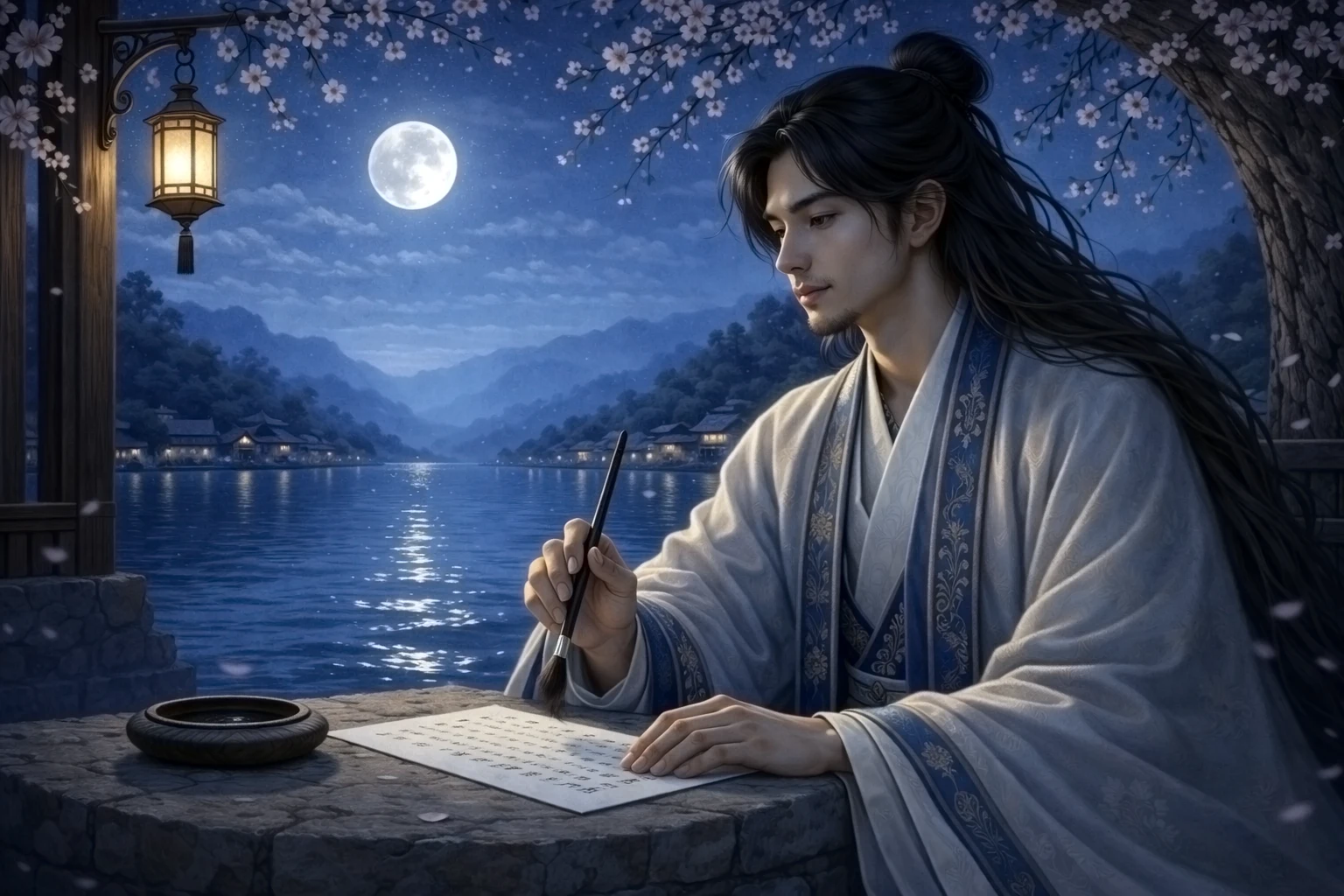
Zhu Qingyu (朱庆馀 dates of birth and death unknown), also known by his given name Kejiu, was a poet of the Mid-Tang period, a native of Yuezhou (present-day Shaoxing, Zhejiang Province). He passed the jinshi examination in the second year of the Baoli era (826 AD) and held the position of Collator in the Imperial Library. His poetry excelled in the five-character regulated verse style, characterized by a refined and subtle elegance, with particular skill in depicting the emotions of boudoir women and palace maidens. In the Complete Tang Poems, two volumes containing 177 of his works are preserved. He was adept at using allegorical and metaphorical techniques, blending everyday emotions with political aspirations. Although not many of his poems survive, his exquisite craftsmanship secures him a unique place in the history of Tang poetry, with his poem Boudoir Sentiments becoming a quintessential example of the fusion of examination-themed and boudoir poetry in later generations.