


No ripples in the river, no mist on the islands,
Yet the landscape is blurred toward my friend in Chu...
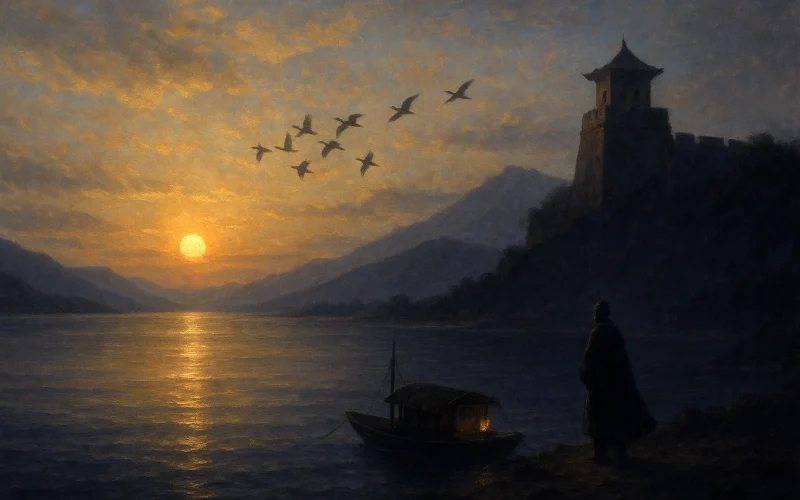
Birds in the slanting sun cross Hankou,
And the autumn sky mingles with Lake Dongting.

...From a bleak mountain wall the cold tone of a bugle
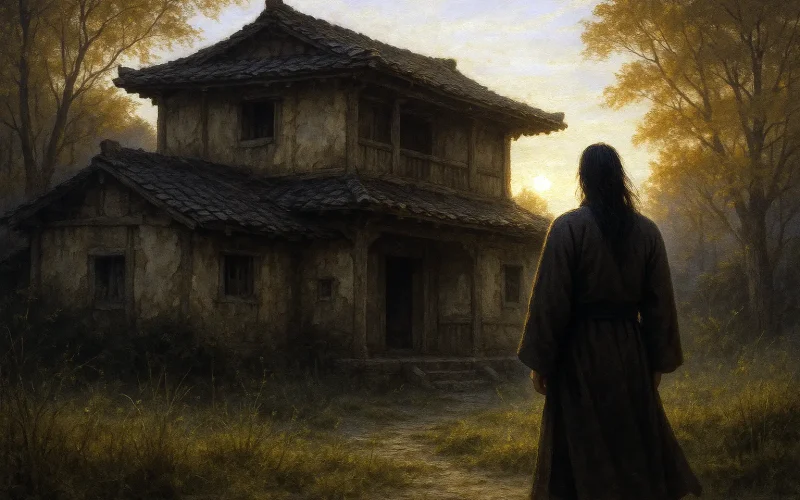
Reminds me, moored by a ruined fort,
That Jia Yi's loyal plea to the House of Han
Banned him to Changsha, to be an exile.
Original Poem
「自夏口至鹦鹉洲夕望岳阳寄源中丞」
刘长卿
汀洲无浪复无烟,楚客相思益渺然。
汉口夕阳斜渡鸟,洞庭秋水远连天。
孤城背岭寒吹角,独戍临江夜泊船。
贾谊上书忧汉室,长沙谪去古今怜。
Interpretation
This poem was composed during the Dali era of Emperor Daizong of Tang, at a time when Liu Zhangqing, due to his integrity and being falsely accused, was demoted from his post as Liuhou of E-Yue to Sima of Muzhou. Afterwards, he drifted to Langzhou (present-day Changde, Hunan) and the Changsha region. The places mentioned in the poem—"夏口" (Xiàkǒu, present-day Wuchang, Wuhan, Hubei), "鹦鹉洲" (Yīngwǔ Zhōu, a sandbar in the Yangtze River at Wuhan), and "洞庭" (Dòngtíng, Dongting Lake in Hunan)—are precisely the waterway route he traveled during his exile. Geographically, the poet likely journeyed from Hubei into Hunan, traveling south along the Yangtze River and Dongting Lake. This poem was written aboard a boat, as he gazed toward Yueyang at dusk, thinking of an old friend.
Liu Zhangqing suffered two demotions in his life, his official career fraught with hardship. The phrase "刚而犯上,两遭迁谪" almost serves as a footnote to the fate of his later years. The profound anguish in his heart following this renewed demotion is easy to imagine. The "Superintendent Yuan" in the title was likely an old friend of the poet, who at the time was perhaps still at court or had also been demoted and was elsewhere. Gazing from the boat toward Yueyang, thinking of his old friend, every sight before the poet's eyes turns into sorrow—the birds flying obliquely at Hànkǒu, the autumn waters of Dongting stretching to the sky, the desolate city with its cold bugle call, the lonely vessel moored by the river at night—all are externalizations of the poet's inner solitude.
It is worth noting the poem's allusion to the典故 of Jia Yi. Jia Yi was a famous minister during the reign of Emperor Wen of Han, who was demoted to Changsha due to slander and died in despondency. Liu Zhangqing held a special affinity for this "fellow sufferer" from a millennium past. His famous work, "Passing by Jia Yi's Residence in Changsha" ("《长沙过贾谊宅》"), directly expresses the lament: "Even under the wise Han Wen, favor was shown thin; / Could the heartless River Xiang know whom I mourn therein?" The poem's final couplet mentions Jia Yi again, continuing this consistent self-portrayal—a man of Jia Yi's talent being banished evokes sorrow across the ages; is it not the same for a man of Liu Zhangqing's resolve being exiled? This technique of using an ancient's cup to pour out one's own sorrow is precisely the most stirring power in Liu Zhangqing's poetry of exile.
First Couplet: "汀洲无浪复无烟,楚客相思益渺然。"
Tīng zhōu wú làng fù wú yān, Chǔ kè xiāngsī yì miǎorán.
The sandbars show no waves nor mist athwart; My yearning for my friend in Chu land grows but more vague and vast.*
The poem opens with a scene of vast, silent loneliness. "无浪复无烟" (wú làng fù wú yān)—the river surface is like a mirror, the islets washed clean, as if only clarity and stillness remain between heaven and earth. Yet this scene of supreme stillness precisely contrasts the extremely unsettled waves in the poet's heart—"楚客相思益渺然" (Chǔ kè xiāngsī yì miǎorán). "Chǔ kè" refers to the poet himself, then in the Chu region; the two characters "渺然" (miǎorán) concretize the formless longing into the vast, misty river water, its end unseen, its far shore untouchable. Using a scene of extreme stillness to write of extremely turbulent emotion; using an image of extreme clarity to write of extremely vague longing—this is the brilliance of Liu Zhangqing's opening.
Second Couplet: "汉口夕阳斜渡鸟,洞庭秋水远连天。"
Hànkǒu xīyáng xié dù niǎo, Dòngtíng qiūshuǐ yuǎn lián tiān.
At Hànkǒu in slanting sunlight birds are crossing slowly; On Dongting Lake autumn water stretches to the skies' far rim.*
This couplet suddenly expands the view, pushing it into the distance. "汉口" (Hànkǒu) is what meets the eye; "洞庭" (Dòngtíng) is what occupies the mind—the poet, traveling from Xiakou to Parrot Islet, is right at Hànkǒu; while Yueyang, where Superintendent Yuan is, borders Dongting Lake. The three characters "斜渡鸟" (xié dù niǎo) are exceptionally fine: birds naturally fly high, yet it says "dù" (to cross, to ferry); the sun slants westward, and the birds also fly obliquely—in a single stroke, there is the slant of light and shadow, and the dynamism of life. The next line, "秋水远连天" (qiūshuǐ yuǎn lián tiān), presents a boundless, misty vastness, pushing the gaze from the river's surface to the sky's edge, from the immediate to a distant, unknowable beyond. This "远" (yuǎn) is both the distance of water and sky, and the distance of longing, and even more, the distance of fate—where is the old friend? Where lies the road ahead?
Third Couplet: "孤城背岭寒吹角,独戍临江夜泊船。"
Gū chéng bèi lǐng hán chuī jiǎo, dú shù lín jiāng yè bó chuán.
A lonely city, backed by the ridge, blows a cold horn drear; My lonely sail, moored by the riverside, hears night fall near.*
The previous two couplets depicted daytime scenes, distant views; this couplet shifts into night, into scenes close at hand. "孤城背岭" (gū chéng bèi lǐng) describes the peril of the terrain; "寒吹角" (hán chuī jiǎo) describes the desolation of sound—the bugle call pierces the cold night, each note striking the poet's heart. "独戍临江" (dú shù lín jiāng) describes the loneliness of his situation; "夜泊船" (yè bó chuán) describes the rootlessness of his life—a lone boat, moored by the river at night, surrounded by cold water on all sides, a solitary city in the distance, between heaven and earth, only this single self. The characters "孤" (gū, solitary) and "独" (dú, alone) echo each other, pushing the bleakness of the poet's circumstances in exile to its extreme.
Fourth Couplet: "贾谊上书忧汉室,长沙谪去古今怜。"
Jiǎ Yì shàngshū yōu Hàn shì, Chángshā zhé qù gǔjīn lián.
Jia Yi, who served the crown, was banished, as all men know. Should I not grieve for him who died so long ago?*
The first six lines are all description and narrative; the final couplet suddenly introduces reflection, like a bolt of lightning across the night sky, illuminating the poem's underlying tone. The poet does not directly speak of his own sorrow, but borrows Jia Yi's cup to pour out his own pent-up grief. The three characters "忧汉室" (yōu Hàn shì) point to Jia Yi's loyalty, and also declare the poet's own sincere intent—his demotion was not due to personal desire, but truly out of concern for the state. The three characters "古今怜" (gǔjīn lián) express pity for the ancients, and also self-pity; it is both a sigh for Jia Yi's fate and a lament for his own situation. Here, all the solitude and sorrow hidden within the scenery of the first six lines finds its destination in this single sigh.
Holistic Appreciation
This is another powerful work among Liu Zhangqing's poems of exile. The entire poem consists of eight lines and fifty-six characters. Using gazing toward an old friend at dusk as its entry point, it merges the vastness of river and sky, the desolate chill of the solitary city, the loneliness of the night mooring, and the sorrowful lament for the ancients, revealing the poet's longing for an old friend and his deep sigh over his own fate during his journey of exile.
Structurally, the poem presents a progressive layering from near to far, day to night, scene to emotion. The first couplet describes the near view—the sandbar without waves, wind and mist both stilled, purely what meets the eye. The second couplet pushes to a distant view—the setting sun at Hànkǒu, the autumn waters of Dongting—moving from the concrete to the abstract, from the eye to the heart. The third couplet shifts to a night scene—the solitary city's bugle call, the lonely mooring at the riverside garrison—pulling from far to near, from outside to within. The fourth couplet concludes the whole—the story of Jia Yi, sorrow shared across the ages—moving from self to other, from present to past. Between the four couplets, the perspective shifts from near to far and back again, time moves from day into night, emotion progresses from implicit to explicit, deepening layer by layer, forming a seamless whole.
Thematically, the core of this poem lies in the character "怜" (lián, to pity, to lament). The vague, distant "longing" of the first couplet is self-pity for his loneliness. The vast, merging of "water and sky" in the second is self-pity for his insignificance. The desolate, cold "solitary" and "alone" of the third is self-pity for his hardship. The three characters "古今怜" in the final couplet gather all of this to a single point—pity for the ancients is also self-pity; self-pity is also pity for all under heaven who, loyal, are banished, or talented, are cast aside. This technique of extending personal sorrow to a lament shared throughout the ages is precisely where Liu Zhangqing surpasses the ordinary.
Artistically, the poem's most moving aspect lies in the dual reflection of "using scene to convey emotion, using the past to write the present." The first six lines are pure description, yet every line is inseparable from feeling—the stillness of "no waves, no mist" contrasts the turbulence of longing; the flight of the "birds crossing at a slant" metaphorically suggests the rootlessness of his life; the desolation of the "solitary city's cold bugle" directly portrays the chill in his state of mind. The final couplet suddenly introduces reflection, using the story of Jia Yi to illuminate the poem's central theme, making all the scenic language of the previous six lines into language of emotion, all the sights before his eyes into the affairs of his heart. This technique of moving from scene to emotion, from emotion to reason, from present to past, is precisely the highest achievement of the classical Chinese poetic methods of "entrusting one's aspiration to objects" and "borrowing the past to express present feeling."
Artistic Features
- Precise Structure, Progressive Layers: From near to far, day to night, scene to emotion, present to past, the four couplets are interlocked, forming a seamless whole.
- Using Scene to Convey Emotion, Subtle and Implicit: The first six lines are pure description, yet every line implies feeling—the stillness of "no waves" contrasts the inner turmoil; the flight of the "birds crossing" is a metaphor for a rootless life; the chill of the "solitary city" portrays the state of mind.
- Allusion Used Aptly, Meaning Profound: The final couplet's comparison to Jia Yi fits both the geographical context of exile to Changsha and the personal context of being banished despite loyalty—a single allusion serving a double purpose, uniting sorrow across the ages.
- Concise Language, Vast and Desolate Artistic Conception: The entire poem has no superfluous words. Characters like "渺然" (miǎorán, vague, distant), "连天" (lián tiān, joining the sky), "寒" (hán, cold), "孤" (gū, solitary), "独" (dú, alone) each carry immense weight, together constructing a vast, desolate artistic space.
Insights
This poem, through the dusk view on the journey of exile, speaks to an eternal theme—the unrecognized scholar, a sorrow shared across all ages.
It first allows us to see the "intertwining of scene and emotion." That sandbar with "no waves, no mist" is an ordinary river scene, yet in the poet's eyes becomes a symbol of longing with no place to send it; that "bird crossing at a slant" is an ordinary bird in flight, yet in the poet's heart becomes a metaphor for a rootless, drifting life. This is the unique beauty of "empathic projection" in Chinese poetry—when the heart holds emotion, all things are imbued with one's own colors.
On a deeper level, this poem prompts us to contemplate the "dialogue between past and present." Liu Zhangqing and Jia Yi, separated by nearly a millennium, yet through similar circumstances, achieve a meeting across time and space in this poem. Jia Yi, "concerned for the Han," was banished; Liu Zhangqing, "concerned for state affairs," was exiled—history seems to repeat itself. The phrase "古今怜" (gǔjīn lián) is both compassion for Jia Yi's fate and lament for his own, and even more, a deep cry of anguish for all who, loyal, were cast aside. This technique of using the past to write the present gives individual sorrow historical weight, elevating a moment's grief into a resonance across the ages.
And what is most thought-provoking is the unyielding moral character in the poem, that sense of "though ten thousand oppose me, I will go forward." Jia Yi, banished to Changsha, still worried for the Han; Liu Zhangqing, twice demoted, still held to his resolve. That bugle call from the "solitary city" blows cold, but also integrity; that night mooring at the "lonely garrison" moors the body, but even more, the heart. Amidst the vicissitudes of fate, they may sigh, they may grieve, but they never abandon their commitment to ideals, their concern for the nation. This character is precisely the most precious tradition of China's scholar-officials through the ages—a person may sink low, but aspiration cannot; the body may be banished, but the heart cannot.
This poem writes of a Tang dynasty exiled literatus, yet allows everyone who encounters injustice or hardship in reality to find resonance within it. That bird flying obliquely at Hànkǒu is the figure of every wanderer; those autumn waters of Dongting stretching to the sky are the longing gaze of every pensive soul; that sigh of sorrow shared across the ages is the shared whisper of all unrecognized talent. This is the vitality of poetry: it writes of one person's experience, but reads as the heart's concern of all.
Poem translator
Kiang Kanghu
About the Poet
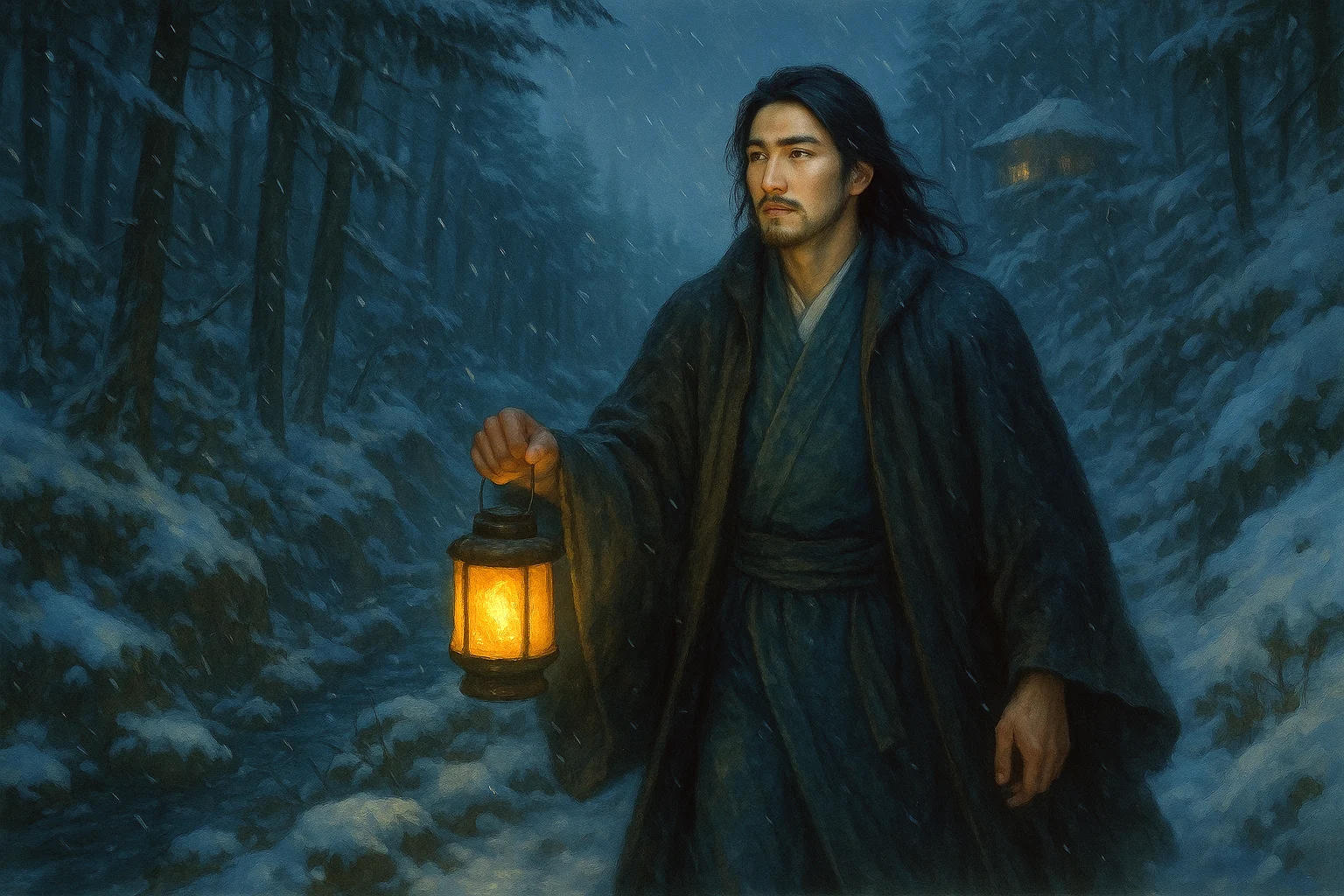
Liu Zhangqing (刘长卿 c. 726 – c. 786), a native of Xuancheng, Anhui Province, was a poet of the Mid-Tang Dynasty. He obtained the jinshi degree (presented scholar) in the late Tianbao era and successively held official posts such as Sheriff of Changzhou and Investigating Censor. Due to his upright and unyielding character, he was exiled twice. His poetry, particularly his five-character verses, achieved the highest distinction, often depicting the melancholy of exile and the joys of reclusion in landscapes. His poetic style is refined, elegant, and ethereal, blending a desolate undertone with the meticulousness characteristic of the Ten Talented Poets of the Dali era. He excelled in using plain sketching to create an atmosphere of tranquil emptiness and profound remoteness. As a pivotal poet bridging the High Tang and Mid-Tang periods, his work inherits the idyllic charm of Wang Wei and Meng Haoran while foreshadowing the bleak and cool elegance of Dali poetry. He exerted a certain influence on late Tang poets such as Yao He and Jia Dao, who belonged to the "painstaking school."