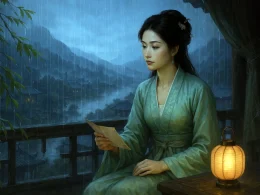



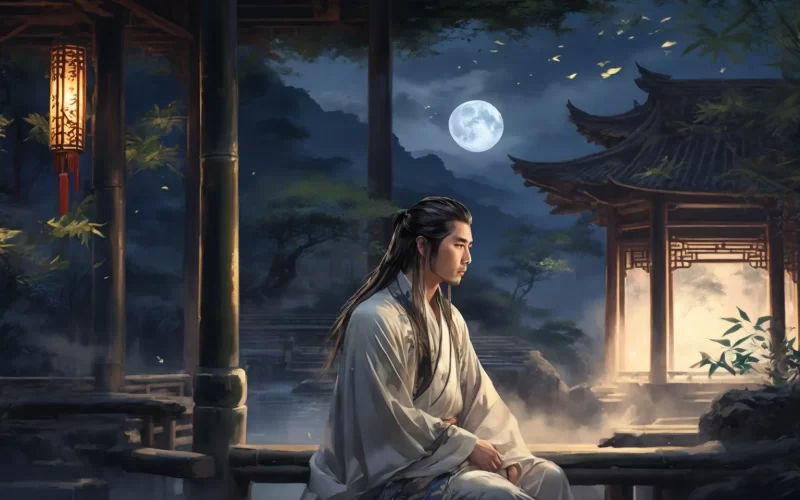
Leaning alone in the close bamboos,
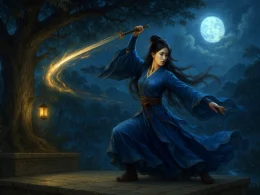
I am playing my lute and humming a song
Too softly for anyone to hear --
Except my comrade, the bright moon.
Original Poem
「竹里馆」
王维
独坐幽篁里,弹琴复长啸。
深林人不知,明月来相照。
Interpretation
This is the most ethereally pure and widely renowned piece among Wang Wei's twenty poems in the Wang River Collection. Composed during his later years of seclusion at Wangchuan, a time when his body and mind had entered a state of profound harmony with nature, the poem uses only twenty characters to construct a microcosmic universe that is at once utterly solitary and utterly replete, supremely silent yet filled with celestial music. It is not merely a portrait of reclusive life, but a poetic manifestation of the highest spiritual state Wang Wei attained by synthesizing Confucian "vigilance in solitude," Daoist "sitting in forgetfulness," and Zen "contemplation of emptiness." It stands as the pinnacle of the "aesthetics of solitude" in classical Chinese poetry.
First Couplet: 独坐幽篁里,弹琴复长啸。
Dú zuò yōu huáng lǐ, tán qín fù cháng xiào.
Sitting alone amidst the secluded bamboo grove,
Strumming my zither, and now and then, whistling long and loud.
The opening establishes the poem's spiritual tenor with the act of "sitting alone." This "solitude" is not loneliness, but a self-chosen, perfectly self-sufficient aloneness. "Secluded bamboo grove" defines the physical space and serves as a metaphor for the state of mind—the hollowness and joints of bamboo symbolize open-mindedness and integrity; the grove's depth secludes it from worldly clamor, creating its own universe. "Strumming my zither" and "whistling" are two actions rich with cultural meaning: the zither represents elegant music, leading to order and harmony; the whistle, derived from Daoist breath-control techniques, is the direct communication of breath with the primal energy of the cosmos. The zither and the whistle, one refined and restrained, the other uninhibited and released, together form the poet's complete ritual for conversing with himself and the universe. In this moment, the man, the zither, the whistle, and the bamboo merge into a seamless whole.
Second Couplet: 深林人不知,明月来相照。
Shēn lín rén bù zhī, míng yuè lái xiāng zhào.
No one knows I'm here, deep in the woods,
Only the bright moon comes to shine upon me.
This couplet shifts from the poet's active actions to the cosmos's passive reflection, elevating the conception to a new level. "No one knows I'm here, deep in the woods" is the objective confirmation of his "solitude," yet it carries not a trace of regret, only a sense of ease and freedom from the burdens of human relations. True understanding companionship need not be human. "Only the bright moon comes to shine upon me" is the heart of the poem's magic: the moon is not invited; it "comes" of its own accord. Its "shining" is not a condescending gaze but an equal, gentle presence, companionship, and affirmation. The words "comes" and "shine upon" lend the moon a personified intimacy and initiative, elevating it from a natural object to the poet's soulmate. Light and shadow, sound and silence, man and moon achieve their deepest fusion in this moment. This moonlight is both physical illumination and a symbol of the luminous mind, illuminating the poet's existence and revealing the abundant essence of "solitude."
Holistic Appreciation
This is a philosophical poem about the ultimate state of "being alone." The poem's structure presents a perfect internal balance: the first two lines describe the man's "movement" (sitting, strumming, whistling), the last two describe the setting's "stillness" (silent woods, moon shining); the first two present a "world with the self," the last two a "world without the self"; the first two show the subject voicing itself to the world, the last two show the world responding to the subject. Yet, there is no division between this movement and stillness, between having a self and having none, between voicing and responding; they together form a closed, self-sufficient system of energy circulation.
In this poem, Wang Wei accomplishes a complete aesthetic transformation and philosophical transcendence of "solitude." Commonly, solitude stems from a desire for, and lack of, connection. The solitude in this poem, however, is the fulfillment and sublimation of connection—through deep communion with the zither, the whistle, the bamboo, and the moon, the poet achieves connection with a higher order (the Dao, Zen). This solitude is not deprivation but plenitude; not closure but openness to the entire cosmos. The figure "sitting alone" is therefore not diminished but, through this effortless companionship with the bright moon and clear breeze, acquires a certain cosmic dignity and freedom. This is precisely the Zen state described as "a solitary light shines alone, utterly free from the roots of the senses."
Artistic Merits
- Purity and Symbolism of Imagery: The four core images—"secluded bamboo grove" (seclusion, integrity), "zither" (refinement, harmony), "whistle" (naturalness, expansiveness), and "bright moon" (clarity, eternity)—are all purged of mundane associations, collectively pointing towards a lofty, transparent, eternal spiritual realm and constructing a pure poetic space.
- Verb Sequence Outlining a Spiritual Path: "Sitting" is the settling of the body and the calming of the mind; "strumming" is the artistic, ordered expression of emotion; "whistling" is the breaking of form to directly connect with the cosmos's vital energy; "shining upon" is the universe's final affirmation and grace bestowed upon the practitioner. These four verbs subtly trace an inner path of cultivation from samadhi/stillness (sitting) through prajna/wisdom (strumming, whistling) to the realized state (shining upon).
- Erasure of Person and Establishment of a Cosmic Perspective: The poem contains no first-person "I," yet the experience is wholly personal; the second couplet further pulls the perspective away from the "I," as if a cosmic eye observes the tranquil scene of "No one knows I'm here… the bright moon comes to shine." This fluid shift in perspective enhances the poem's objectivity and sense of timelessness.
- Philosophical Orchestration of Sound and Light: The poem contains the sounds of the zither and the whistle (human-made, cultural sounds), and the deeper silence of the woods and the "soundless sound" of moonlight flowing. In light and shadow, there is the gloom of bamboo shadows and the clear glow of moonlight. Sound and light, manifestation and concealment, together weave a sensorily rich yet suprasensory Zen field.
Insights
This work is like a clear spring, reflecting modern humanity's deepest longing and most distant nostalgia. It reveals to us: the true "capacity for solitude" is the most scarce and precious quality of mind for contemporary people. In an age of boundless social networks yet increasingly shallow human connections, Wang Wei shows us that only in the depths where "no one knows" can one encounter the moon that "comes to shine"—that might be the inspiration of art, the insight of philosophy, the presence of faith, or the quiet manifestation of life's true nature.
This poem invites us to undertake an "inner seclusion": we may not need a bamboo grove or a bright moon, but we need to clear a space for a "secluded bamboo grove" within our hearts. There, we can "sit alone," converse with ourselves (strum the zither), resonate with heaven and earth (whistle long and loud), and ultimately await the "moonlight" that belongs to us alone—the light that illuminates solitude and makes solitude abundance. In twenty characters, Wang Wei safeguards and points to an ancient path towards inner freedom and spiritual fulfillment. Walking it, perhaps we too can hear the zither and whistle within our own hearts and see that moon from a thousand years ago, crossing time to shine gently upon every modern soul that longs for peace.
Poem translator
Kiang Kanghu
About the poet
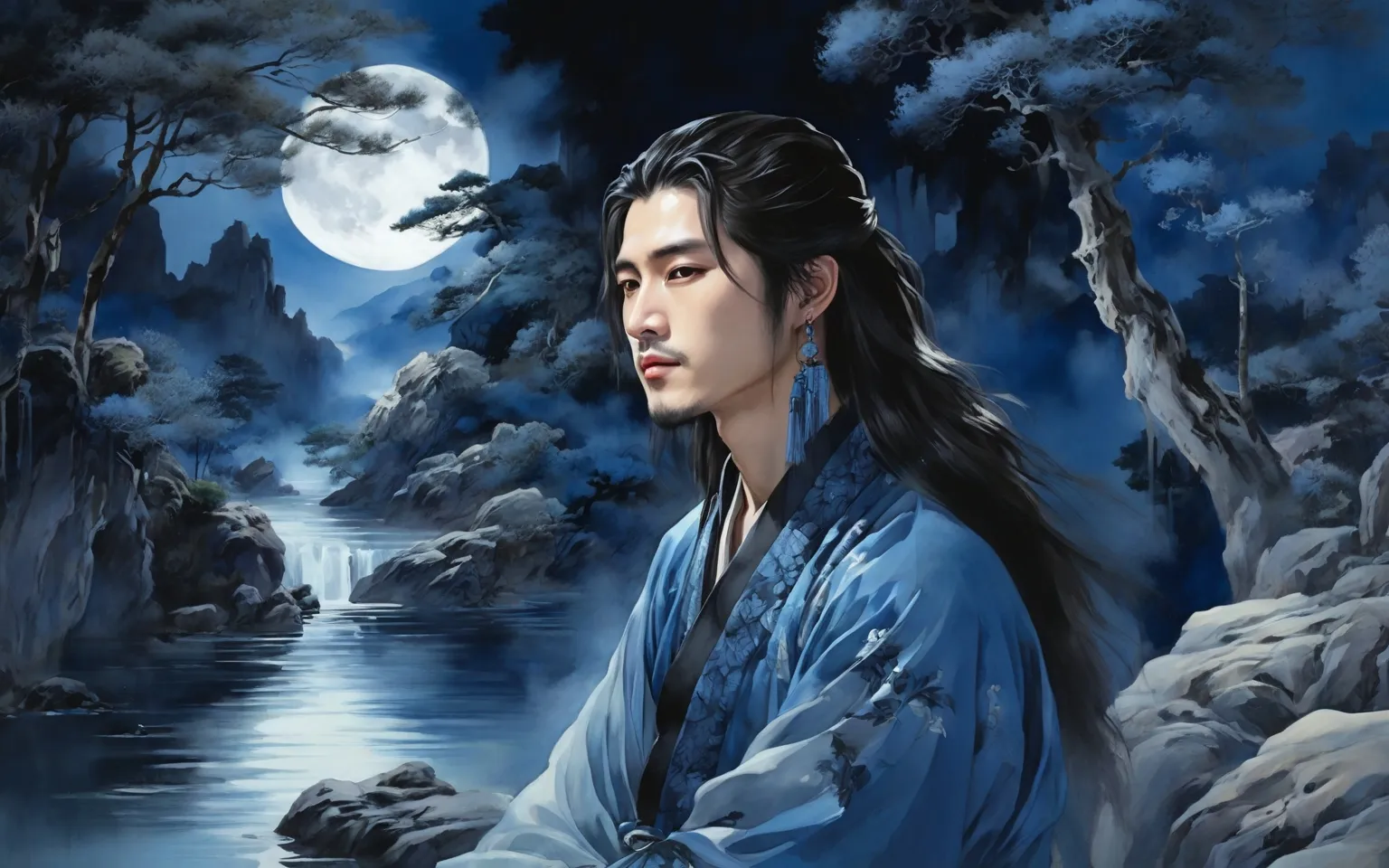
Wang Wei (王维), 701 - 761 A.D., was a native of Yuncheng, Shanxi Province. Wang Wei was a poet of landscape and idylls. His poems of landscape and idylls, with far-reaching images and mysterious meanings, were widely loved by readers in later generations, but Wang Wei never really became a man of landscape and idylls.