


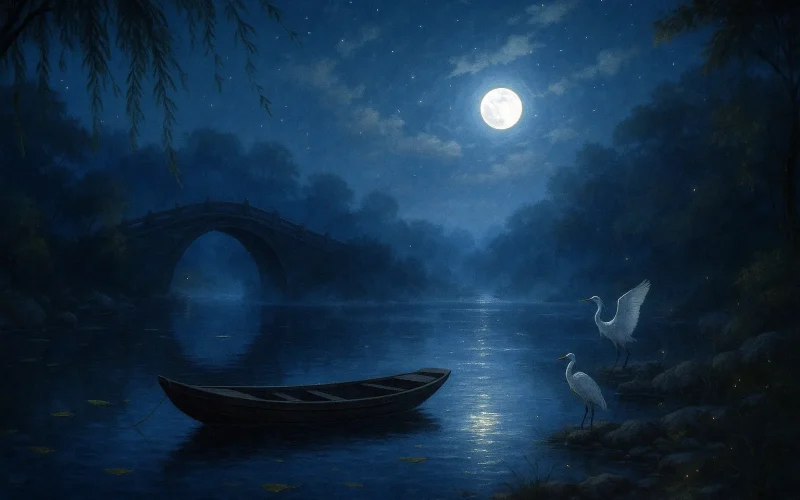
After rain, the pond’s edge clears into a quiet scene;
Under the bridge, cool air comes with a gentle breeze.
A pair of autumn cranes, one lonely boat —
Keeping company in the moonlight, deep into the night.
Original Poem
「舟中夜坐」
白居易
潭边霁后多清景,桥下凉来足好风。
秋鹤一双船一只,夜深相伴月明中。
Interpretation
The precise date of this poem’s composition is difficult to ascertain. Judging from its relaxed clarity and its artistic conception where the self dissolves into the world, it belongs to Bai Juyi’s middle or later years, when his state of mind had turned completely towards peace and detachment. By this time, the poet was well-versed in the Dao of “balanced seclusion,” having distanced himself from the strife of the court to lodge his affections in the natural world of rivers and lakes. The poem resembles a literati ink-wash painting executed with sparse, simple brushstrokes. Within its plain, descriptive outline of the scenery lies a deep acceptance of solitude, a conscious choice of quietude, and a serene arrival at a state of harmony between Heaven and man.
First Couplet: “潭边霁后多清景,桥下凉来足好风。”
Tán biān jì hòu duō qīng jǐng, qiáo xià liáng lái zú hǎo fēng.
By the pool, once rain clears, scenes of pure freshness lie; / Beneath the bridge, a cool and wholly satisfying breeze drifts by.
The opening establishes the setting and mood with a plain, measured touch. “By the pool” and “Beneath the bridge” locate the scene in specific, modest spots—not famous mountains or great rivers, but ordinary watersides—revealing the poet’s contentment with simple vistas. “Once rain clears” specifies the moment: a shower has just ended, the air is purified, everything feels washed clean, providing the physical and psychological basis for the scene’s “pure freshness.” In “a cool and wholly satisfying breeze,” the word “satisfying” is key. It expresses a sense of contentment and perfect sufficiency: the breeze is not too much or too little, too strong or too weak—it is precisely, perfectly enough. The lines show no agitation, yet they precisely convey the comfort and satisfaction of being soothed perfectly by nature, with both body and mind at ease.
Second Couplet: “秋鹤一双船一只,夜深相伴月明中。”
Qiū hè yī shuāng chuán yī zhī, yè shēn xiāng bàn yuè míng zhōng.
A pair of autumn cranes, a single boat—that is the sum; / Deep in the night, we keep each other company where the bright moon has come.
Here, the focus shifts from describing the environment to presenting its core elements, constructing the poem’s central poetic conception. With a supremely calm, objective hand, the poet arrays three images: “a pair of autumn cranes,” “a single boat,” and the sphere of “bright moonlight.” The numerical contrast (“pair” versus “single”) might superficially suggest solitude, but the verb “keep each other company” completely transforms that potential reading. Who keeps company with whom? The cranes with the boat? The poet with the cranes and moon? Or do all things under the moonlight—including the poet himself—together form a harmonious world of mutual companionship and seamless unity? The answer is clearly the latter. The noble solitude of the autumn cranes, the unmoored drifting of the small boat, the eternal clear radiance of the moon—in this deep night, they transcend the boundaries between self and object, merging into a tranquil, self-sufficient communion. “Deep in the night” intensifies the feeling of silent time; the realm of “bright moonlight” acts like a softly lit stage, endowing this silent gathering with a sacred, poetic luminosity.
Holistic Appreciation
This heptasyllabic quatrain is a model of Bai Juyi’s “poetry of leisurely contentment,” achieving the artistic ideal of growing “more profound in its plainness, reaching farther in its simplicity.” The poem’s structure resembles the “level-distance” composition of a Chinese landscape painting. The first couplet establishes an open, peaceful foundation, like the painting’s background, where clarity follows rain and the heart is refreshed by the breeze. The second couplet is the focal point and soul, where a few spare images (crane, boat, moon) are juxtaposed under the moon’s dominion, forming spatial and philosophical relationships rich with meaning. The poet is not merely “sitting at night” to observe the scene; in the act of sitting, he becomes part of the scene itself, achieving a sublimation from “observing things” to “becoming-one-with-things.” Not a single line directly expresses emotion, yet feelings of contentment, the beauty of solitude, and thoughts of harmony pervade the work. Nowhere does it preach doctrine, yet the philosophy of the unity of all things and the constant joy found in sufficiency is fully present.
Artistic Merits
- The Fusion of Plain Description and Profound Conception: The poem’s language is of the utmost simplicity, approaching the colloquial, relying purely on nouns and simple verbs. Yet it is precisely this “reduced-brush” technique, like the empty space in an ink painting, that provides infinite room for the reader’s imagination and the generation of poetic conception, reaching the supreme realm where “the extreme of splendour returns to plainness.”
- The Art of Selecting and Juxtaposing Images: The images of the “autumn crane,” the “lone boat,” and the “bright moon” are all classically rich in poetic association. The poet detaches them from their traditional melancholic contexts and re-juxtaposes them within the present structure of “keep[ing] each other company” in the deep night, endowing them with a new, peaceful, and mutually understanding relationship, thus renewing their connotations.
- Philosophical Meaning within Numerical Contrast: The contrast between “pair” and “single” initially seems a mark of difference, but within the context of shared company under the moonlight, that difference dissolves, transforming into a harmony of “diverse coexistence” where each finds its proper place. This reflects the poet’s transcendence of worldly loneliness, entering a philosophical plane of communion with all creation.
- A Concluding Scene that Resonates Beyond the Words: The poem ends within the luminous, eternal sphere of moonlight, which enfolds all the preceding pure scenes, cooling breeze, cranes, and boat in an undifferentiated, tranquil radiance. Feeling and thought are not stated directly, yet they diffuse with this moonlight, lingering endlessly, truly achieving the effect where “the verse ends, but the meaning does not.”
Insights
This work reveals a refined solitude and deep tranquility attainable only after life’s tempering. The “alone” (the single boat) in the poem is not desolate and adrift, but a quietude actively chosen; the “company” (with cranes and moon) is not boisterous conviviality, but a spiritual recognition and silent understanding. It reveals a truth: When a person’s inner world is sufficiently rich and clear, he can transform his own “solitude” into a starting point for “coexistence” with a vaster existence.
Through this small poem, Bai Juyi shows that life’s joy and satisfaction can come from nature’s most modest gifts, can come from the quietest depths of solitary night. True leisure is not idleness, but maintaining a sensitive and open heart within the simplest circumstances, thereby finding resonance with the rhythms of the cosmos. This state of “keep[ing] each other company where the bright moon has come” is a wisdom that diminishes the self within Heaven and earth while simultaneously merging the self with them. It reminds us that in a tumultuous world, we might occasionally pause, sit quietly through a night in our own “boat,” to feel that “pure freshness,” that “wholly satisfying breeze,” and the silent “company” of all things under the moonlight. This richness found within silence is perhaps what the modern psyche lacks most, and values most.
About the Poet
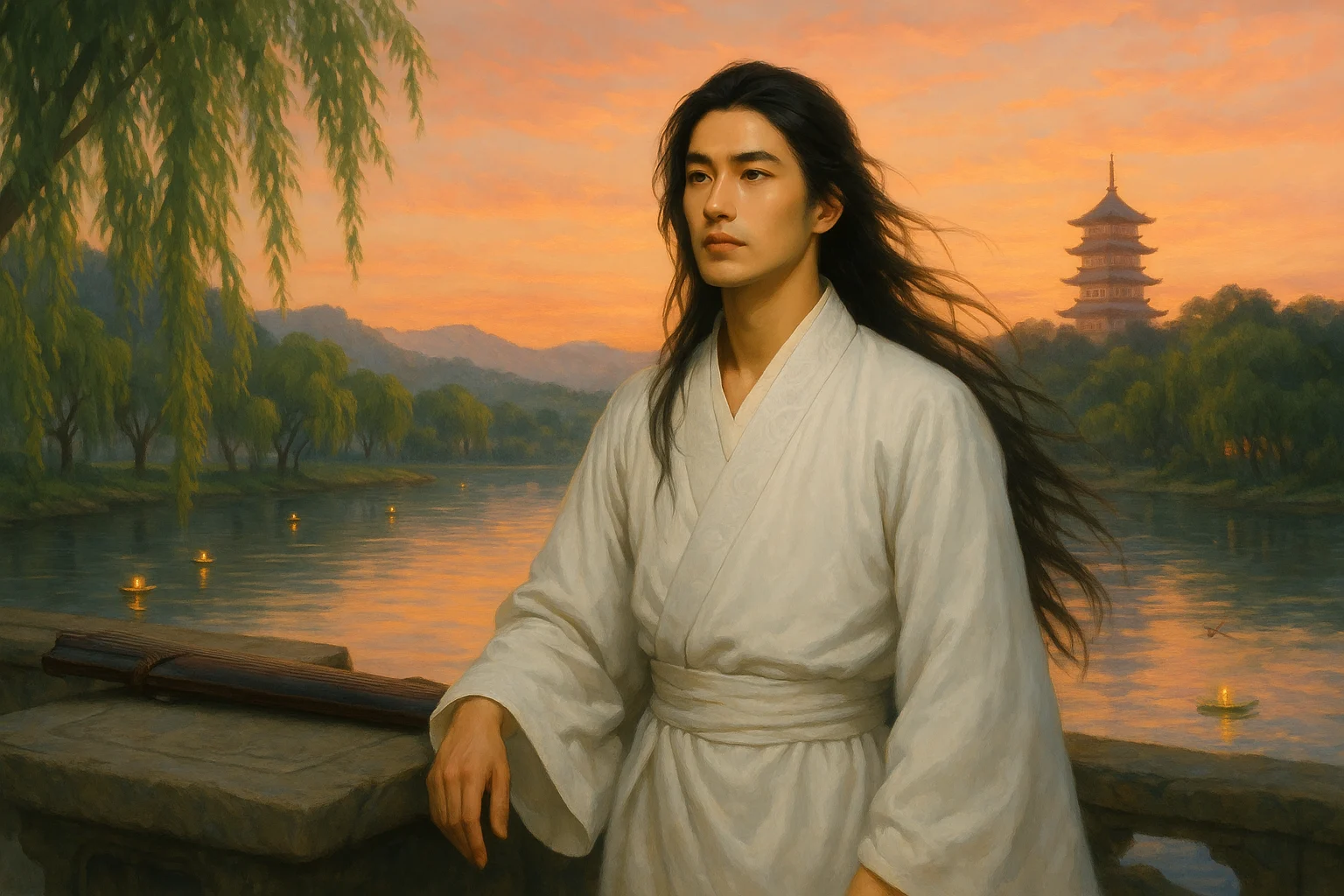
Bai Juyi (白居易), 772 - 846 AD, was originally from Taiyuan, then moved to Weinan in Shaanxi. Bai Juyi was the most prolific poet of the Tang Dynasty, with poems in the categories of satirical oracles, idleness, sentimentality, and miscellaneous rhythms, and the most influential poet after Li Bai Du Fu.