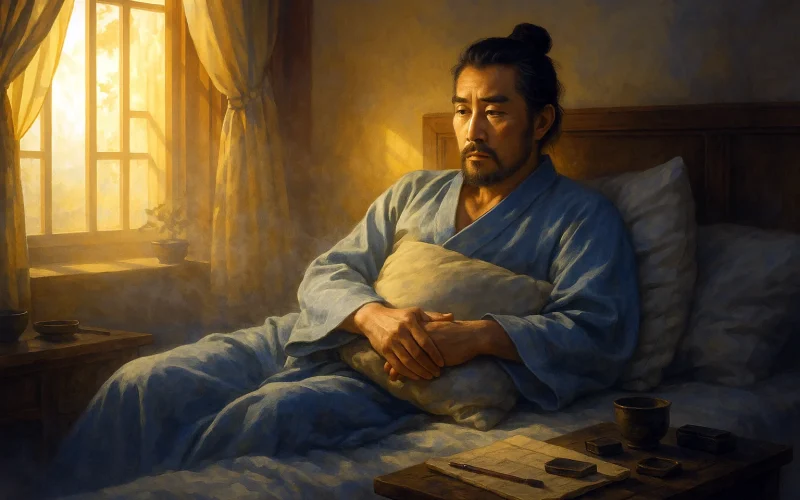
Hugging the pillow, without a sound;
Empty room, alone, stillness all around.
Who knows I lie all day in bed this way?
Not sick, not sleeping — just being, I’d say.
Original Poem
「昼卧」
白居易
抱枕无言语,空房独悄然。
谁知尽日卧,非病亦非眠。
Interpretation
While the precise time and place of this poem’s composition remain undocumented, the profound stillness, quiet weariness, and sense of existential remove that permeate it unmistakably mark it as a work from Bai Juyi’s later years, composed after a lifetime of worldly experience. The poet was likely living in semi-retirement in Luoyang, embodying the "reclusion within society" that he espoused. This poem sheds all external circumstance and specific sorrow, focusing intently on a most fundamental, yet strangely unsettling, condition of being—a state that emerges only when life’s burdens are set down and its ornaments removed. It is a condition of pure existence: "neither due to illness nor for the sake of sleep." It moves beyond lamenting the seasons or grieving unfulfilled ambitions, becoming instead a contemplative, almost philosophical, examination of existence itself.
First Couplet: "抱枕无言语,空房独悄然。"
Bào zhěn wú yányǔ, kōng fáng dú qiǎorán.
Hugging a pillow, without a word to say; / Alone in the empty room, in a stillness holding sway.
The opening lines sketch a scene of utter physical and psychological stillness with minimal strokes. The posture, "Hugging a pillow," is ambiguous—neither fully reclining nor properly upright—suggesting a state of lassitude and disengagement. "Without a word to say" denotes an absence of speech and an inner silence, as if thought itself has stalled. "The empty room" expands the sense of space, mirroring an internal void, while "a stillness holding sway" intensifies the absolute, private nature of the quiet. In just ten characters, a solitary realm is constructed where a person is enveloped and adrift in the simple fact of their own presence.
Second Couplet: "谁知尽日卧,非病亦非眠。"
Shéi zhī jǐn rì wò, fēi bìng yì fēi mián.
Who knows I lie reclined the livelong day? / It is not illness, nor is it sleep, I’d say.
This couplet forms the poem’s conceptual core, using a calm tone to articulate a striking existential condition. "Lie reclined the livelong day" extends the momentary tableau into a sustained, almost habitual, mode of being. The negating definition, "It is not illness, nor is it sleep," thoroughly strips the act of "lying down" of its conventional causes (physical need) and purposes (restorative repose). It negates both external compulsion and internal intention, thereby suspending "lying" in a pure state, without clear cause or goal. This represents a kind of "existential interstice": the person is neither actively engaged (not ill, thus not recuperating) nor passively withdrawn (not asleep, thus not unconscious). It is precisely within this "neither-nor" space that the poet confronts, nakedly, the unnameable ground of being itself. The phrase "Who knows" faintly hints at a quiet lament for being misunderstood, but primarily conveys a cool, self-aware acknowledgment.
Holistic Appreciation
This pentasyllabic quatrain exemplifies Bai Juyi’s ability to distill philosophical insight from a mundane moment. Its structure is crisp: the first two lines paint a static scene and its atmosphere; the last two unveil the paradoxical nature of this state. It depicts not pain nor sorrow, but a more fundamental experience akin to what might now be termed "lassitude" or "existential quietude." In his later years, as political fervor cooled and life found a stable rhythm, the poet perceived with greater acuity the primal, faintly barren state of pure "being" exposed when all social roles and specific pursuits are relinquished. The poem resembles a meticulously composed still life; the figure is both subject and object, and in the absolute quiet, the very texture of existence—that neutral, transparent quality which is neither suffering nor delight—is brought into stark relief.
Artistic Merits
- A Minimalist Style: The entire poem comprises only twenty characters, with no superfluity or ornate language. Verbs are limited to "hugging" and "lie"; adjectives to "without," "empty," "alone"; nouns are commonplace (pillow, room, illness, sleep). This extreme verbal economy is perfectly aligned with the "emptiness" and "stillness" it seeks to express.
- The Philosophical Weight of Negation: "It is not illness, nor is it sleep" is key to the poem. This mode of definition through negation approaches, in logic, the description of a "pure state," reminiscent of a philosophical suspension of judgment. It elevates the poetic meaning beyond the particular situation, granting it a metaphysical universality.
- Depth of Introspection: The poem is written from a completely internal vantage point. The poet is both observer and the observed. This detached, precise self-scrutiny renders a private experience observable and analyzable, demonstrating a high degree of self-conscious awareness.
- Potent Evocation of Atmosphere: Through the reiterated motifs of wordless silence and pervasive stillness, the poem masterfully conjures an almost tangible atmosphere. This atmosphere itself becomes the carrier of emotion and thought, acting directly upon the reader’s senses and mind.
Insights
This work reads as an ancient premonition of a modern state of mind. It reveals the fundamental "quiet" and "stillness" that life may disclose when external strivings, busyness, and even sufferings momentarily withdraw. This is not sickness, nor is it rest, but a kind of existential "pause" or "ground state." With remarkable honesty, Bai Juyi recorded and faced this condition.
The poem’s insight holds deep relevance today. In a culture that prizes "productivity," "fullness," and "positivity," we often fear and avoid such moments of "neither-illness-nor-sleep." Bai Juyi suggests that a complete life may well include accepting these states of "lying still with nothing to be done." This is not necessarily negative; it may be a necessary clearing of existence, the spirit settling after constant motion, a way of reconnecting with the source of life itself.
It encourages us not to seek pragmatic justification (illness or sleep) for every moment we "lie reclined the livelong day." Sometimes, permitting ourselves to remain in the "stillness" of being "neither this nor that," without judgment, may be the very moment we meet our most authentic, most tranquil selves. This acceptance, even appreciation, of life’s "empty intervals" is a precious gift from the wisdom of Bai Juyi’s later years, reminding us to preserve, within our busy lives, the courage and ease to occasionally **"hug a pillow, without a word to say."
About the Poet
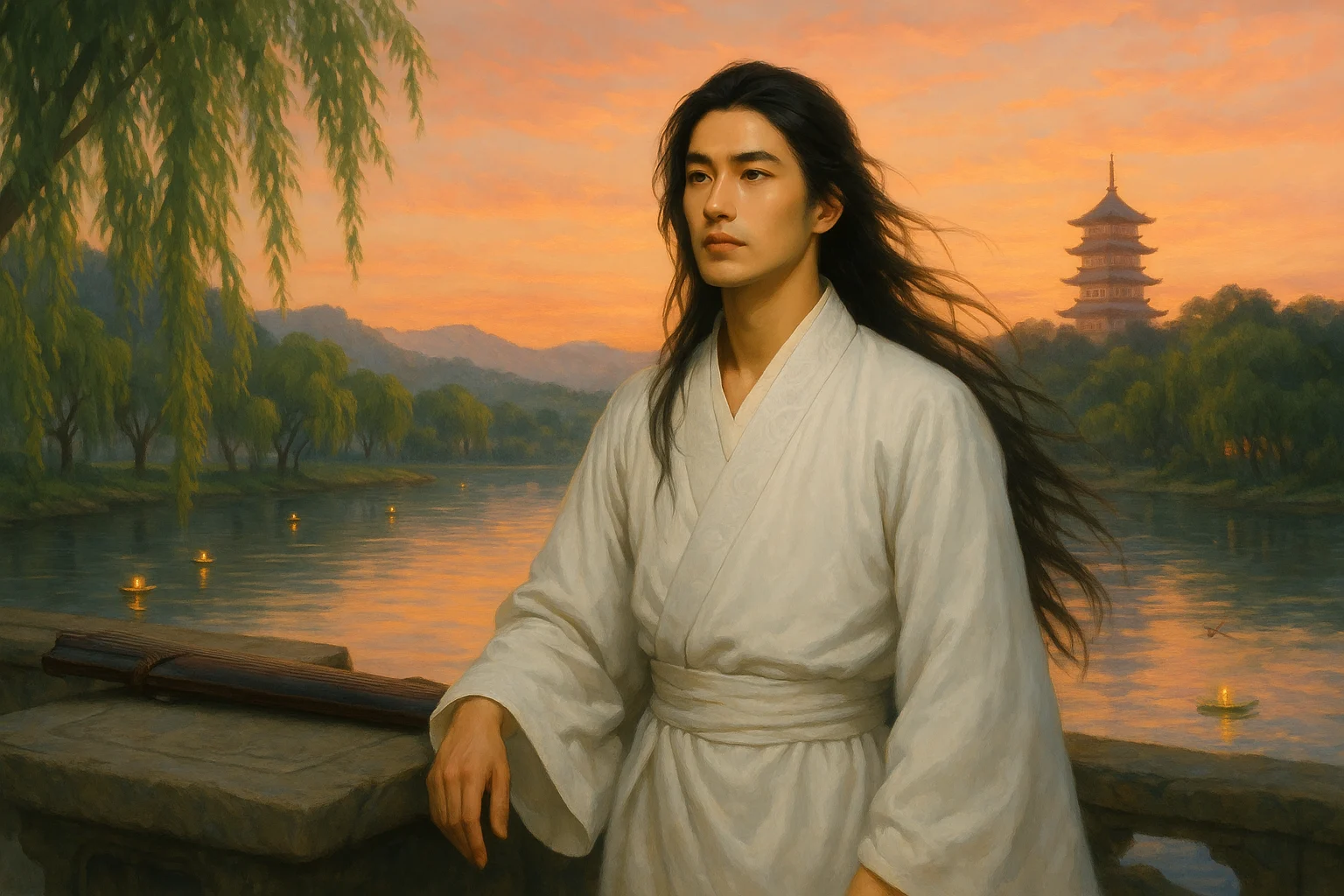
Bai Juyi (白居易), 772 - 846 AD, was originally from Taiyuan, then moved to Weinan in Shaanxi. Bai Juyi was the most prolific poet of the Tang Dynasty, with poems in the categories of satirical oracles, idleness, sentimentality, and miscellaneous rhythms, and the most influential poet after Li Bai Du Fu.