
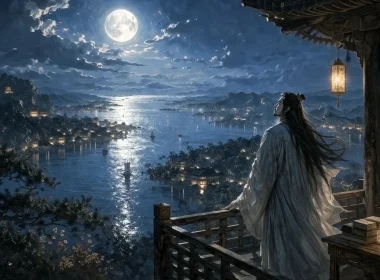
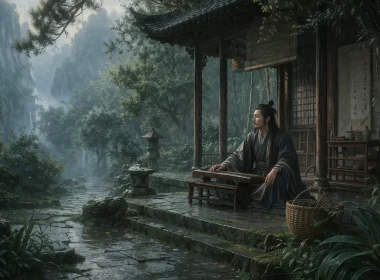

From of old, her portion was appointed — this,
To suffer change, and fill, and fail, and not to miss

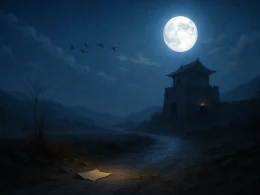
Her time. And for this night she keeps her troth, and wears
A brightness that is like the washing of all cares

From the wide world. The Four Seas, in her holy sleep,
Lie clear, as if the day‑world they had left to keep

A purer vigil. In the stillness, I perceive
A wind that scarcely breathes; a cold, as of the eve

Of snow, falls sudden. Lonely, high, and rarely seen
With such a perfect grace, she holds the vast demesne

Of heaven; and I, who gaze and make my solitary rhyme,
Feel how the hour is doubled, and redeemed from time.
Original Poem
「中秋月」
朱庆馀
自古分功定,唯应缺又盈。
一宵当皎洁,四海尽澄清。
静觉风微起,寒过雪乍倾。
孤高稀此遇,吟赏倍牵情。
Interpretation
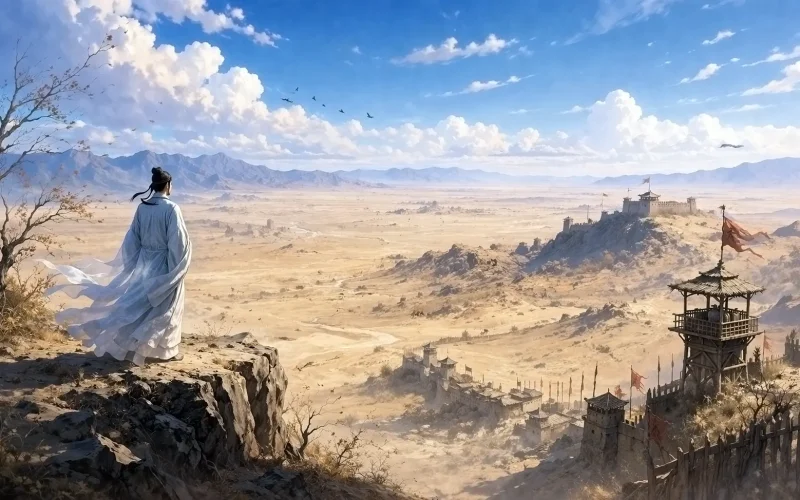
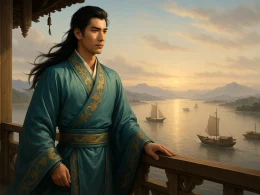
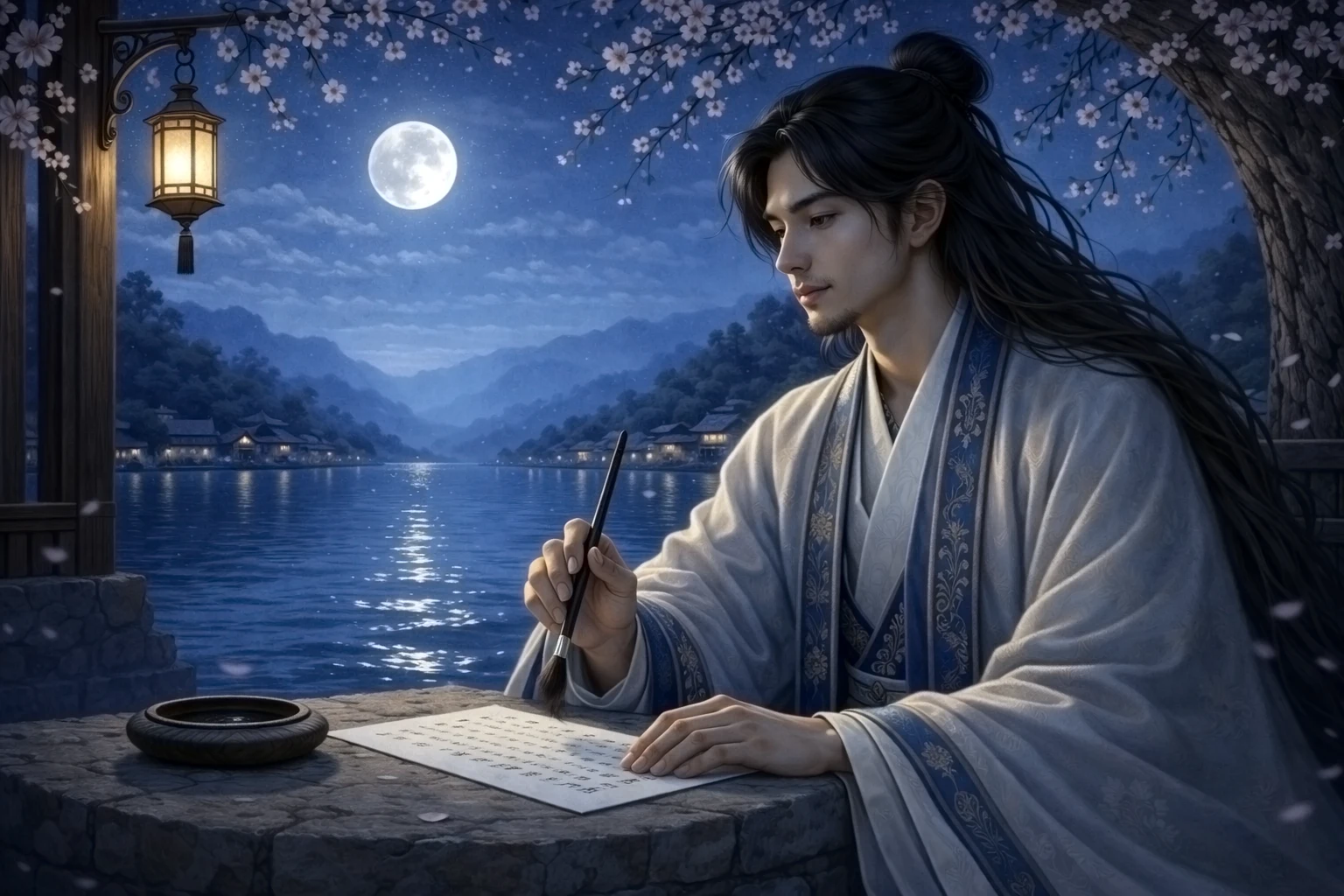
This poem was composed during Zhu Qingyu's later years of seclusion in the mountains of Yuezhou. One Mid-Autumn Festival, the poet sat alone in his mountain dwelling, gazing up at the azure sky where a solitary moon hung full as a mirror. In the mountains, there was no disturbance from worldly clamor, nor gatherings of family and friends; only the clear moonlight kept him company. Precisely because of this, he could calmly contemplate the moon's essential nature—its law of waxing and waning, its appearance of pure brightness, and its character of solitary loftiness and chill.
Thinking back to those Mid-Autumn Festivals spent in Chang'an, he was then still pursuing fame and fortune, either socializing at banquets or buried in his study, never truly settling down to face the moon. Now, worldly burdens were shed, empty fame entirely discarded; with just one person, one cup of tea, and a curtain of moonlight, he sat peacefully until deep into the night. This poem was written during such a solitary sitting—it does not describe the bustle of the Mid-Autumn Festival, but the moon's essence; it does not describe human reunion, but the reflections of an individual. He saw the moon's waning and waxing, constant since ancient times, unchanged by human affairs; he saw tonight's luminous purity, shining equally on all within the Four Seas, showing no partiality to any place. And the moon's loneliness at the sky's heart seemed so similar to his own state of mind at this moment. The physical sensation of "静觉风微起,寒过雪乍倾" (In stillness, I feel a faint breeze rise; a chill passes, as if snow were about to fall) merges the clear cold of the autumn night with the clarity of his inner world. The final line, "吟赏倍牵情" (Chanting and admiring, my feelings are stirred twofold), speaks of "牵情" (stirred feelings)—not the sorrow of parting or resentment, but a profound, spontaneous emotion arising from the resonance between a person and the cosmos, and the mutual understanding between one solitude and another.
First Couplet: "自古分功定,唯应缺又盈。"
Zì gǔ fēn gōng dìng, wéi yīng quē yòu yíng.
Since ancient times, its allotted course decreed; as is its due, it wanes and waxes again.
The poem opens with philosophical reflection, not describing the moonlight's brightness, but first stating the law of the moon's phases. "自古分功定" (Since ancient times, its allotted course decreed) writes that the moon's course is a fixed principle of heaven and earth—"分功" refers to the moon's function in the cosmos, and the word "定" (decreed/fixed) conveys its unchangeable certainty. The next line, "唯应缺又盈" (as is its due, it wanes and waxes again), describes the changes of the moon's phases—the two words "唯应" (as is its due) express that this waxing and waning is a natural necessity, not chance. These three characters, "缺又盈" (wanes and waxes again), are the "eye" of the entire poem: they are both the natural law of the moon and a metaphor for the rise and fall, the alternation of all things in the world. The poet uses the moon's waxing and waning to write of life's vicissitudes, and the constancy of celestial phenomena to write of the impermanence of human affairs, setting the entire poem on a philosophical tone from the very beginning.
Second Couplet: "一宵当皎洁,四海尽澄清。"
Yī xiāo dāng jiǎo jié, sì hǎi jìn chéng qīng.
This one night, it ought to be most radiant; pure clarity reigns from end to end of the Four Seas.
This couplet shifts from the law of the moon's phases to the particular qualities of the Mid-Autumn moon. "一宵当皎洁" (This one night, it ought to be most radiant) writes of the special nature of the Mid-Autumn night's moon—the word "当" (ought to) means both "should be" and "is," expressing that on this night the moonlight is at its fullest, brightest, and most complete. The next line, "四海尽澄清" (pure clarity reigns from end to end of the Four Seas) describes the scene of moonlight shining everywhere—the word "尽" (from end to end/completely) expresses the omnipresence of the moonlight, illuminating every corner under heaven. These two words, "澄清" (pure clarity), describe both the purity of the moonlight and the clarity of the human heart. Sitting alone in the mountains, the poet is immersed in this world of clear radiance; the distracting thoughts in his mind are also washed clean. This couplet portrays the fullness and clarity of the Mid-Autumn moon with expansive grandeur and profound artistic conception.
Third Couplet: "静觉风微起,寒过雪乍倾。"
Jìng jué fēng wēi qǐ, hán guò xuě zhà qīng.
In stillness, I feel a faint breeze rise; a chill passes, as if snow were about to fall.
This couplet shifts from the visual to the tactile, describing the physical sensations of sitting alone beneath the moon. "静觉风微起" (In stillness, I feel a faint breeze rise) describes the feeling of a faint breeze beginning—the two words "静觉" (in stillness, feel) convey the poet's inner tranquility and sensory acuity; only with a sufficiently still mind can one perceive that subtle, almost imperceptible stirring of the wind. The next line, "寒过雪乍倾" (a chill passes, as if snow were about to fall) describes the deepening chill—"寒过" is the chill passing over, and "雪乍倾" is an exaggerated metaphor, as if the chill were falling upon one like a sudden snowfall. These three characters, "雪乍倾" (as if snow were about to fall), use a visual image to describe a tactile sensation, portraying the clear cold of the autumn night with great impact. Though it does not snow on Mid-Autumn Festival, the chill in the mountains is deep; the poet uses "snow" as a metaphor, describing both reality and the heart—that chill is the cold of the autumn night, and also the cold of solitude.
Final Couplet: "孤高稀此遇,吟赏倍牵情。"
Gū gāo xī cǐ yù, yín shǎng bèi qiān qíng.
Suspended alone on high, such meetings are rare; chanting and admiring, my feelings are stirred twofold.
The final couplet concludes with emotion, condensing the philosophical reflections and sensations accumulated in the previous six lines into a single thought. "孤高稀此遇" (Suspended alone on high, such meetings are rare) describes the moon's solitary loftiness and the rarity of such an encounter—"孤高" (suspended alone on high) is the moon's characteristic, and also the poet's own self-description at this moment; the three words "稀此遇" (such meetings are rare) express that such a quiet night, such a state of mind, and such a face-to-face encounter with the moon are not commonplace. The next line, "吟赏倍牵情" (chanting and admiring, my feelings are stirred twofold) describes the deep feeling the poet experiences in this encounter—"吟赏" (chanting and admiring) is the action, and "牵情" (feelings stirred) is the result. These two words, "牵情", are the emotional core of the poem: it is not wild joy, nor great sorrow, but a deep resonance felt after being moved—between person and moon, solitude mirrors solitude, clear cold illuminates clear cold. At this point, the poem elevates the appreciation of the Mid-Autumn moon from a festive custom to a philosophical experience of dialogue between the individual and the cosmos, leaving a long-lasting aftertaste.
Holistic Appreciation
This is a work of philosophical reflection among Zhu Qingyu's poems on objects. The entire poem consists of eight lines and forty characters. Taking the Mid-Autumn moon as its subject, it begins with the law of the moon's waxing and waning, moves to the luminous purity of the Mid-Autumn night, then to the physical sensations of sitting alone beneath the moon, and finally concludes with "孤高稀此遇,吟赏倍牵情", blending natural scenery, bodily sensation, and inner feeling into one, revealing the poet's profound and lucid life experience as he sat facing the moon on the Mid-Autumn night.
Structurally, the poem presents a progressive sequence from principle to scene, from scene to body, from body to emotion. The first couplet writes of the moon's law, the starting point of philosophical reflection. The second couplet writes of the moon's radiance, the presentation of the scene. The third couplet writes of the rising breeze and arriving chill, the sensation of the body. The final couplet writes of the stirred feelings from chanting and admiring, the destination of emotion. Between the four couplets, the poem moves from principle to scene, from scene to body, from body to emotion, progressing layer by layer, forming a seamless whole.
Thematically, the core of this poem lies in the resonance between "孤高" (suspended alone on high) and "牵情" (feelings stirred). That "孤高" is the moon's characteristic, and also the poet's self-description—sitting alone in the mountains, far from the dusty world, he is like the moon at the sky's heart, clear, cold, and solitary. Yet it is precisely this solitary loftiness that allows him to resonate deeply with the moon; that "牵情" is the profound emotion born from this resonance. This "孤高" is not desolation, but a state of being; this "牵情" is not sorrow, but understanding.
Artistically, the poem's most moving aspect lies in its unique technique of "writing scenery through philosophy, writing the heart through the body." The poet does not describe how round or bright the moon is, but first writes of its laws; he does not directly express his feelings, but first writes of the bodily sensations of "a faint breeze rise" and "a chill passes, as if snow were about to fall." That acuity of "静觉" (in stillness, feel) is the externalization of a still heart; that physical sensation of "寒过" (a chill passes) is the tactile expression of solitude. This technique of blending philosophical thought, scenery description, bodily sensation, and emotional expression makes this poem unique among the many poems on the Mid-Autumn moon.
Artistic Merits
- Philosophy Enters Poetry, Conception Lofty and Far-reaching: Beginning with "自古分功定,唯应缺又盈", it elevates the appreciation of the Mid-Autumn moon from a festive custom to a philosophical reflection on natural law.
- Writing the Heart through the Body, Sensations Subtle and Precise: The couplet "静觉风微起,寒过雪乍倾" expresses solitude through tactile sense and state of mind through bodily sensation, with细腻 (delicate) and真切 (vivid) detail.
- Concise Language, Rich Meaning: The entire poem of forty characters contains philosophy, imagery, sensation, and deep feeling. Each word is plain, yet each word is flavorful.
- Using "孤高" for Self-Description, Concluding with "牵情": The final couplet merges the moon's solitary loftiness with the poet's solitude, uniting object and self, blending scene and feeling, leaving a long-lasting aftertaste.
Insights
Through a solitary sitting on the Mid-Autumn Festival, this poem speaks to an eternal theme—True appreciation is not revelry amidst bustle, but mutual understanding in solitude; true fulfillment is not external reunion, but internal clarity.
First, it lets us see the "realm of solitude." The poet sits alone in the mountains, facing the moon, with no family or friends for company, no feasting or merrymaking. Yet he does not feel desolate; on the contrary, in this solitude, he perceives the moon's "solitary loftiness," and also confirms his own. It reminds us: Solitude is not a deficiency, but a realm from which one can dialogue with the other; when a person can enjoy solitude, he gains the ability to resonate with heaven and earth.
On a deeper level, this poem makes us contemplate "another meaning of fulfillment." The world celebrates Mid-Autumn Festival seeking reunion; the poet observes it seeking mutual understanding with the moon. The moon's "wanes and waxes" is a law of nature; life's meetings and partings are also the normal state of existence. It makes us understand: True fulfillment is not everything going as wished, but the ability to still appreciate, to still be moved, amidst imperfection.
And what is most memorable is that acuity of "in stillness, I feel" in the poem. A faint breeze rises, and he can perceive it; a chill comes, and he can experience it. This acuity is not an innate sensitivity, but the natural state after the heart becomes still. When a person is no longer troubled by mundane affairs, no longer burdened by empty fame, his senses become exceptionally clear, and his mind becomes exceptionally lucid.
This poem is about a Mid-Autumn Festival in the Mid-Tang era, yet it offers solace to everyone who yearns for tranquility amidst noise and seeks resonance in solitude. The law of "its allotted course decreed since ancient times" is the unchanging order of heaven and earth. The moonlight where "pure clarity reigns from end to end of the Four Seas" is the clear radiance illuminating every solitary soul. The acuity of "in stillness, I feel a faint breeze rise" is the perceptiveness one can only possess after the heart is still. The encounter of "suspended alone on high, such meetings are rare" is the deepest tacit understanding between every solitary person and the cosmos. This is the vitality of poetry: it writes of Zhu Qingyu's Mid-Autumn Festival, but one reads of people of all eras—those who, in solitude, converse with heaven and earth, and in stillness, meet themselves.
About the Poet
Zhu Qingyu (朱庆馀 dates of birth and death unknown), also known by his given name Kejiu, was a poet of the Mid-Tang period, a native of Yuezhou (present-day Shaoxing, Zhejiang Province). He passed the jinshi examination in the second year of the Baoli era (826 AD) and held the position of Collator in the Imperial Library. His poetry excelled in the five-character regulated verse style, characterized by a refined and subtle elegance, with particular skill in depicting the emotions of boudoir women and palace maidens. In the Complete Tang Poems, two volumes containing 177 of his works are preserved. He was adept at using allegorical and metaphorical techniques, blending everyday emotions with political aspirations. Although not many of his poems survive, his exquisite craftsmanship secures him a unique place in the history of Tang poetry, with his poem Boudoir Sentiments becoming a quintessential example of the fusion of examination-themed and boudoir poetry in later generations.