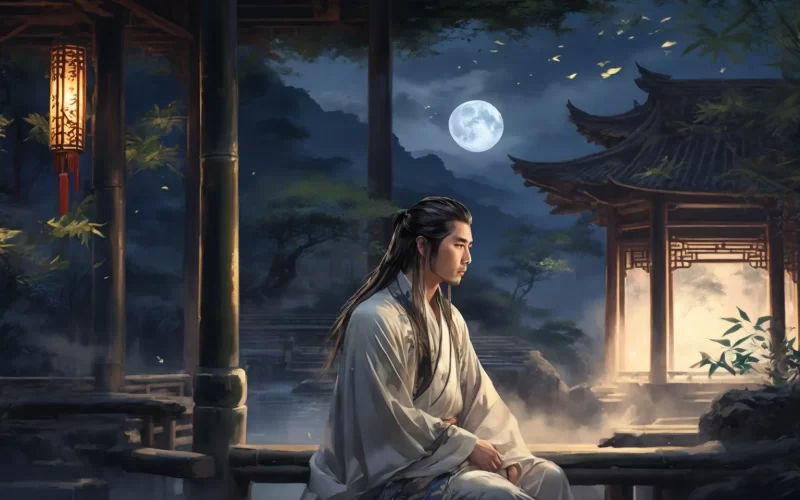



Its lofty peaks approach the Heavenly Capital;
Ridges upon ridges stretch to the ocean’s verge.
When I look back, clouds close in behind me;
As I enter, the blue mists vanish.

The central summit splits the wilderness,
And weathers vary across a thousand valleys.
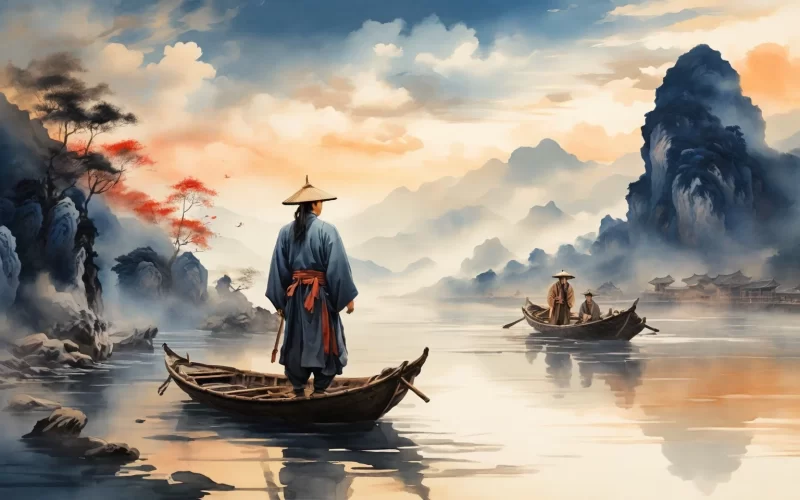
Seeking a place to pass the night,
I call to a woodcutter across the stream.
Original Poem
「终南山」
王维
太乙近天都,连山接海隅。
白云回望合,青霭入看无。
分野中峰变,阴晴众壑殊。
欲投人处宿,隔水问樵夫。
Interpretation
This poem stands as a landmark in Wang Wei's landscape poetry, marking an evolution from serene tranquility towards the sublime and majestic. Composed likely during his later years in retreat at Wangchuan, a period of frequent travel to Mount Zhongnan, it not only captures the mountain's monumental grandeur with painterly spatial composition but also embeds within this vast physical vision the poet's profound insight into cosmic order, nature's transformations, and the place of life within it. In eight lines, akin to an unfurling blue-green landscape scroll, the poem contains the immensity of a thousand miles within its frame, revealing the heart of heaven and earth in silent contemplation. It exemplifies the High Tang landscape aesthetic of "encompassing vastness within the minute, conveying stillness through dynamism."
Opening Couplet: 太乙近天都,连山接海隅。
Tài yǐ jìn tiān dū, lián shān jiē hǎi yú.
The Taiyi Peak approaches the Celestial City's might;
Ridge upon ridge extends to the ocean's farthest bound.
The opening immediately adopts a mytho-cosmic perspective, endowing Mount Zhongnan with transcendent loftiness and scope. The vertical connection between "Taiyi Peak" and the "Celestial City" establishes a sacred axis where mountain communes with heaven. The horizontal reach of "ridge upon ridge" to the "ocean's farthest bound" unfolds a majestic panorama spanning the Middle Kingdom. Using the verbs "approaches" and "extends to," Wang Wei transforms static mountain forms into dynamic spatial tension. Through this imaginative hyperbole, he conveys the awe-inspiring presence of Mount Zhongnan as both a cosmic pivot and a cultural symbol, setting the poem's tone of heroic grandeur.
Second Couplet: 白云回望合,青霭入看无。
Bái yún huí wàng hé, qīng ǎi rù kàn wú.
White clouds, looked back upon, seal the path from sight;
Blue mists, gazed into close, dissolve to empty light.
The couplet shifts to the immediate, intimate experience of the traveler, revealing the illusory nature of appearances and the limits of perception. "Looked back upon" and "gazed into close" create a subtle interplay of time and perspective: the clouds' "sealing" is the landscape's self-concealment with the passage of time; the mists' "dissolving" is the vanishing of substance upon intimate approach. These lines vividly capture the ethereal mutability of mountain clouds and haze, and, on a deeper level, symbolize the boundaries of cognition—what seems solid behind us becomes obscured; what appears tangible before us reveals its emptiness. This is the marvel of the landscape and the insight of Zen contemplation.
Third Couplet: 分野中峰变,阴晴众壑殊。
Fēn yě zhōng fēng biàn, yīn qíng zhòng hè shū.
The central peak divides the celestial field's domain;
Sun and shade in countless ravines are not the same.
The poet elevates his vision to cosmic and geological scales. "Celestial field" refers to the ancient astrological division of the heavens corresponding to earthly regions. This line, using the "central peak" as a dividing line, implies Mount Zhongnan's geographical sovereignty in demarcating the cosmic principles of yin and yang. "Sun and shade in countless ravines are not the same" presents, within a single moment, the microclimatic spectacle shaped by the mountain's terrain—where light and shadow are variously apportioned among the gorges, as if nature were playing with its own brush and ink. Moving from grand conception (astral fields) to fine observation (weather), these lines display the poet's power to comprehend the whole while discerning the particular.
Final Couplet: 欲投人处宿,隔水问樵夫。
Yù tóu rén chù sù, gé shuǐ wèn qiáo fū.
I wish to find a dwelling place among mankind;
Across the stream, I call out to a woodcutter.
After fully depicting the mountain's majesty, the final couplet turns gently towards the human realm, achieving profound artistic effect with a simple gesture. "I wish to find a dwelling place among mankind" reveals the poet as not merely an observer but a traveler within the mountains, a seeker of shelter, returning the immense landscape to a human scale. "Across the stream, I call out to a woodcutter" is like a tiny figure delicately added to a corner of a painting: the stream marks distance and carries sound; the woodcutter is a mountain dweller, an integral part of nature. This call breaks the mountain's silence, introducing human voice and the possibility of response, transitioning the poetic scene from a "realm without humans" to the warmth and vitality of "seeking connection within the human world." The lingering resonance is filled with tentative hope and the simple poetry of mountain life.
Holistic Appreciation
This is a dual epic of spatial conquest and spiritual wandering. The poem's structure is as disciplined as a symphony: the opening couplet is a majestic prelude (distant, upward view), the second a lyrical adagio (mid-range, personal experience), the third a brilliant allegro (overarching panorama), and the final a serene coda (close-up, human element). With the dual sensibilities of poet and painter, Wang Wei accomplishes in these eight lines a multi-dimensional portrayal of Mount Zhongnan—it is mythical, geographical, climatic, perceptual, and ultimately, human.
Notably, the poem sustains a compelling tension: between the mountain's infinite outward expansion ("approaches the Celestial City," "extends to the ocean's bound") and an inward convergence ("dissolve to empty light," "call out to a woodcutter"); between the diverse multiplicity of "sun and shade… not the same" and the empty essence of "dissolve to empty light." Wang Wei does not resolve this tension but lets it stand, rendering Mount Zhongnan a complex existence vibrant with life and philosophical revelation. The poet moving through it is both surveyor and the surveyed, the questioner finding answers within the vista itself.
Artistic Merits
- Cinematic Shifts in Perspective: The viewpoint constantly moves—upward gaze, backward glance, level stare, downward survey, searching look—guiding the reader on an immersive journey through the mountains, greatly enhancing the dynamic and three-dimensional quality of the imagery.
- Cosmology Embodied in Parallel Structure: "White clouds" parallels "blue mists" (color and texture); "looked back upon" parallels "gazed into close" (time and action); "celestial field" parallels "sun and shade" (space and climate); "central peak" parallels "countless ravines" (the singular and the multiple). The precise parallelism is not mere formal elegance but a poetic expression of the world's principle of binary opposition and unity.
- Masterful Shifts in Scale: From the cosmic scale of the "Celestial City" and "ocean's bound," to the meteorological scale of "blue mists" and "white clouds," to the topographical scale of "ravines" and the "stream," finally to the human scale of the "woodcutter." This free movement across scales demonstrates Wang Wei's exceptional ability to handle vast subjects with seemingly effortless grace.
- The Art of Suggestive Detail: The final couplet functions like the small, crucial human figures in a landscape painting. The woodcutter's appearance draws the poem's philosophical gaze back to the human sphere, provides a point of warmth connecting to nature, and leaves, in the space between the call and its unanswered state, a profound poetic silence and room for imagination.
Insights
This work stands as a spiritual monument among the peaks of Tang poetry. It reveals that true appreciation and understanding of great nature (or any vast system) require the fusion and traversal of multiple perspectives—one needs both the sublime仰望 of "approaches the Celestial City" and the penetrating inquiry of "dissolve to empty light"; both the discerning eye for "sun and shade… not the same" and the humble heart to "call out to a woodcutter."
In our contemporary age of information explosion yet increasingly narrowed viewpoints, this poem teaches a more complete mode of perception: moving freely between the grand and the minute, the sacred and the everyday, the eternal and the transient. We may not dwell on Mount Zhongnan, but we can preserve within a "Taiyi Peak," letting it remind us on life's horizon of existence's grandeur and depth. We must also remember the call of "across the stream, I call out to a woodcutter"—on the long mountain path in pursuit of truth and beauty, humble inquiry and connection to the human world remain the warm coordinates that keep us from losing our way.
With a single poem, Wang Wei preserved for us the landscape spirit of the High Tang and the full dimension of a great soul. Each reading is an ascent of the spirit. And we, the readers of later ages, are all those travelers across the stream, calling out and awaiting a reply.
Poem translator
Kiang Kanghu
About the poet
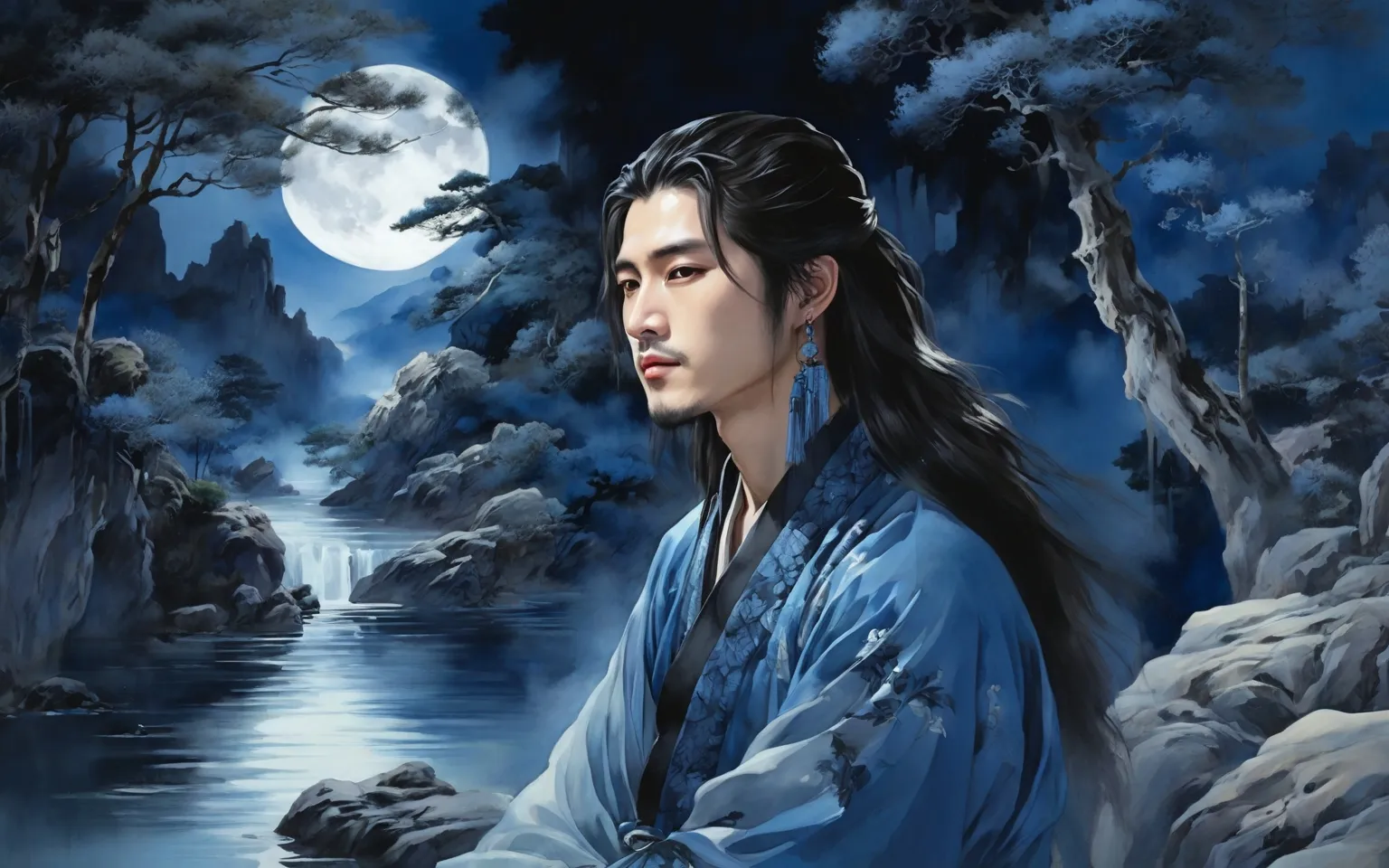
Wang Wei (王维), 701 - 761 A.D., was a native of Yuncheng, Shanxi Province. Wang Wei was a poet of landscape and idylls. His poems of landscape and idylls, with far-reaching images and mysterious meanings, were widely loved by readers in later generations, but Wang Wei never really became a man of landscape and idylls.