


In middle age, I grew to love the Way,
And made my home near the foot of this mountain.
When a mood comes, I wander out alone
To find beauty that is mine to enjoy.

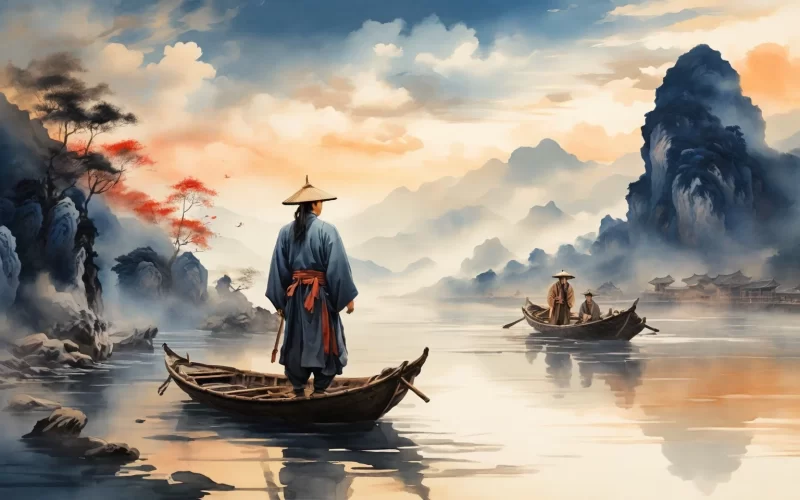
I walk until the stream checks my path,
Then sit to watch the clouds as they rise.
By chance, I may meet an old woodcutter;
We talk and laugh — and forget about going home.
Original Poem
「终南别业」
王维
中岁颇好道,晚家南山陲。
兴来美独往,胜事空自知。
行到水穷处,坐看云起时。
偶然值林叟,谈笑无还期。
Interpretation
This poem stands as a definitive masterpiece of Wang Wei's later recluse poetry and the ultimate synthesis of his life philosophy and artistic achievement. Composed during a period of crystalline clarity in his later years, following the turmoil of the An Lushan Rebellion and the vicissitudes of official life, it reflects his complete devotion to Buddhist truth and the serene joy of Zen contemplation while dwelling at Mount Zhongnan. Using the plainest language to recount several emblematic moments of his hermit life, the poem reveals, within these seemingly spontaneous activities, a path of spiritual sublimation from "conscious pursuit of the Way" to "unconscious harmony with the Way." It stands as the paradigmatic example within ancient Chinese recluse poetry that most fully embodies the Zen-inspired state of "following circumstance and letting things take their course, where all that meets the eye is true."
First Couplet: 中岁颇好道,晚家南山陲。
Zhōng suì pō hào dào, wǎn jiā nán shān chuí.
In my middle years, I grew deeply fond of the Way;
Now, in my later days, I make my home by South Mountain's side.
The opening sketches a pivotal turn in the poet's life with a historian's detachment. "Middle years" and "later days" frame a span of time; "grew deeply fond of the Way" signifies the inner calling, and "make my home by… side" is its physical fulfillment. The word "deeply" (颇) is nuanced—it conveys a sustained, quiet inclination, neither fervent obsession nor casual dabbling. "By South Mountain's side" denotes not merely a location but the periphery and starting point of a spiritual realm—withdrawing from the worldly center to nature's edge is precisely the journey towards the heart's own center.
Second Couplet: 兴来每独往,胜事空自知。
Xìng lái měi dú wǎng, shèng shì kōng zì zhī.
When inspiration stirs, I often wander forth alone;
The beauty encountered, known fully to myself alone.
This couplet captures the habitual rhythm of reclusive life. "When inspiration stirs" emphasizes the spontaneity and intrinsic drive for action; "wander forth alone" highlights the solitary freedom and absolute sovereignty of choice. "The beauty encountered" may refer to scenic wonders or the joy of Zen insight; the word "空" in "known fully to myself alone" signifies not emptiness but a self-sufficient completeness that seeks no external validation and transcends words. These lines define the joy of seclusion as a purely private experience, free from any performative or social aspect, establishing the poem's profoundly introspective tone.
Third Couplet: 行到水穷处,坐看云起时。
Xíng dào shuǐ qióng chù, zuò kàn yún qǐ shí.
I walk until the water ends its course;
And sit to watch the clouds arise.
This couplet, an immortal poetic distillation, forms the soul and central vision of the entire poem. It transcends mere scenery to become a symbol of life's ultimate state and a cosmic principle. "Walk until the water ends its course" marks the termination of linear seeking, the conclusion of "having a path." "Sit to watch the clouds arise" initiates contemplative openness, the sudden clarity found where "there is no path." The shift from "walk" to "sit," from "ends" to "arise," reflects the Zen approach to enlightenment: "letting go reveals the path immediately." The water's end is the limit of "being"; the rising clouds are the vitality within "non-being." Here, the poet achieves an instantaneous transcendence from "purposeful seeking" to "expectant abiding." This is not merely an action but a transformation in perception and state of being.
Final Couplet: 偶然值林叟,谈笑无还期。
Ŏu rán zhí lín sŏu, tán xiào wú huán qī.
By chance, I meet an old woodsman;
We talk and laugh, with no thought of returning home.
The conclusion moves from solitude to chance encounter, from silent contemplation to shared laughter, yet feels perfectly seamless and integrated. "By chance" is the key, emphasizing that all is a fortuitous confluence, an unplanned meeting, freeing the moment from all design and purpose. "Meet an old woodsman" is the unexpected human connection; "talk and laugh" is the spontaneous communion. "With no thought of returning home" finally dissolves the constraints of time and worldly concerns, entering the eternal present where self and other are forgotten, subject and object merge. Is this "old woodsman" not another "Wang Wei," or perhaps nature itself embodied? In their talk and laughter, the recluse and the mountain wilderness are one.
Holistic Appreciation
This is a poem of enlightenment that expresses profound truth through lived experience, finding the sublime within the ordinary. Its structure subtly mirrors the stages of Zen awakening: the first couplet is the initial resolve (起), the second is practice and personal verification (承), the third is sudden enlightenment (转), and the fourth is harmonious abiding in accordance with conditions (合). The four couplets trace a complete, circular spiritual journey.
Here, Wang Wei blends Daoist "naturalness," Confucian "self-cultivation in solitude," and Buddhist "contemplation of emptiness" into a seamless whole, presented with utmost simplicity. The "I" in the poem is not a lofty sage but an ordinary wanderer in the hills, one who can lose the path, sit idly, meet by chance, and forget to return. It is precisely this "ordinariness" that constitutes its profundity. The poem contains no direct discourse, yet insight permeates it; it crafts no deliberate artistry, yet artistry suffuses it. It presents an ideal existence where life moves in sync with nature, the mind resonating with the cosmos.
Artistic Merits
- Convergence of Narrative and Spiritual Rhythm: The progression from "grew deeply fond" (intent) to "wander forth alone" (action), to "water ends / clouds arise" (turning point), and finally to "talk and laugh… no thought of returning" (dissolution) mirrors the mind's natural movement from seeking to release through its fluid, unhurried pace.
- Dynamic Unity of Opposites: "Walk" and "sit"; "ends" and "arise"; "alone" and "meet"; "forth" and "returning"—these opposing terms achieve a higher harmony within the Zen sensibility, embodying the wisdom that "nirvana is found within samsara."
- Effacement of Self and Openness of Vision: The poet, while the agent of action, possesses no assertive ego. He is a transparent medium, allowing the landscape, clouds, and woodsman to simply be. This self-effacement opens the poetic space infinitely, letting the reader enter and find their own "beauty… known fully to myself alone."
- Purified Language with Profound Resonance: The diction is simple, approaching the cadence of everyday speech, without obscurity or artifice, yet each word is perfectly placed. Particles and adverbs like "deeply," "often," "alone," and "by chance" precisely capture subtle shades of feeling and attitude, revealing depth within simplicity and richness within plainness.
Insights
This poem is a timeless antidote to the modern afflictions of anxiety and purpose-driven existence. It teaches that meaning may lie not in always "having a path to walk," but in the composure to "sit to watch the clouds arise" where the "water ends its course." True turning points and wisdom often arrive when striving ceases, preconceptions are abandoned, and the present is fully accepted.
In an age that worships efficiency, fears stillness, and over-plans, Wang Wei offers another way: to allow ourselves to "wander forth alone" when inspiration stirs, honoring our inner rhythm; to cherish what is "known fully to myself alone," without haste to share; and to learn to "sit" peacefully where paths end, for that is where "clouds arise"—where inspiration and new vistas emerge unforeseen. The encounter of "meet[ing] an old woodsman… with no thought of returning home" reminds us that the deepest joys and connections spring from utterly unplanned, purposeless chance.
Wang Wei's retreat is not at Mount Zhongnan, but in any heart willing to "make [its] home by South Mountain's side." This poem is the map and the key he left for all wayfarers to come.
Poem translator
Kiang Kanghu
About the poet
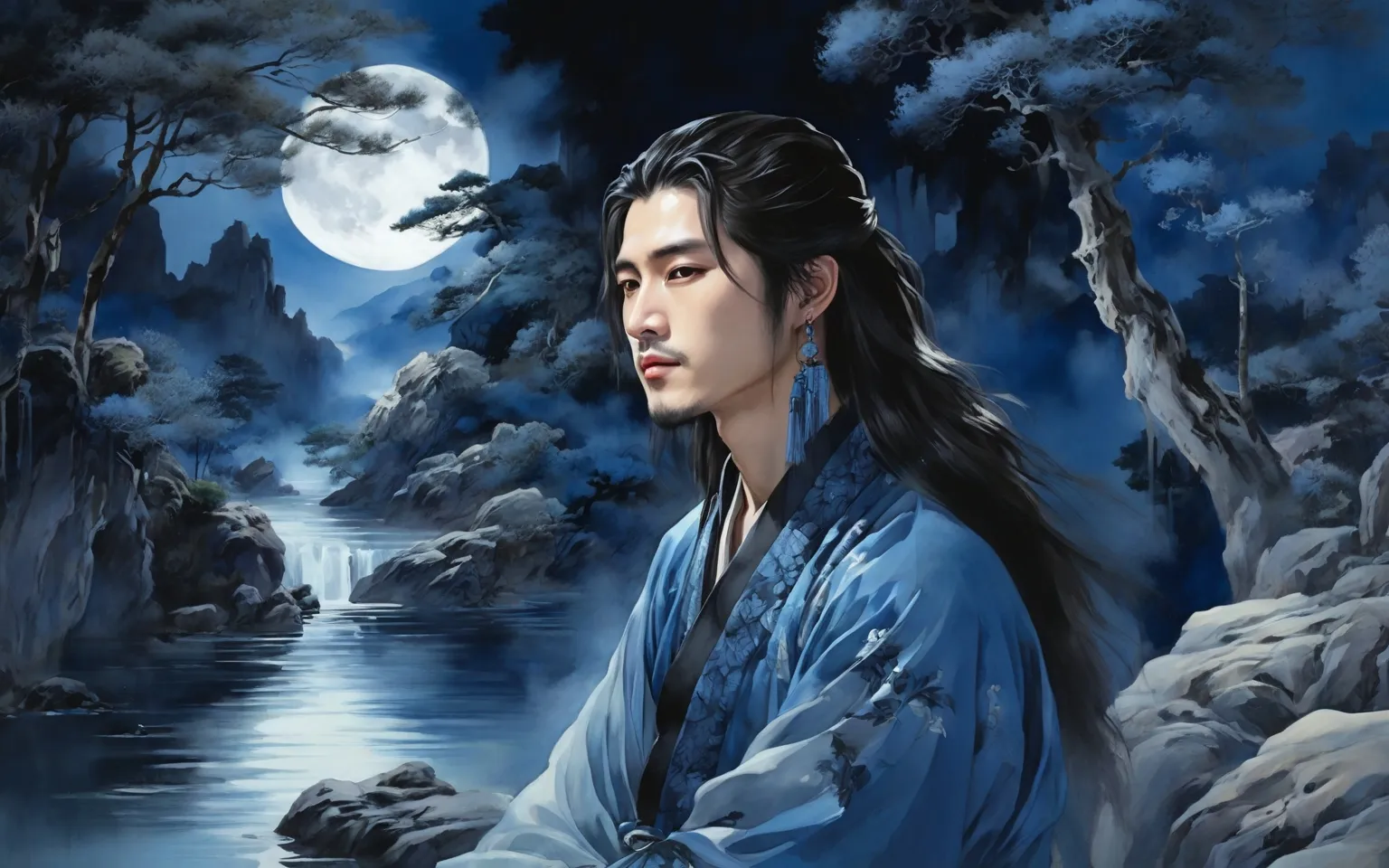
Wang Wei (王维), 701 - 761 A.D., was a native of Yuncheng, Shanxi Province. Wang Wei was a poet of landscape and idylls. His poems of landscape and idylls, with far-reaching images and mysterious meanings, were widely loved by readers in later generations, but Wang Wei never really became a man of landscape and idylls.