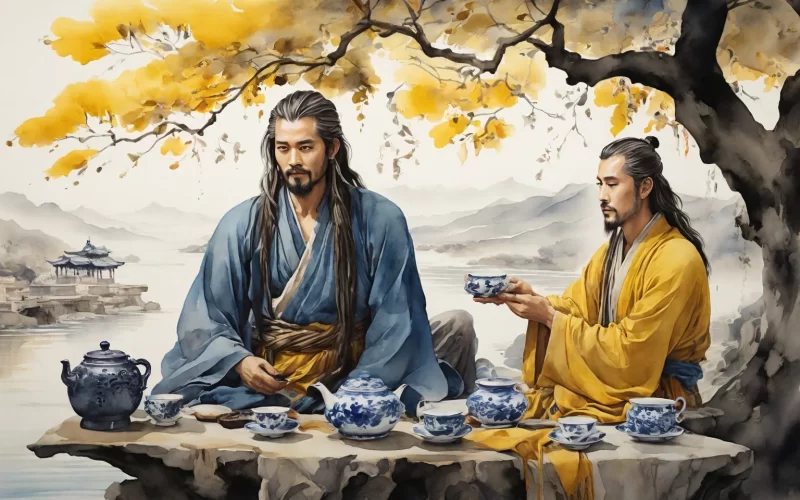
Since we left, roaming like thistledown in autumn wind,
We've not found the pill of life, ashamed of Master Ge.
We've wasted our days in wine and song in vain;
For whom should we be unruly and proud and free?
Original Poem
「赠李白」
杜甫
秋来相顾尚飘蓬,未就丹砂愧葛洪。
痛饮狂歌空度日,飞扬跋扈为谁雄。
Interpretation
This work was composed in the autumn of 758 CE, the first year of the Qianyuan era under Emperor Suzong. At the time, Du Fu was serving as a military advisor in Huazhou, but his official career had stalled after he angered the emperor by pleading for the disgraced minister Fang Guan. That summer and autumn, Du Fu reunited in Luoyang and the Shandong region with Li Bai, who was likewise adrift and disillusioned. The flames of the An Lushan Rebellion still burned, and the two greatest poets of the High Tang met once more amid the upheaval of the age and the disappointment of their personal lives. In just twenty‑eight characters, this poem condenses Du Fu’s deepest understanding of Li Bai, his most complex emotions, and his most subtly expressed counsel. It can be called a miniature epic of “twin stars in dialogue.”
First Line: “秋来相顾尚飘蓬,未就丹砂愧葛洪。”
Qiū lái xiāng gù shàng piāo péng, wèi jiù dān shā kuì Gě Hóng.
Autumn finds us face to face, still like drifting tumbleweed; / No cinnabar elixir achieved—ashamed of Ge Hong, indeed.
The opening words “autumn finds” point to the bleak season and metaphorically suggest the harsh autumn of both their lives and the era. “Face to face” is a gaze full of unspoken depth. The word “still” in “still like drifting tumbleweed” carries immense weight, conveying that beneath the joy of reunion lies the profound sorrow of years of unending wandering and an uncertain future. The latter half of the line shifts from circumstance to aspiration: “cinnabar elixir” alludes to Li Bai’s obsession with Daoist transcendence, while “ashamed of Ge Hong” expresses a complex self‑mockery and probing question—having achieved neither transcendence nor worldly contribution, for what have we lived, and what have we become? This couplet interweaves the personal fate of “drifting tumbleweed” with the spiritual frustration of “no elixir achieved,” establishing the poem’s desolate and introspective tone.
Second Line: “痛饮狂歌空度日,飞扬跋扈为谁雄。”
Tòng yǐn kuáng gē kōng dù rì, fēi yáng bá hù wèi shuí xióng.
Drinking wildly, singing mad songs—our days pass, vain and void; / Soaring spirit, defiant pride—for whom is this prowess deployed?
This line addresses the core posture of Li Bai’s life. With highly condensed brushwork, Du Fu precisely captures Li Bai’s outward form of “drinking wildly, singing mad songs” and his inner spirit of “soaring spirit, defiant pride.” The three words “vain and void” are the emotional pivot of the entire poem, filled with Du Fu‑style sorrow and anxiety: he understands and pities Li Bai’s need to drown sorrows in wine and vent frustration in song, but he worries even more deeply that this untamed vital energy is being pointlessly consumed in emptiness. The ultimate question, “for whom is this prowess deployed?” is poignant and sharp. It expresses profound sympathy for Li Bai’s unrecognized talent and unfulfilled ambitions, but it is also a silent indictment of an era that could not accommodate such genius, and it carries an implicit, earnest hope that his friend might yet rouse himself to meaningful action.
Holistic Appreciation
This work is a poem of intense tension—both a “poem of understanding” and a “song of consolation.” Du Fu does not simply criticize or praise from the sidelines; adopting the voice of “us,” he binds his own fate closely to Li Bai’s, achieving true empathy.
The poem’s depth lies in its structure of “fourfold remorse”: the first line’s “ashamed of Ge Hong” expresses remorse for failing to attain the Daoist ideal of transcending the world; the second line’s “vain and void” and “for whom is this prowess deployed?” implicitly convey remorse for failing the Confucian ideal of serving the world, remorse for wasting one’s talent and life, and remorse toward an era that betrayed its genius. This interwoven sense of remorse allows these four short lines to bear an immensely heavy spiritual burden.
Artistically, the poem demonstrates the power of Du Fu’s later quatrains to “capture a thousand miles within an inch of silk.” From the seasonal marker “autumn,” to the image of “drifting tumbleweed,” to the scene of “drinking wildly, singing mad songs” and the aura of “soaring spirit, defiant pride,” culminating in the philosophical inquiry of “for whom?”—the poem flows seamlessly from start to finish, with intense emotional concentration and far‑reaching resonance.
Artistic Merits
- Highly Condensed and Symbolic Imagery: “Drifting tumbleweed” is the central image of Du Fu and Li Bai’s wandering lives; “cinnabar elixir” symbolizes Li Bai’s spiritual pursuit and the dilemma of his era. Together, they outline the poets’ state of being—physically and spiritually unmoored.
- Complex Emotion in Paradoxical Rhetoric: “Drinking wildly, singing mad songs” describes acts of bold, unrestrained joy, yet is followed by the negation of “vain and void”; “soaring spirit, defiant pride” describes a heroic, extraordinary stance, yet is undermined by the questioning of “for whom?” This paradoxical rhetoric reveals the vast emptiness and sorrow beneath the surface exuberance.
- Dialogic and Inclusive Tone: The poem employs phrases like “face to face” and “no elixir achieved” (we have not achieved), fully drawing Li Bai into a framework of dialogue and shared feeling. This makes the counsel and lament feel not condescending but like heartfelt words between intimate friends.
- The Crushing Force of a Rhetorical Conclusion: Ending with the question “for whom?” provides no answer, yet the answer is clear. It elevates personal disappointment into the tragedy of an era, leaving behind endless vastness for reflection—a conclusion of tremendous power.
Insights
This masterpiece transcends the category of a simple occasional poem for a friend. It touches on eternal themes: genius and its era, personal ambition and real‑world adversity, unrestrained behavior and inner torment. With deep sympathy and clear‑eyed compassion, Du Fu shows us that true understanding means seeing the pain beneath another’s exuberant posture, the loneliness beneath glorious talent.
It reminds us that tension between the individual and their environment can exist in any age. When external paths are blocked, people may turn to the release of “drinking wildly, singing mad songs” or the self‑preservation of “soaring spirit, defiant pride.” Du Fu’s lines urge us, while sympathizing with such postures, to inquire more deeply into their roots and to maintain a measure of the self‑reflection inherent in “for whom?”—lest life’s force be dissipated in vain.
Ultimately, this poem is an echo between two great souls in the canyon of history. It shows us that even in the most difficult times, profound understanding, sincere dialogue, and implicit hope between kindred spirits remain precious light illuminating life’s darkness. What Du Fu wrote to Li Bai is not only a sigh but also a mirror, reflecting all souls unwilling to sink yet lost on the way forward.
About the poet
Du Fu (杜甫), 712 - 770 AD, was a great poet of the Tang Dynasty, known as the "Sage of Poetry". Born into a declining bureaucratic family, Du Fu had a rough life, and his turbulent and dislocated life made him keenly aware of the plight of the masses. Therefore, his poems were always closely related to the current affairs, reflecting the social life of that era in a more comprehensive way, with profound thoughts and a broad realm. In his poetic art, he was able to combine many styles, forming a unique style of "profound and thick", and becoming a great realist poet in the history of China.