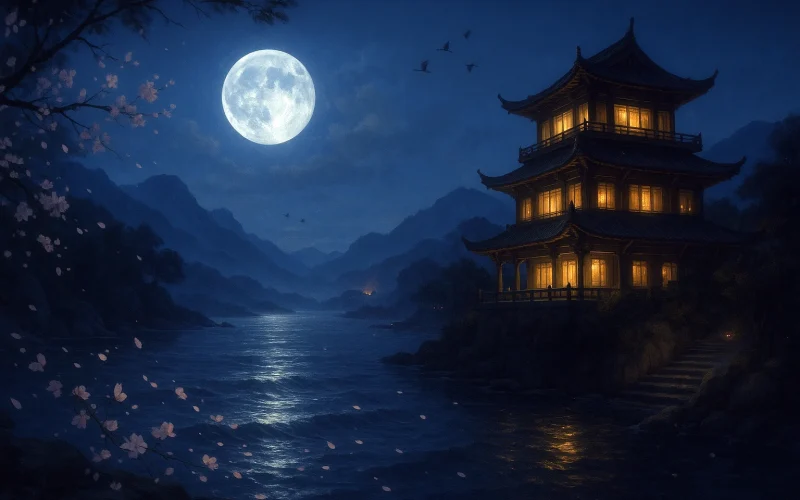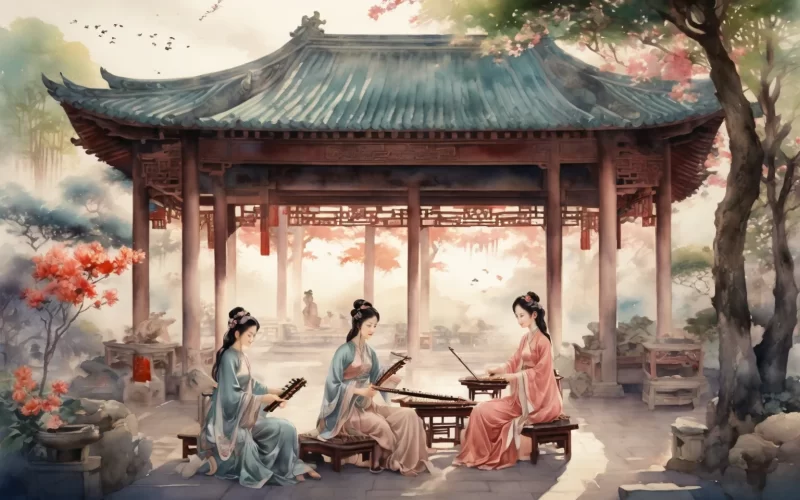
Daily in Brocade Town the music floats around,
Half on the river wind, half to the clouds ascending.
This melody should only dwell where celestials are found;
How rare for mortal ears to hear such notes descending!
Original Poem
「赠花卿」
杜甫
锦城丝管日纷纷,半入江风半入云。
此曲只应天上有,人间能得几回闻。
Interpretation
This work was composed in 761 CE, the second year of the Shangyuan era under Emperor Suzong, while Du Fu was residing in Chengdu. The "General Hua" (花卿) mentioned in the title refers to Hua Jinding, the military commander of Chengdu. Having suppressed a rebellion in the region, this man grew arrogant from his achievements, indulging in a life of extravagance. Notably, the ceremonial music employed in his daily feasts and entertainments exceeded the propriety of his official rank, suggesting an act of presumption. While attending one of these banquets, Du Fu, stirred by the music he heard, composed this poem. Superficially, it praises the exquisite artistry of the performance, yet it contains a layer of pointed allegorical critique. It stands as a quintessential example of Du Fu's poetic principles of "gentle sincerity" and "indirect admonition through refined art," showcasing the subtle yet penetrating political insight characteristic of his work.
First Couplet: “锦城丝管日纷纷,半入江风半入云。”
Jǐnchéng sīguǎn rì fēnfēn, bàn rù jiāng fēng bàn rù yún.
Within Brocade City, flutes and strings resound without an end; / Half to the river winds ascend, half to the clouds on high they wend.
The opening vividly conjures the scene of Chengdu's ceaseless musical revelry. The phrase "resound without an end" captures both the lavish frequency of the performances and subtly introduces a note of unease regarding this persistent opulence. The line "Half to the river winds ascend, half to the clouds on high they wend" is a masterstroke, granting tangible form and trajectory to the intangible music. "To the river winds ascend" evokes its pervasive diffusion through the mundane world, while "to the clouds on high" suggests its soaring, transcendent quality, reaching toward the heavens. This description extols the music's captivating beauty yet simultaneously carries a potent double meaning: could melodies that penetrate the very clouds be overstepping the bounds of a subject's proper station, audaciously approaching the celestial realm reserved for the sovereign alone?
Second Couplet: “此曲只应天上有,人间能得几回闻。”
Cǐ qǔ zhǐ yīng tiānshàng yǒu, rénjiān néng dé jǐ huí wén.
A tune like this belongs to heaven's sphere alone, I deem; / How rarely in our mortal world may we encounter such a theme!
This couplet forms the poem's climactic point, elevating its meaning from artistic appreciation to the plane of political allegory. In classical literature, "heaven's sphere" (天上) frequently serves as a metaphor for the imperial court. The declaration "belongs to heaven's sphere alone" is, on the surface, the highest possible praise, yet its true force operates as a stern implicit critique: music of such ceremonial stature, by ritual propriety, is the exclusive preserve of the emperor. By what right does a regional commander enjoy it as daily fare? The exclamation "How rarely in our mortal world" ostensibly marvels at its rarity but functions in truth as a tactful yet pointed query and warning: how can such presumptuous acts be commonplace? Wrapping sharp censure within a tone of rapt admiration, the poet's technique—appearing to celebrate while fundamentally admonishing—is one of supreme artistry.
Holistic Appreciation
This heptasyllabic quatrain is a classic example of the poetic principle where "the words describe one thing, but the meaning points to another." It resembles a medicinal pill coated in sugar: beneath a dazzling surface of lavish praise lies a core of serious political and social critique.
The poem's essence resides in the paradoxical fusion of "praise" and "reproof." The first two lines depict the music's pervasive splendor; the final two elevate it to the supreme domain of "heaven's sphere." However, this very act of supreme elevation, within the specific context of Hua Jinding's transgression and the framework of traditional ritual norms, triggers a profound reversal of meaning. The more fervently the music is praised as belonging to heaven, the more starkly it exposes the incongruity and peril of a mortal subject claiming it for himself. Du Fu masterfully integrates a reflection on ritual boundaries into his depiction of aesthetic beauty, achieving a perfect synthesis of artistic form and intellectual depth.
The poem also reveals Du Fu's stance and acumen as a Confucian scholar-official. He forgoes the method of direct confrontation, opting instead for poetry's inherent subtlety and ambiguity to deliver a reminder that is both tactful and profound. Thus, the work stands as both a splendid ode to music and a miniature, artistically potent "memorial of admonition."
Artistic Merits
- Masterful Use of Double Entendre and Irony: The juxtaposition of "heaven's sphere" and "our mortal world" is the pivotal mechanism generating the poem's layered meaning. The tension between literal appreciation (music of divine quality) and contextual implication (a breach of ceremonial law) creates a rich, enduring significance that rewards contemplation.
- Vivid Imagery through Synesthesia and Hyperbole: Describing the music's ubiquity as "resound without an end" and its reach as extending to the winds and clouds translates auditory sensation into visual and spatial terms with great imaginative power. The hyperbolic claim that it "belongs to heaven's sphere alone" establishes the essential foundation for the poem's ironic structure.
- Euphonious Language and Harmonious Rhythm: The lines themselves are melodious and flowing, their cadence mirroring the music they describe. The deliberate choice of resonant words like "resound" (纷纷), "clouds" (云), and "encounter" (闻) imbues the poem with its own intrinsic musicality, achieving a resonant unity of form and content.
- The Art of Implication and Open Interpretation: The poet leaves the critical intent entirely implicit, offering the space for judgment and reflection wholly to the reader (and to the poem's intended recipient, "General Hua"). This quality of suggestive restraint liberates the poem from the confines of a single historical incident, granting it a timeless, universal relevance as a meditation on the perennial themes of power, propriety, and transgression.
Insights
This work offers enduring insight concerning "the boundaries of artistic expression" and "the wisdom inherent in critique." It reminds us that artistic beauty—such as exquisite music—once severed from its proper ethical and social framework, can degenerate into a perilous indulgence and an expression of usurped authority. Du Fu's profundity lies in his keen perception of the latent tension between "aesthetic delight" and "ritual decorum," between the "refinement of art" and the "restraints of political order."
Concurrently, the poem exemplifies a sophisticated mode of criticism. It achieves its end not through direct accusation but by invoking a higher aesthetic and moral standard, using the guise of "praise" to effect "admonition." This wise and constructive form of engagement suggests that in addressing error or excess, beyond blunt confrontation, one might choose a more nuanced, face-saving approach that appeals to the recipient's sense of propriety and self-awareness. Thus, this concise poem serves not only as a mirror to its own historical moment but also as an enduring parable on the arts of perceptive communication and ethical persuasion.
About the poet
Du Fu (杜甫), 712 - 770 AD, was a great poet of the Tang Dynasty, known as the "Sage of Poetry". Born into a declining bureaucratic family, Du Fu had a rough life, and his turbulent and dislocated life made him keenly aware of the plight of the masses. Therefore, his poems were always closely related to the current affairs, reflecting the social life of that era in a more comprehensive way, with profound thoughts and a broad realm. In his poetic art, he was able to combine many styles, forming a unique style of "profound and thick", and becoming a great realist poet in the history of China.