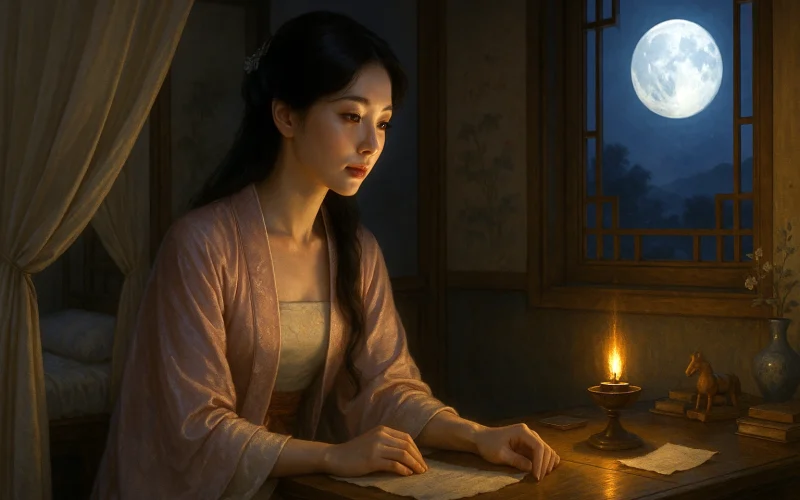
Far off in Fu-chou she is watching the moonlight,
Watching it alone from the window of her chamber -
For our boy and girl, poor little babes,
Are too young to know where the Capital is.

Her cloudy hair is sweet with mist,
Her jade-white shoulder is cold in the moon.
...When shall we lie again, with no more tears,
Watching this bright light on our screen?
Original Poem
「月夜」
杜甫
今夜鄜州月,闺中只独。
遥怜小儿女,未解忆长安。
香雾云鬟湿,清辉玉臂寒。
何时倚虚幌,双照泪痕干?
Interpretation
This poem was composed in the autumn of 756 CE, the first year of the Zhide era under Emperor Suzong (also the fifteenth year of the Tianbao era). At that time, Chang'an had fallen to the rebel forces of An Lushan and Shi Siming. Du Fu, having been captured en route to join Emperor Suzong's mobile court in Lingwu, was detained but, owing to his low official rank, not imprisoned. He found himself stranded in the occupied capital, his movements restricted. His wife, née Yang, resided with their children in Qiang Village, Fuzhou. Communication between the two places was severed, and in that chaotic era of uncertain fate, the poet, consumed by anxiety and hardship, gazed at the moon and thought of his distant family. In this state, he composed this deeply moving, exquisitely crafted poem of longing under the moonlight, which pioneered the lyrical paradigm of "projection," writing from the imagined perspective of the beloved.
First Couplet: “今夜鄜州月,闺中只独看。”
Jīn yè Fū zhōu yuè, guī zhōng zhī dú kàn.
Tonight, the moon over Fuzhou shines; / Alone, in your chamber, you watch its light.
The opening line achieves a masterful stroke. Instead of writing about his own moonlit yearning for his wife, the poet begins from the opposite shore, directly depicting her solitary vigil in Fuzhou. The phrase "Alone… you watch" carries immense emotional weight, conveying both the loneliness of her solitary figure and the poet's own unspoken guilt and anguish at being unable to be with her. The same moon illuminates two separate places, witnessed by both, yet only compounds the solitude. This conceit is ingeniously crafted and profoundly emotive.
Second Couplet: “遥怜小儿女,未解忆长安。”
Yáo lián xiǎo ér nǚ, wèi jiě yì Cháng'ān.
From afar, I think of our children, young and dear, / Who cannot grasp why mother's thoughts to Chang'an steer.
Developing from the idea of "solitary watching," the emotional layers deepen. The word "think of" (怜) is saturated with tender feeling—pity for the children's innocence, unaware of sorrowful separation, and a deeper pity for the wife who must bear the heavy burden of longing alone. "Cannot grasp" forms a subtle yet poignant contrast with "Alone… you watch": the children's innocent incomprehension throws into sharper relief the depth and pain of their mother's conscious, solitary yearning. The poet's meticulous care and profound love for his family are fully encapsulated here.
Third Couplet: “香雾云鬟湿,清辉玉臂寒。”
Xiāng wù yún huán shī, qīng huī yù bì hán.
Your cloudlike tresses damp with fragrant mist, the night-dews chill; / Your jade-white arms grow cold in the moon's clear, silent spill.
This is a celebrated couplet passed down through the ages, materializing longing into an image of poignant beauty. Through imaginative vision, the poet depicts his wife gazing at the moon, steadfast and long. The words "damp" and "cold" are both literal descriptions of the heavy night dew and cool air, and metaphorical expressions of a longing that permeates body and soul—a desolate chill that penetrates to the bone. The figure with mist-dampened hair and moon-chilled arms, standing within these ethereal and melancholic images, embodies fidelity, devotion, and deep affection. The poet's profound tenderness and admiration are self-evident.
Fourth Couplet: “何时倚虚幌,双照泪痕干?”
Hé shí yǐ xū huǎng, shuāng zhào lèi hén gān?
Oh, when shall we, side by side, lean by the window screen, / Watching the moonlight dry the traces of our tears, unseen?
The poem shifts from imagination and reverie to a longing for the future. The question "Oh, when…" concentrates the most fervent desire of those trapped in turbulent times for peaceful reunion. "Watching the moonlight dry" beautifully echoes the "solitary watching" of the opening line, forming the emotional axis of the entire poem—from the present desolation of solitary gazing to the longed-for future solace of shared illumination. The phrase "dry the traces of our tears" is especially poignant: only reunion can end the tears that flow silently through these long nights. The concluding line holds deep sorrow within a glimmer of hope, its resonance lingering.
Holistic Appreciation
The poem's most distinctive artistic feature is its lyrical technique of projection—the poet's spirit travels to where his beloved stands, and the verses seem to emanate from her perspective. Not a single word directly expresses his own longing; instead, the entire poetic effort is spent visualizing and imagining his wife's demeanor and state of mind in that distant place. This indirect mode of expression not only avoids emotional directness but also generates powerful artistic tension. The poet's deep consideration and profound love for his wife are revealed with redoubled intensity precisely within this "Fuzhou Moon-Gazing Portrait" he paints for her.
The poem is built upon multiple exquisite contrasts: "solitary watching" versus "shared illumination" represents spatial isolation versus the yearning for reunion; "cannot grasp" versus "conscious memory" contrasts the innocent ignorance of youth with the acute suffering borne of clear understanding; the present sensory reality of "damp" and "cold" versus the future hope of "dry" opposes the desolation of the moment with the solace of an ideal future. With a poet's heart, Du Fu distilled the universal emotion of wartime separation into these intimate yet universally resonant, timeless images. This poem showcases, beyond his characteristic somber and powerful style, another supreme realm of lyrical subtlety and profound tenderness.
Artistic Merits
- Projected Perspective, Achieving Subtle Depth
Adopting the unique viewpoint of writing from the beloved's imagined perspective, the poet channels all his emotions into visualizing his distant wife. This indirect lyrical approach renders the feeling of longing more nuanced, profound, and empathetic, greatly enhancing the poem's emotional power and artistic resonance. - Images of Poignant Beauty, Diction Precise and Arresting
The couplet "Your cloudlike tresses damp… Your jade-white arms grow cold…" combines ethereal and beautiful imagery, rich in pictorial and lyrical quality. The words "damp" and "cold" use physical sensation to convey emotional depth, demonstrating exquisite observation and infused feeling—a paradigm of emotional "materialization." - Meticulous Structure, Skillful Echoes
The poem begins with the image of "solitary watching" and concludes with the vision of "shared illumination," tracing a complete emotional arc. The two central couplets—through the children's inability to comprehend and the poignant portrayal of the wife with "damp" hair and "cold" arms—gradually intensify the emotional weight and solitude inherent in the opening scene. The structure is tightly woven, and the flow of thought unfolds seamlessly. - Somber Emotion, Far-Reaching Implication
On the surface, it is a poignant love poem of yearning. Yet within it intertwines the collective lament of a shattered nation, ruined homes, and personal captivity. The grief of personal separation merges with the pain of national turmoil, allowing this intimate poem to carry a weightier historical significance.
Insights
On a Moon Lightnight reveals another dimension of Du Fu, the "Poet Sage": beyond the grand narrative of concern for the nation and its people, he was also a deeply affectionate husband and a loving father. This poem teaches us that the greatest radiance of humanity is often manifested within the most intimate bonds of human relationships. Under the shadow of war, a fixed gaze upon the bright moon and a quiet worry over whether a loved one feels the cold constitute the most solid force against nihilism and chaos.
It tells us that true longing is the ability to traverse space and "see" the other's life and state of mind in vivid detail. "Your cloudlike tresses damp… Your jade-white arms grow cold…" is not merely poetic imagination but the capacity for profound empathy. In an age of pervasive uncertainty, this kind of emotional connection, rooted in deep understanding and consideration, becomes an indispensable source of light, illuminating each other's lives and warming the human spirit. With his sincere and deeply humane poetic vision, Du Fu preserved for us this most precious warmth of humanity and dignity of emotion amidst the ruins of his time.
Poem translator:
Kiang Kanghu
About the poet
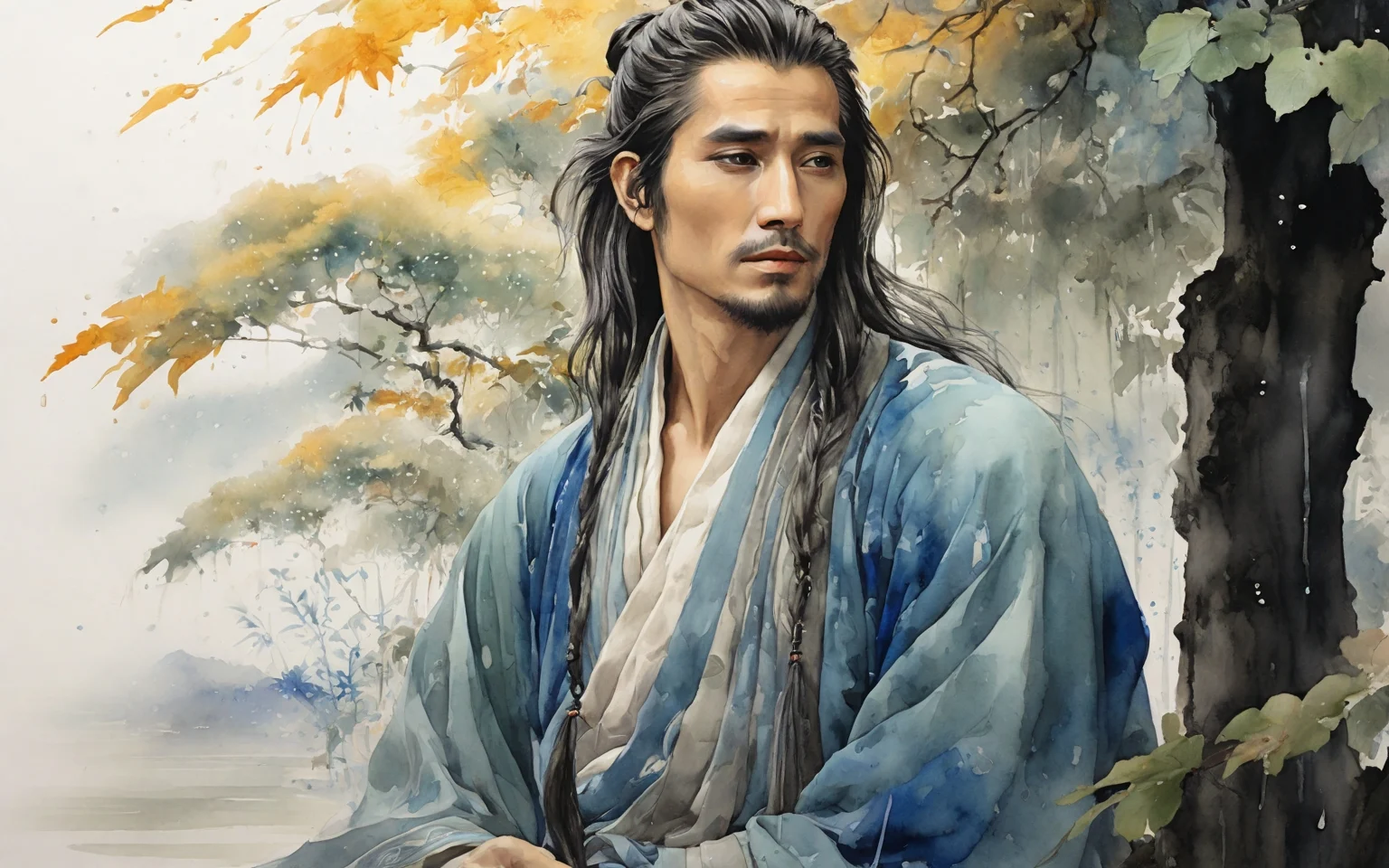
Du Fu (杜甫), 712 - 770 AD, was a great poet of the Tang Dynasty, known as the "Sage of Poetry". Born into a declining bureaucratic family, Du Fu had a rough life, and his turbulent and dislocated life made him keenly aware of the plight of the masses. Therefore, his poems were always closely related to the current affairs, reflecting the social life of that era in a more comprehensive way, with profound thoughts and a broad realm. In his poetic art, he was able to combine many styles, forming a unique style of "profound and thick", and becoming a great realist poet in the history of China.