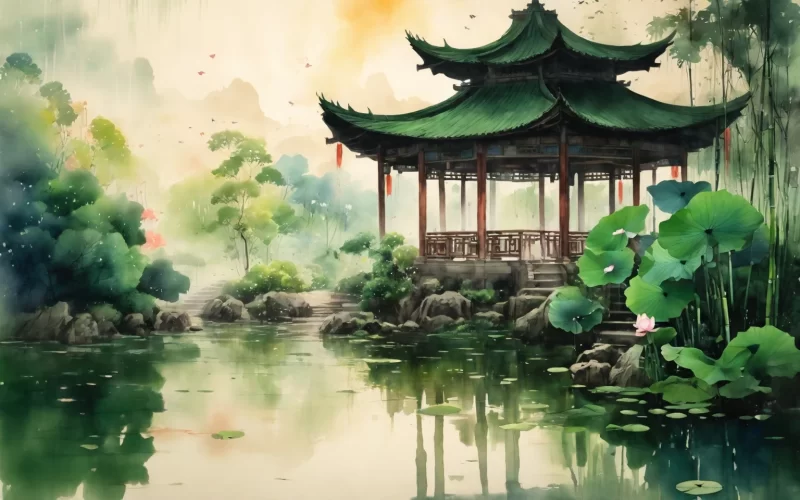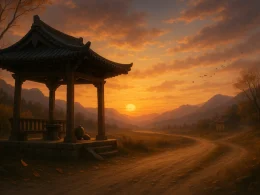



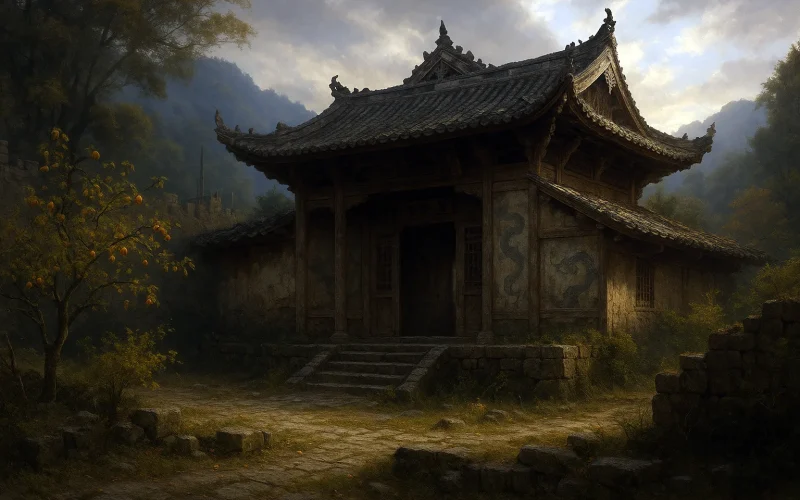
Your temple stands in empty hills,
The autumn breeze with sunset fills.
Oranges still hang in your courtyard;
Dragons on your old walls breathe hard.

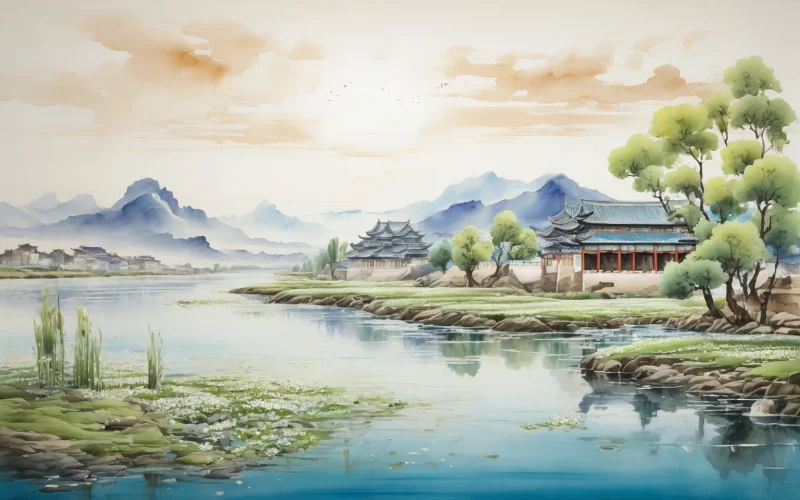
Over green cliff float clouds in flight;
The river washes the sand white.
On water as on land you'd go
To dredge the streams and make them flow.
Original Poem
「禹庙」
杜甫
禹庙空山里,秋风落日斜。
荒庭垂桔柚,古屋画龙蛇。
云气嘘青壁,江声走白沙。
早知乘四载,疏凿控三巴。
Interpretation
This poem was composed in the autumn of 765 CE, during the first year of the Yongtai era under Emperor Daizong. Du Fu had left his Chengdu cottage and was traveling east with his family when he passed through Zhongzhou (present-day Zhong County, Chongqing). Although the An Lushan Rebellion had ended, the state was feeble, regional warlords ruled independently, and the populace suffered in destitution. During his journey, Du Fu visited the Temple of Yu the Great. Confronted with the legacy of this ancient sage-king—whose monumental achievements of taming floods and ordering the land stood in stark contrast to the fractured nation and chaotic governance of his own time—the poem expresses not only reverence for the ancient sage but also the poet’s profound longing for the restoration of order and the salvation of a troubled age.
First Couplet: “禹庙空山里,秋风落日斜。”
Yǔ miào kōng shān lǐ, qiūfēng luòrì xié.
In vacant hills stands Yu the Great’s lone shrine; / Through autumn wind, the sun begins to decline.
The opening lines sketch the scene with broad, evocative strokes. “Vacant hills” describes a remote, secluded landscape and evokes a profound sense of historical emptiness—the sage-king is long gone, leaving only the temple behind. The classic imagery of “autumn wind” and the “declining sun” not only marks the season and time of day but also, with its inherent tones of vastness and melancholy, mirrors the poet’s own rootless wandering and his perception of an era in its twilight. The scene is expansive yet solitary, establishing the poem’s solemn and somber tone.
Second Couplet: “荒庭垂桔柚,古屋画龙蛇。”
Huāng tíng chuí jú yòu, gǔ wū huà lóng shé.
In the desolate courtyard, mandarins hang low; / On ancient walls, painted dragons and serpents show.
The focus shifts from the panoramic view to specific details of the temple grounds. “Desolate courtyard” and “ancient walls” further stress the erosion of time. Yet, within this decay, signs of life and memory persist: “Mandarins hang low” deftly alludes to a passage in the Tribute of Yu (“mandarins and pomelos were offered in bundles”), subtly hinting that the land’s fertility remains, a lasting blessing from Yu’s civilizing influence. “Painted dragons and serpents show” quietly invokes the legend from Mencius (“Yu drove away the dragons and serpents”), recalling Yu’s feat of quelling the floods and bringing order to all creatures. These lines use still images rich with allusion to retrieve echoes of a glorious past from the present ruins.
Third Couplet: “云气嘘青壁,江声走白沙。”
Yún qì xū qīng bì, jiāng shēng zǒu bái shā.
Cloud‑breath steams from cliffs of moss‑grown stone; / River‑thunder rolls where white sands are strown.
The perspective expands from the temple to depict the majestic, dynamic landscape surrounding it. The verb “steams” lends life to the mist, capturing its emergence from the cliffs. “Rolls” gives palpable form to the river’s roar, conveying the immense power of the current driving the sand. These lines are not merely magnificent description; they serve as a symbolic re-enactment of Yu the Great’s mighty labor—the steaming cloud‑breath seems the lingering resonance of the primal force that once split mountains and channeled rivers, and the thundering river‑sound is the flood, long ago tamed by Yu, still surging forward. The natural world becomes an echo of historic triumph.
Fourth Couplet: “早知乘四载,疏凿控三巴。”
Zǎo zhī chéng sì zài, shū záo kòng sān bā.
Well I know you rode four conveyances, by every course, / Dredged channels, cut through gorges, and subdued the Triple Ba’s force.
The final couplet turns from description to direct veneration, using condensed historical language to summarize Yu’s deeds. “Rode four conveyances” refers to the records of Yu traveling by boat on water, cart on land, sledge in mud, and spiked shoes in the mountains, illustrating the hardship of his task. “Dredged channels, cut through gorges, and subdued the Triple Ba’s force” focuses the grand legend of flood control onto this specific region (the Triple Ba, roughly present-day Chongqing and eastern Sichuan), linking myth to immediate geography. The verb “subdued” carries tremendous force; it conveys both the power to conquer nature and implies a deep yearning for the establishment of order and mastery over circumstance. This is both a paean to the ancient sage and an implicit critique of—and longing for—such monumental capability in the poet’s own age.
Holistic Appreciation
This regulated verse is a refined example of Du Fu’s historical meditation poetry. Its excellence lies in perfectly fusing profound historical remembrance, majestic natural description, and urgent contemporary concern within eight lines. The structure is meticulous: the first two couplets depict the temple, moving from exterior to interior, finding legacy within desolation; the third couplet expands to the surrounding landscape, transforming stillness into mighty motion; the final couplet draws the focus back, culminating in direct tribute. The poet masterfully makes every scene before his eyes a trigger for historical memory: the vacant hills and autumn wind prompt thoughts of antiquity; the mandarins and painted creatures hold allusions; the steaming clouds and thundering river seem like echoes of divine power.
More importantly, Du Fu is not merely dwelling on the past. The figure of Yu the Great in his verse is that of a pragmatic, effective savior, capable of establishing and maintaining order. This stands in sharp contrast to the reality of Du Fu’s own time—an era of separatist warlords, unheeded commands, and a people suffering as if in flood and fire. Therefore, beneath the surface of historical reverence, this poem vibrates with the poet’s profound anxiety about contemporary governance and his urgent longing for the kind of decisive, ordering action embodied by “dredging channels and subduing the flood’s force.”
Artistic Merits
- Subtle and Resonant Use of Allusion: Allusions like “mandarins,” “dragons and serpents,” and “four conveyances” are woven seamlessly into the scenic description and historical narrative. They are not obscure but enrich the poem’s cultural depth and historical perspective.
- Precision and Power of Verbs: A series of carefully chosen verbs—“hang,” “show,” “steams,” “rolls,” “rode,” “dredged/cut,” “subdued”—either imply movement within stillness, convey immense momentum, or summarize heroic deeds. They are exact and forceful, greatly enhancing the poem’s visual and emotional impact.
- Interweaving of Space and Time: The spatial frame unfolds layer by layer, from distant hills to the desolate court, from ancient walls to the cliffs and sands. Temporally, it shifts between the present (autumn wind, setting sun) and remote antiquity (Yu taming the floods), constructing a vast spatio-temporal realm within a concise form.
- Deployment of Symbolism: Natural elements (cloud‑breath, river‑thunder) are imbued with symbolic meaning, becoming an externalization of Yu’s spirit and achievements. This lifts the poem beyond realistic description into a realm of sublime, symbolic conception.
Insights
Du Fu’s poem reveals that true commemoration resides not in architectural grandeur, but in the resonance of spirit across time. What Du Fu honored in the autumn wind and fading light was not merely an ancient shrine, but a spirit of extraordinary courage, wisdom, and responsibility in the face of cataclysm. The image of Yu “riding four conveyances” and “subduing the Triple Ba’s force” is a poetic testament to the ancient conviction that “human will can master nature,” and, more profoundly, a tribute to the human capacity to organize strength, respect natural law, and transform the world.
In our own time, the challenges we face are no longer simply floods, yet the courage to confront adversity, the wisdom for systematic management (“dredging channels”), and the resolve to achieve effective governance (“subduing the force”) embedded in the poem remain deeply pertinent. It reminds us that whether mastering the physical world or ordering human society, we need the capability and the boldness exemplified by Yu the Great—to proceed with unwavering effort, to overcome all obstacles, and to establish a lasting order. Du Fu’s invocation from a millennium ago remains a poignant exhortation for all who would build and bear responsibility in any age.
Poem translato
Xu Yuanchong (许渊冲)
About the poet
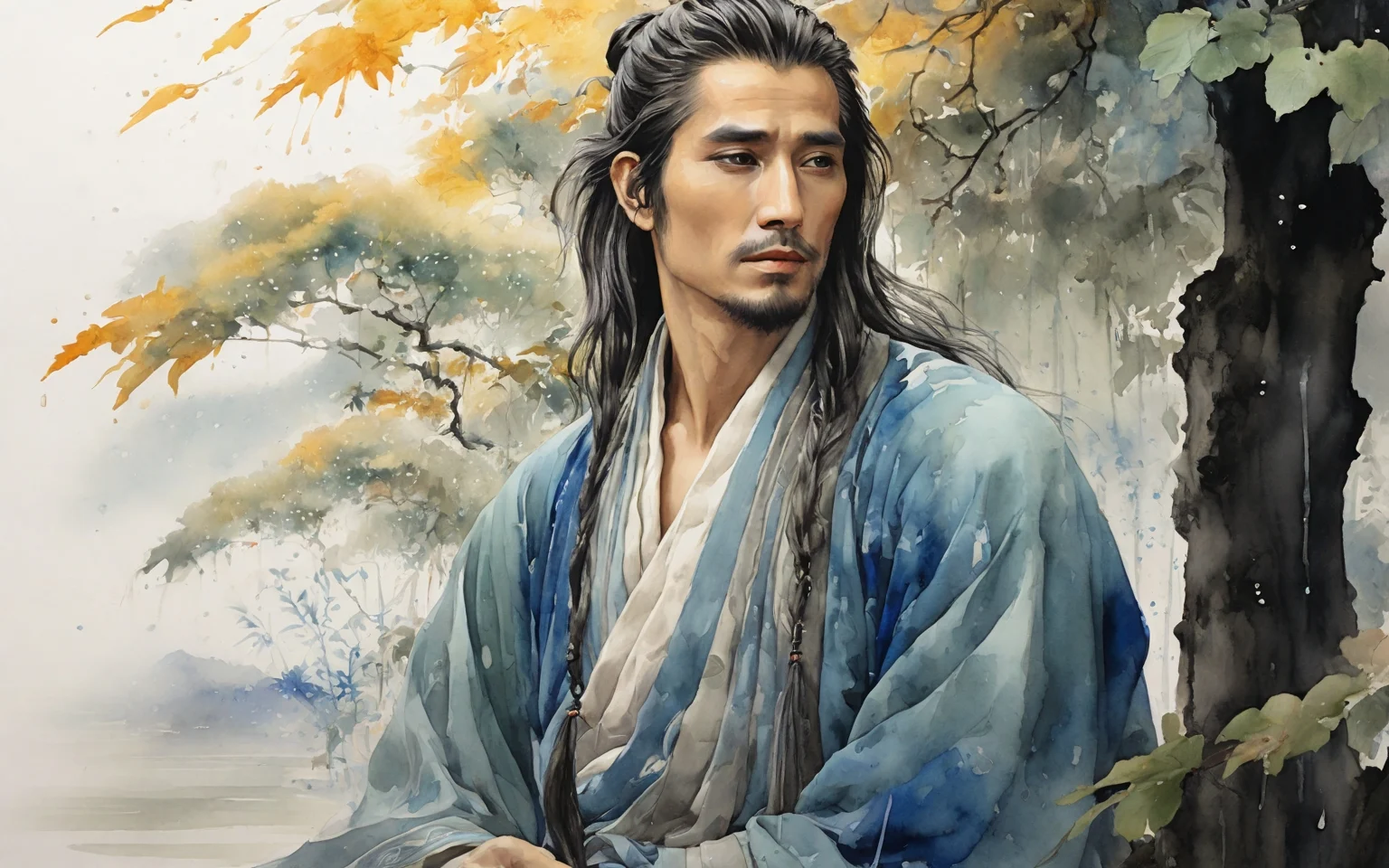
Du Fu (杜甫), 712 - 770 AD, was a great poet of the Tang Dynasty, known as the "Sage of Poetry". Born into a declining bureaucratic family, Du Fu had a rough life, and his turbulent and dislocated life made him keenly aware of the plight of the masses. Therefore, his poems were always closely related to the current affairs, reflecting the social life of that era in a more comprehensive way, with profound thoughts and a broad realm. In his poetic art, he was able to combine many styles, forming a unique style of "profound and thick", and becoming a great realist poet in the history of China.