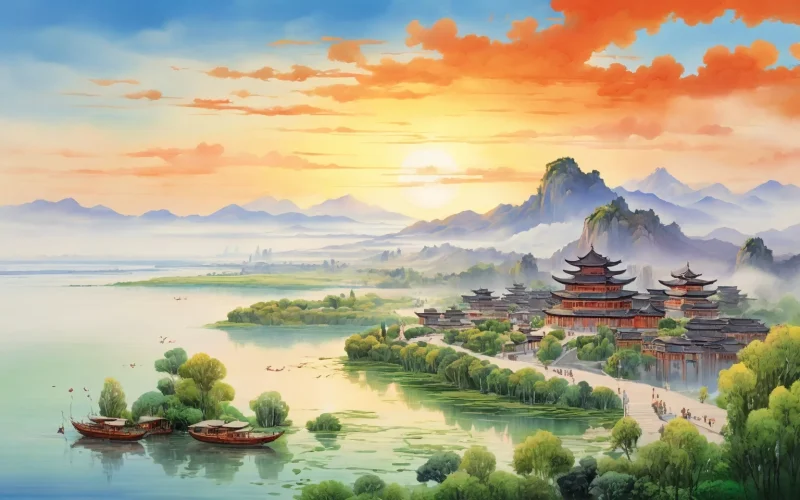




I had so long been troubled by official hat and robe
That I am glad to be an exile here in this wild southland.
I am a neighbour now of planters and reapers.
I am a guest of the mountains and woods.
I plough in the morning, turning dewy grasses,
And at evening tie my fisher-boat, breaking the quiet stream.
Back and forth I go, scarcely meeting anyone,
And sing a long poem and gaze at the blue sky.
Original Poem
「雨后晓行独至愚溪北池」
柳宗元
宿云散洲渚,晓日明村坞。
高树临清池,风惊夜来雨。
予心适无事,偶此成宾主。
Interpretation
This poem was composed during Liu Zongyuan's exile in Yongzhou and belongs to his series of poems on "Fool's Creek." After 810 AD, he acquired land west of the Xiao River, renamed Ran Creek to "Fool's Creek," and gradually developed the "Eight Fools" scenic spots, including Fool's Hill, Fool's Spring, Fool's Hall, Fool's Pavilion, and Fool's Pond. This landscape became his most important spiritual haven during his years of exile. The "Fool's Creek North Pond" in the title is one of the "Eight Fools." One early morning after rain, the poet came alone to the pond's edge. Seeing the night rain just cleared, lingering clouds dispersing, the dawn sun shining, tall trees overlooking the pond, and wind startling the rain from the leaves, a rare sense of peace and contentment arose within him. Thus, he wrote this short poem to record this momentary "harmony between guest and host."
Unlike Liu Zongyuan's more anguished and indignant poems, this piece is fresh and bright in tone, calm and serene in mood. The liveliness of "the wind startles the rain that fell by night" and the self-satisfaction of "here we meet by chance, as host and guest" reveal the moments of peace the poet found amidst his exiled life. However, the word "chance" also reminds us: this serenity is not the norm; it is merely a gift that descends occasionally. It is precisely this "fortuitousness" that makes the transient peace all the more precious.
First Couplet: "宿云散洲渚,晓日明村坞。"
Sù yún sàn zhōu zhǔ, xiǎo rì míng cūn wù.
Lingering clouds, on isles, on sandbars dissipate;
The dawning sun now brightens village homes.
The opening depicts the morning-after-rain scene with a broad perspective. "Lingering clouds" are the remnants of last night's clouds; on a morning after rain, they gradually scatter. "Dissipate on isles, on sandbars" captures the dynamic process of mist flowing and dispersing among the isles and banks. "The dawning sun now brightens village homes"—the first sunlight illuminates the thatched cottages of the mountain village. The word "brightens" conveys both the brightness of the sunlight, the clarity of the scene, and the illumination of the poet's own mood.
This couplet is buoyant in tone and expansive in conception. Clouds scatter, the sun rises, heaven and earth are clear—this is the unique freshness and clarity after rain. Standing by Fool's Pond, gazing upon this scene, the poet's heart seems cleansed by the morning light.
Second Couplet: "高树临清池,风惊夜来雨。"
Gāo shù lín qīng chí, fēng jīng yè lái yǔ.
Tall trees loom o'er the clear pool's glassy face;
The wind startles the rain that fell by night.
This couplet is the poetic core of the entire poem, intensely visual and dynamic. "Tall trees loom o'er the clear pool's glassy face" depicts stillness—trees are tall, the pond is clear, trees and pond face each other quietly, forming a serene picture. Then immediately, "The wind startles the rain that fell by night"—a gust of wind comes, startling the raindrops still clinging to the leaves and branches, causing them to fall, scattering into the pond. The word "startles" personifies the wind, as if the wind is intentional, deliberately disturbing the slumbering raindrops. The phrase "rain that fell by night" reminds the reader of last night's rain—it came, left its trace, and now, in the morning breeze, bids its final farewell.
This couplet uses movement to depict stillness; the lively disturbance of the raindrops by the wind sets off the tranquility of the surroundings. Without this wind, without these startled, falling drops, how silent the tall trees and the clear pond would be. It is precisely this touch of motion that makes the silence more palpable and fills the scene with vitality.
Third Couplet: "予心适无事,偶此成宾主。"
Yǔ xīn shì wú shì, ǒu cǐ chéng bīn zhǔ.
My mind, for now, from all affairs is free;
Here we meet by chance, as host and guest.
The final couplet shifts from scene to person, expressing the poet's present state of mind and insight. "My mind, for now, from all affairs is free"—the word "for now" indicates this leisure is not deliberately sought, but happens to occur at this moment, in this place, with a mind unburdened. "Here we meet by chance, as host and guest"—"chance" expresses the contingency of the encounter; the notion of "host and guest" elevates the relationship between person and scene to one of mutual appropriateness and equality.
Usually, we speak of "taking the scene as guest and oneself as host," but Liu Zongyuan says "become host and guest"—person and scene are mutual host and guest, reflecting and fulfilling each other. The tall trees, the clear pond, the startled falling raindrops are not passive objects of appreciation but existences meeting the poet as equals. This state of "harmony between guest and host" is precisely the poetic expression of the philosophical concept of "the unity of heaven and man" in Chinese thought. The words "for now" and "chance" also reveal subtle information: this leisure, this harmony, is not the常态, but a chance encounter. The poet knows well that more often, his mind is not "free of affairs," and on more mornings, he does not possess this leisure. Precisely because of this, this moment of peace is格外珍贵, worthy of being recorded in poetry.
Holistic Appreciation
This five-character ancient-style poem uses "a morning walk after rain" as its thread, unfolding a complete picture of the morning scene at Fool's Pond through the passage of time. The first couplet describes the distant view: clouds dispersing over isles and banks, the sun brightening village homes—a broad vista. The second couplet describes the near view: tall trees overlooking the pond, wind startling the night rain—a interplay of movement and stillness. The final couplet describes the state of mind: the mind momentarily free, guest and host in harmony—a fusion of feeling and scene.
The entire poem features simple, plain language and a bright, lively conception, standing out as unique among Liu Zongyuan's works. There is no anguished indictment, no indignant outcry, only appreciation for natural beauty and cherishing of a moment's peace. Yet it is precisely this "uniqueness" that allows us to see another facet of Liu Zongyuan's character—the man who, amidst "surviving a thousand deaths in exile," could still appreciate "the wind startl[ing] the rain that fell by night"; the man who, with a "shattered, desolate spirit," could still feel that "here we meet by chance, as host and guest." This sensitivity to beauty and passion for life, maintained even in adversity, is more moving than any direct protest.
Artistic Merits
- Harmony of Movement and Stillness, Each Enhancing the Other: The first couplet depicts stillness, the second movement. Using the dynamic of wind-startled raindrops to set off the serenity of the environment is a masterful technique.
- Vivid Diction, Lively Imagery: The word "startles" in "The wind startles the rain that fell by night" personifies the wind, imparting life to nature, creating a highly visual scene.
- Fusion of Feeling and Scene, Unity of Subject and Object: The final couplet's notion of "host and guest" describes the equal, mutual encounter between person and scene, embodying the philosophical realm of the unity of heaven and man.
- Simple Language, Profound Meaning: The entire poem uses not a single difficult or obscure word, yet contains deep insight into life and nature, revealing genuineness within plainness.
Insights
This poem first illuminates for us maintaining sensitivity to beauty amidst adversity. Exiled to Yongzhou, placed in a situation of "surviving a thousand deaths in exile," Liu Zongyuan could still walk alone to Fool's Pond on a morning after rain, could still admire the expansiveness of "lingering clouds, on isles, on sandbars dissipat[ing]," and could still be moved by the liveliness of "the wind startl[ing] the rain that fell by night." This keeping one's senses open amid suffering is the most powerful weapon against despair. It reminds us: no matter how difficult the circumstances, do not close your eyes and ears, do not stop feeling the world. Beauty is always there, waiting for us to discover it.
Secondly, the word "for now" in "予心适无事" leads us to contemplate the contingency and preciousness of a tranquil state of mind. Liu Zongyuan does not say "my mind is often free of affairs," but "for now… is free." This clarity makes him cherish this moment of peace all the more. It reveals to us: Inner tranquility is not a given; it is often merely a chance gift. Precisely because of this, when it comes, we must learn to pause, to fully feel it, to truly cherish it.
Looking deeper, the realm of "偶此成宾主" also prompts us to consider the relationship between humanity and nature. Liu Zongyuan does not assume the position of "host," does not treat nature as an object for appreciation, but "becomes host and guest" with it—treating it as an equal, mutually fulfilling. This humility and respect towards nature is especially worthy of learning in our present era dominated by anthropocentrism. It reminds us: we are not nature's masters, only its guests; and when we treat nature with the heart of a guest, nature will also treat us with the courtesy of a host.
Finally, the figure who "独至愚溪北池" is profoundly moving. He was alone, yet felt no loneliness; he was an exiled man, yet bore no resentment. He simply stood there quietly, watching the clouds scatter and the sun rise, watching the wind startle the rain, and then said softly: At this moment, my mind happens to be free of affairs, and happens to meet this scene. How good. This ability to find contentment in solitude, this capacity to meet the world with gentleness even in adversity, is the most precious spiritual legacy Liu Zongyuan leaves us. It teaches us: true freedom lies not in where we are, but in what our heart encounters.
Poem translator
Xu Yuanchong (许渊冲)
About the poet
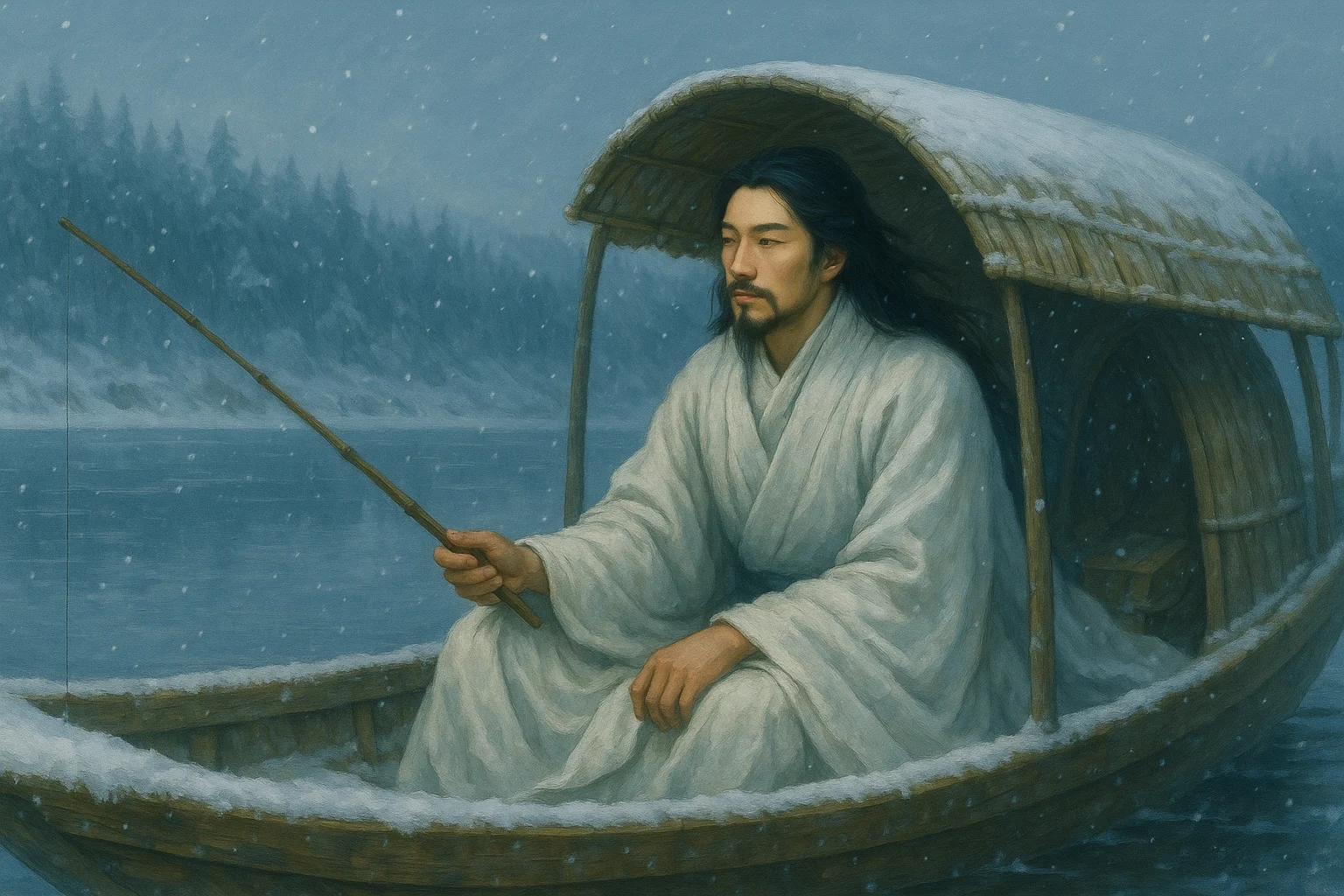
Liu Zongyuan (柳宗元), 773-819 A.D., a native of Yongji, Shanxi, was a progressive thinker, brilliant writer, and revolutionary statesman of the Tang Dynasty. Nineteen years before he was born, the An Shi Rebellion broke out, which dramatically changed the Tang Dynasty from prosperity to decline. The subsequent failure of the Yongzhen Reform was a historical tragedy that cut short Liu Zongyuan's political future, but made him one of the leading thinkers and literary figures of the Tang Dynasty.