


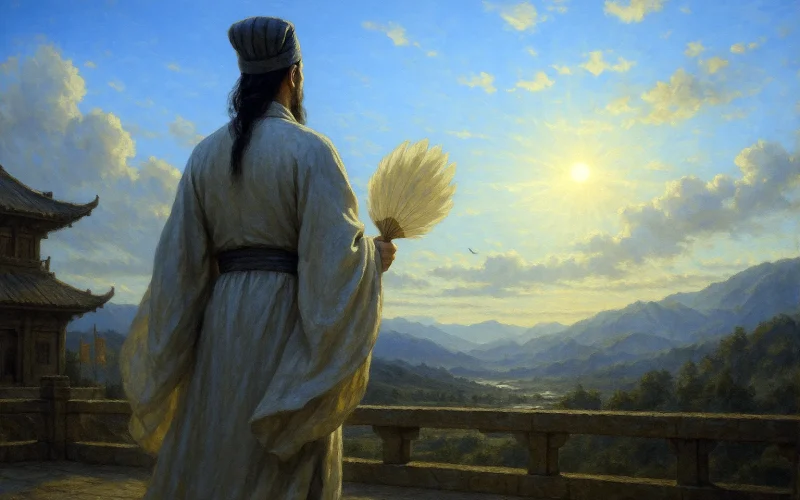
Zhuge's prestige transcends the earth;
There is only reverence for his face;
Yet his will, among the Three Kingdoms at war,
Was only as one feather against a flaming sky.
He was brother of men like Yi and Lu
And in time would have surpassed the greatest of all statesmen.
Though he knew there was no hope for the House of Han,
Yet he wielded his mind for it, yielded his life.
Original Poem
「咏怀古迹 · 其五」
杜甫
诸葛大名垂宇宙,宗臣遣像肃清高。
三分割据纡筹策,万古云霄一羽毛。
伯仲之间见伊吕,指挥若定失萧曹。
运移汉祚终难复,志决身歼军务劳。
Interpretation
This poem serves as the culminating masterpiece of Thoughts of Old Time and, like the third poem in the series, was composed in the autumn of 766 CE, during Du Fu's exile in Kuizhou. By this time, the poet was in his twilight years, plagued by poor health and drifting through the southwestern regions. Confronted with a declining nation fragmented by rebellious military governors, he personally visited the Temple of the Martial Marquis in Kuizhou to pay homage to the statue of Zhuge Liang. Zhuge Liang's loyalty, embodied in his commitment to "devote myself to the state until my heart ceases to beat," and the poignant tragedy of his "passing before his northern campaign could succeed," resonated profoundly with Du Fu, whose own life was marked by displacement and unfulfilled aspirations. This poem is not merely a tribute to a great historical figure; it represents a profound dialogue and spiritual resonance between a later poet and an ancient sage-minister within the hall of history.
First Couplet: “诸葛大名垂宇宙,宗臣遗像肃清高。”
Zhūgé dàmíng chuí yǔzhòu, zōngchén yíxiàng sù qīnggāo.
Zhuge's great name through all the universe shines clear; / His statue, revered statesman, stands in homage here.
The opening line resonates like a grand bell, with the phrase "through all the universe shines clear" bestowing upon Zhuge Liang a timeless significance that transcends eras, establishing the poem's tone of supreme reverence. The second line shifts from vast renown to the concrete act of contemplation. "Stands in homage here" describes not only the solemn appearance of the statue but also the poet's own awe and solemnity upon connecting with the spirit of this revered statesman. The movement from "shines clear" to "stands in homage" transitions from the abstract to the tangible, from the distant to the immediate, allowing veneration to flow forth powerfully.
Second Couplet: “三分割据纡筹策,万古云霄一羽毛。”
Sān fēn gējù yū chóucè, wàn gǔ yúnxiāo yì yǔmáo.
For tripartite rule his subtle plans were deeply laid; / Like a lone feather 'mid eternal clouds his fame will never fade.
This couplet summarizes Zhuge Liang's lifelong achievements and elevates them poetically. "His subtle plans were deeply laid" depicts the arduous and complex nature of his strategies, a realistic portrayal of history. "Like a lone feather 'mid eternal clouds" is an ultimate metaphorical tribute. By comparing Zhuge Liang to a single, ethereal feather, the poet lifts his accomplishments beyond mere historical facts, sublimating them into a spiritual symbol—both supremely lofty and uniquely isolated, carrying an air of unreachable pathos. The interplay of reality and metaphor creates an immortal line.
Third Couplet: “伯仲之间见伊吕,指挥若定失萧曹。”
Bózhòng zhī jiān jiàn Yī Lǚ, zhǐhuī ruò dìng shī Xiāo Cáo.
With Yi and Lü compared, his talent stands the test; / In strategy he Cao and Xiao surpassed, at his behest.
Using history's most outstanding ministers as a benchmark, this couplet establishes Zhuge Liang's supreme status in terms of both virtue and talent. "Stands the test" is the highest affirmation, while "surpassed" elevates him further. Du Fu's judgment is not a simplistic ranking but is based on a profound understanding: Zhuge Liang alone shouldered the crisis as the Han dynasty crumbled; the difficulty of his situation, the weight of his responsibility, and the comprehensive nature of his achievements (combining the talents of both a chancellor and a commander) indeed surpassed those of Xiao He and Cao Shen, who served in times of peace. This is the brushstroke of a historian who understands people and their times.
Fourth Couplet: “运移汉祚终难复,志决身歼军务劳。”
Yùn yí Hàn zuò zhōng nán fù, zhì jué shēn jiān jūnwù láo.
Though fortune from the House of Han had passed away, / His will was firm to die in harness, come what may.
This final couplet elevates the poem to a tragic and heroic climax. The first line acknowledges the cold reality of historical inevitability, admitting the irreversible decline of the Han dynasty's mandate. The second line celebrates the radiant force of human character, praising Zhuge Liang's unwavering resolve to devote himself utterly until death. Within this profound conflict between impersonal fate ("fortune") and personal conviction ("will"), Zhuge Liang's strength of character is revealed in its purest and most stirring form. The phrase "to die in harness" is deceptively simple, yet it contains boundless depths of emotion and reverence.
Holistic Appreciation
This poem represents the pinnacle of Du Fu's historical and reflective poetry. Its power lies in the perfect unity of historical insight, poetic sentiment, and tribute to character. The poet does not get bogged down in narrating specific historical details but, with a masterful brush, directly addresses the core of Zhuge Liang's spirit and his historical stature. The poem's structure is rigorous, its emotion abundant: the first couplet introduces his timeless fame; the second summarizes his achievements, metaphorically elevating him to the clouds; the third assesses his talent and virtue, placing him at the peak of history's worthy ministers; and the final couplet reveals his tragic fate, completing the deepest, most solemn tribute to this tragic hero within the paradox of "fortune" and "will."
Most importantly, Du Fu pours all his own political ideals and life sentiments into the figure of Zhuge Liang. Are not Zhuge Liang's "revered stature," his "subtle plans," and his "will…to die in harness" reflections of the very character Du Fu pursued throughout his life and the real-world dilemmas he faced? Every line of praise in the poem echoes Du Fu's own ideal to "make my sovereign surpass the sage-kings" and his lament of "wandering between heaven and earth in the southwest." This is not merely historical reflection; it is personal expression. It is remembrance of the past, but even more, it is a mirror of the self.
Artistic Merits
- Grand and Vast Conception, Exceptional Opening and Closing
The opening line, "through all the universe," possesses a cosmic scope, while the closing line, "to die in harness," lands on a specific, tragic detail. The interplay of grandeur and subtlety creates the poem's majestic and somber overall atmosphere. - Uniquely Ingenious Metaphor, Elevating the Realm
"Like a lone feather 'mid eternal clouds" is a stroke of genius. Using the lightness of a "feather" to metaphorize the weight of achievement and character, and the lofty distance of "eternal clouds" to symbolize transcendent spiritual stature, the metaphor itself creates an ethereal, unattainable aesthetic realm, thoroughly poeticizing and mythologizing the figure of Zhuge Liang. - Skillful Use of Allusion and Comparison, Presenting Superior Judgment
The comparisons with Yi Yin, Lü Shang, Xiao He, and Cao Shen are not simplistic rankings but establish Zhuge Liang's uniqueness within a specific historical context. The allusions are precise and insightful, demonstrating Du Fu's profound historical insight and exceptional judgment. - Intense Emotion, Powerful Expression
Feelings of reverence, admiration, and tragic lament build layer upon layer throughout the poem, finally crystallizing in the four characters "will…to die in harness," each word carrying immense weight. Du Fu expresses deep, fervent emotion through highly condensed, restrained, yet potent language, creating tremendous emotional tension.
Insights
The greatest insight this work offers concerns "the posture of humanity before historical fate." The story of Zhuge Liang is an eternal parable of "persisting in a task despite knowing it may be impossible." Du Fu deeply understood that Zhuge Liang's greatness lay precisely in his transcendence of utilitarian calculations of success or failure. Before the inevitability of "fortune from the House of Han had passed away," he still chose the ultimate commitment of "will…to die in harness."
It teaches us that the value of a life is not solely measured by the success or failure of its outcome. The very loyalty and dedication that exhausts all efforts for a lofty ideal, unwavering until death, can itself transcend time, illuminate future generations, and become an immortal emblem within a nation's spirit. By celebrating Zhuge Liang, Du Fu also found spiritual solace and strength for himself and for all who persist in their ideals amidst adversity and keep watch for light in the darkness. In a world filled with uncertainty, this commitment of "will" and devotion unto "harness" remains the most precious radiance within humanity.
Poem translator
Kiang Kanghu
About the poet
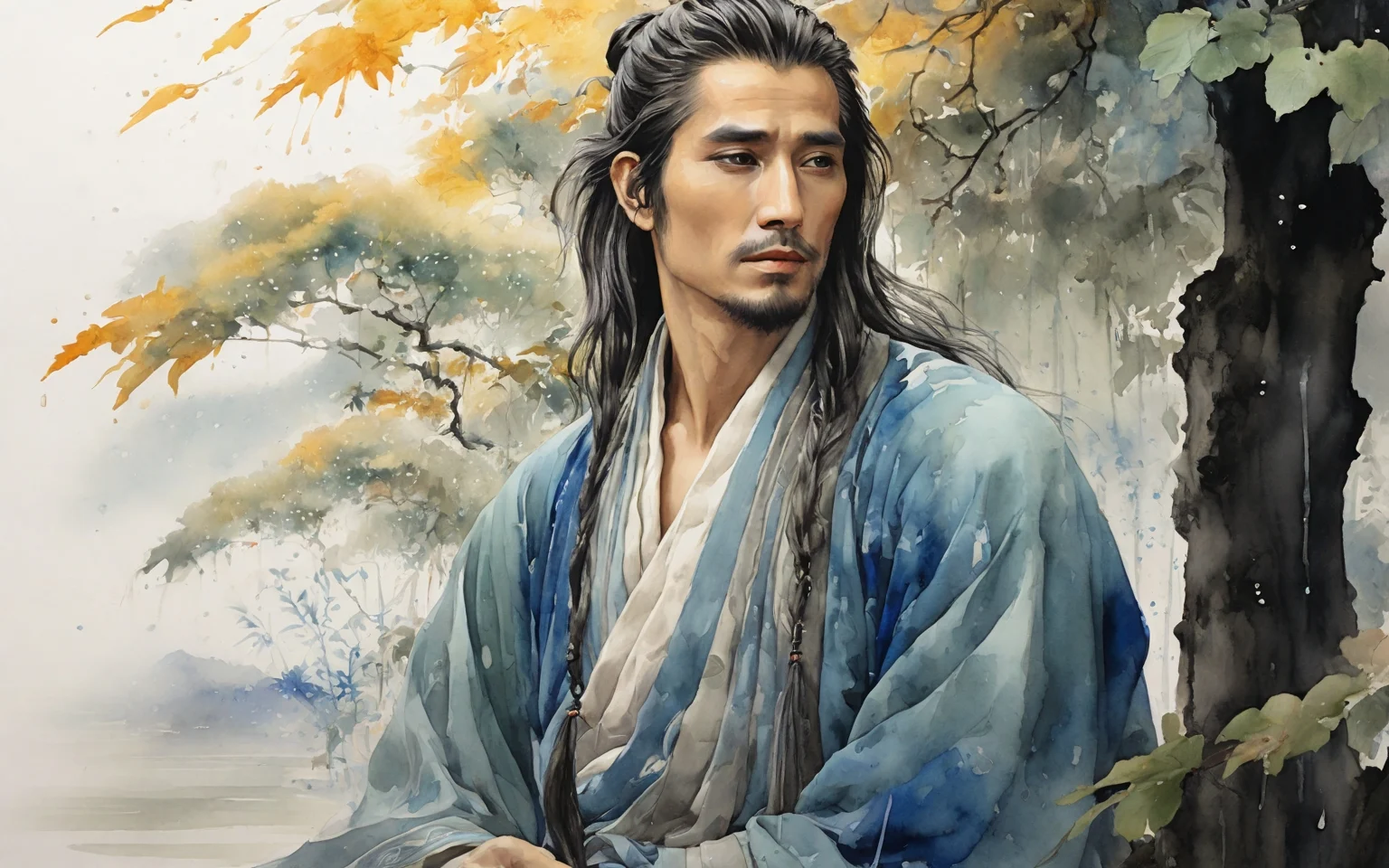
Du Fu (杜甫), 712 - 770 AD, was a great poet of the Tang Dynasty, known as the "Sage of Poetry". Born into a declining bureaucratic family, Du Fu had a rough life, and his turbulent and dislocated life made him keenly aware of the plight of the masses. Therefore, his poems were always closely related to the current affairs, reflecting the social life of that era in a more comprehensive way, with profound thoughts and a broad realm. In his poetic art, he was able to combine many styles, forming a unique style of "profound and thick", and becoming a great realist poet in the history of China.