


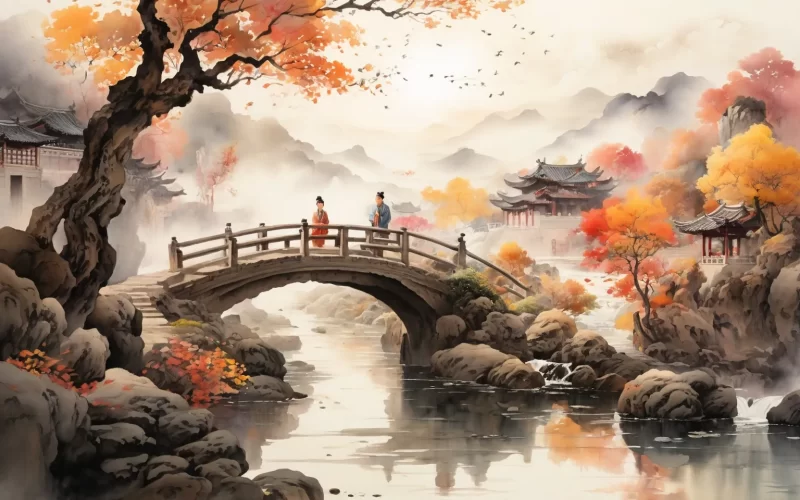
Ten thousand ranges and valleys approach the Jing Gate
And the village in which the Lady of Light was born and bred.
She went out from the purple palace into the desertland;
She has now become a green grave in the yellow dusk.

Her face ! Can you picture a wind of the spring?
Her spirit by moonlight returns with a tinkling
Song of the Tartars on her jade guitar,
Telling her eternal sorrow.
Original Poem
「咏怀古迹 · 其三」
杜甫
群山万壑赴荆门, 生长明妃尚有村。
一去紫台连朔漠, 独留青冢向黄昏。
画图省识春风面, 环佩空归月下魂。
千载琵琶作胡语, 分明怨恨曲中论。
Interpretation
This poem is the third in Du Fu's series Thoughts of Old Time, composed in the autumn of 766 CE, the first year of the Dali era under Emperor Daizong, while the poet was living in exile in Kuizhou. In his later years, Du Fu drifted through the southwestern regions, plagued by ill health and failing to realize his ambitions, against the backdrop of a declining nation fractured by rebellious military governors. Gazing from the majestic mountains and gorges of the Three Gorges toward the lands of Jing and Chu, his thoughts turned to Wang Zhaojun, who was born there. Her fate—sent far away to a foreign land, her regret echoing through millennia—resonated deeply with his own experience of "wandering between heaven and earth in the southwest." Thus, using Zhaojun's story, the poem expresses the poet's own solitude and indignation, and projects his anxieties for his country.
First Couplet: “群山万壑赴荆门,生长明妃尚有村。”
Qún shān wàn hè fù Jīngmén, shēngzhǎng Míngfēi shàng yǒu cūn.
Mountains on mountains, gorges on gorges race toward Jingmen's walls; / There, 'tis said, in her own village still, the fair Bright Lady dwells.
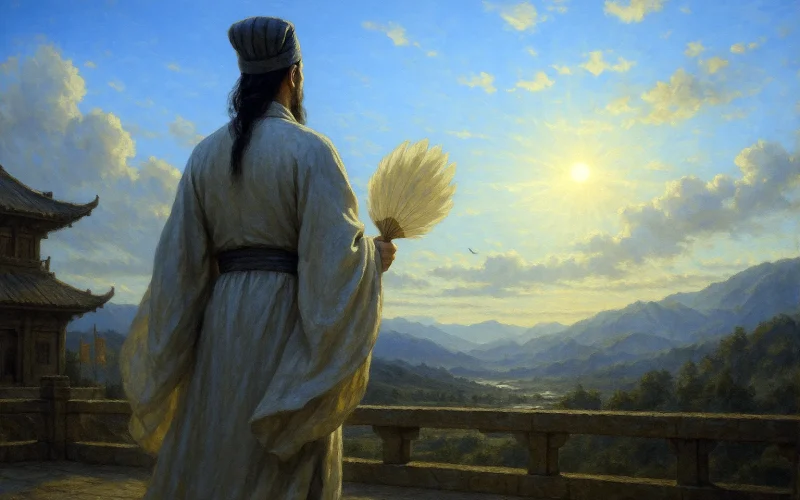
The poem opens with a grand, sweeping landscape, like an ink-wash panorama. The word "race" transforms stillness into motion, imbuing the mountains with a rushing force. This captures not only the dramatic topography of the Three Gorges but also seems to echo the irresistible tide of history in Zhaojun's fate. Against this vast backdrop, the phrase "still dwells" lightly introduces the human element, linking the historical figure across time and space with the tangible scene before the poet. Amidst the immensity, there is intimacy; within the grandeur, lies pathos.
Second Couplet: “一去紫台连朔漠,独留青冢向黄昏。”
Yī qù zǐ tái lián shuò mò, dú liú qīng zhǒng xiàng huánghūn.
She left the Purple Palace, bound for the vast desert; / Alone, her verdant tomb faces the twilight, bereft.
This couplet summarizes Zhaojun's life with immense force. "She left" and "Alone… faces" form a stark contrast, concisely presenting the irrevocable turn and final resting place of a personal destiny. "The Purple Palace" (the Han court) and "the vast desert" (the barbarian land), the finality of "left" and the endlessness implied by "bound for," encapsulate a vast geographical and cultural leap, a lifelong isolation. "Her verdant tomb faces the twilight" is an image both poignantly beautiful and eternal. The lone tomb faces not just dusk, but also the wordless desolation of history. Zhaojun's tragic life is crystallized in these ten words.
Third Couplet: “画图省识春风面,环佩空归月下魂。”
Huàtú shěng shí chūnfēng miàn, huánpèi kōng guī yuè xià hún.
By her portrait the emperor learned her face, springtide-fair; / Her soul in vain returned, with tinkling girdle gems, 'neath moonlight there.
This delves into the roots of the tragedy, the brushstroke aimed directly at history. "By her portrait… learned" directly criticizes the emperor's folly and the manipulation by petty men, which allowed the fate of a peerless beauty to be decided by mere pigment. It is a profound indictment of talent buried and truth obscured. "Her soul in vain returned" is the poem's most heart-wrenching imagination: denied return in life, even her soul's homecoming is futile. The tinkling of girdle gems contrasts with the silent moonlight, the soul's form is intangible—this line masterfully blends the real and the imagined, expressing Zhaojun's unwavering longing for her homeland and her eternal regret.
Fourth Couplet: “千载琵琶作胡语,分明怨恨曲中论。”
Qiān zǎi pípá zuò hú yǔ, fēnmíng yuànhèn qǔ zhōng lùn.
For a thousand years her lute has sung a Tartar strain; / Clearly her grievous sorrow is told in its refrain.
The poem concludes with music that transcends time, its resonance lingering. "For a thousand years" places the personal tragedy within the long river of history. "Her lute has sung a Tartar strain" is both the cultural symbol of Zhaojun's journey beyond the frontier and the artistic embodiment of her tragic fate. The word "grievous sorrow" points to the poem's central theme. This sorrow belongs not only to Zhaojun's personal plight but also to the timeless solitude and indignation of all whose talent remained unrecognized and whose fate was one of drift. Through the lute's "strain," Du Fu completes a dual lament—for history and for personal destiny.
Holistic Appreciation
The poem begins with a landscape invocation and ends with music. The middle four lines sweep like a historian's brush, sketching the map of Zhaojun's fate. Du Fu does not settle for simple sympathy for a beauty ill-fated in life. Instead, he examines Zhaojun's experience within the multiple tensions between individual and era, beauty and political machination, Han palace and barbarian dust, life's separation and death's return, granting her tragedy profound historical and philosophical depth.
Most importantly, the poet skillfully weaves in his own sense of life's journey. Are not Zhaojun's "leav[ing] the Purple Palace" and "fac[ing] the twilight" also reflections of Du Fu's own "abandoning office" and "drift[ing]"? Was Zhaojun sent afar because her true face was unseen "By her portrait," just as Du Fu was demoted for his frank remonstrance? The "grievous sorrow… told in its refrain" is both Zhaojun's lament and Du Fu's own bitterness over unrecognized talent and his grief for the times. This technique of "singing of the ancients, yet fully revealing one's own character and feelings" represents the highest achievement of Du Fu's historical poetry.
Artistic Merits
- Majestic Opening, Resonant Closing
The first couplet opens with dynamic landscape, grand and imposing. The final couplet concludes with the lingering notes of a lute, sorrowful and far-reaching. The opening and closing together form a complete cycle of意境, moving from vast space to deep time, embodying the characteristic restrained and powerful style of Du Fu's poetry. - Exquisite Parallelism with Flowing Vitality
The two middle couplets exhibit extremely precise parallelism (e.g., "She left" vs. "Alone… faces"; "By her portrait" vs. "Her soul"). Yet within this formal rigor, there is fluidity; within the gravity, deep feeling—never rigid or stagnant. This demonstrates Du Fu's masterful command of the regulated verse form. - Concentrated Imagery, Profound Symbolism
Images like "the Purple Palace," "verdant tomb," "portrait," "girdle gems," and "lute" are highly symbolic, pointing respectively to the court, the frontier, slander and obscurity, the faithful soul, and cultural clash. They carry rich historical and cultural meaning within limited lines. - History and Judgment Interwoven, Reason and Emotion Combined
The poem contains narration of historical fact ("She left the Purple Palace"), analysis of historical cause ("By her portrait… learned"), and deep lament based on human nature ("grievous sorrow is told"). It achieves a perfect unity of historical insight, poetic sentiment, and philosophical reflection.
Insights
This poem is not merely a masterpiece of reflecting on the past to express personal grief. It offers a profound perspective for understanding the relationship between history and the individual. It tells us: Historical tragedy is often the product of systemic flaws converging with the contingency of individual fate. Zhaojun's "grievous sorrow" stemmed from a structural injustice—an individual's worth (her "springtide-fair" face) was obscured and distorted by a corrupt mechanism (the "portrait").
Through Zhaojun's story, Du Fu poses an eternal question to later generations: How can a society truly "learn" to recognize its talent? When personal ability and ambition conflict with the limitations of the age and the folly of power, how should one live? The poem offers no answer. Yet, with the eternal echo of the "lute [that] has sung a Tartar strain," it warns us to look squarely at those faces buried and those youths betrayed by history. In our own time, it urges us to strive to let every "springtide-fair" countenance be seen and cherished with sincerity. This is the oasis of humanistic care that Du Fu, using the ancient's cup, irrigates for generations to come.
Poem translator
Kiang Kanghu
About the poet
Du Fu (杜甫), 712 - 770 AD, was a great poet of the Tang Dynasty, known as the "Sage of Poetry". Born into a declining bureaucratic family, Du Fu had a rough life, and his turbulent and dislocated life made him keenly aware of the plight of the masses. Therefore, his poems were always closely related to the current affairs, reflecting the social life of that era in a more comprehensive way, with profound thoughts and a broad realm. In his poetic art, he was able to combine many styles, forming a unique style of "profound and thick", and becoming a great realist poet in the history of China.