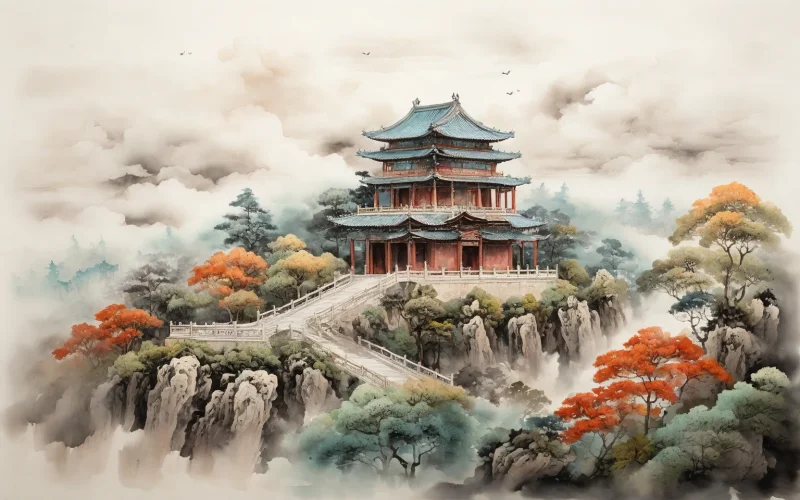



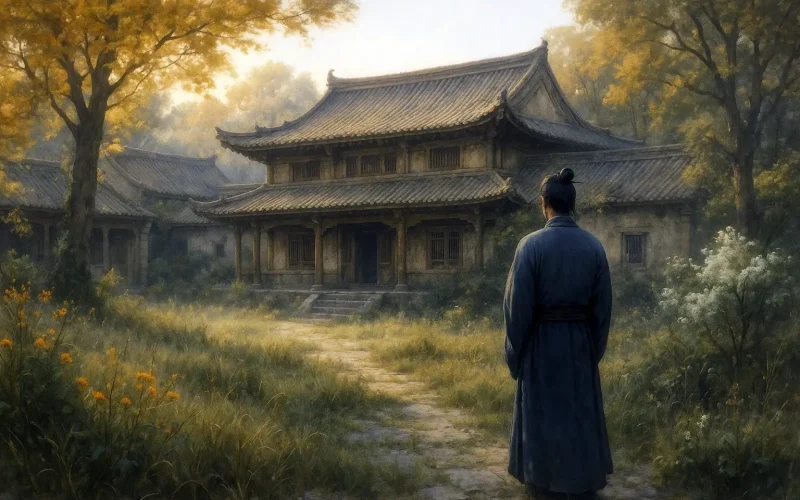
When leaves shiver and fall, I see the poet drear;
Gallant and elegant, he is my master dear.
Looking back a thousand springs, can I not shed tears?
Desolate for long, we are not of the same years.

His autumn song's left in his old home by the stream.
Did clouds bring showers for flowers in the king's dream?
Even the royal palace falls now in decay,
The boatman points to the ruins in doubt today.
Original Poem
「咏怀古迹 · 其二」
杜甫
摇落深知宋玉悲,风流儒雅亦吾师。
怅望千秋一洒泪,萧条异代不同时。
江山故宅空文藻,云雨荒台岂梦思。
最是楚宫俱泯灭,舟人指点到今疑。
Interpretation
This poem was composed in the autumn of 766 CE, the first year of the Dali reign under Emperor Daizong, while Du Fu was living in displacement in Kuizhou. The poet was by then in the final stage of his life. Visiting the former residence of the Chu poet Song Yu in Guizhou, he not only paid homage to this earlier master of verse but also recognized in Song Yu the perennial predicament of himself—and indeed of all talented scholars throughout history. The poem rises above ordinary nostalgia, becoming a profound spiritual dialogue and a resonant convergence of fate across the centuries.
First Couplet: “摇落深知宋玉悲,风流儒雅亦吾师。”
Yáo luò shēn zhī Sòng Yù bēi, fēngliú rúyǎ yì wú shī.
Falling leaves—I fully understand the sorrow of Song Yu; / Graceful and cultivated, he remains forever my teacher, too.
The opening intimately connects the poet’s immediate life experience (“falling leaves” depict the autumnal scene and metaphorically suggest his own late years of wandering) with the emotional legacy of the historical figure (the “autumn grief” expressed in Song Yu’s Nine Arguments). The phrase “I fully understand” is no casual remark; it signifies a resonance of souls born of shared destinies—unfulfilled talent and a life of desolate wandering. “Graceful and cultivated” succinctly captures Song Yu’s personal bearing and literary refinement, while “forever my teacher” solemnly declares Du Fu’s conscious placement of himself within this literary predecessor’s spiritual lineage, establishing the poem’s tone of dignified yet intimate lyricism.
Second Couplet: “怅望千秋一洒泪,萧条异代不同时。”
Chàng wàng qiānqiū yī sǎ lèi, xiāotiáo yì dài bù tóng shí.
Gazing sadly across a thousand autumns, my tears freely start; / Though born in different ages, we share the same desolate heart.
This couplet brings the empathetic resonance to its peak. “Gazing sadly across a thousand autumns” is a contemplation that spans both space and time. “My tears freely start” is deeply moving: these tears are shed for Song Yu, for himself, and for all “desolate” scholars across the ages. “Born in different ages” superficially marks a temporal separation, but the shared condition of “desolate” utterly demolishes this barrier, proclaiming the timeless nature of their spiritual plight. In this moment, Du Fu achieves a millennial identification with Song Yu.
Third Couplet: “江山故宅空文藻,云雨荒台岂梦思。”
Jiāngshān gù zhái kōng wén zǎo, yúnyǔ huāng tái qǐ mèng sī.
These hills and streams, his former home—empty fame for fine prose; / The lore of clouds and rain around that ruined terrace—was that a mere romantic fantasy, who knows?
The focus shifts from direct lyricism to deep reflection and defense. “Empty fame for fine prose” is filled with regret: later generations merely admire the ornate diction of Song Yu’s writings, overlooking the profound allegory and intent within. The following line mounts a defense of Song Yu’s famous Rhapsody on Gaotang: the often-retold tale of “clouds and rain” and the “ruined terrace,” in Du Fu’s view, was by no means simple romantic fancy (“a mere romantic fantasy”), but a parable rich with political allegory (serving as an admonition to the king of Chu). Du Fu’s argument serves to clear Song Yu’s name and speak for all misunderstood literati, while also hinting at his own anxiety concerning the future reception of his work.
Fourth Couplet: “最是楚宫俱泯灭,舟人指点到今疑。”
Zuì shì Chǔ gōng jù mǐnmiè, zhōurén zhǐdiǎn dào jīn yí.
Most telling is how all the palaces of Chu have vanished without a trace; / Where boatmen point and speculate, doubt lingers in that place.
The concluding couplet closes with the stark reality of history, lifting the poem to a philosophical plane. In contrast to the “former home” associated with “empty fame for fine prose,” the “palaces of Chu,” symbols of worldly power, have utterly “vanished without a trace.” The scene “boatmen point and speculate, doubt lingers” is profoundly ironic: the actual monuments of history (the Chu palaces) are lost, while the literary creations born of a scholar’s spirit (the lore of clouds and rain) continue to circulate, albeit often misunderstood. This reveals the transience of material power versus the relative endurance of spiritual creation (even when misinterpreted), deepening the poem’s meditation on historical memory and cultural legacy.
Holistic Appreciation
This poem stands out within Du Fu’s Reflections on Historic Sites series for its exceptional philosophical depth and lyrical intensity. It perfectly illustrates the characteristic progression of Du Fu’s historical meditation: from empathetic resonance sparked by the scene (“I fully understand the sorrow”), to trans-temporal identification (“we share the same desolate heart”), to cultural reflection defending the ancients (“was that a mere romantic fantasy”), and finally culminating in a lament on historical oblivion and the persistence of spirit (“vanished without a trace,” “doubt lingers”).
The poem orchestrates multiple dialogues: between Du Fu and Song Yu, between literature and history, between truth and legend. The poet is not merely honoring Song Yu; he is also, through Song Yu’s example, giving voice to his own anguish concerning the unrecognized scholar, the value of writing, and the caprices of historical memory. The emotion throughout is profound and complex, the discourse incisive yet nuanced, showcasing the consummate artistry and intellectual maturity of Du Fu’s later poetry.
Artistic Merits
- Seamless Fusion of Emotion, Scene, History, and Discourse: The poem masterfully interweaves autumnal melancholy, nostalgic feeling, historical inquiry, and literary debate, allowing its eight lines to bear exceptionally rich layers of meaning.
- Construction of a Trans-Temporal Lyrical Voice: Through phrases like “I fully understand,” “forever my teacher,” and “share the same desolate heart,” the poet consciously integrates himself into Song Yu’s spiritual tradition, creating a lyrical model of “kindred spirits across generations.”
- Poetic Expression of Critical Reappraisal: The interpretation of the “clouds and rain” lore (“was that a mere romantic fantasy”) constitutes, in effect, astute literary criticism. Using poetic language to defend an ancient writer, it demonstrates remarkable originality and insight.
- Effective Use of Contrast and Irony: The contrast between the “former home” and the “vanished palaces,” the juxtaposition of the “empty” literary fame and the lingering “doubt” of popular lore, powerfully illuminate the complex relationship between culture, power, and how history is remembered.
Insights
This work demonstrates how a truly great mind can traverse time to find spiritual companions in history’s echo. Du Fu’s “full understanding” of Song Yu’s grief represents a profound resonance that transcends personal fortune, rooted in a deep comprehension of a plight shared by the talented across eras. It teaches us that cultural transmission involves not just studying the words of the past, but comprehending the spiritual struggles and aspirations that lie behind them.
Furthermore, the lament that the “palaces have vanished” while the “fine prose” endures (even if misunderstood) prompts us to reflect: What truly possesses greater vitality in the flow of time? Is it ephemeral power and majesty, or those spiritual and literary creations that, however they may be received, continue to carry the weight of human emotion and thought? The poem ultimately confronts an eternal question: In the face of historical oblivion, how do literature and thought create meaning and leave a trace of individual existence? Through this millennial dialogue with Song Yu, Du Fu provides his own enduring answer.
Poem translator
Xu Yuanchong (许渊冲)
About the poet
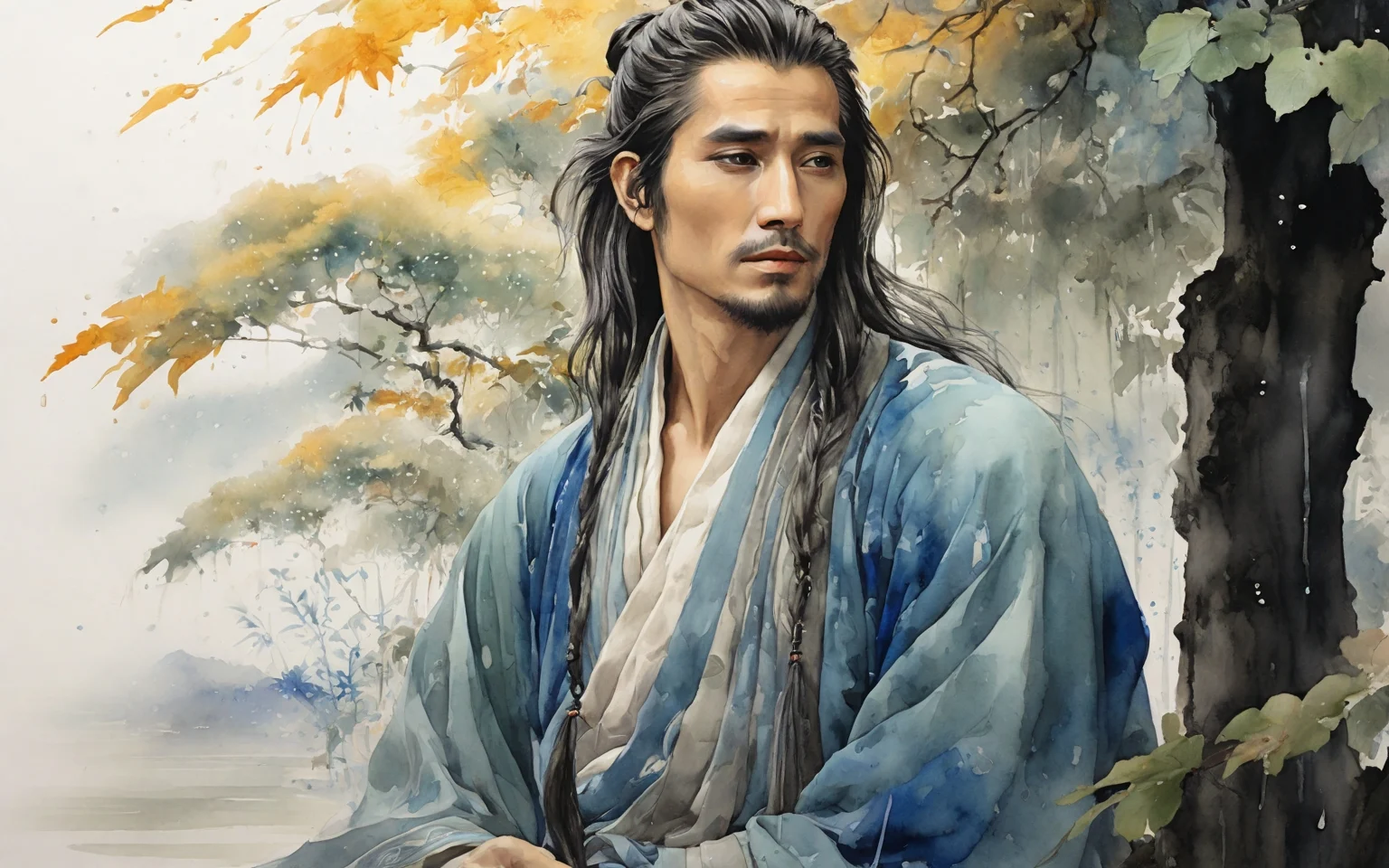
Du Fu (杜甫), 712 - 770 AD, was a great poet of the Tang Dynasty, known as the "Sage of Poetry". Born into a declining bureaucratic family, Du Fu had a rough life, and his turbulent and dislocated life made him keenly aware of the plight of the masses. Therefore, his poems were always closely related to the current affairs, reflecting the social life of that era in a more comprehensive way, with profound thoughts and a broad realm. In his poetic art, he was able to combine many styles, forming a unique style of "profound and thick", and becoming a great realist poet in the history of China.