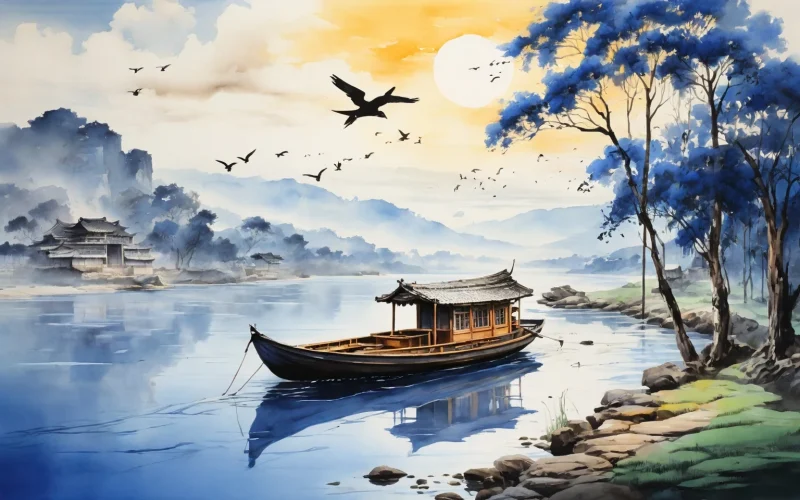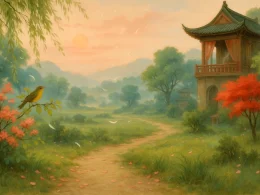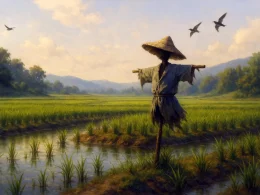




Soughing, the cool breeze blows;
My wooded dell clean grows.
It drives smoke off the rill,
Rolls up mist over the hill,
Leaves no trace when we part,
And moves as if moved at heart.
When sunset calms the scene,
Hear the song of pines green.
Original Poem
「咏风」
王勃
肃肃凉风生,加我林壑清。
驱烟寻涧户,卷雾出山楹。
去来固无迹,动息如有情。
日落山水静,为君起松声。
Interpretation
This poem is a work by the Early Tang poet Wang Bo, using an object to express his ideals (tuō wù yán zhì). Wang Bo, renowned for his talent from aouth, is ranked alongside Yang Jiong, Lu Zhaolin, and Luo Binwang as one of the "Four Paragons of the Early Tang." However, his life was marked by exceptional talent and ill fortune, with a bumpy official career. He was expelled from the court of the Prince of Pei for a satirical piece, Proclamation Against the Prince of Ying’s Cocks, and later sentenced for killing a government slave, an offense that led to his father’s banishment to Jiaozhi. This poem was likely composed during a period of career frustration and wandering in the Shu region. At that time, his talents went unrecognized, and he found no path to serve the state. Yet, in his Preface to the Pavilion of Prince Teng, he still wrote the impassioned lines, "无路请缨,等终军之弱冠;有怀投笔,慕宗悫之长风" (wú lù qǐng yīng, děng Zhōng Jūn zhī ruòguàn; yǒu huái tóu bǐ, mù Zōng Què zhī chángfēng, having no chance to request a cord to bind the enemy, I am like Zhong Jun at his capping age; bearing the ambition to cast aside my brush, I admire Zong Que’s long wind), revealing a heart that, despite setbacks, still held firm to its aspiration of aiding the world.
In this poem, the poet uses the pure wind to convey his aspirations. That "肃肃凉风" (sù sù liáng fēng, soughing, cool wind), passing through forests and ravines, driving away smoke and rolling up mist, comes and goes without trace yet seems full of feeling in its movement and stillness; as the sun sets and mountains and waters grow quiet, it again "为君而起松声" (wèi jūn ér qǐ sōng shēng, for you, stirs the sound of pines), sending forth heavenly music. This wind is both the breath of nature and the embodiment of the poet’s ideal—selfless, asking for nothing, silently dedicating itself, bringing coolness and solace to all things, yet never claiming credit, never speaking of weariness. Using the wind as a metaphor for himself, Wang Bo entrusted his ideals of "aiding the world and benefiting the people" (jì shì wéi mín) and his character of "seeking no fame or merit" (bù wèn gōngmíng) entirely to this formless, traceless, yet omnipresent wind.
First Couplet: “肃肃凉风生,加我林壑清。”
Sù sù liáng fēng shēng, jiā wǒ lín hè qīng.
Soughing, the cool wind arises, lending clarity to my forests and ravines.
The poem opens with "肃肃" (sù sù, soughing/rustling) imitating the sound of the wind, carrying both an auditory chill and a tactile coolness. The three words "凉风生" (liáng fēng shēng, cool wind, arise) describe the dynamic process of the wind coming into being, from nothing to something, from far to near. The next line, "加我林壑清" (jiā wǒ lín hè qīng, add/for, me, forests/ravines, clarity), uses the word "加" (jiā, to add/lend) with marvelous effect—the wind does not blow passively; it actively "gives" or "lends," bestowing clarity and coolness upon the forests and ravines. This "我" (wǒ, I/me) refers both to the poet himself and, by extension, to all things in the mountains and forests. With his first brushstroke, the poet endows the wind with an active character and a spirit of selfless giving.
Second Couplet: “驱烟寻涧户,卷雾出山楹。”
Qū yān xún jiàn hù, juǎn wù chū shān yíng.
It drives away smoke as if seeking dwellings by the stream; it rolls up the mist, emerging past mountain cottages.
This couplet makes the wind’s dynamics concrete and personifies it. "驱烟" (qū yān, drive away smoke) and "卷雾" (juǎn wù, roll up mist)—these two verbs depict the wind’s power; it is not weak but capable of dispelling smoke and scattering fog. "寻涧户" (xún jiàn hù, seek, ravine/stream, dwelling) and "出山楹" (chū shān yíng, emerge, mountain, pillar/cottage) endow the wind with human action—it seems to actively seek out dwellings in the mountains, delivering freshness to those living in seclusion by streams and among hills. This wind is no longer a blind force of nature but becomes a purposeful, feeling spirit, silently caring for every corner of the human world. The poet’s concern for the people’s hardships is subtly implied herein.
Third Couplet: “去来固无迹,动息如有情。”
Qù lái gù wú jì, dòng xī rú yǒu qíng.
Its coming and going inherently leave no trace, yet in its movement and stillness, it seems full of feeling.
This couplet shifts from concrete description to abstract reflection, key to the poem’s expression of ideals through an object. "去来固无迹" (qù lái gù wú jì, go come, inherently, without, trace) describes the wind’s nature—it is formless, traceless, coming and going unseen, unknown. "动息如有情" (dòng xī rú yǒu qíng, move/still, as if, have, feeling) then turns the brush, using the word "如" (rú, as if) to highlight the poet’s subjective perception—though it is inherently without feeling, in the poet’s eyes, its every stirring, every stillness, seems filled with care and solace for humanity. These two words, "有情" (yǒu qíng, have feeling/be sentient), are precisely the "诗眼" (shī yǎn, poetic eye) of the entire poem: the wind is inherently without feeling, but the poet has feeling; the wind is inherently without intent, but the poet has intent. Wang Bo projects his own emotions onto the wind, making it the embodiment of his ideal.
Final Couplet: “日落山水静,为君起松声。”
Rì luò shān shuǐ jìng, wèi jūn qǐ sōng shēng.
The sun sets, mountains and waters grow still; for you, it stirs the sound of pines.
The final couplet concludes feeling with scene, leaving a lasting resonance. "日落山水静" (rì luò shān shuǐ jìng, sun, set, mountain water, quiet) describes the twilight hour, as all things fall silent, and heaven and earth grow tranquil. "为君起松声" (wèi jūn qǐ sōng shēng, for, you, stir, pine, sound) then, within this stillness, suddenly brings forth the sound of wind in the pines—the sound of the wind passing through the pine forest, the heavenly music the wind plays "为君" (wèi jūn, for you). This "君" (jūn, you, honorific) refers both to the poet himself and, by extension, to all people in the world in need of solace. During the day, the wind drives smoke and rolls mist, bringing coolness; at dusk, the wind again stirs the sound of pines, keeping loneliness company. No matter the time or place, the wind is always silently giving, asking for nothing in return. These two words, "为君" (wèi jūn, for you), push the wind’s "有情" (sentience) to its extreme—it does not exist passively but actively exists "for" others.
Holistic Appreciation
This is an excellent work among Wang Bo’s poems expressing ideals through objects. The entire poem, eight lines and forty characters, uses chanting of the wind in name but writing of ideals in substance, merging the natural attributes of the wind with the ideal character of a person, revealing the poet’s noble sentiment of maintaining his aspiration to aid the world despite setbacks.
Structurally, the poem presents a progressive layering, moving from surface to depth, from concrete to abstract. The first couplet describes the wind’s arrival, using "加我林壑清" (jiā wǒ lín hè qīng) to highlight its giving spirit. The second couplet depicts the wind’s dynamic actions, concretizing its behavior with "驱烟" (qū yān) and "卷雾" (juǎn wù), subtly implying care for the human world. The third couplet shifts from concrete to abstract, using "去来无迹" (qù lái wú jì) and "动息有情" (dòng xī yǒu qíng) to pinpoint the wind’s character, key to the poem’s expression of ideals. The final couplet concludes feeling with scene, using "为君起松声" (wèi jūn qǐ sōng shēng) to elevate the wind’s spirit of dedication to its climax. Between the four couplets, the movement is from form to spirit, from object to person, deepening layer by layer into a seamless whole.
Thematically, the poem’s core lies in the word "情" (qíng, feeling/sentience). That active "驱烟寻涧户" (qū yān xún jiàn hù) is sentience; that caring "卷雾出山楹" (juǎn wù chū shān yíng) is sentience; that perception in "动息如有情" (dòng xī rú yǒu qíng) is sentience; that companionship in "为君起松声" (wèi jūn qǐ sōng shēng) is even more profoundly sentience. This "feeling" is both the personified characteristic of the wind and the projection of the poet’s own ideal—he wishes to be like the wind: formless and traceless, yet omnipresent; unknown to others, yet always bringing coolness and solace to the world. This spirit of "dedication without seeking return" (bù qiú huíbào de fèngxiàn jīngshén) is precisely the portrayal of Wang Bo’s unwavering character despite setbacks.
Artistically, the poem’s most moving feature is the skillful use of "personifying the object, with dual-layer symbolism" (yǐ wù nǐ rén, shuāngguān xiàngzhēng). The poet writes of the wind—every brushstroke describes the wind, yet every brushstroke also describes a person. Writing of the wind’s "driving smoke and rolling mist" is also writing of a person’s care for the people’s welfare; writing of the wind’s "coming and going without trace" is also writing of a person’s disdain for fame and merit; writing of the wind’s "movement and stillness as if with feeling" is also writing of a person’s heart of childlike innocence; writing of the wind’s "stirring pine sounds for you" is also writing of a person’s silent companionship with the world. This technique of perfectly fusing the nature of the object with human sentiment is the highest realm of classical Chinese poetry in "expressing ideals through an object" (tuō wù yán zhì).
Artistic Merits
- Expressing Ideals Through an Object, Using the Wind as Metaphor for a Person (tuō wù yán zhì, yǐ fēng yù rén): Merging the wind’s selfless dedication with a person’s ideal character. Object and self blend seamlessly, mysteriously boundless.
- Vivid Personification, Endowing with Emotion: The wind, ordinarily without feeling, is endowed with sentience and a righteous spirit through phrases such as "寻涧户" , "出山楹" , "如有情" , and "为君起" —an intimate, deeply moving touch.
- Real and Unreal Intertwined, Moving from Form to Spirit (xūshí xiāngshēng, yóu xíng rù shén): Progressing from concrete description to abstract reflection, from external action to inner character. Layering deeply, meaning rich and profound.
- Concluding with Scene, Resonance Lingers (yǐ jǐng jié qíng, yúyùn yōucháng): The final couplet, "日落山水静,为君起松声" (rì luò shān shuǐ jìng, wèi jūn qǐ sōng shēng), concludes the whole piece, fixing the wind’s spirit of dedication within the eternal picture of dusk—words end but meaning is endless.
Insights
Using the formless wind, this poem speaks to an eternal theme—true dedication is often traceless; true deep feeling is often wordless.
First, it allows us to see "greatness within the traceless." The wind comes and goes without trace, unseen by others, yet it constantly gives silently to all things—driving away smoke, rolling up mist, stirring pine sounds, delivering coolness. It never claims credit, never speaks of weariness, never seeks reward. This kind of "traceless dedication" is precisely the noblest character. It reminds us: true value lies not in being seen but in existing authentically; true contribution lies not in being praised but in being truly beneficial to others.
On a deeper level, this poem prompts us to contemplate "feeling within the feelingless." The wind is inherently without feeling; it is the poet projecting his own emotions onto it that makes it "seem with feeling" (rú yǒu qíng). Yet, it is precisely this projection that lets us see: whether things in the world have feeling depends on whether we view them with a feeling heart. When we harbor goodwill, all things become kind; when we harbor gratitude, all things become worthy of respect.
And most touching is the active stance of "为君" (wèi jūn, for you) in the poem. The wind does not exist passively; it actively "stirs pine sounds for you." This posture of "being-for-others" is the core of all spirit of dedication. A true noble person does not wait to be needed but actively gives; does not wait to be praised but silently contributes.
This poem writes of a gust of wind from the Early Tang, yet allows everyone with ideals who silently dedicates themselves to find resonance within it. That figure of "驱烟寻涧户" is a portrait of everyone who cares for the people's welfare; that posture of "去来无迹" is the moral character of everyone who disdains fame and merit; that companionship of "为君起松声" is the deepest, most tender message silent givers offer to the world. This is the vitality of poetry: it writes of the wind, yet speaks to the human heart.
Poem Translator
Xu Yuanchong (许渊冲)
About the Poet
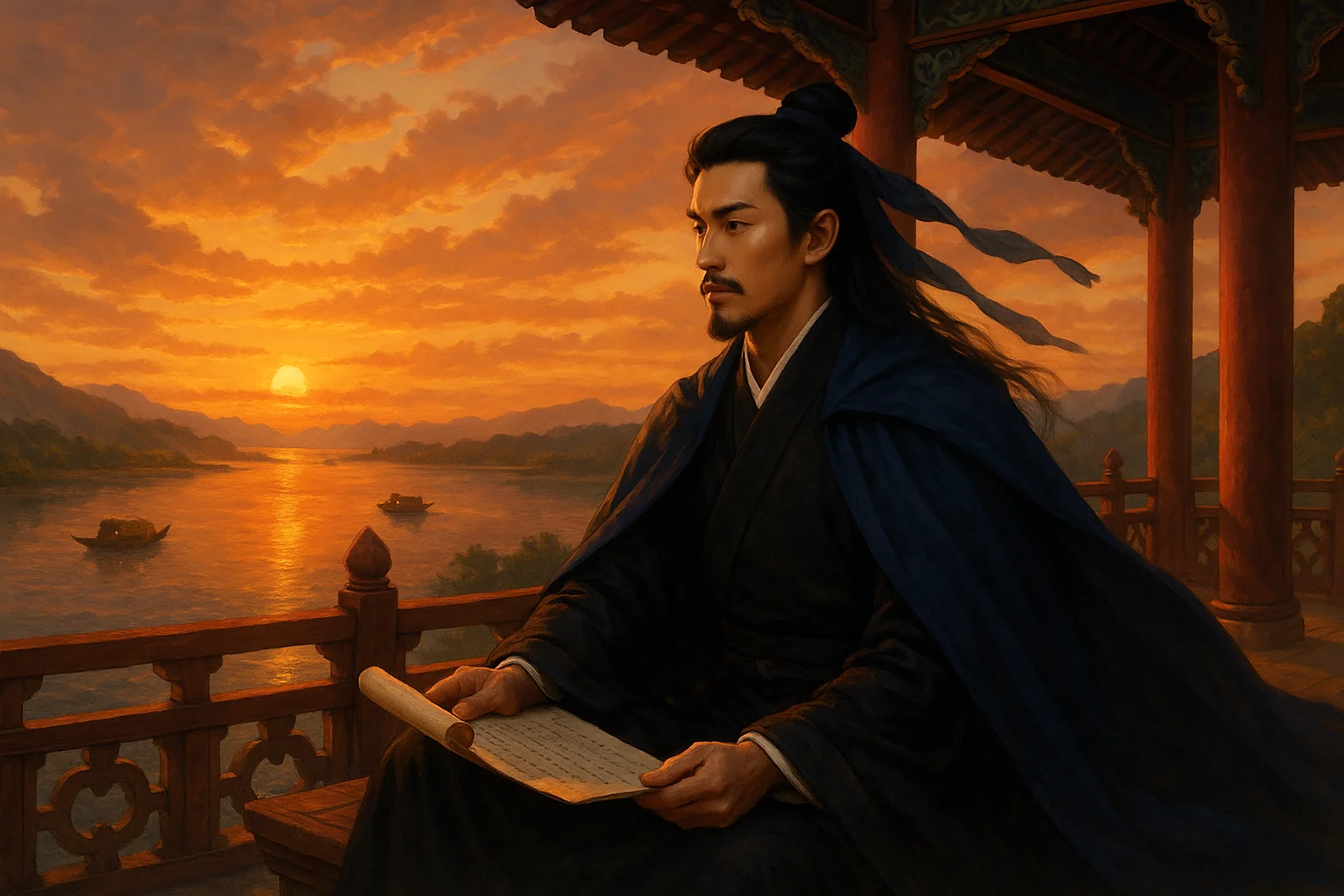
Wang Bo (王勃 c. 650 – 676), a native of Hejin, Shanxi Province, was a renowned writer of the Early Tang Dynasty and the foremost of the "Four Elites of the Early Tang." Exceptionally gifted from childhood, he could compose literary works at the age of six and passed the special imperial examination at sixteen, earning him the position of Gentleman for Court Service. Later, due to an incident, he was dismissed from office. In the third year of the Shangyuan era (676 AD), while crossing the sea to visit relatives, he fell into the water and died of fright at the young age of twenty-seven. His poetry and prose are celebrated for their abundant talent and grand vision. Wang Bo occupies a crucial position in the literary history of the Tang Dynasty. Together with Yang Jiong, Lu Zhaolin, and Luo Binwang, he collectively reversed the ornate and decadent literary style that had prevailed since the Qi and Liang dynasties, heralding the dawn of the resounding voice of the High Tang.