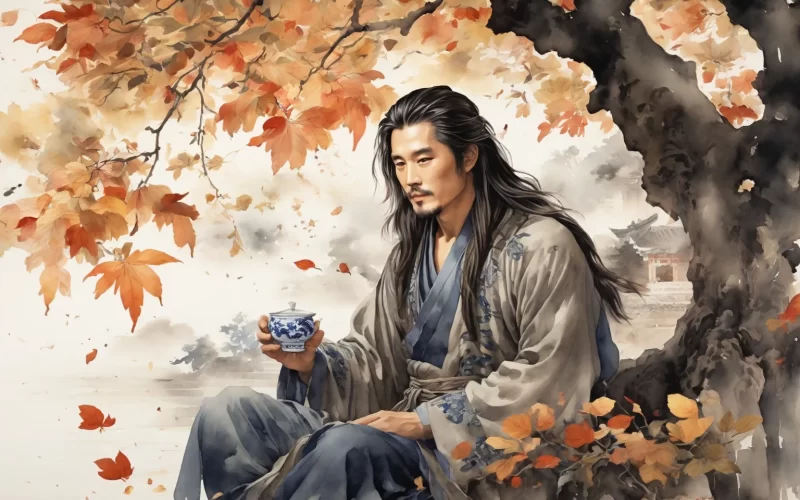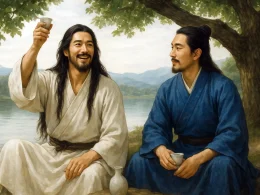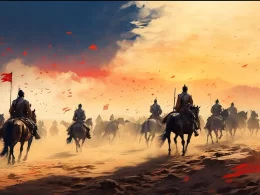



Tonight, joy’s slight; I rise, pour pure wine in the air.
To the First Brewer, I offer — drive off my care!

Soon, heart altered, the world’s chill is gone;
Hills soften, stream warms in the setting sun.

By the south gate, trees dense and deep;
Their shade my shelter, their talk I keep.

Drunk, on sweet herbs I’ll lie, no more to part.
Jin’s and Chu’s wealth lack this Way of the heart.
Original Poem
「饮酒」
柳宗元
今夕少愉乐,起坐开清尊。
举觞酹先酒,为我驱忧烦。
须臾心自殊,顿觉天地暄。
连山变幽晦,绿水函晏温。
蔼蔼南郭门,树木一何繁。
清阴可自庇,竟夕闻佳言。
尽醉无复辞,偃卧有芳荪。
彼哉晋楚富,此道未必存。
Interpretation
This poem was composed around 806 AD, during the first year of the Yuanhe era under Emperor Xianzong of Tang, marking the early period of Liu Zongyuan's exile in Yongzhou. Following the failure of the Yongzhen Reform, he was demoted from a Vice Director of the Ministry of Rites to a Marshal of Yongzhou—a hollow title with no real authority—resulting in the complete collapse of his political ideals and a drastic shift in his life's trajectory. In his initial years at Yongzhou, Liu Zongyuan's state of mind was undoubtedly one of resentment and profound solitude. In his "Letter to Li Hanlin Jian," he described his circumstances: "Yongzhou lies at the southernmost edge of Chu, its features resembling those of Yue. When vexed, I venture out, yet such excursions often bring fear. Crossing the wilds, one encounters venomous snakes and giant hornets; gazing at the sky or the earth, each step is wearisome." Yet, it was precisely within this context that he began seeking spiritual solace in nature, poetry, and wine. This poem captures the mindset of this period—a solitary drinking session, a state of inebriation, a moment of transcendence, documenting how an exile encounters heaven and earth through wine.
Stanza 1: "今夕少愉乐,起坐开清尊。举觞酹先酒,为我驱忧烦。"
Jīn xī shǎo yú lè, qǐ zuò kāi qīng zūn. Jǔ shāng lèi xiān jiǔ, wèi wǒ qū yōu fán.
Tonight brings little joy; I rise and sit, opening the clear wine goblet. Lifting the cup, I pour a libation to the first brewer, asking him to dispel my worries and troubles.
The opening directly expresses his feelings, without concealment. "Tonight brings little joy"—five words that articulate the poet's present state of mind: not profound grief or agony, but a lingering sense of dullness and discontent. He does not choose to endure it but instead "rises and sits, opening the clear wine goblet," using wine to counter this state of "little joy."
"Lifting the cup, I pour a libation to the first brewer" is a gesture rich in ritual significance. "Pouring a libation" is an act of offering, typically directed to spirits or ancestors; yet the poet offers it "to the first brewer"—the legendary inventor of winemaking. This detail elevates the act of drinking to a spiritual plane: it is not mere inebriation but a dialogue with the ancients, a homage to the culture of wine, and an invocation of its power—"to dispel my worries and troubles." These four lines describe the commencement of drinking: the mood is low, the actions solemn, as if initiating a rite.
Stanza 2: "须臾心自殊,顿觉天地暄。连山变幽晦,绿水函晏温。"
Xūyú xīn zì shū, dùn jué tiāndì xuān. Lián shān biàn yōu huì, lǜ shuǐ hán yàn wēn.
In a moment, the heart transforms of itself; suddenly I feel warmth permeating heaven and earth. The continuous mountains shed their gloominess; the green waters hold a gentle warmth.
This captures the moment when the wine's effect begins and the mood shifts. "In a moment" conveys the swiftness of the change; the word "自" (of itself) in "心自殊" (the heart transforms of itself) implies a natural transition—not forced, but induced by the wine, flowing effortlessly.
"Suddenly I feel warmth permeating heaven and earth"—"warmth" here signifies gentle, soothing heat. Wine enters the melancholy heart, and the once cold world seems to grow warm. The following two lines project this inner warmth outward: "The continuous mountains shed their gloominess"—the once dim mountains now appear bright; "the green waters hold a gentle warmth"—the once cool green waters seem to contain a mild, luminous glow. This exemplifies the principle that "the observer's inner state colors all things perceived." As the poet's mood shifts, the world in his eyes transforms accordingly. These four lines describe the midst of drinking: spirits lift, and the world brightens in response.
Stanza 3: "蔼蔼南郭门,树木一何繁。清阴可自庇,竟夕闻佳言。"
Ăi ăi nán guō mén, shù mù yī hé fán. Qīng yīn kě zì bì, jìng xī wén jiā yán.
Lush and dense is the South Gate; how luxuriant are its trees! Their clear shade offers self-shelter; all evening long, fine words are heard.
This couplet shifts the gaze from distant mountains to the immediate surroundings. "South Gate" refers to the southern city gate of Yongzhou, a place the poet frequented. "How luxuriant are its trees!" depicts the verdant, thriving scene before him, echoing the earlier "continuous mountains" and "green waters" to construct a vibrant natural space.
"Their clear shade offers self-shelter"—the tree shade provides not only respite from the sun but also sanctuary for the soul. The phrase "self-shelter" is deeply meaningful: what the poet needs is not just physical cover but a spiritual refuge. "All evening long, fine words are heard" reveals that within this shade, he is not utterly alone; there is the company of kindred spirits, and "fine words" to be heard. These "fine words" might be conversations with friends, the whispers of nature, or the soliloquy of his own heart. These four lines describe the setting of the drinking: offering both nature's shelter and spiritual resonance.
Stanza 4: "尽醉无复辞,偃卧有芳荪。彼哉晋楚富,此道未必存。"
Jìn zuì wú fù cí, yǎn wò yǒu fāng sūn. Bǐ zāi Jìn Chǔ fù, cǐ dào wèi bì cún.
To drink one's fill without demur; reclining to rest amid fragrant grasses. As for the wealth of Jin and Chu—this Way they may not possess.
The final stanza describes the climax of drinking and the insights gained. "To drink one's fill without demur"—holding nothing back, with no further reservations, simply indulging to the point of drunkenness. "Reclining to rest amid fragrant grasses": drunk, he lies down on the fragrant grass, his body in intimate contact with nature, as if returning to the embrace of Mother Earth.
The last two lines are the punchline of the entire poem and a declaration of the poet's values. "As for the wealth of Jin and Chu"—those possessing the riches of ancient states Jin and Chu, those deemed successful by worldly standards. "This Way they may not possess"—they likely do not comprehend "this Way," the joy found in wine, the delight in nature, the freedom of the spirit. The term "this Way" refers both to the Way of drinking and to the lifestyle the poet pursues: finding contentment amidst hardship, settling the soul in nature, maintaining independence and freedom of spirit. These four lines conclude the drinking experience with a contrast, elevating personal experience to universal philosophy.
Holistic Appreciation
Using a solitary drinking session as its thread, this poem chronically records the poet's psychological journey from gloom to ease, from sorrow to transcendence. It begins with "little joy," a low spirit; then, as the wine takes effect, "the heart transforms of itself," and the world brightens; next, it describes the drinking place, sheltered by tree shade and accompanied by fine words; finally, it concludes with drinking to fullness and reclining, using contrast to highlight the central theme.
The poem's structure is clear and progressively layered. Moving from internal to external (heart → world), from near to far (immediate scene → South Gate → the wealth of Jin and Chu), from concrete to abstract (drinking → nature → philosophy), each part connects seamlessly to form an organic whole. The language is simple and natural, the rhythm relaxed and harmonious, yet it contains profound insights into life. Compared to Liu Zongyuan's more anguished and resentful works, this poem exhibits a greater degree of detachment and philosophical acceptance. It is not an escape from reality but a transcendence of it; not a passive indulgence but an active choice. The declaration, "As for the wealth of Jin and Chu—this Way they may not possess," stands as clear evidence of the poet affirming his own value amidst adversity.
Artistic Merits
- Clear Structure, Progressive Layering: From the start of drinking, to its midst, to its conclusion, and finally ending with philosophical insight, the logic is rigorous, and transitions are smooth.
- Fusion of Emotion and Scene, Unity of Self and World: As the wine's effect rises and the mood shifts, the perceived world transforms accordingly. "The continuous mountains shed their gloominess; the green waters hold a gentle warmth" is a classic example of "the observer's inner state coloring all things perceived."
- Simple Language, Profound Artistic Conception: The poem uses no obscure or difficult phrases, yet it contains deep reflections on life and value, revealing genuineness within plainness.
- Conclusive Contrast, Lofty Theme: Juxtaposing "the wealth of Jin and Chu" with "this Way" elevates personal experience to universal philosophy, granting the poem transcendent depth.
Insights
This poem first teaches us how to achieve self-healing in adversity. Facing exile, Liu Zongyuan did not wallow in bitterness and resentment but chose to "rise and sit, opening the clear wine goblet," using wine to counter the state of "little joy." This is not passive escapism but an active form of self-regulation. It tells us: in difficult times, we need to find our own "clear wine goblet"—be it wine, poetry, music, nature, or anything that allows us to temporarily set down our burdens and reconnect with the world.
Secondly, the transformation described in "须臾心自殊,顿觉天地暄" (In a moment, the heart transforms of itself; suddenly I feel warmth permeating heaven and earth) prompts us to consider the relativity and malleability of one's state of mind. The same world appears "gloomy" in sorrow and "gentle/warm" in ease. The world has not changed; what changes is our heart. This insight reminds us: our perception of the external world is largely determined by our internal state. Learning to adjust our state of mind is learning to adjust how the world appears to us.
On a deeper level, the declaration in "彼哉晋楚富,此道未必存" (As for the wealth of Jin and Chu—this Way they may not possess) encourages us to reflect on the plurality of values. In the世俗 eye, "the wealth of Jin and Chu" symbolizes success; but in Liu Zongyuan's view, the true riches lie in "this Way" of drinking one's fill, reclining, and coexisting with nature. This teaches us: we need not be bound by世俗 standards of value. True success is not measured by how much one possesses, but by whether, within one's finite possessions, one can live with composure, clarity, and self-sufficiency.
Finally, the image of the figure "偃卧有芳荪" (reclining to rest amid fragrant grasses) is particularly moving. The drunken poet, lying on fragrant grass, his body in intimate contact with the earth, his spirit merging with nature. This picture is partly disheveled yet profoundly transcendent. This transcendence maintained amidst dishevelment, this freedom pursued amidst hardship, is the most precious spiritual legacy Liu Zongyuan bequeaths to us. It teaches us: even at our lowest point, we can still "recline amid fragrant grasses"; even possessing nothing, we can still possess "this Way."
About the poet
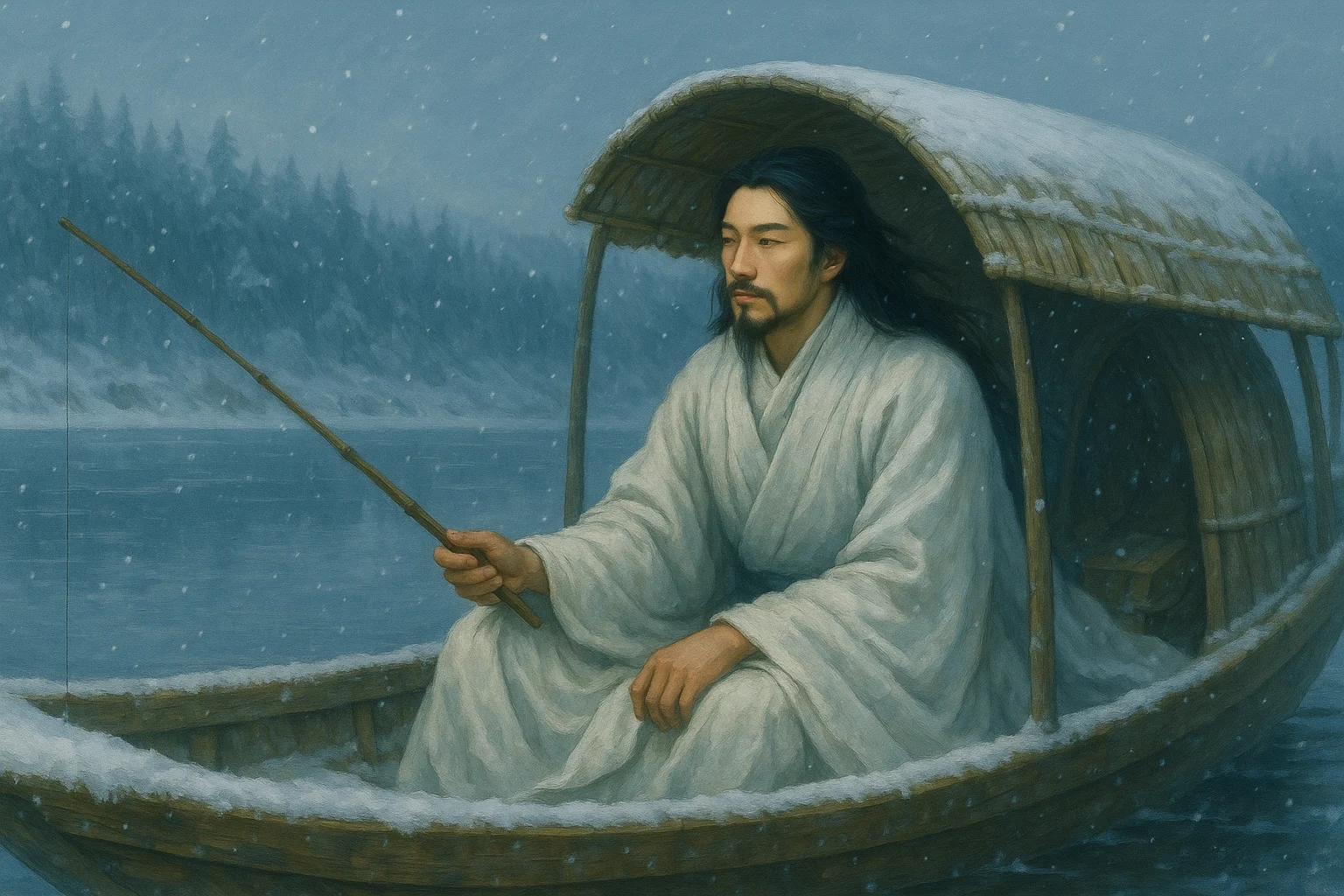
Liu Zongyuan (柳宗元), 773-819 A.D., a native of Yongji, Shanxi, was a progressive thinker, brilliant writer, and revolutionary statesman of the Tang Dynasty. Nineteen years before he was born, the An Shi Rebellion broke out, which dramatically changed the Tang Dynasty from prosperity to decline. The subsequent failure of the Yongzhen Reform was a historical tragedy that cut short Liu Zongyuan's political future, but made him one of the leading thinkers and literary figures of the Tang Dynasty.