A traveler back from Luoyang this spring told,
He’d been to where the Secretary’s tomb lies cold.
They say white poplars grow as pillars tall and true —
Then tell me, how could a face of rouge not wither too?
Original Poem
「燕子楼和张仲素 · 其三」
白居易
今春有客洛阳回,曾到尚书墓上来。
见说白杨堪作柱,争教红粉不成灰?
Interpretation
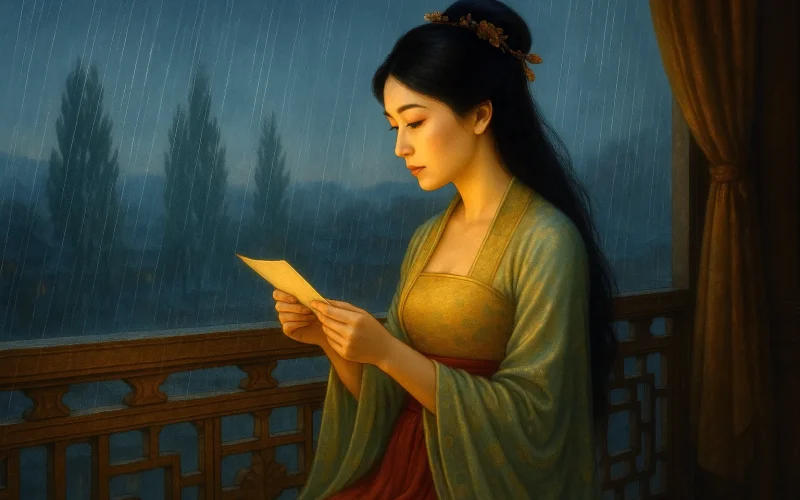
As the concluding piece of the trio, Bai Juyi shifts his focus in this third poem from the solitary figure within the tower (first poem) and the stored-away gown in the chest (second poem) to a vaster domain beyond the tower's walls—the boundary separating life and death. Here, the poet moves beyond pure dramatic monologue and psychological depiction. He introduces an external narrator (the "traveler") and, through a contrast of objective images rendered with dispassionate, almost cruel objectivity, poses a question that strikes at the very essence of Guan Panpan's existence. He examines her personal tragic fate against the vast canvas of nature's indifference and cosmic permanence, elevating the suite's thematic resonance to a philosophical level.
First Couplet: 今春有客洛阳回,曾到尚书墓上来。
Jīn chūn yǒu kè Luòyáng huí, céng dào shàngshū mù shàng lái.
This spring, a traveler returned to us from Luoyang town; / He said he'd visited the late Minister Zhang's burial mound.
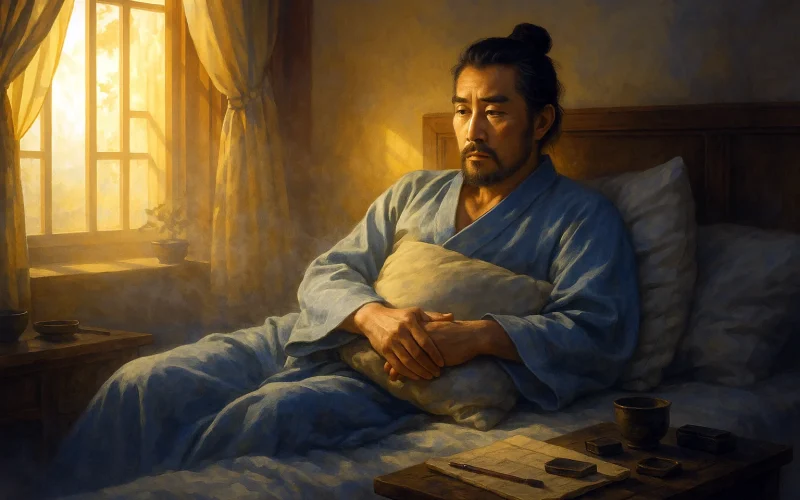
The poem opens with a plain narrative tone, introducing a crucial intermediary perspective—the "traveler." This figure is a messenger connecting the world of the living (the poet, Panpan) with that of the dead (Zhang Yin), and a witness to objective fact. "This spring" establishes temporal immediacy; "returned from Luoyang" implies great distance and delayed information. "He said he'd visited the late Minister's burial mound" instantly shifts the reader's gaze from Swallow Tower to the funeral hills, from the seclusion of the living to the long sleep of the dead. This seemingly simple report calmly lays the narrative groundwork for the startling juxtaposition in the following couplet, also granting the entire poem an objective, observational distance that transcends personal emotion.
Second Couplet: 见说白杨堪作柱,争教红粉不成灰?
Jiàn shuō bái yáng kān zuò zhù, zhēng jiào hóng fěn bù chéng huī?
He mentioned poplars by the grave, now stout for beams to serve. / Then how could beauty in her tower her fragile form preserve, / and not to dust and ashes turn, as all things must, in time?
This couplet is the soul of the poem, constructing an unfeeling yet profound contrast between the "life" of a natural object and the "passing" of a human. "He mentioned" continues from above, emphasizing the traveler's objective account. "Poplars by the grave, now stout for beams to serve": Poplars are common grave-site trees. Their fast-growing, tall, straight nature is here imbued with a temporal dimension—"stout for beams" means that in the decade-plus since the burial, far from withering with the deceased, the trees have thrived, almost absurdly displaying nature's vital, relentless growth. Set against this is the implied "rouge and powder" (representing Guan Panpan's beauty). "Then how could beauty… not to dust and ashes turn…?" is an ultimate sigh mingling astonishment, accusation, and pity. The poet employs a stark logic of "using the tree's growth to question the person's extinction": if even the trees by the grave continually grow, verging on usefulness (as beams), then how could the beauty, youth, emotion, and life of the living person left behind in the world, consuming herself in hopeless longing, possibly avoid withering, decaying, and finally turning to dust with time? Here, "dust and ashes" signifies both physical dissolution and the dead silence of extinguished spirit.
Holistic Appreciation
This poem serves the roles of "conclusion" and "sublimation" within the suite. The first poem dealt with the "long night," the second with the "empty chest," and this third points directly to "turning to dust"—the inevitable, ultimate destination following emotional solitude and existential barrenness. Through the "traveler's" perspective and the image of the poplar, Bai Juyi executes a skillful shift in narrative strategy: from an internal view (Panpan's perception) to an external observation (another's witness), from emotional evocation to factual statement, from psychological time ("long for one") to physical time (the growth of trees). This shift brings about a more clear-eyed, and more severe, realization: in the face of eternally operating, indifferently procreative natural law, personal fidelity, longing, and even the entire sorrowful state of existence face the possibility of being questioned and deconstructed. The poplar's "stout for beams" and the beauty's "turning to dust" are no longer simple metaphors but an unvarnished juxtaposition of existential conditions, forcing the reader to ponder: when the object of longing has returned to dust, and even the trees on his grave flourish, what, ultimately, is the value and meaning of the "past" that the living person guards with her whole life?
Artistic Merits
- The Interposition of a Narrative Perspective and Its Distancing Effect: Introducing the third-party narrator, the "traveler," shifts the poetry from pure subjective lyricism to a multi-layered narrative structure containing "report-retelling-reflection." This enhances the sense of the event's reality and the objectivity of the reflection, also creating a cool, aesthetic distance.
- The Extremity and Philosophical Nature of Imagistic Contrast: The contrast between "poplar" and "beauty" surpasses the common metaphor of "pine/cypress vs. beauty" denoting fragility. The poplar's "stout for beams" is a positive, useful, growing image; the beauty's "turning to dust" is a negative, useless, vanishing image. This contrast concerns not only time but also the vast disparity in existential value between natural law and human emotion, generating potent philosophical tension.
- The Resonant Power and Open-Endedness of the Rhetorical Question: "Then how could beauty… not to dust and ashes turn…?" uses a rhetorical question instead of a declaration, making the tone more forceful and the implication more complex. It is both a helpless acknowledgment (will ultimately turn to dust) and a reluctant challenge (how did it come to this), and furthermore a profound insight into the absurdity of fate. The answer is suspended, leaving the reader with endless contemplation.
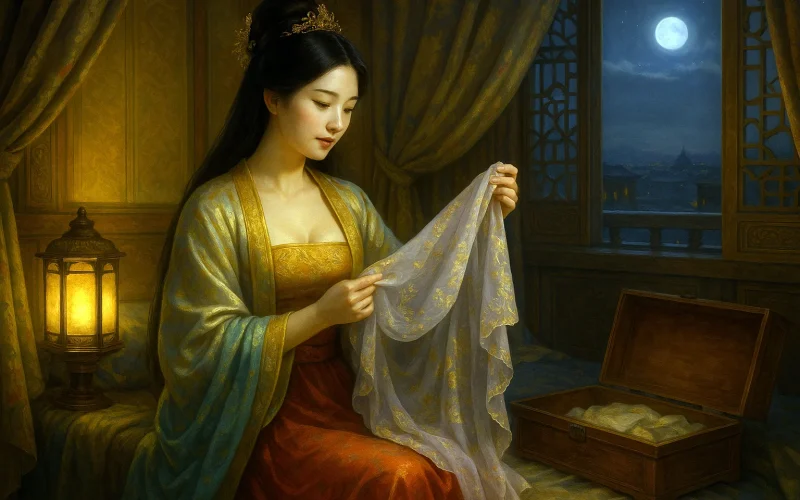
- The Progressive Structure and Culminating Finale of the Suite: As the suite's conclusion, this poem shows progression in imagery from "frosty moon" (first) and "gauze gown" (second) to "poplar"; in space from inside the tower, inside the chest, to outside the grave; in time from an autumn night, to eleven years, to trees reaching maturity; and in emotion from solitude, to struggle, to confronting dissolution. It constitutes a complete artistic edifice that advances layer by layer to a powerful climax.
Insights
This poem places a personal tragedy within the eternal conflict expressed in the sentiment, "Grasses and trees are heartless, in time they fade and fall; / But man, a living creature, is the soul of all things." It reveals an existential dilemma: human emotional steadfastness (like Panpan's fidelity) can appear both sublime and absurd, both deeply moving and potentially futile, when confronted with nature's indifferent yet ceaselessly generative world. The poplar's growing to useful size beside the grave seems a kind of mockery of, or transcendence over, the feelings of both the dead and the living.
This poem prompts us to reflect on the relationship between emotion and time, memory and life. Have we, too, lived for a certain "past" or "belief," as if guarding a "gauze gown" in an "empty chest"? When time flows on in the external world, with plants flourishing and withering ("poplars stout for beams"), is the world within our hearts inevitably moving toward "turning to dust"? Bai Juyi provides no answer, but with poetic sharpness, he dissects this dilemma.
It enlightens us that while cherishing emotion and memory, we may also need a greater reverence for and clarity about life itself and the transformations of nature. True commemoration may not necessarily be static waiting and self-consumption, but could also be, after acknowledging the inevitability that "beauty must turn to dust," still finding a way to coexist with, or even converse with, the ever-renewing world of the "poplar" within our finite lives. This is not a betrayal of deep feeling, but an exploration, on a broader cosmic scale, of another possibility for life's resilience. Because of its profound tragic and philosophical nature, Bai Juyi's poem ultimately elevates the story of "Swallow Tower" beyond the singular theme of a chaste lady's tale, making it an eternal parable about the human condition.
About the Poet
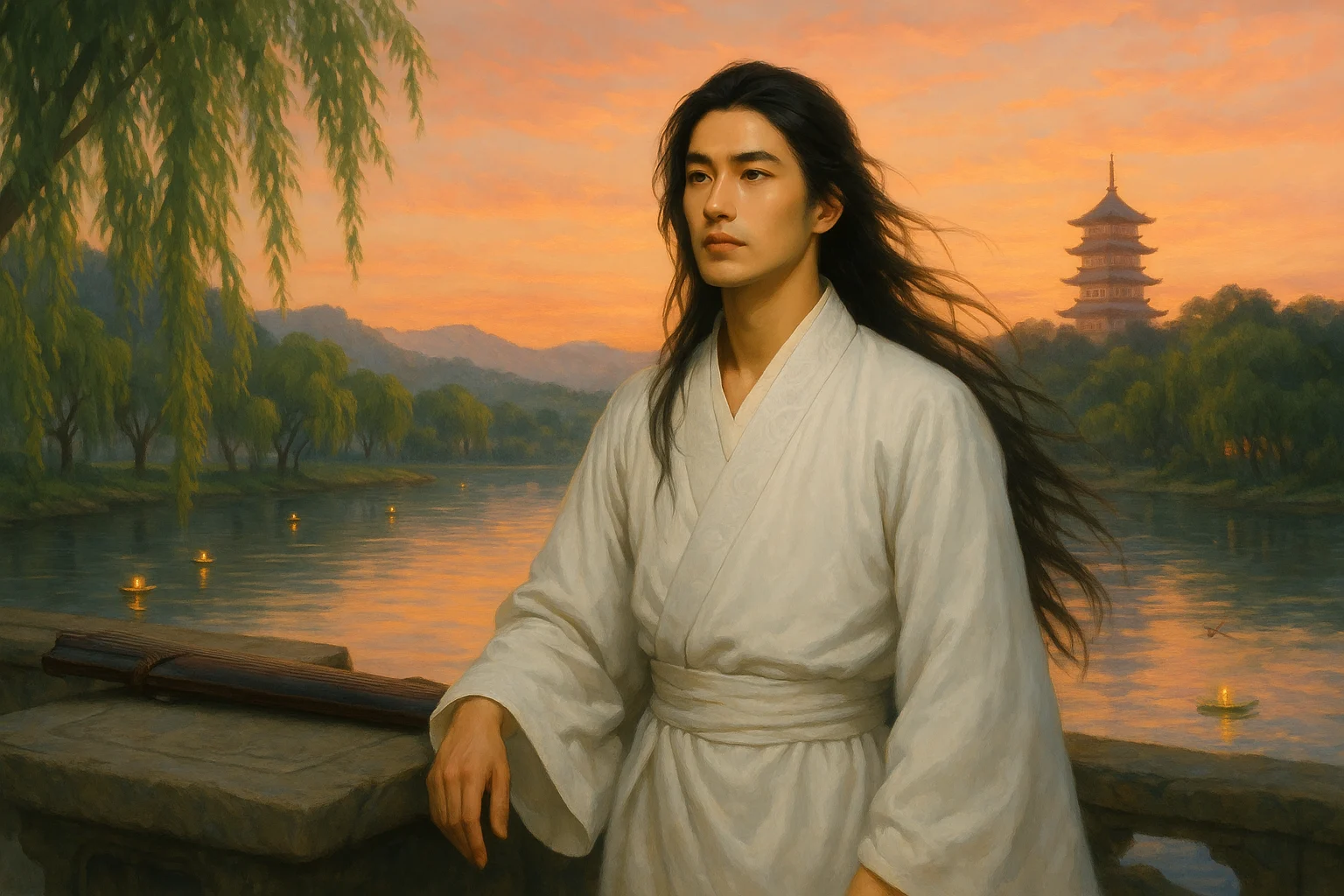
Bai Juyi (白居易), 772 - 846 AD, was originally from Taiyuan, then moved to Weinan in Shaanxi. Bai Juyi was the most prolific poet of the Tang Dynasty, with poems in the categories of satirical oracles, idleness, sentimentality, and miscellaneous rhythms, and the most influential poet after Li Bai Du Fu.