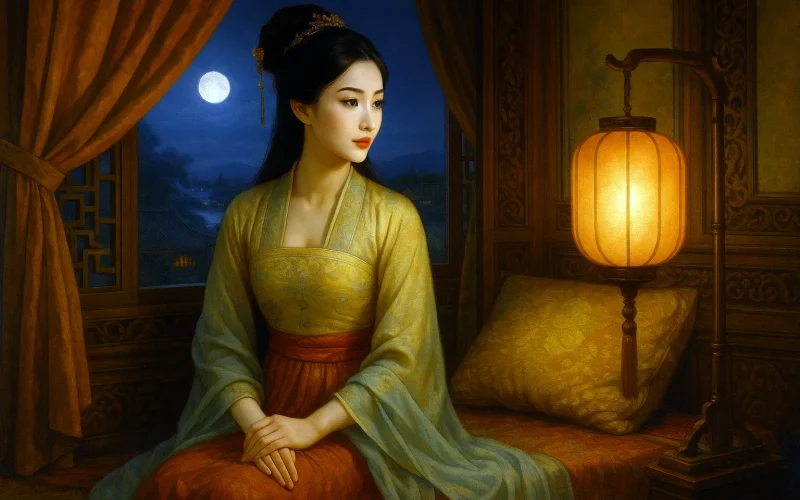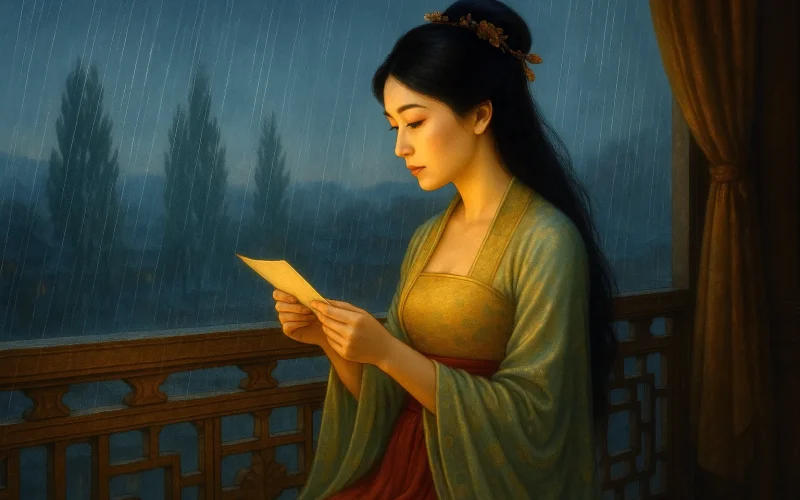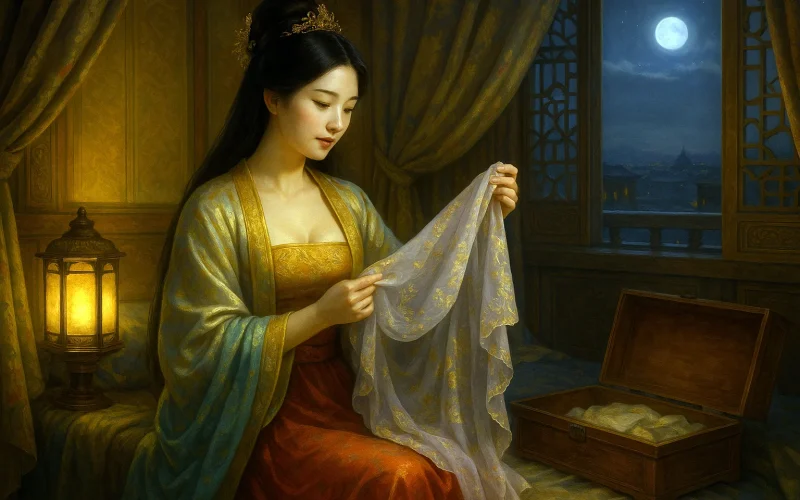
My silken robe, its pattern faint as haze;
I reach to wear it — tears blur my gaze.
Since the Rainbow Dance vanished from my sight,
In a dusty chest it’s lain, eleven years of night.
Original Poem
「燕子楼和张仲素 · 其二」
白居易
钿晕罗衫色似烟,几回欲著即潸然。
自从不舞霓裳曲,叠在空箱十一年。
Interpretation
As the second poem in Bai Juyi’s responding set to Zhang Zhongsu, this piece continues the deep empathetic technique of the dramatic monologue, fully inhabiting the character's inner world. However, the perspective shifts from a macro perception of time and space to a microscopic contemplation of a physical object. Through a dance costume preserved for over a decade, the poet condenses Guan Panpan’s lament for past splendor and present decline, her thoughts on life and death, and her profound sense of existential desolation, onto an intensely private and richly symbolic object. This achieves a brilliant artistic synthesis where an object becomes a vessel for history and a garment articulates the heart's condition.
First Couplet: 钿晕罗衫色似烟,几回欲著即潸然。
Diàn yùn luó shān sè sì yān, jǐ huí yù zhuó jí shān rán.
Her sheer silk gown, with inlaid designs that gleam like haze, / How many times, about to don it, has she met a weeping phase?
The opening focuses on a specific material relic—the sheer silk gown with inlaid designs. It is not merely a garment, but a crystallization of past glory, youth, and love. The phrase "gleam like haze" is exquisite: it describes the ethereal beauty of the silk's sheen and embroidered luster, while also hinting that this splendor is now like mist—illusory and unattainable. The next line reveals the painful relationship between the person and the object: "about to don it" represents a subconscious impulse, a fleeting desire to reclaim an old identity and intimacy; however, "has she met a weeping phase" is the instant of clear-eyed recognition and emotional collapse. The piercing reality of the surviving object and the absent beloved shatters any possibility of reliving the past. The conjunction "about to" captures the rapid shift from attempt to despair, dynamically depicting the character's cycle of hope and immediate sorrow.
Second Couplet: 自从不舞霓裳曲,叠在空箱十一年。
Zì cóng bù wǔ Nícháng qǔ, dié zài kōng xiāng shíyī nián.
Since she last danced the "Rainbow and Feather Robe" air, / Folded within an empty chest, it's lain for eleven years there.
This couplet transitions from emotional turmoil to a state fixed in time, using a calm statement to convey immense existential bleakness. "Since she last danced…" is the pivotal line: the Rainbow and Feather Robe melody was not just a dance; it was the pinnacle of shared understanding with Zhang Yin, the artistic expression of her life's meaning. To stop dancing meant the loss of her stage, the permanent loss of her soulmate, and the end of both her public purpose and artistic expression. "Folded within an empty chest" is the physical form of this end: "Folded" implies careful preservation yet also conscious storage away; "empty chest" symbolizes the profound void of her life thereafter—the chest is empty, and so is her existence. The phrase "eleven years"—a precise, almost cruel measure of time—is the poem's most impactful element. It is no longer the subjective longness from the first poem, but an objective, accumulated, silent duration. Year after year, the dance costume lay in the chest with the dust, and her life in the tower with solitude; time itself became a visible, weighty relic.
Holistic Appreciation
The artistic power of this heptasyllabic quatrain stems from the extreme tension and profound unity forged between object and person, and between momentary impulse and protracted duration. The entire poem revolves around the "sheer silk gown." The first line captures the object's former beauty, a sudden memory flash. The second line describes the painful present interaction with it, a sharp rupture with reality. The third line reveals the cause of its disuse—the end of dancing—marking a definitive turning point. The final line details the state and duration of its storage ("in an empty chest for eleven years"), a crystallized image of desolation. The four lines form a complete narrative loop, with the emotional core condensing into the temporal void of "eleven years." Through the biography of a dance costume, the poet refracts the character's eleven-year inner history: the complete process of how a splendid garment became a relic, how a dancer became a living memorial, and how a vivid memory was compressed, folded, and sealed in the trunk of time. Its poignancy lies in loading the immense passage of time and its attendant emotional trauma onto a silent, private object, inviting the reader, through contemplation of this "gown," to imagine and feel the locked-away solitude of those eleven years.
Artistic Merits
- Symbolic Focus on a Core Image: The poem centers on the image of the sheer silk gown with inlaid designs. It encapsulates the character's profession (dancer), talent (skilled performer), relationship (adorning herself for her beloved), memory (shared appreciation of the dance), and current state (stored away). This choice of image is powerfully resonant and evocative.
- The Emotional Force of Precise Numbers: "How many times" and "eleven years" form a stark contrast. "How many times" suggests vague, repeated instances of futile inner struggle; "eleven years" denotes a precise, fixed, objective length of time. The exact number (eleven years) carries a heavier sense of factual weight and tragic inevitability than a vague "many years."
- Meticulous Choice of Verbs and States: "About to don" is an uncompleted action; "met a weeping phase" is an interrupted emotion; "last danced" is a terminated act; "folded" and "lain" describe an ongoing state of passivity. These words precisely trace the character's psychological path from attempting to reactivate the past to finally accepting its demise.
- The Metaphorical Space of the "Empty Chest": The "empty chest" is not merely a storage box but a superb metaphor for the character's inner world. It is closed, unused, gathering dust, holding outdated, useless finery—much like Guan Panpan's own state of being: outwardly perhaps still beautiful (like the preserved gown), but inwardly hollow, her life's vitality and meaning having been drained and sealed away.
Insights
Through a single dance costume, this work reveals the material form of traumatic memory and the tangible weight of time. It shows us how, after a great loss, associated objects become emotional "tombstones" and temporal "time capsules." To touch them triggers collapse; to seal them away signifies accepting the formal death of a life chapter and beginning the long vigil.
This poem offers modern readers insight into how we face loss and its relics. Do we, too, possess such a "sheer silk gown"—perhaps an old photograph, a letter, any object laden with memory? Is our relationship with it one of repeatedly being "about to" engage with it only to be overcome, or have we long since "folded it within an empty chest," maintaining a silent, painful distance across the years?
Through Guan Panpan's story, Bai Juyi explores the relationship between memory, attachment to objects, and time. It reveals that true mourning is sometimes not about forgetting, but learning to "fold" away surging emotions, place them in an inner "empty chest," acknowledge their existence while also acknowledging they belong to another time. The count of "eleven years" is a brutal honesty; it measures the difficulty of forgetting and marks the absence of renewal. The poem's profundity lies not in providing an answer for moving beyond grief, but in presenting with utmost fidelity how grief itself materializes and coexists with time. This presentation, through its high artistic truth, possesses a power to console and to foster understanding—it lets all who have their own "empty chest" know that the arrested time and the stored-away splendor within are not a solitary experience.
About the Poet
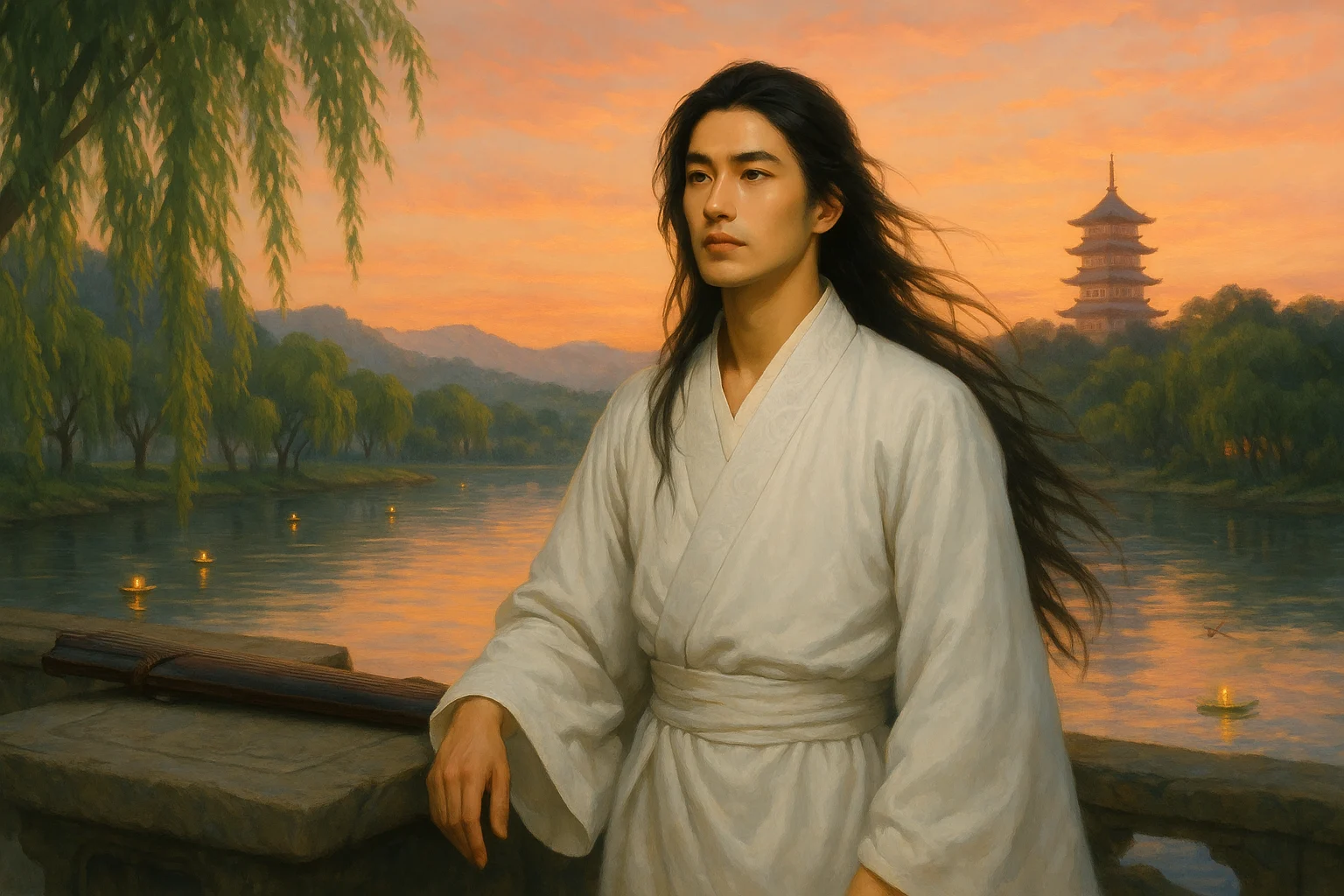
Bai Juyi (白居易), 772 - 846 AD, was originally from Taiyuan, then moved to Weinan in Shaanxi. Bai Juyi was the most prolific poet of the Tang Dynasty, with poems in the categories of satirical oracles, idleness, sentimentality, and miscellaneous rhythms, and the most influential poet after Li Bai Du Fu.