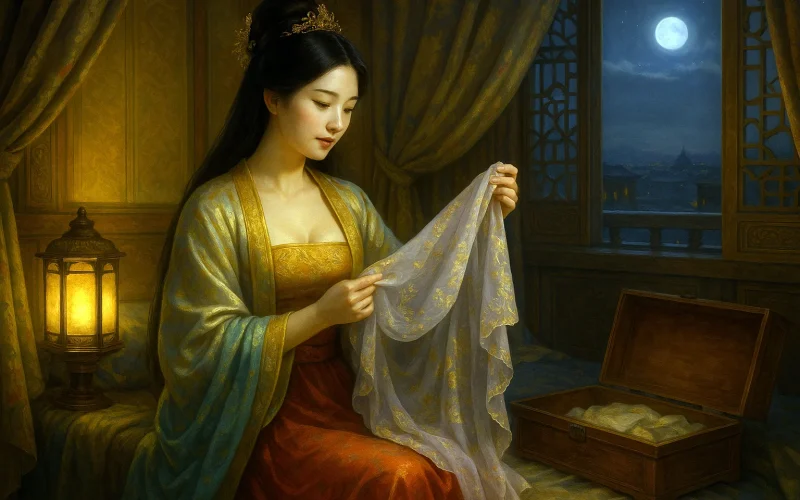



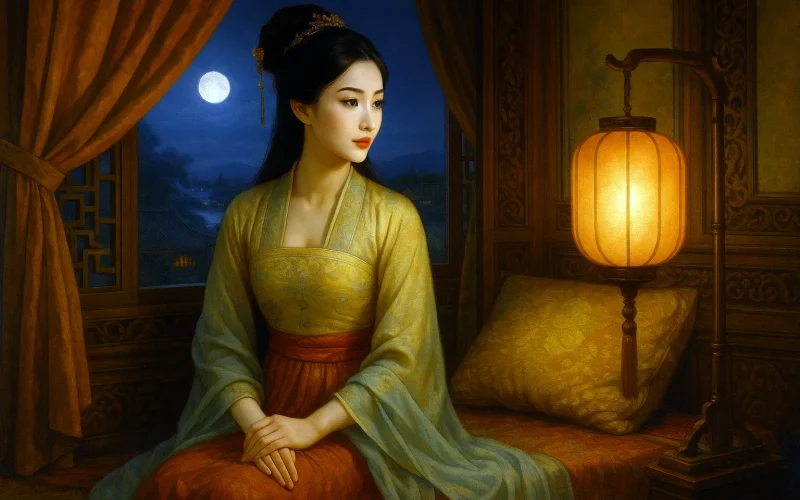
Moonlight floods the bed, frost covers the screen;
Quilt cold, lamp low, I tidy the bed unseen.
In Swallow Tower, where frost and moonlight stay,
For one person, autumn nights are long this way.
Original Poem
「燕子楼和张仲素 · 其一」
白居易
满床明月满帘霜,被冷灯残拂卧床。
燕子楼中霜月夜,秋来只为一人长。
Interpretation
This poem was composed around 815 CE, during the Yuanhe era of Emperor Xianzong, as a response to a poem by Bai Juyi's friend Zhang Zhongsu. Zhang's original trio of poems took as their subject the famous Tang courtesan Guan Panpan, who lived in seclusion in Swallow Tower after the death of her patron, Zhang Yin. Bai Juyi's poem is a profound attempt to inhabit and give voice to Guan Panpan's solitary state of mind, a masterful example of a "persona poem" or "poem written in another's voice." The poet does not express emotion or commentary directly. Instead, he immerses himself in the character's soul, building an infinitely magnified, desolate, and frozen autumn night defined by her sensory and temporal experience. It showcases Bai Juyi's astonishing skill in psychological portraiture and the creation of mood.
First Couplet: 满床明月满帘霜,被冷灯残拂卧床。
Mǎn chuáng míng yuè mǎn lián shuāng, bèi lěng dēng cán fú wò chuáng.
Moonlight floods the bed, frost fills the screen, a hoary sight; / Quilt turns cold, lamp dims, she smooths the bedding in the night.
The opening, with its dense accumulation of imagery, instantly immerses the reader in an intensely oppressive sensory world. "Moonlight floods the bed" and "frost fills the screen"—the repetition of "full/floods/fills" conveys the all-pervasiveness of the moonlight and frost, symbolizing the total occupation of body and mind by loneliness and desolation. Visually, it is a fusion of clear light and cold hues; tactilely, it is a chill that penetrates to the bone. "Quilt turns cold, lamp dims" further moves from the environment to bodily sensation and the passage of time: the "cold" is the absence of a shared warmth, the "dims" is the torment of facing the solitary lamp as the long night wanes. The minute action, "she smooths the bedding," is subconscious yet revealing—she smoothes away dust, and perhaps unconsciously attempts to smooth away the omnipresent solitude, or repeats an old habit of service, seeking a trace of past tenderness in the emptiness. This line uses an extremely simple action to carry immense psychological weight—a thunderclap heard in silence.
Second Couplet: 燕子楼中霜月夜,秋来只为一人长。
Yànzi lóu zhōng shuāng yuè yè, qiū lái zhǐ wèi yī rén cháng.
In Swallow Tower, a frost-and-moonlight night, autumn's spell / Seems to have grown so long for one soul's grief to dwell.
This couplet is the soul of the poem, elevating the preceding concrete scene into a philosophical experience of time. "In Swallow Tower, a frost-and-moonlight night" summarizes and freezes the preceding imagery, locking the character (though unseen), the place, the time, and the scene into this poignantly beautiful frame. The latter line, "Seems to have grown so long for one soul's grief to dwell," is the stroke of genius, an immortal line through the ages. The poet employs a poetic expression of "subjective time": the objective autumn night is the same for all, but in Guan Panpan's acutely painful, wakeful perception, it is infinitely stretched and frozen. The phrase "for one soul's grief" declares the individual, utterly subjective experience as the sole truth of this night, filled with a tragic sense of the sublime and loneliness. This "long" is the drawn-out length of yearning, the protracted stretch of memory, the physical and psychological duration of a life that is difficult to endure after a great loss.
Holistic Appreciation
The artistic achievement of this heptasyllabic quatrain lies in its realization of the complete fusion of scene and psyche. The poem does not describe Panpan uttering a word or shedding a tear. Instead, through her environment (frosty moon, cold quilt, dying lamp) and her slight action (smoothing the bed), the environment becomes the direct externalization of her inner world, and the action becomes the unconscious overflow of her psychology. The poem's structure presents a perfect combination of "a close-up of the scene (first two lines)" and "a lament on time (last two lines)." The former is spatial, sensory, and concrete; the latter is temporal, psychological, and abstract. Moving from the concrete to the abstract, from the external to the internal, it ultimately focuses on the profound insight into the solitary life experience encapsulated in "so long for one." Writing as a male poet, Bai Juyi so accurately captures and expresses the subtle psychology and perception of time of a woman in prolonged, faithful solitude. The depth of his empathy and the precision of his brush are astonishing.
Artistic Merits
- Density of Imagery and Intensity of Emotion: The dense arrangement of images—"bright moon," "frost," "cold quilt," "dying lamp"—leaves not a single idle word. Together, they weave a web of desolate, lonely, and frozen perception, pushing emotional intensity to its limit.
- Psychological Depth in a Detailed Action: "Smoothing the bedding" is a classic "pregnant moment." Behind this simple action lies habitual memory, hopeless longing, a subconscious act to pass the long night, and a futile effort to maintain some order of life. Its connotations are extremely rich.
- Poetic Creation of Subjective Time: "Seems to have grown so long for one soul's grief to dwell" is the poem's greatest innovation. It breaks the homogeneous flow of physical time, granting the emotional subject the privilege to distort and stretch its measure, quantifying and visualizing inner torment. It has become a classic paradigm for expressing extreme solitude and pain.
- High Verisimilitude of the Persona Mode: The poet completely effaces himself, submerging into the character's perspective—seeing with her eyes (the flooded bed and screen), feeling with her body (the cold), and measuring time with her heart (the length). This achieves an artistic "realm of selflessness" (impersonality) that results in the strongest possible empathetic "realm of self" (personal resonance) for the reader.
Insights
The value of this work far exceeds a compassionate retelling of a historical love story. It touches upon a fundamental human experience: how, after suffering a great emotional loss, an individual is cast into a completely private space and time utterly reshaped by subjective feeling. The world of that "frost-and-moonlight night" and that time that "grew long for one" is an absolute island that only the experiencer can comprehend.
This poem reveals that true loneliness is not the absence of people around, but the loss of shared meaning in one's entire world (including time, space, and scenery) due to the absence of a significant other. It becomes a heavy, slow, private experience related only to the self. In poetic form, Bai Juyi gives shape to this ineffable "subjective time," allowing us to glimpse and empathize with those living in their own emotional time zones.
Today, although we rarely have stories of fidelity like that of Swallow Tower, anyone may experience that psychological time where "autumn seems to have grown so long for one" in moments of loss, separation, or depression. This poem reminds us that understanding another's pain requires moving beyond objective measurement to comprehend the distortions and weight of their subjective world. Simultaneously, it demonstrates the power of art: through precise imagery and deep psychological portrayal, the most private pain can be expressed, perceived, and shared across time and space, thus opening a sliver of the comfort of being understood within absolute solitude. This is precisely why Bai Juyi's poetry, traversing a millennium, can still speak directly to the human heart.
Poem translator
Xu Yuanchong (许渊冲)
About the Poet

Bai Juyi (白居易), 772 - 846 AD, was originally from Taiyuan, then moved to Weinan in Shaanxi. Bai Juyi was the most prolific poet of the Tang Dynasty, with poems in the categories of satirical oracles, idleness, sentimentality, and miscellaneous rhythms, and the most influential poet after Li Bai Du Fu.