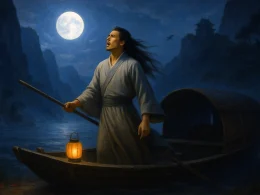



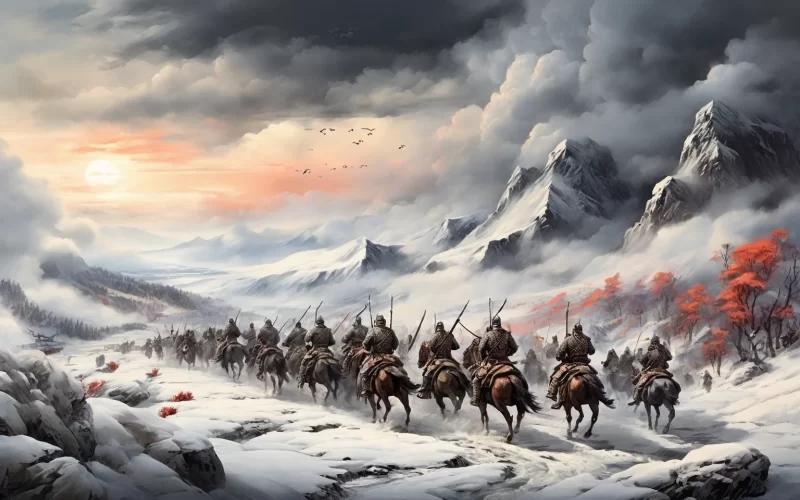
From the empire’s northeast marches, smoke and dust arise;
Han’s generals leave their homes to break the foe, their battle-cries.
Our warriors, ever eager for conquest far and wide;
The emperor, in his grace, beams on them with pride.
With clanging bronze and throbbing drums, they march past Elm-Gate high;
Their banners twist and turn between the crags that scrape the sky.

Through the vast desert, urgent missives like winged arrows fly;
The Khan’s hunt‑fires on Wolf Mountain light the alien sky.

Where hills and streams fade into desolation, at the world’s edge;
Tartar horsemen, like a howling gale, charge from the ledge.
Before the battle line, half of the men are dead or maimed;
Within the commander’s tent, beauties dance, and wine is famed.

In the great desert, deep in autumn, border grasses die;
The sinking sun slants on the lone town, where few still fight, or try.
Those favored by the throne too often held the enemy cheap;
They fought until their strength was spent, yet still the siege lay deep.

Long have they served in iron mail, on distant, weary guard;
At home, her tears like strings of jade have fallen, long and hard.
South of the city, young wives wait with hearts torn by despair;
North of Ji, soldiers gaze backward through the empty air.

The borderlands are shifting, vast — who can their measure take?
A wild and barren desolation, for forsakenness’ sake.

From dawn to dusk, the breath of slaughter thickens into cloud;
All night, the chilling sound of the watch‑clapper rings aloud.

We face each other, seeing our bright blades with crimson sprayed;
Who dies for duty here ever thinks of the reward he’s paid?

Have you not seen the bitterness of war upon the sand?
To this day, we remember General Li, who held the land.
Original Poem
「燕歌行」
高适
汉家烟尘在东北,汉将辞家破残贼。
男儿本自重横行,天子非常赐颜色。
摐金伐鼓下榆关,旌旆逶迤碣石间。
校尉羽书飞瀚海,单于猎火照狼山。
山川萧条极边土,胡骑凭陵杂风雨。
战士军前半死生,美人帐下犹歌舞。
大漠穷秋塞草腓,孤城落日斗兵稀。
身当恩遇常轻敌,力尽关山未解围。
铁衣远戍辛勤久,玉箸应啼别离后。
少妇城南欲断肠,征人蓟北空回首。
边庭飘飖那可度,绝域苍茫无所有。
杀气三时作阵云,寒声一夜传刁斗。
相看白刃血纷纷,死节从来岂顾勋!
君不见沙场征战苦,至今犹忆李将军。
Interpretation
This poem was composed in 738 AD, the 26th year of the Kaiyuan era under Emperor Xuanzong of Tang, when Gao Shi was about thirty-four years old, during a period of traveling in the Liang-Song region, not yet having entered official service. A preface explains the occasion for its creation: "In the 26th year of Kaiyuan, a guest who had returned from accompanying a commander on a frontier campaign composed a poem to show me. Moved by the affairs of campaigning and garrison duty, I responded in kind." The identity of this "guest" has long been debated; one theory suggests he was a staff officer who accompanied Zhang Shougui, the Military Governor of Youzhou, on an expedition. That year, Zhang's subordinate Zhao Kan and others, falsely using the commander's orders, instructed Wuzhi Yi, the Military Commissioner of Pinglu, to lead troops in an attack on remnants of the rebellious Khitan and Xi tribes. They were initially victorious but were later defeated. Zhang Shougui concealed the defeat and falsely reported victory, and was demoted when the truth came to light. Hearing of this, and combining it with his own observations and reflections on frontier campaigns, Gao Shi wrote this matching poem.
However, this poem is by no means merely a record of a single event. It is a profound summation of the nature of frontier warfare in the Tang dynasty. The poem contains both a lofty tribute to the soldiers' «死节从来岂顾勋» (sǐjié cónglái qǐ gù xūn), and a sharp critique of the commanders' «美人帐下犹歌舞» (měirén zhàngxià yóu gēwǔ). It includes stark realism in «战士军前半死生» (zhànshì jūn qián bàn sǐshēng) and the heart-wrenching gaze of «少妇城南欲断肠» (shàofù chéngnán yù duàncháng). It contains both a longing cry for a worthy general like Li Guang, and a grave warning against the complacency implied in «身当恩遇常轻敌» (shēn dāng ēnyù cháng qīngdí). With his powerful style, Gao Shi forged the complex aspects of war into a single masterpiece, making this poem the pinnacle of High Tang frontier poetry.
Stanza One: «汉家烟尘在东北,汉将辞家破残贼。男儿本自重横行,天子非常赐颜色。摐金伐鼓下榆关,旌旆逶迤碣石间。校尉羽书飞瀚海,单于猎火照狼山。»
Hànjiā yānchén zài dōngběi, hànjiàng cíjiā pò cánzéi. Nán'ér běn zì zhòng héngxíng, tiānzǐ fēicháng cì yánsè. Chuāng jīn fá gǔ xià Yúguān, jīngpèi wēiyí Jiéshí jiān. Xiàowèi yǔshū fēi Hànhǎi, Chányú lièhuǒ zhào Lángshān.
Smoke and dust of Han rise in the northeast, / Han's generals leave home to crush the remnants of rebels.
A man's nature holds most dear to rove and fight, / The Son of Heaven grants extraordinary favor and countenance. Gongs clash, drums beat, the army descends on Yuguan Pass; / Pennons and banners wind through the Jieshi hills. Commanders' dispatches speed over the desert sea; / The Khan's hunting fires light up Wolf Mountain.
The opening unfurls a scroll of departure with a majestic sweep. «汉家烟尘» (Hànjiā yānchén) uses the Han to allude to the Tang, establishing the poem's historical depth. The line «男儿本自重横行» (Nán'ér běn zì zhòng héngxíng) deserves careful attention: the three words «重横行» (zhòng héngxíng) express both the warrior's pride and contain a hidden worry—if "roving and fighting" becomes excessive, it can descend into recklessness. The immediate follow-up, «天子非常赐颜色» (tiānzǐ fēicháng cì yánsè), describes the emperor's favor and expectations, laying the groundwork for the later line «身当恩遇常轻敌» (shēn dāng ēnyù cháng qīngdí). «摐金伐鼓» (chuāng jīn fá gǔ) and «旌旆逶迤» (jīngpèi wēiyí) vividly depict the imposing spectacle of the army, while «羽书飞瀚海» (yǔshū fēi Hànhǎi) and «猎火照狼山» (lièhuǒ zhào Lángshān), by juxtaposing urgent military reports with the enemy's brazen show of force, build the tense atmosphere to a climax. At this point, a great battle is imminent.
Stanza Two: «山川萧条极边土,胡骑凭陵杂风雨。战士军前半死生,美人帐下犹歌舞。大漠穷秋塞草腓,孤城落日斗兵稀。身当恩遇常轻敌,力尽关山未解围。»
Shānchuān xiāotiáo jí biān tǔ, húqí pínglíng zá fēngyǔ. Zhànshì jūn qián bàn sǐshēng, měirén zhàngxià yóu gēwǔ. Dàmò qióngqiū sài cǎo féi, gūchéng luòrì dòu bīng xī. Shēn dāng ēnyù cháng qīngdí, lì jìn guānshān wèi jiěwéi.
Mountains and rivers bleak, reaching the farthest frontier earth, / Tartar horsemen press the attack, mixed with wind and rain. Before the ranks, soldiers are half dead, half living; / Under command tents, beauties still sing and dance.
In the great desert's deep autumn, border grasses wither; / A lone city at sunset, the fighting men are few.
Honored with such favor, they often take the foe too lightly; / Strength spent at the frontier pass, the siege remains unbroken.
This stanza contains the poem's sharpest critical edge. «山川萧条» (shānchuān xiāotiáo) and «胡骑凭陵» (húqí pínglíng) constitute a dual压迫 of harsh environment and enemy aggression; the three words «杂风雨» (zá fēngyǔ) merge the sound and fury of the Tartar cavalry charge with the violence of a natural storm. Immediately, the poet delivers the immortal line: «战士军前半死生,美人帐下犹歌舞» (Zhànshì jūn qián bàn sǐshēng, měirén zhàngxià yóu gēwǔ). Within fourteen characters, heaven and hell are juxtaposed, fervent sacrifice and cold indifference are set side-by-side, compressing the commanders' decadence and the soldiers' bloody struggle into the same time and space, creating a breathtaking power of critique. The desolate imagery of «大漠穷秋» (dàmò qióngqiū) and «孤城落日» (gūchéng luòrì) further渲染 the direness of the battle and the severity of the losses. The line «身当恩遇常轻敌» (shēn dāng ēnyù cháng qīngdí) directly identifies the root cause of defeat—the commander, relying on imperial favor, becomes arrogant, takes the enemy lightly, and advances recklessly, leading to «力尽关山未解围» (lì jìn guānshān wèi jiěwéi). The depth of this critique and the boldness of its accusation are rare among High Tang poetry.
Stanza Three: «铁衣远戍辛勤久,玉箸应啼别离后。少妇城南欲断肠,征人蓟北空回首。边庭飘飖那可度,绝域苍茫无所有。杀气三时作阵云,寒声一夜传刁斗。»
Tiěyī yuǎn shù xīnqín jiǔ, yùzhù yīng tí biélí hòu. Shàofù chéngnán yù duàncháng, zhēngrén Jìběi kōng huíshǒu. Biāntíng piāoyáo nà kě dù, juéyù cāngmáng wú suǒyǒu. Shāqì sān shí zuò zhènyún, hán shēng yīyè chuán diāodǒu.
Iron armor worn long in far garrison, toil unending; / Jade chopsticks—tears—should fall after parting.
Young wives south of the city, hearts near to breaking; / Campaigners north of Ji, vainly look back toward home. The frontier post drifts, precarious, who can cross it? / The wild domain, vast and blank, holds nothing at all. Killing aura, thrice daily, turns to massed war-clouds; / All night long, the cold sound of watchman's clappers passes.
The perspective shifts from the battlefield to the home front, from the group to the individual. «玉箸» (yùzhù) uses jade chopsticks to metaphorize the wife's tears of grief; «欲断肠» (yù duàncháng) describes her heart-wrenching pain; «空回首» (kōng huíshǒu) conveys the soldier's futile glance homeward. This parallel montage of two places makes concrete the war's撕裂 of countless families. «边庭飘飖» (biāntíng piāoyáo) and «绝域苍茫» (juéyù cāngmáng) pull the focus back to the desolate cold of the frontier, while «杀气三时作阵云,寒声一夜传刁斗» (shāqì sān shí zuò zhènyún, hán shēng yīyè chuán diāodǒu) uses the rhythm of the day-night cycle to depict the unending torment of war—by day, the killing aura solidifies into war-clouds; by night, the watchman's clappers startle the heart. The soldiers' nerves remain forever taut, with no peace.
Stanza Four: «相看白刃血纷纷,死节从来岂顾勋!君不见沙场征战苦,至今犹忆李将军。»
Xiāng kàn bái rèn xuè fēnfēn, sǐjié cónglái qǐ gù xūn! Jūn bú jiàn shāchǎng zhēngzhàn kǔ, zhìjīn yóu yì Lǐ jiāngjūn.
Facing each other, they see only white blades, blood flying thick; / To die for principle, since when did they heed reward? Have you not seen the bitterness of fighting on sandy fields? / Even now we still recall General Li.
The concluding four lines gather the poem's themes, pushing its emotion to a climax. «相看白刃血纷纷» (xiāng kàn bái rèn xuè fēnfēn) depicts the惨烈 of close combat, but the following line, «死节从来岂顾勋» (sǐjié cónglái qǐ gù xūn), elevates the soldiers' sacrifice to a spiritual realm beyond mere reward—they die for the state, not for titles or rank, but out of a soldier's duty and integrity. This stroke is both a lofty tribute to the soldiers and contains a silent condemnation of the现实中 commanders who, «身当恩遇» (shēn dāng ēnyù), take the enemy lightly and误国. Ending with «至今犹忆李将军» (zhìjīn yóu yì Lǐ jiāngjūn) and the figure of Li Guang is deeply resonant: Li Guang is remembered not only for his skill in battle but also for "distributing all his rewards among his officers and sharing food and drink with his men"—for treating his soldiers as his own sons. What the poet yearns for is precisely such a good general, one who shares hardships with his troops, not those arrogant commanders of «美人帐下犹歌舞» (měirén zhàngxià yóu gēwǔ).
Holistic Appreciation
The artistic achievement of this poem lies in its accomplishing an encyclopedic depiction of Tang frontier warfare within twenty-eight lines. The four stanzas correspond, respectively, to the豪迈 of departure, the惨烈 of battle, the凄苦 of longing, and the悲壮 of dying for principle, forming a complete, closed narrative of war. But Gao Shi's ambition extends beyond mere narration; he seeks to pack into this cycle as many contradictions and tensions as possible: high spirits and desolation, loyalty and arrogance, longing and resolve, sacrifice and oblivion. These opposing elements clash激烈 within the poem, ultimately forged into a meditation on the nature of war.
Particularly commendable is the poet's consistently maintained transcendent perspective: he can face war's残酷 with the cold峻 of «战士军前半死生» (zhànshì jūn qián bàn sǐshēng), yet also comprehend its aftermath with the温情 of «少妇城南欲断肠» (shàofù chéngnán yù duàncháng); he can praise sacrifice with the崇高 of «死节从来岂顾勋» (sǐjié cónglái qǐ gù xūn), yet also call for worthy generals with the深沉 of «至今犹忆李将军» (zhìjīn yóu yì Lǐ jiāngjūn). This polyphonic, multi-voiced writing elevates "Song of the Yan Frontier" beyond a simple frontier or war poem, making it an eternal elegy concerning humanity, power, sacrifice, and memory.
Artistic Merits
- The Pinnacle of Contrast as an Artistic Device
The poem's most震撼 power comes from a series of startling contrasts. The juxtaposition of «战士军前半死生» (zhànshì jūn qián bàn sǐshēng) and «美人帐下犹歌舞» (měirén zhàngxià yóu gēwǔ) compresses the commanders' decadence and the soldiers' sacrifice into a single frame; its critical锋芒 remains chilling even today. The implied contrast between «身当恩遇常轻敌» (shēn dāng ēnyù cháng qīngdí) and «死节从来岂顾勋» (sǐjié cónglái qǐ gù xūn) reveals the eternally unfair exchange between power and sacrifice. This use of contrast is not mere rhetorical skill but a profound insight into war's本质. - Structural Ingenuity: A Spatio-temporal Montage
The poet skillfully employs cinematic shot changes: from the浩浩荡荡 of departure (wide shot) to the惨烈 of battle (close-up), from the bitter cold of the frontier (setting) to the wives' tears (interiority), from the白天杀气 (long shot) to the夜晚刁斗 (tight shot). This multi-dimensional jumping through time and space constructs a立体 perception of war, allowing the reader to see simultaneously the战场血腥, the后方眼泪, the commanders'享乐, and history's回声. - The Ability to Transform Allusion into Reality
The allusion to «李将军» (Lǐ jiāngjūn) is used with particular brilliance. Without any explanation, the poet uses only the four words «至今犹忆» (zhìjīn yóu yì) to create a潜在对比 between the Han dynasty General Li Guang—who loved his soldiers and shared their hardships—and the current commanders' arrogance and轻敌. This method of allusion both uses the past to讽刺 the present and maintains the poem's fluidity, achieving the ideal of "using典故 so the reader doesn't notice, as if speaking from the heart." - Masterful Control of Emotional Rhythm
The poem's emotions rise and fall like tides: the departure section is昂扬奋厉, the battle section沉痛激愤, the longing section凄婉低回, and the conclusion悲壮苍凉. This design of alternating tension and release makes the reader's emotions follow its起伏, ultimately achieving a cathartic震撼 in the lingering sound of «至今犹忆李将军» (zhìjīn yóu yì Lǐ jiāngjūn).
Insights
Transcending a millennium, the primary insight this poem offers contemporary readers concerns the ethics of leadership responsibility. The contrast in «战士军前半死生,美人帐下犹歌舞» (zhànshì jūn qián bàn sǐshēng, měirén zhàngxià yóu gēwǔ) reveals the greatest injustice within an organization: the decision-makers' pleasure is often built upon the sacrifice of those on the front lines. The reason this line has become an immortal phrase is precisely because it touches an eternal痛点 of human society: when will true equity between power and responsibility, between pleasure and奉献, ever be realized?
Secondly, the depiction of «死节从来岂顾勋» (sǐjié cónglái qǐ gù xūn) raises the ultimate question regarding the meaning of sacrifice. For what exactly do those soldiers, «相看白刃血纷纷» (xiāng kàn bái rèn xuè fēnfēn), sacrifice? For their commander's glory? For illusory imperial "favor"? Or merely because of the belief in «男儿本自重横行» (nán'ér běn zì zhòng héngxíng)? Gao Shi provides no simple answer, but concluding with «至今犹忆李将军» (zhìjīn yóu yì Lǐ jiāngjūn) suggests a朴素 truth: what is truly worth remembering is not the blustering commanders, but the generals who shared the soldiers' hardships. The conscience of an organization, of an era, is often reflected in how it treats its默默付出的 "soldiers."
Finally, the poem's warning against 轻敌 (qīngdí) holds universal significance beyond the military realm. The lesson of «身当恩遇常轻敌» (shēn dāng ēnyù cháng qīngdí) reminds us: any arrogance born of past success can be the prelude to the next failure. Whether for an individual, an organization, or a nation, only by maintaining a敬畏 of challenges and a willingness to listen to those on the front lines can we avoid the困局 of «力尽关山未解围» (lì jìn guānshān wèi jiěwéi) in a complex, changing reality. In this sense, "Song of the Yan Frontier" is not merely a frontier poem; it is an eternal revelation concerning power, responsibility, and human weakness.
About the poet
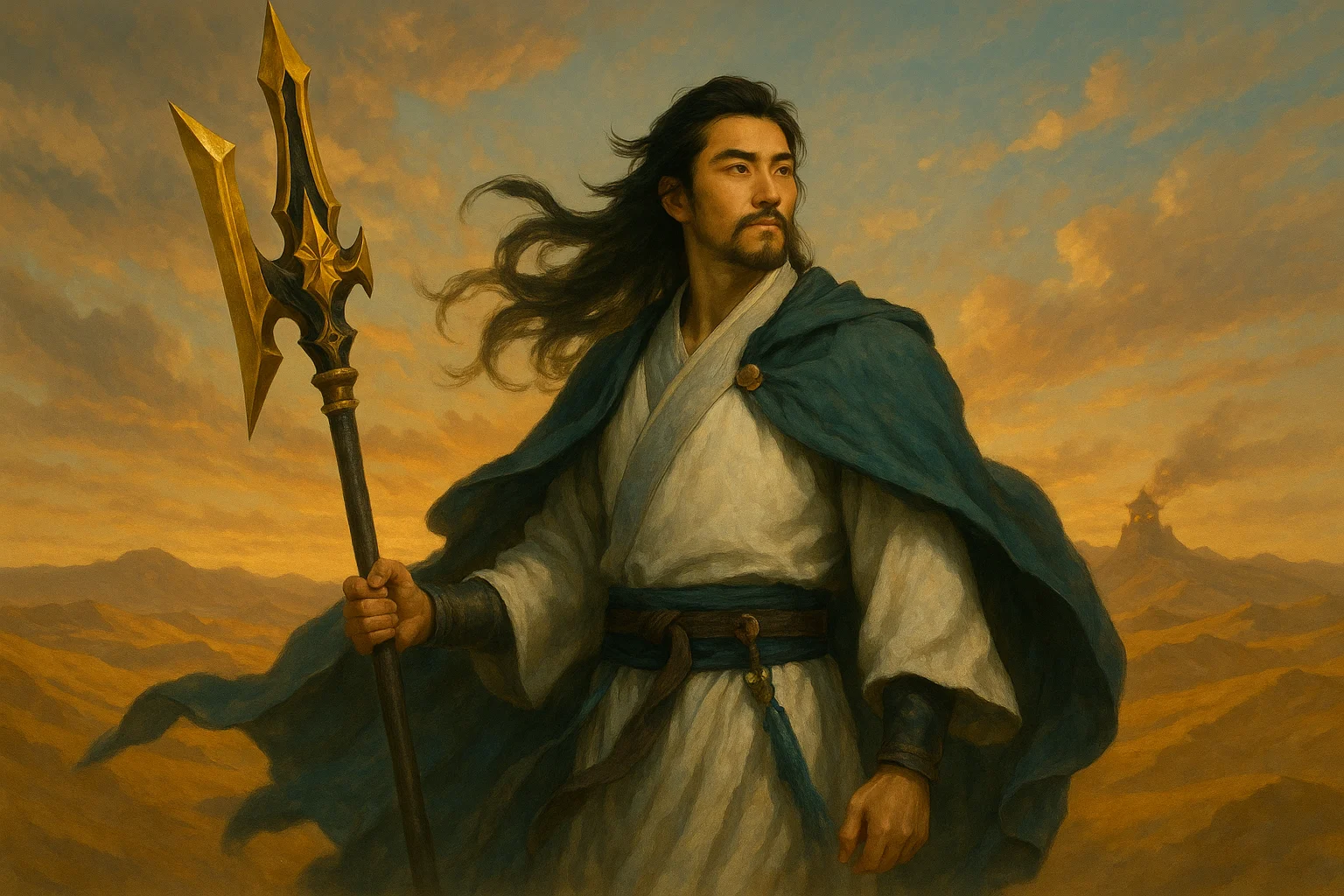
Gao Shi (高适 704 - 765), a native of Jingxian County, Hebei Province, he was a representative poet of the Frontier Fortress School in the High Tang period. In his early years, he lived in poverty and hardship, associating with Li Bai and Du Fu. After the age of fifty, he rose through successive official posts from Prefect of Songzhou to Chief Steward of the Court, and was ennobled as Marquis of Bohai County. Gao Shi excelled in the seven-character ancient verse, with a vigorous and solemn style. He pioneered a new realm of frontier poetry by incorporating a political and military perspective, exerting a profound influence on frontier poetry of the Mid and Late Tang dynasties as well as on patriotic poets like Lu You.