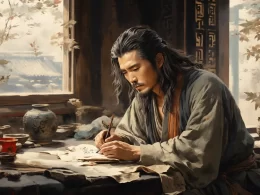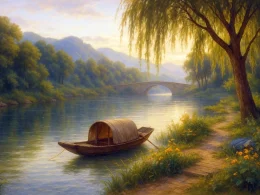



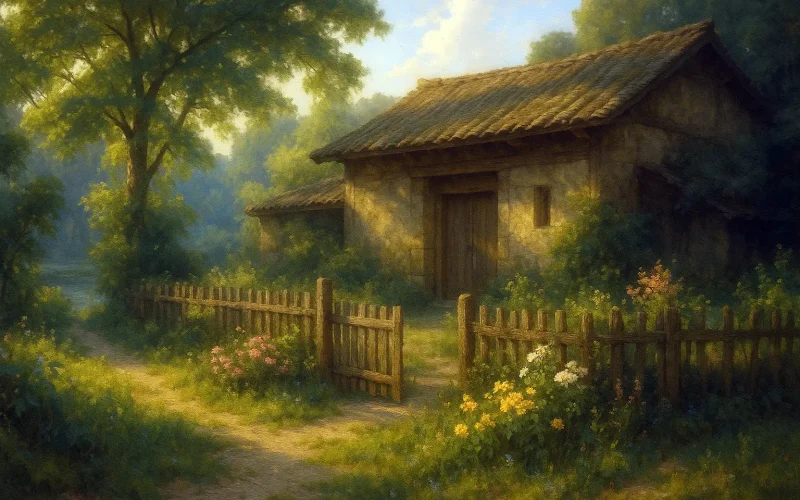
Walking along a little path,
I find a footprint on the moss,
A white cloud low on the quiet lake,
Grasses that sweeten an idle door,
A pine grown greener with the rain,
A brook that comes from a mountain source -
And, mingling with Truth among the flowers,
I have forgotten what to say.
Original Poem
「寻南溪常道士」
刘长卿
一路经行处,莓苔见屐痕。
白云依静渚,芳草闭闲门。
过雨看松色,随山到水源。
溪花与禅意,相对亦忘言。
Interpretation
This poem is a fine work among Liu Zhangqing's landscape and reclusion poetry. Using the search for a recluse as its thread, it sketches a deeply serene and distantly clear mountain and forest landscape. Liu Zhangqing's official career was fraught with difficulties, marked by two demotions; the phrase "刚而犯上" (unyielding and offending superiors) almost entirely sums up the vicissitudes of his official life. Yet it was precisely this disappointment that gave him a profound yearning for the life of a recluse—those mountains and forests far from the worldly clamor, those hermits dwelling amidst clouds and waters, became the sustenance and solace for his spirit.
The exact date of composition for this poem is difficult to ascertain, but judging from the scenery and mood described, it was likely written during the poet's travels in the Jiangnan region. "South Stream" is presumably the name of a mountain stream; "Taoist Chang" was a Taoist recluse dwelling there. The poet made a special trip to visit, though he may not have actually met him. Instead, he gained from the journey a dialogue with the landscape and an encounter with Chan (Zen) sensibility. The traces of clogs on the moss, the silent islet embraced by white clouds, the verdant hue of pines after rain, the silent wildflowers by the stream—all reveal the poet's appreciation and longing for the reclusive life. The poem shows no hermit, yet the hermit's presence is everywhere; it contains no Chan discourse, yet the flow of Chan meaning is throughout. This is Liu Zhangqing's brilliance: using the search for a person as a pretext to write of the delight of landscape; using the visit to a recluse as a name to express the aspiration for detachment.
First Couplet: "一路经行处,莓苔见屐痕。
Yīlù jīngxíng chù, méitái jiàn jī hén.
Along the path I’ve traveled, moss has overgrown The footprints by the wooden clogs on stepping-stone.
The poem opens with a deeply secluded mountain path. "Along the path I’ve traveled" begins plainly, yet it is captivating—we follow the poet's footsteps onto this journey to find the recluse. The five characters "莓苔见屐痕" (méitái jiàn jī hén, moss, traces of clogs are seen) immediately reveal the seclusion of this place: moss grows where few people tread, and the traces of clogs are imprinted upon the moss, indicating someone passed by a few days ago. These footprints were likely left by Taoist Chang coming and going; this moss witnesses the quiet solitude of a place rarely visited. The word "见" (jiàn, to see) gently reveals the poet's expectation in his search and his delight upon discovering the footprints, subtle and full of charm.
Second Couplet: "白云依静渚,芳草闭闲门。
Bái yún yī jìng zhǔ, fāngcǎo bì xián mén.
White clouds lean on quiet shores; sweet grass shuts rustic doors.
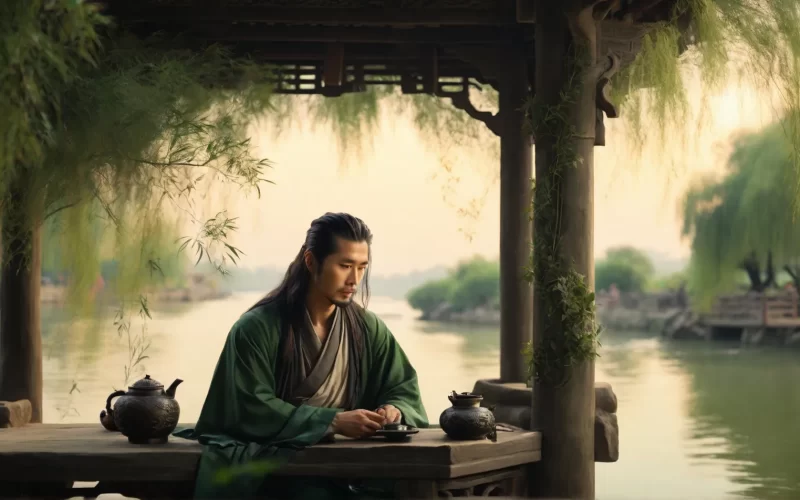
The poet arrives at the Taoist's dwelling, and before his eyes is a scene of profound quiet. "白云依静渚" (bái yún yī jìng zhǔ, white clouds lean on quiet shores) describes the distant view—over the small islet by the water, white clouds linger, as if clinging to this pure, quiet place. "芳草闭闲门" (fāngcǎo bì xián mén, sweet grass shuts rustic doors) describes the nearer view—the lush grass before the gate has grown so thick it almost obscures the door. The word "闭" (bì, to shut, close) is wonderfully used: the door is closed of itself, yet because of the lush, abundant grass, it appears all the more "idle" and all the more indicative of its master's long absence. This couplet, with distant and near views reflecting each other, stillness and life intermingling, renders the pure seclusion and detachment of the Taoist's dwelling to perfection. Though no person is seen, that person's lofty detachment is already implied without words.
Third Couplet: "过雨看松色,随山到水源。
Guò yǔ kàn sōng sè, suí shān dào shuǐ yuán.
After rain I watch the pine’s hue; Following the hill, I find the stream’s head new.
The Taoist not being in, the poet does not return disappointed. Instead, following his inclination, he continues onward. "过雨看松色" (guò yǔ kàn sōng sè, after rain, watch the pine's hue) describes the pine forest after rain—washed by a shower, the green of the pines becomes even more vividly lush. Within this word "看" (kàn, to watch, look) lies the poet's sensitive observation of nature, as well as the pleasure after clearing rain. "随山到水源" (suí shān dào shuǐ yuán, following the hill, reach the stream's source) describes following the mountain's contours all the way to the stream's source. The word "随" (suí, to follow) conveys both the winding mountain path and the poet's state of mind—following circumstance, at ease. Not meeting the person sought, he met the landscape instead; failing to find the hermit, he found the source for his spirit. This couplet elevates the process of searching into a spiritual wandering, foreshadowing the Chan enlightenment in the final couplet.
Fourth Couplet: "溪花与禅意,相对亦忘言。
Xī huā yǔ chán yì, xiāngduì yì wàng yán.
With a recluse’s philosophy Flower on the stream’s in unity; Facing each other, we forget words to say.
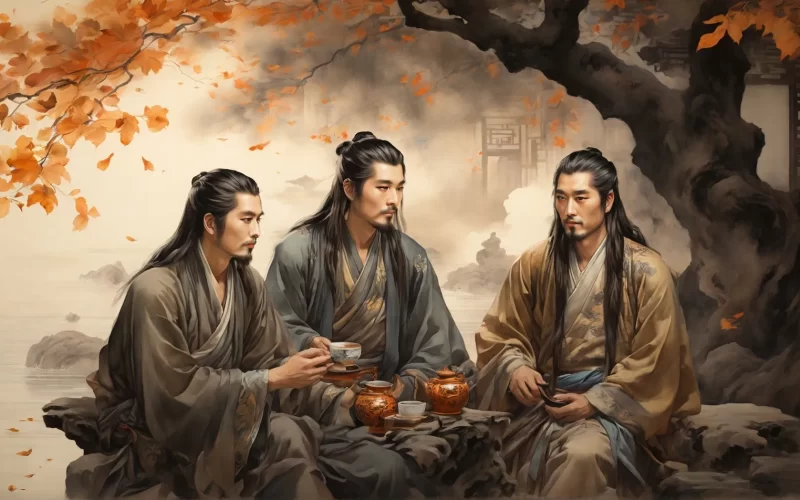
The final couplet is the soul of the entire poem. "溪花与禅意" (xī huā yǔ chán yì, stream flowers and Chan meaning)—the poet places the wildflowers by the stream alongside "Chan meaning." It is not that the flowers possess Chan, but that within this scene and moment, Chan understanding arises in the poet's heart. Those stream flowers bloom quietly, unseen, yet bloom freely nonetheless; that stream water babbles and flows, unheard, yet flows freely nonetheless. Is this not precisely the realm of Chan? Facing the stream flowers, the poet's mind connects with the object; suddenly he enters the state of "相对亦忘言" (xiāngduì yì wàng yán, facing each other, we also forget words). This "forgetting words" is not having nothing to say, but transcending the realm of speech—when hearts and minds commune, what need is there for words? Just as Tao Yuanming wrote, "Herein lies the true meaning; I meant to explain, but forgot the words," Liu Zhangqing here reaches the same sudden enlightenment: true Chan meaning is not in scriptures, not in words, but amidst this landscape, within these wordless flowers and plants.
Holistic Appreciation
This is a masterpiece among Liu Zhangqing's landscape and reclusion poetry. The entire poem consists of eight lines and forty characters. Using the search for a hermit as its thread, it merges the scenes seen along the way, the feelings stirred, and the principles apprehended, presenting a deeply serene, distantly clear, and richly Chan-infused mountain and forest landscape.
Structurally, the poem presents a progressive layering from journeying to stillness, from outer to inner, from object to mind. The first couplet describes what is seen on the path—moss and footprints, highlighting the seclusion of the route. The second couplet describes the scene of the dwelling—white clouds and fragrant grass, enhancing the environment's pure solitude. The third couplet describes following inclination—watching pines, seeking the source, moving from stillness back to journeying, transitioning into a wandering of the spirit. The fourth couplet describes the state of Chan enlightenment—stream flowers, forgetting words, moving from object to mind, sublimating into a recognition of philosophy. Between the four couplets, moving from journeying to stillness, stillness to wandering, wandering to enlightenment, the poem deepens layer by layer, seamlessly natural.
Thematically, the core of this poem lies in the two words "忘言" (wàng yán, forget words). The "footprints" of the first couplet are the pursuit of the hermit; the "idle door" of the second is the disappointment of searching but not meeting; the "watching pines" and "seeking the source" of the third are the open-mindedness of following circumstance and being at ease; the "forgetting words" of the final couplet is the transcendence gained amidst the landscape—not meeting the hermit sought, he met himself instead; not finding Chan meaning, he attained sudden enlightenment before the stream flowers. This "meeting within not meeting" is the deepest implication of the entire poem: true reclusion is not in the mountains and forests, but in the state of mind; true Chan meaning is not in words, but in wordlessness.
Artistically, the poem's most moving aspect lies in the dual reflection of "using scene to write of person, using object to apprehend the Way." Writing of the hermit, the poet never lets the hermit appear, only hinting at his presence with "footprints" and "idle door." Writing of Chan meaning, he does not touch a single phrase of Chan discourse, only suggesting its realm with "stream flowers" and "forgetting words." Writing of a person without showing the person, yet the person's lofty detachment appears of itself; speaking of Chan without speaking of Chan, yet the interest and meaning of Chan deepen of itself. This technique of subtle implication, meaning beyond words, is precisely the highest realm of classical Chinese poetry: "not using a single word, yet capturing all the charm."
Artistic Merits
- Using Scene to Portray Person, Subtle and Rich: The entire poem does not use a single word to directly describe the hermit, yet through imagery like moss, footprints, white clouds, fragrant grass, and the idle door, it vividly renders the hermit's lofty detachment and simplicity.
- Clear Layers, Gradually Reaching Excellence: Moving from journeying to dwelling, from dwelling to landscape, from landscape to Chan enlightenment, the four couplets unfold like a scroll painting, captivating and leading one into the scene.
- Clear, Beautiful Language, Natural and Unaffected: Lines like "White clouds lean on quiet shores" and "After rain I watch the pine’s hue" use concise, refined wording without artificial carving, possessing a strong sense of imagery, making the reader feel as if present in the scene.
- Meaning Beyond Words, Lingering Chan Flavor: The final couplet concludes with "forgetting words," pushing the poem's artistic conception to a philosophical level. The words end, but the meaning is endless.
Insights
Using the journey to visit a hermit, this poem speaks to an eternal theme—true meetings often occur not where expected; true gains often come at the moment of not meeting.
It first allows us to see the "beauty of not meeting." The poet made a special trip to visit Taoist Chang but did not get to see him. Yet it was precisely this "not meeting" that allowed him to leisurely appreciate the scenery along the way, to wander freely to the water's source, to attain sudden enlightenment in Chan before the stream flowers. Many of life's beauties occur precisely "outside of plans": seeking but not finding, one often gains more; striving too urgently, one often loses the process. Through this unsuccessful search, Liu Zhangqing tells us: let go of attachments, follow circumstance, and you will often encounter more beautiful scenery.
On a deeper level, this poem prompts us to contemplate the "realm of wordlessness." "Facing each other, we forget words to say"—when the poet faced the stream flowers and Chan meaning arose in his heart, he found words were superfluous. The deepest understandings in this world are often inexpressible in words; the most beautiful encounters are often completed in silence. We are accustomed to using language to define, explain, and express, forgetting that some things can only be grasped in silence. Those stream flowers are wordless, yet express everything; that landscape is wordless, yet contains everything. This is the realm in Chinese philosophy of "the greatest sound seems soundless; the greatest image appears formless."
And what is most evocative is the attitude towards life of "following circumstance and being at ease" in the poem. The poet, not meeting the hermit he sought, is neither disappointed nor insistent. Instead, he follows the mountain until he reaches the water's source. This attitude of following circumstance is itself a form of Chan meaning. In life, eight or nine out of ten things do not go as we wish. If one can be like Liu Zhangqing, finding "meeting" within "not meeting," finding "gain" within "having gained nothing," that is a rare open-mindedness and wisdom.
This poem writes of a mountain search in the Tang dynasty, yet allows everyone searching on life's path to find resonance within it. The footprints on the moss are the traces of every seeker; the wildflowers by the stream are the opportunity for every enlightened person; the wordless facing is the shared tacit understanding of every kindred spirit. This is the vitality of poetry: it writes of one person's experience, but reads as the state of mind of all.
Poem translator
Kiang Kanghu
About the Poet
Liu Zhangqing (刘长卿 c. 726 – c. 786), a native of Xuancheng, Anhui Province, was a poet of the Mid-Tang Dynasty. He obtained the jinshi degree (presented scholar) in the late Tianbao era and successively held official posts such as Sheriff of Changzhou and Investigating Censor. Due to his upright and unyielding character, he was exiled twice. His poetry, particularly his five-character verses, achieved the highest distinction, often depicting the melancholy of exile and the joys of reclusion in landscapes. His poetic style is refined, elegant, and ethereal, blending a desolate undertone with the meticulousness characteristic of the Ten Talented Poets of the Dali era. He excelled in using plain sketching to create an atmosphere of tranquil emptiness and profound remoteness. As a pivotal poet bridging the High Tang and Mid-Tang periods, his work inherits the idyllic charm of Wang Wei and Meng Haoran while foreshadowing the bleak and cool elegance of Dali poetry. He exerted a certain influence on late Tang poets such as Yao He and Jia Dao, who belonged to the "painstaking school."