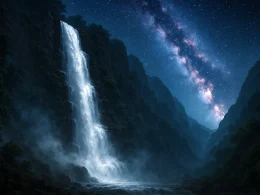



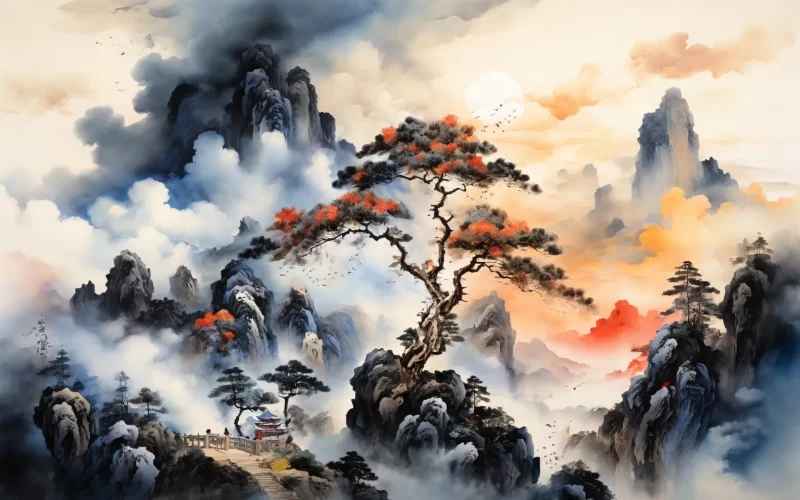
Lords of the capital, sharp, unearthly,
The Great Flower's three points pierce through heaven.
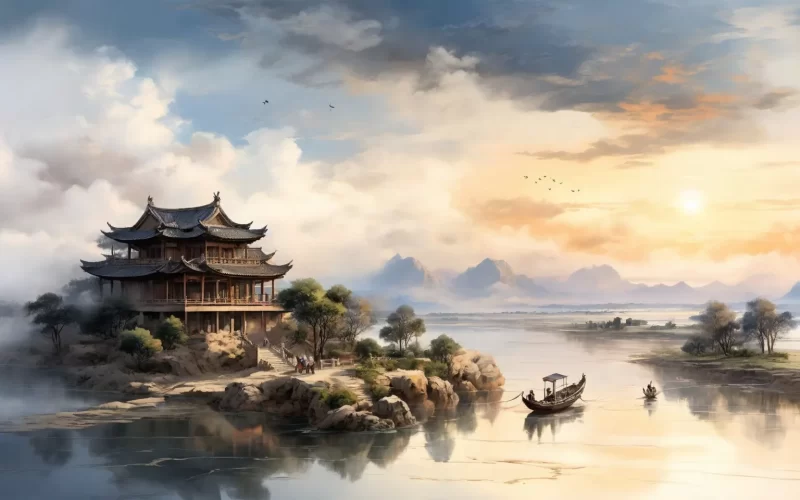
Clouds are parting above the Temple of the Warring Emperor,
Rain dries on the mountain, on the Giant's Palm.

Ranges and rivers are the strength of this western gate,
Whence roads and trails lead downward into China.
...O pilgrim of fame, O seeker of profit,
Why not remain here and lengthen your days?
Original Poem
「行经华阴」
崔颢
岧峣太华俯咸京,天外三峰削不成。
武帝祠前云欲散,仙人掌上雨初晴。
河山北枕秦关险,驿树西连汉畤平。
借问路傍名利客,无如此处学长生。
Interpretation
"Passing through Huayin" is a representative landscape poem by the Tang poet Cui Hao, composed as he traveled through the Huayin region. The poem takes the majestic grandeur of Mount Hua (Huashan) as its backdrop, interweaving reflections on nature, history, and human existence. Huayin lay on the essential route from Bianliang to Chang'an. Standing before the towering presence of Mount Hua, the poet was awestruck by nature's sublime artistry, yet also stirred to profound questioning about the worldly pursuit of fame and fortune. The poem masterfully integrates the magnificence of the landscape, the remoteness of history, and a moment of personal insight. Its language is vigorous, its conception vast and profound, making it a distinguished philosophical landscape piece within Cui Hao's corpus of heptasyllabic regulated verse. To understand its creation, one must consider the dual context of Cui Hao's early life trajectory and the prevailing ethos of the High Tang era. Huayin was a necessary postal station between Luoyang and Chang'an, and Mount Hua, the "Western Sacred Peak," was not merely a geographical pinnacle but a spiritual landmark bearing a rich legacy of history, culture, and religious lore. Emperor Wu of Han had performed sacrifices to heaven here; legends surrounding the Immortal's Palm Peak stretch back centuries. It had long been revered as a sacred space bridging the human and the divine.
Cui Hao was undertaking a journey emblematic of Tang literati: traveling to seek patronage or proceed to the capital for official selection. As a young scholar-official harboring career ambitions, his destination was Chang'an, the empire's political heart, symbolizing the ultimate worldly achievement—fame and status. Yet, arriving at Huayin and gazing up at the "towering Mount Hua," this colossal peak, with its overwhelming natural grandeur and profound historical aura, posed a spiritual interrogation to all "seekers of fame and fortune" hastening along the postal roads. Therefore, the birth of this poem was far from an ordinary lyrical response to scenery. It represents the intense inner turmoil experienced by a young soul at a critical juncture in life's path when confronted with an eternal spiritual symbol.
First Couplet: "岧峣太华俯咸京,天外三峰削不成。"
Tiáo yáo tài huà fǔ xián jīng, tiān wài sān fēng xuē bù chéng.
Lofty Mount Hua overlooks the Capital Xianjing; / Its three perilous peaks, as if from beyond the skies, no human craft could shape.
The opening couplet immediately sketches Mount Hua's full majesty from a commanding, overlooking perspective, emphasizing its dominance over the Central Plains and its connection to realms beyond heaven. The phrase "no human craft could shape" not only depicts the mountain's dangerously steep, uncarvable natural form but also subtly hints at its transcendent, immortal quality, establishing the poem's lofty and profound tone.
Second Couplet: "武帝祠前云欲散,仙人掌上雨初晴。"
Wǔ dì cí qián yún yù sàn, xiān rén zhǎng shàng yǔ chū qíng.
Before Emperor Wu's shrine, the clouds begin to disperse; / Upon the Immortal's Palm, the rain has just cleared.
The perspective shifts from distant to near, focusing on specific scenes within the mountains. The momentary changes of dispersing clouds and clearing rain not only depict Mount Hua's ethereal, misty charm but also, through the cultural and legendary imagery of "Emperor Wu's shrine" and the "Immortal's Palm," subtly fuse the natural scenery with historical mythology. Layers of time and belief instantly coalesce within the spatial description.
Third Couplet: "河山北枕秦关险,驿树西连汉畤平。"
Hé shān běi zhěn qín guān xiǎn, yì shù xī lián hàn zhì píng.
To the north, rivers and mountains rest against the perilous Qin passes; / To the west, trees along the postal road stretch toward the plains of Han sacrificial altars.
The poet's gaze expands again, placing Mount Hua within a broader geographical and historical framework. The perilous terrain to the north contrasts with the distant, level plains to the west. Between "perilous" and "level," the poet captures the geographical contrasts while implicitly contemplating the historical depth woven from power and belief since the Qin and Han dynasties.
Fourth Couplet: "借问路傍名利客,无如此处学长生。"
Jiè wèn lù bàng míng lì kè, wú rú cǐ chù xué cháng shēng.
I ask those wayfarers by the roadside, seekers of fame and gain: / Why not stay here instead, and learn the way to lasting life?
Following the descriptive momentum built over the first three couplets, the final couplet naturally transitions to lyrical reflection. The poet uses "I ask" to pose a rhetorical question to the "seekers of fame and gain," which is essentially a self-interrogation. Before eternal nature and profound history, worldly fame and fortune appear fleeting and insignificant. "Learn the way to lasting life" signifies not merely the Daoist pursuit of longevity but symbolizes a spiritual quest to distance oneself from worldly burdens and return to nature and authenticity.
Holistic Appreciation
The poem unfolds from the mobile perspective of a traveler. Spatially, it moves from a distant gaze to a closer observation, then to expansive historical and geographical connections. Emotionally, it progresses from scene to feeling, from feeling to thought, layer upon layer, ultimately settling on a reflection on life's values.
The poet does not directly praise or condemn the pursuit of "fame and gain" versus the quest for "lasting life." Instead, through the towering eternity of Mount Hua and the vicissitudes of history contrasted with the "seekers of fame and gain" bustling on the postal road, he creates a vivid juxtaposition of stillness versus motion, permanence versus transience. Within this contrast, the poem naturally reveals a spiritual tension: should one continue westward to Chang'an in pursuit of achievement, or halt here and turn towards the clarity and peace of the mountains? This tension is not simplistically resolved; rather, amplified by the sublimity of Mount Hua and the vastness of history, it appears exceptionally profound and moving.
Artistic Merits
- Dynamic Perspective, Orderly Layers: From the overarching, distant view of "overlooks the Capital" to the nearer mountain scenes of "clouds begin to disperse" and "rain has just cleared," then to the historical-geographical expansion of "rest against the Qin passes" and "stretch toward… Han sacrificial altars," the perspective shifts freely between distance and proximity, the tangible and the intangible, time and space, creating a three-dimensional and majestic poetic expanse.
- Interwoven Imagery, Profound and Weighty: Elements like "Emperor Wu's shrine," "Immortal's Palm," "Qin passes," and "Han sacrificial altars" are both specific historical sites and cultural symbols bearing memory and Daoist legend. Natural scenery and humanistic imagery mutually enhance each other, endowing the poem with a deep sense of history and a dimension of transcendence.
- Vigorous Language with Implicit Meaning: The poetic lines possess an expansive atmosphere and robust force, particularly the first and third couplets, which are highly visually impactful and spatially tense. Yet, the expression of emotion remains restrained and implicit. The questioning in the final couplet appears direct but actually harbors profound life choices within its seemingly light words, leaving a lasting resonance.
- Precise Structure, Natural Transitions: The first three couplets describe the scenery, the final couplet expresses sentiment. The progression is clear and fluent. The description subtly lays the groundwork for the lyrical expression, which in turn circles back to the scenes at hand. Scene and feeling give rise to each other, forming a seamless whole.
Insights
The deeper value of this work lies in its depiction of a moment of "spiritual encounter" common to humanity. On our life's journey, there always exist presences akin to "Mount Hua"—it might be a noble calling, a lofty ideal, a form of pure beauty, or a question concerning life's ultimate meaning. It stands imposingly beside the track of our daily progress, its transcendent height and depth reflecting the limitations of the specific goals we ordinarily chase.
The modern significance of the question, "I ask those wayfarers by the roadside, seekers of fame and gain," is not to advise abandoning all social pursuits for a hermit's life, but to remind us that in our wholehearted striving toward a goal, we must not lose our perception of and reverence for the higher dimensions and broader scales of existence. The eternal nature and historical depth represented by Mount Hua offer a corrective perspective. It allows us to temporarily detach from the anxiety of viewing daily affairs at eye level or even looking down upon them, and to learn to "look up" and "contemplate deeply."
Ultimately, the poet does not provide a simple, either-or answer. The poem's conclusion is an open-ended pause and inquiry. This reveals a profound wisdom: true maturity may lie in simultaneously embracing these two orientations. We can continue to advance diligently on the "postal road" of reality, but if we can always hold within our hearts the reflection of a "Mount Hua"—maintaining sensitivity and yearning for nature, beauty, history, and transcendent values—then our journey will carry less restlessness born of being wholly driven by utility, and more composure and steadfastness drawn from vaster spans of time and space.
This poem stands as an eternal spiritual signpost. It tells us that a rich life requires not only the perseverance to press forward but also the timely act of pausing, to accept the baptism and rigorous questioning offered by the sublime, and through this, to gain a clearer and more profound understanding of one's own path.
Poem translator
Kiang Kanghu
About the poet
Cui Hao (崔颢), A.D. ? – 754, a native of Kaifeng, Henan Province. He was admitted as a scholar in 723 AD. At that time, Cui Hao was well known, along with Wang Changling, Gao Shi, Meng Haoran, and Wang Wei.