

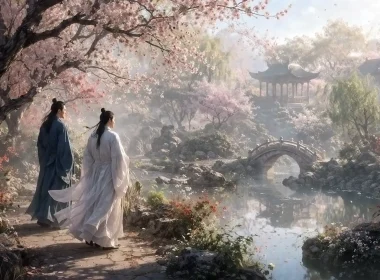
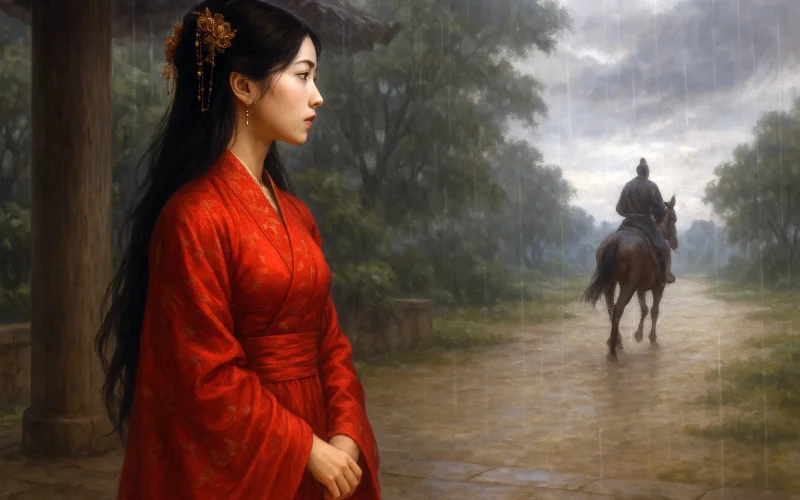
Dodder clings to hemp, but its vine won’t grow long.
To marry a girl to a soldier is to cast her away.
Tying my hair, I became your wife last night;
But hardly had I warmed your bed by my side.
We wed at dusk, and you leave at dawn;
Isn’t it too hasty, this morning goodbye!
Although you’re not going a long way away,
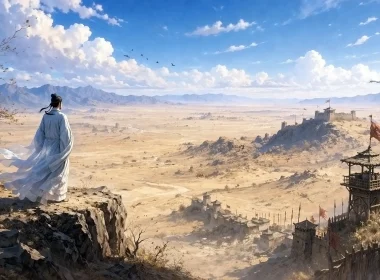
To guard the border you’ll go to the riverside.
As your wife, I’m not yet acknowledged by your kin;
How can I pay respect to your parents as daughter-in-law?

When I lived with my parents, I was kept indoors day and night.
They said a girl should be wedded, be it to cock or dog.
You’re going now to the place of death;
Grief presses hard on my heart and my bowels.
I swear to go with you, but the situation is urgent and grim.
Don’t think of your new-wedded wife! Serve in the army with might!
A woman in the army would lower the soldiers’ morale.
Alas! I’m but a girl of a poor family;
It took long to get silk clothes for the bridal day.
No more shall I wear the silk robe;
For you I’ll wash off my bridal paint.
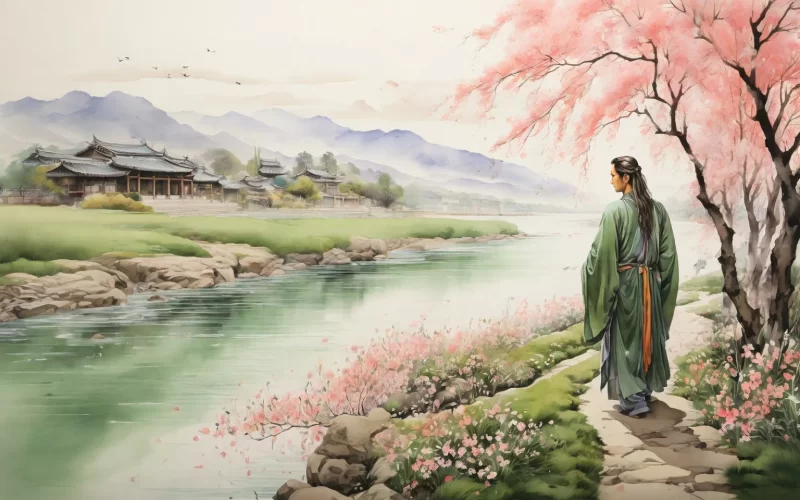
Looking up, I see birds in flight, large and small, wing to wing.
Human affairs often go wrong;
I’ll gaze at you for ever and ever!
Original Poem:
「新婚别」
杜甫
兔丝附蓬麻,引蔓故不长。
嫁女与征夫,不如弃路旁。
结发为君妻,席不暖君床。
暮婚晨告别,无乃太匆忙。
君行虽不远,守边赴河阳。
妾身未分明,何以拜姑嫜?
父母养我时,日夜令我藏。
生女有所归,鸡狗亦得将。
君今往死地,沉痛迫中肠。
誓欲随君去,形势反苍黄。
勿为新婚念,努力事戎行。
妇人在军中,兵气恐不扬。
自嗟贫家女,久致罗襦裳。
罗襦不复施,对君洗红妆。
仰视百鸟飞,大小必双翔。
人事多错迕,与君永相望。
Interpretation:
This poem is the first in Du Fu's acclaimed "Three Partings" series, written in the spring of 759 AD during the Qianyuan era. The An Lushan Rebellion was still ongoing, and the disastrous defeat of the Nine Military Governors at Yecheng led to widespread conscription around Luoyang and Tong Pass. Against this backdrop of extreme wartime brutality, Du Fu adopts a "persona" or "dramatic monologue" form, speaking through the voice of a bride who faces a life-and-death separation the morning after her wedding. The poem expresses war's most cruel and intimate destruction of ordinary human bonds and happiness, revealing the profound sorrow and resilience of common people amidst national calamity.
Part 1: "兔丝附蓬麻,引蔓故不长。嫁女与征夫,不如弃路旁。结发为君妻,席不暖君床。暮婚晨告别,无乃太匆忙。"
Tù sī fù péng má, yǐn màn gù bù cháng. Jià nǚ yǔ zhēng fū, bùrú qì lù páng. Jiéfà wéi jūn qī, xí bù nuǎn jūn chuáng. Mù hūn chén gàobié, wú nǎi tài cōngmáng.
I am like the dodder vine clinging to lowly hemp; its tendrils thus can never grow long. To wed a daughter to a soldier bound for war is worse than abandoning her by the roadside at dawn.
Bound as your wife by the marriage knot, I've not yet warmed the mat upon your bed. Wed at dusk, parting at dawn—is this not far too rushed ahead?
The poem opens with two striking metaphors. "The dodder vine clinging to lowly hemp" uses the delicate dodder (the bride) clinging to short-lived hemp (the soldier-husband) as a self-description, foreshadowing the fragility of the marriage's foundation and its tragic end. "Worse than abandoning her by the roadside" is an utterance of utter agony, portraying the fate of a soldier's wife in wartime as more wretched than that of an abandoned infant—a direct indictment of war's absurdity. The extreme situation of "wed at dusk, parting at dawn" encapsulates the fleeting nature of ordinary happiness in wartime. The anguished question, "is this not far too rushed?" is a deeply grievous lament against the mercilessness of fate.
Part 2: "君行虽不远,守边赴河阳。妾身未分明,何以拜姑嫜?父母养我时,日夜令我藏。生女有所归,鸡狗亦得将。"
Jūn xíng suī bù yuǎn, shǒu biān fù hé yáng. Qiè shēn wèi fēnmíng, héyǐ bài gū zhāng? Fùmǔ yǎng wǒ shí, rìyè lìng wǒ cáng. Shēng nǚ yǒu suǒ guī, jī gǒu yì dé jiāng.
Your journey is not distant, yet you go to guard Heyang, the frontier's strife. My status as a wife remains unclear; how can I face your parents in this life?
When my parents raised me, day and night they taught me to stay unseen. A daughter must find her home, they said; I must follow, whether cock or hound, the man to whom I'm wed.
This section shifts to detailing practical dilemmas. "My status as a wife remains unclear" points to the specific social predicament caused by the immediate separation: according to ancient rites, a bride's status was confirmed only after "meeting her parents-in-law" the day after the wedding. Her husband's sudden departure leaves her in an awkward, isolated state of unresolved identity. This leads to recollections of her upbringing ("day and night they taught me to stay unseen") and the proverb about "following the man, be he cock or hound." This illustrates both her proper upbringing and her acceptance of fate, while also universalizing her plight—a woman raised according to social norms is thrown into the maelstrom of destiny by the abnormality of war.
Part 3: "君今往死地,沉痛迫中肠。誓欲随君去,形势反苍黄。勿为新婚念,努力事戎行。妇人在军中,兵气恐不扬。自嗟贫家女,久致罗襦裳。罗襦不复施,对君洗红妆。仰视百鸟飞,大小必双翔。人事多错迕,与君永相望。"
Jūn jīn wǎng sǐdì, chéntòng pò zhōng cháng. Shì yù suí jūn qù, xíngshì fǎn cāng huáng. Wù wéi xīnhūn niàn, nǔlì shì róng háng. Fùrén zài jūnzhōng, bīng qì kǒng bù yáng. Zì jiē pín jiā nǚ, jiǔ zhì luó rú cháng. Luó rú bù fù shī, duì jūn xǐ hóngzhuāng. Yǎng shì bǎi niǎo fēi, dàxiǎo bì shuāng xiáng. Rénshì duō cuòwǔ, yǔ jūn yǒng xiāng wàng.
You go now to a place of likely death; grief wrenches my very core. I vowed to follow you, yet fear my presence might bring chaos more.
Think not of our new marriage; strive your martial duties to fulfill. A woman in the army's ranks might dampen the troops' will.
Alas, I am a daughter from a poor family, who long saved for this silken bridal dress. This silken dress I'll wear no more; before you, I wash off my redness.
I look up: a hundred birds in flight, all wing in pairs, both large and slight. Human affairs are fraught with strife; I shall gaze towards you all my life.
This is the emotional culmination and resolution of the entire poem. The bride's feelings wrestle fiercely between the excruciating pain of "grief wrenches my very core" and the rational choice of "Think not of our new marriage; strive your martial duties to fulfill." She even considers following the army but restrains herself with the simple understanding that "A woman in the army's ranks might dampen the troops' will," showing a profound sense of responsibility towards family and country. Then, the resolute act of "before you, I wash off my redness" is her emotional vow and chosen destiny—washing off the bridal makeup signifies bidding farewell to marital joy and entering a long, chaste wait. The ending uses the image of "birds in flight, all wing in pairs" to contrast human separation. With a sigh over "human affairs are fraught with strife," the poem concludes with the vow "I shall gaze towards you all my life," elevating the personal tragedy into a timeless expression of fidelity and steadfast waiting.
Holistic Appreciation
The artistic achievement of this work lies in Du Fu's astonishing empathy and descriptive power, which allow a perfect "assumption of persona." He delves into the inner world of a humble bride, portraying the undulations of her emotions as convincingly real: from indignant accusation, to practical bewilderment, to painful struggle, finally settling into patient sacrifice and watchfulness. The poem employs a folk-song-style soliloquy; the language is plain as speech, yet every word carries the weight of blood and tears. The bride is no longer a passively sorrowful figure of traditional boudoir laments, but a flesh-and-blood, admirable woman who, facing immense catastrophe and weathering an emotional storm, ultimately subsumes her personal pain into duty towards family and country. Her final choices (urging her husband on, forswearing adornment, eternal gazing) represent the highest choice available to ordinary people who have no other, embodying the resilient character of the common folk in Du Fu's works—"sorrowful but not morbid, resentful but not raging."
Artistic Merits
- Exquisite Metaphor and Evocative Opening: The opening metaphor, "the dodder vine clinging to lowly hemp," is apt and poignantly beautiful, establishing the poem's tragic tone. The concluding evocation of "birds in flight, all wing in pairs" uses nature's harmony to contrast the discord of human affairs, leaving a lasting resonance.
- Subtle Depiction of Psychological Development: The poem strictly follows the psychological logic of "encountering sudden change → emotional outburst → practical consideration → rational choice → emotional transcendence," making the character three-dimensional, fully fleshed, and deeply moving.
- Symbolic Meaning of Detailed Action: The typical detail "before you, I wash off my redness" is visually and emotionally powerful. It symbolizes the multiple vows of bidding farewell to the wedding, maintaining chastity, and awaiting return, serving as the definitive gesture that crystallizes the character's personality.
- Deep Fusion of Personal Tragedy and Historical Background: Not a single word directly describes the battlefield or the court, yet through brief mentions like "guard Heyang" and "strive your martial duties," the personal tragedy of the newlyweds' parting is firmly anchored within the broader context of the An Lushan Rebellion, achieving an epic effect of "revealing the universal through the particular."
Insights
This work shows us that war's greatest crime lies not only in taking lives but in destroying the most fundamental and beautiful of human emotions and bonds—the warmth of a single night's marriage bed. The bride's transformation from the despair of "worse than abandoning her by the roadside" to the steadfastness of "I shall gaze towards you all my life" constitutes a spiritual rebirth. She teaches us that in the face of unavoidable, immense suffering, one can still retain the dignity of choice: to wallow in grief, or, upon recognizing the inevitability of tragedy, to elevate personal feeling into a broader form of devotion and endurance.
This poem moves us across a millennium because it touches a universal human vulnerability: the longing for stable happiness, and the resilience of the spirit under the heavy press of fate. It reminds us that no grand narrative (like war, state policy) should ignore its crushing effect on the microscopic happiness of countless individuals; and that the individual's sense of duty—"strive your martial duties"—and fidelity—"gaze towards you all my life"—within the torrent of the times, is among the most imperishable glories of human nature.
About the poet
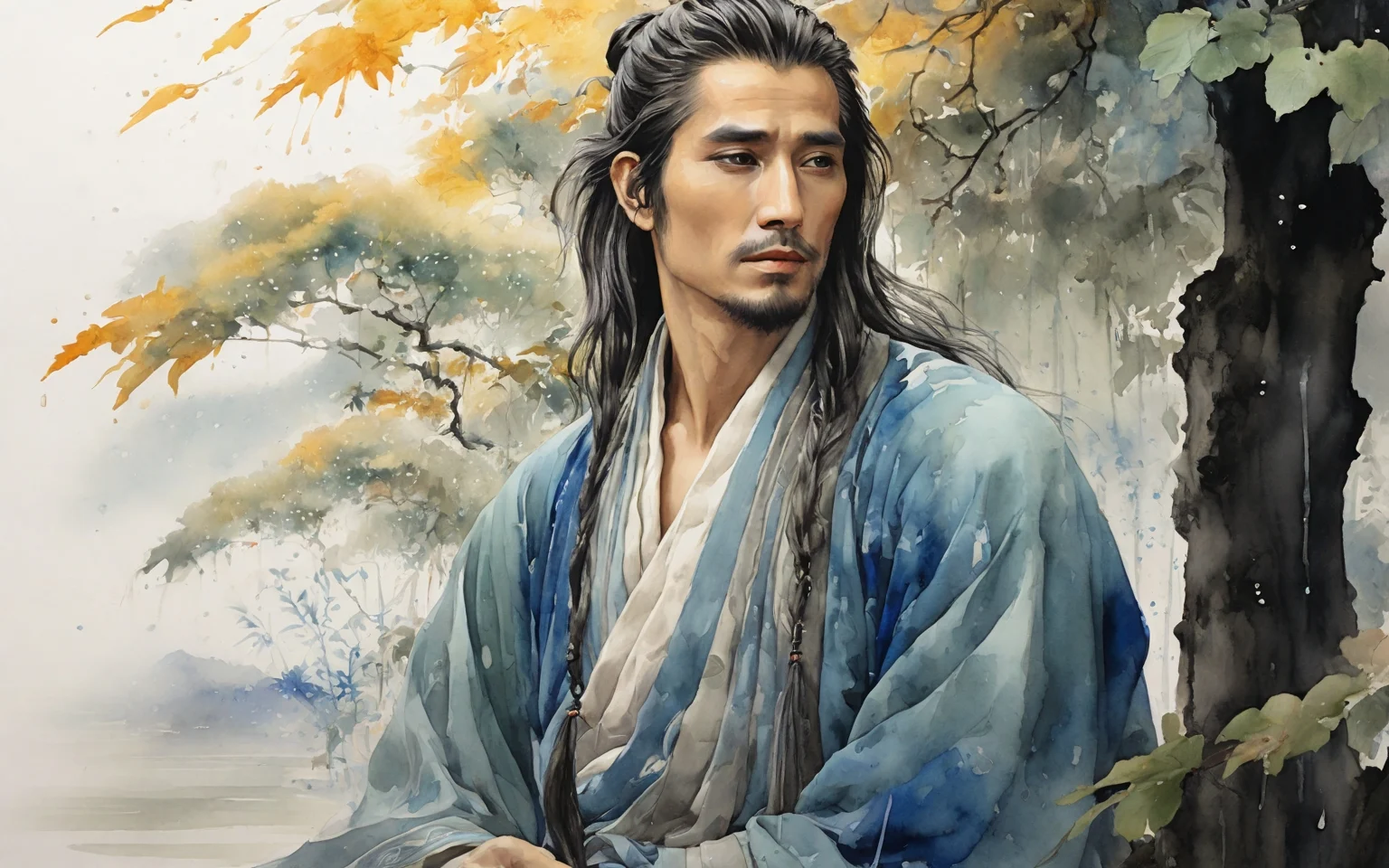
Du Fu (杜甫), 712 - 770 AD, was a great poet of the Tang Dynasty, known as the "Sage of Poetry". Born into a declining bureaucratic family, Du Fu had a rough life, and his turbulent and dislocated life made him keenly aware of the plight of the masses. Therefore, his poems were always closely related to the current affairs, reflecting the social life of that era in a more comprehensive way, with profound thoughts and a broad realm. In his poetic art, he was able to combine many styles, forming a unique style of "profound and thick", and becoming a great realist poet in the history of China.