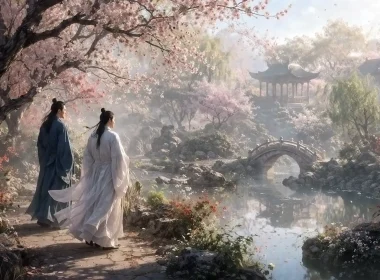


Spring’s half is gone, the rest but borrowed light;
To drink with falling flowers is like wine of winter’s night.

I toast spring’s parting, sweep the blooms away —
Who can hold back the eastward stream and say
“Stay!”
Original Poem
「惜春 · 其二」
杜牧
春半年已除,其馀强为有。
即此醉残花,便同尝腊酒。
怅望送春杯,殷勤扫花帚。
谁为驻东流,年年长在手。
Interpretation
This poem was composed during a crucial period of transition in Du Mu's life and poetic career, roughly between the mid-to-late 840s and early 850s. By this time, the poet had served in various military-governor offices across the Jiangnan region and had returned to the imperial court, holding posts such as Investigating Censor and Left Rectifier of Omissions. Situated at the political heart of the Tang empire, he had developed a lucid, yet increasingly acute sense of futility regarding the dynasty's systemic decline and the inherent constraints of his own official career. During this stage, Du Mu's poetic style gradually shifted from the spirited confidence and lyrical elegance of his youth towards a more somber, resonant tone characterized by profound philosophical contemplation. His thematic focus turned increasingly to the inevitability of historical dissolution and the finitude of individual life, cultivating a distinctive and expansive consciousness of temporality.
This work stands as a crystallization of that consciousness. In the late Tang era, the illusion of a "dynastic restoration" was crumbling, and society was pervaded by a collective intuition that past splendor was irrecoverable and that the present grandeur was approaching its twilight. This zeitgeist, interwoven with Du Mu's personal experience of thwarted ambitions and the passing of his middle years, compelled him to interrogate repeatedly the nature of transience in his poetry. Though titled "Lament for the Spring," its concern extends far beyond seasonal change; it grapples with a core existential dilemma: in the face of time's irreversible laws, what meaning and efficacy do human emotion, will, and action truly possess? The poet positions himself at the charged temporal juncture of "mid-spring," employing it as a metaphor for the midpoint of life, the empire's mid-decline, and the critical tipping point where all beautiful things turn from efflorescence to decay, thereby initiating a deep meditation on being and vanishing.
First Couplet: 春半年已除,其馀强为有。
Chūn bàn nián yǐ chú, qíyú qiǎng wéi yǒu.
Half of spring has passed, subtracted from the year's score; What yet remains can barely claim existence anymore.
Explication: The opening lines perform a stark temporal accounting with clinical precision. The verb "subtracted" cuts with a sense of decisive severance and finality, suggesting the passage of beauty is not a gentle fading but a form of inexorable subtraction. "Can barely claim existence" exposes a common psychological truth: once the zenith has passed, our sense of possession over what remains is often fragile and self-deceptive. This is more than a description of spring; it is a piercing insight into the condition that follows any peak experience—those nominal continuances are often hollow at the core.
Second Couplet: 即此醉残花,便同尝腊酒。
Jí cǐ zuì cán huā, biàn tóng cháng là jiǔ.
To be drunken now on fading blooms' last breath Is just like tasting year-old wine stored against winter's depth.
Explication: This couplet achieves a powerful dislocation of temporal experience through daring synesthesia. The act of being "drunken" in late spring should evoke a languid, sentimental warmth, yet the poet's palate is haunted by the stark, aged flavor of "year-old wine," a preserve from deep winter. This reveals that his internal season has outpaced the external calendar; while the visible world has not fully shed its bloom, his spirit has already entered a state of wintry desolation. "Fading blooms" signify present decay, while "year-old wine" represents provisions stored against future hardship. Their conflation suggests the poet is consuming emotional reserves from the past to endure a present he knows is ending.
Third Couplet: 怅望送春杯,殷勤扫花帚。
Chàng wàng sòng chūn bēi, yīnqín sǎo huā zhǒu.
With melancholy gaze, I raise the cup to bid spring's end goodbye; Yet diligently wield the broom where fallen blossoms lie.
Explication: The poet captures, through a pair of contradictory rituals, the quintessential human response to loss. "Raise the cup to bid spring's end goodbye" is a ceremonial, almost liturgical, act of acknowledgment—a symbolic farewell to the abstract season. "Wield the broom" is a practical, mundane effort to impose order on the concrete aftermath. This juxtaposition of the contemplative gaze and the diligent hand, the abstract farewell and the concrete tidying, lays bare the inherent paradox of our condition: we must cognitively accept the fact of endings while simultaneously engaging in physical actions that resist their visible disorder. The very diligence of the futile sweeping underscores the depth of the melancholy gaze.
Fourth Couplet: 谁为驻东流,年年长在手。
Shéi wéi zhù dōng liú, niánnián zhǎng zài shǒu.
Who can halt this easterly stream's constant race, To hold it captive, here within my hand, from year to year, in place?
Explication: The final couplet elevates the poem to a plane of universal inquiry with a profoundly naive, and thus deeply moving, question. "Easterly stream" symbolizes time's eternal, irreversible flow; "halt" represents the feeble yet persistent human delusion of control. "To hold it captive… from year to year" articulates the impossible desire to render the intangible tangible, to grasp the ungraspable. The question expects no answer. Its power resides entirely in the courageous act of asking it, a gesture that gathers the shared, tragic nobility of humanity confronting cosmic inevitability—a blend of defiance and profound attachment.
Holistic Appreciation
Taking "lament for spring" as its starting point, this poem conducts a profound poetic investigation into the nature of time itself. The poet crafts a world of intense internal tension: the external cycle of seasons diverges sharply from internal perception; solemn rites of farewell are directed at a miniature, perishing world; clear-eyed recognition of an end coexists with relentless, futile action.
Du Mu's mastery lies in not indulging in sentiment but using sentiment as the raw material for contemplation. Through the startling equation of "drunkenness on fading blooms" with "tasting year-old wine," he demonstrates how the passage of time warps and layers our inner sensory experience. By anchoring a vast existential anxiety in the humble, concrete act of sweeping fallen blossoms, he grounds metaphysical dread in the palpable real. Finally, the cry of "Who can halt this easterly stream?" transcends personal plaint to become a timeless, collective interrogation of mortality. The language is supremely distilled, the imagery precise and inventive. Within a traditional framework, Du Mu instills a deeply personal philosophical gravity and emotional resonance, showcasing the mature artistry of his later period—a fusion of profound thought and nuanced feeling.
Artistic Merits
- Acute Formulation of Temporal Perception: The poet moves beyond generic descriptions of "passing" to employ verbs charged with force and subjective intent—"subtracted," "barely claim," "halt." This transforms abstract temporal flow into an object perceived with startling clarity and even actively resisted, thereby intensifying the poem's intellectual and emotional tension.
- Strategic Use of Dislocating Synesthesia: The link between "drunken on fading blooms" and "tasting year-old wine" deliberately fractures conventional sensory and seasonal associations. This synesthesia is not ornamental but diagnostic, precisely conveying a state where subjective experience overrides objective chronology, revealing the psychological dissonance of a consciousness out of sync with the natural world.
- Paradoxical Rendering of Daily Ritual: The poem juxtaposes two mundane, yet opposing, actions: the symbolic toast of farewell and the practical sweep of the broom. This pairing stages a philosophically charged tableau vivant, enacting the eternal human struggle between accepting an end in principle and resisting its physical evidence in practice.
- Refinement of Imagery from Concrete to Abstract: The poem's imagery follows a deliberate ascension: from "mid-spring" (a temporal point), to "fading blooms" (decaying matter), to the "easterly stream" (an eternal symbol). This trajectory accomplishes a sublimation from specific circumstance to universal principle, allowing a personal seasonal lament to culminate in a metaphysical inquiry into time's essence.
Insights
The work starkly illuminates the central paradox of the human relationship with time: we are its creatures, living within its current, yet remain its perpetual dissenters, striving to comprehend, oppose, and command its direction. The poem's progression—from the resigned recognition of "can barely claim existence," to the futile diligence of sweeping, to the impossible fantasy of halting the stream—maps the archetypal arc of this dialogue.
The insight it offers may be this: the meaning of a life may not depend on ultimately conquering time or making beauty permanent. True dignity may reside precisely in the clarity of the "melancholy gaze," in the persistence of the "diligent" sweep, and in the courage to voice the unanswerable question. This capacity for deep feeling, conscientious action, and relentless inquiry, maintained against the tide of inevitable loss, is how humanity inscribes meaning upon the river of time. It cannot dam the easterly flow, but it ensures that every passing moment leaves behind a resonant trace of consciousness.
About the poet
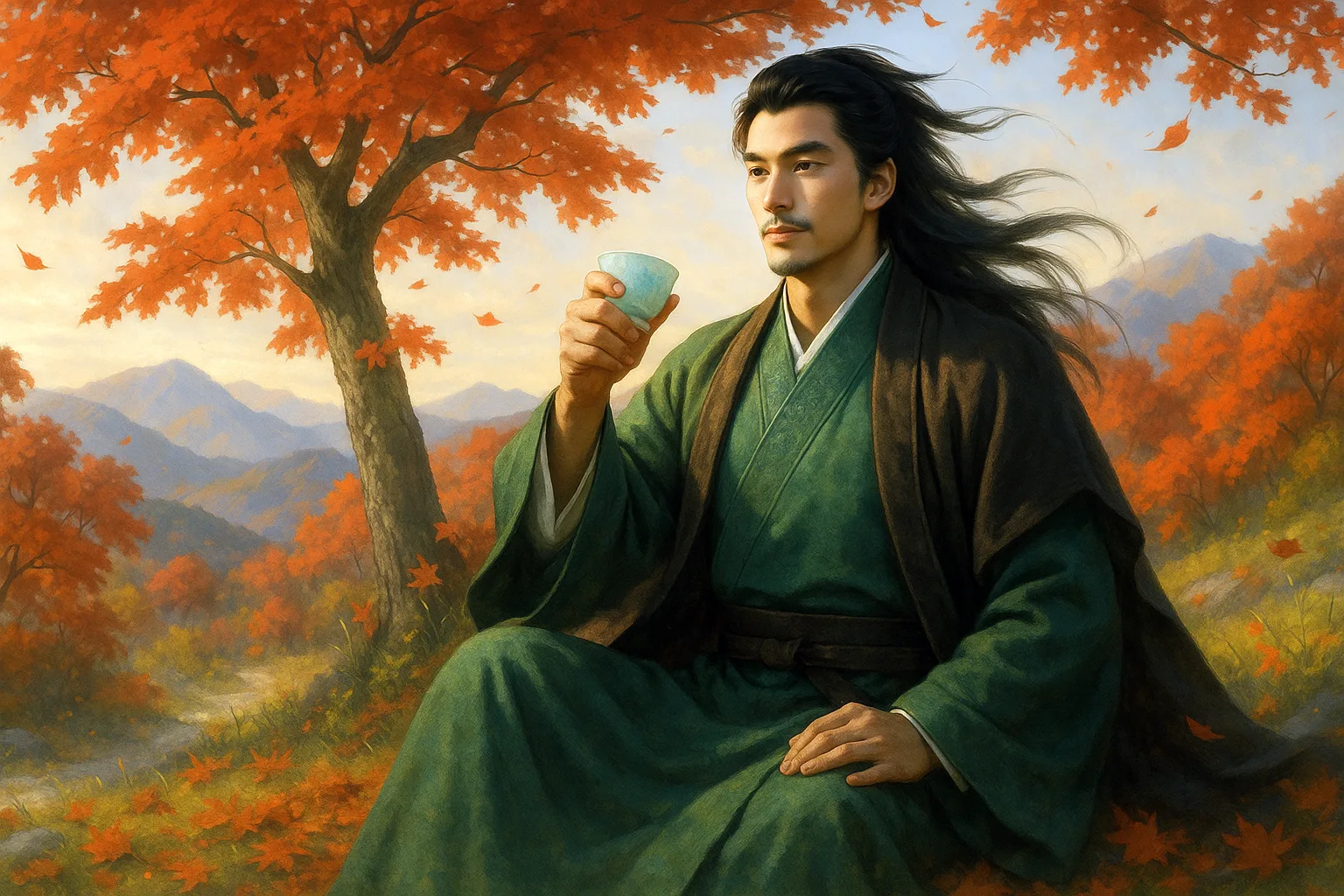
Du Mu (杜牧), 803 - 853 AD, was a native of Xi'an, Shaanxi Province. Among the poets of the Late Tang Dynasty, he was one of those who had his own characteristics, and later people called Li Shangyin and Du Mu as "Little Li and Du". His poems are bright and colorful.