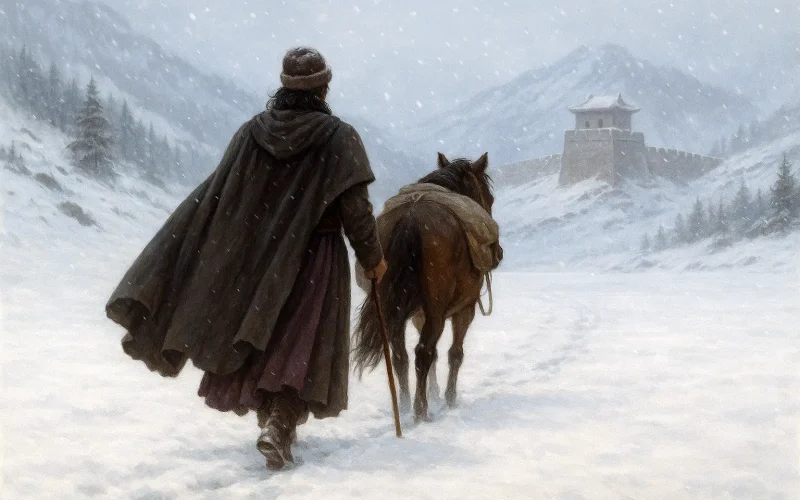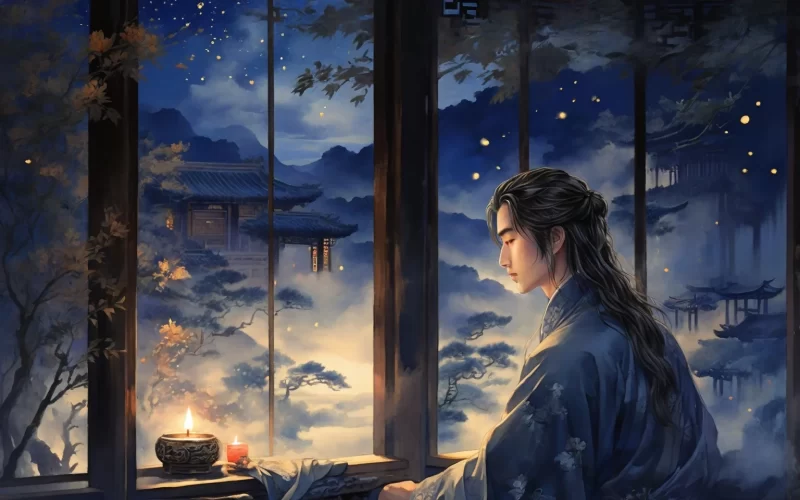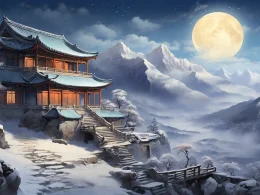



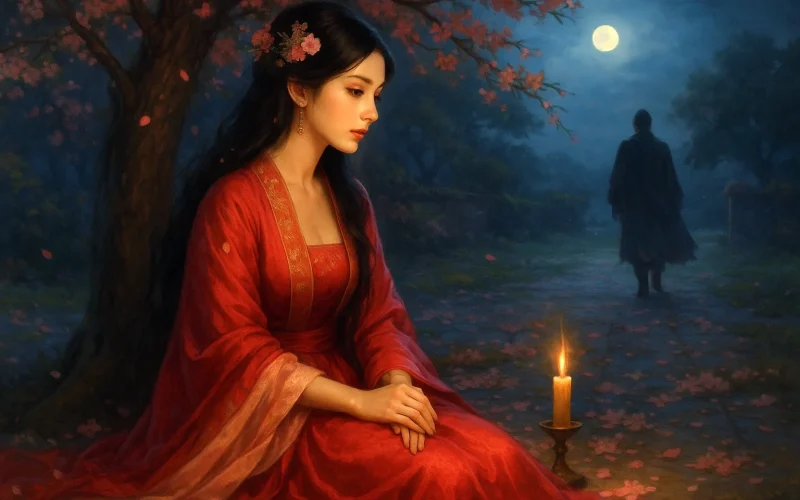
It's difficult for us to meet and hard to part;
The east wind is too weak to revive flowers dead.
Spring silkworm till its death spins silk from love-sick heart;
A candle but when burned out has no tears to shed.

At dawn I'm grieved to think your mirrored hair turns grey;
At night you would feel cold while I croon by moonlight.
To the three fairy hills it is not a long way.
Would the blue birds oft fly to see you on the height?
Original Poem
「无题 · 相见时难别亦难」
李商隐
相见时难别亦难,东风无力百花残。
春蚕到死丝方尽,蜡炬成灰泪始干。
晓镜但愁云鬓改,夜吟应觉月光寒。
蓬山此去无多路,青鸟殷勤为探看。
Interpretation
This masterpiece stands as a pivotal work within Li Shangyin’s "Untitled" series and indeed within the entire tradition of Chinese love poetry, representing the culmination of emotional intensity and symbolic depth. It transcends conventional themes of separation and longing, elevating the experience of love to a state akin to a religious offering—a form of life’s consumption and an existential dilemma. Interwoven with the enduring tensions between despair and dedication, expenditure and perpetuity, obstruction and quest, the poem constructs, through a stunning system of imagery and a recursive emotional logic, a self-enclosed yet fervent, agonizing yet sublime universe of feeling.
First Couplet: 相见时难别亦难,东风无力百花残。
Xiāng jiàn shí nán bié yì nán, dōng fēng wú lì bǎi huā cán.
So hard it is for us to meet, and harder still to part;
The east wind, spent, cannot revive a single withered heart.
Explication: The opening strikes directly at the core of the sentiment with its repetitive structure and paradoxical expression. "So hard it is for us to meet" speaks to obstacles of space and circumstance; "harder still to part" conveys the torment of psychology and time. The double use of "hard" lays bare the dual plight of lovers caught between two forms of suffering. The following line paints a natural scene: the east wind, which should bring renewal, is here "spent"; the flowers, which should flourish, lie "withered." This is not mere background setting but a metaphor for the enfeebled external world the lovers inhabit and a symbol of their own depleted vitality. The difficulty of meeting is spatial; the pain of parting is temporal; and the "spent" east wind hints at the absence of any cosmic force capable of reversing this fate, establishing the poem’s somber, inescapable mood.
Second Couplet: 春蚕到死丝方尽,蜡炬成灰泪始干。
Chūn cán dào sǐ sī fāng jìn, là jù chéng huī lèi shǐ gān.
The silkworm spins its thread of love until its final breath;
The candle dries its tears of grief when it burns out in death.
Explication: This couplet is an immortal expression of unwavering devotion in the history of Chinese poetry. Its power lies in transforming abstract emotion into two vivid, physical processes of self-consumption ending in annihilation. "The silkworm spins its thread of love until its final breath" — the "thread" (丝, sī) is a homophone for "longing" or "thought" (思, sī), using the insect’s biological drive to symbolize a longing that ceases only with life itself. "The candle dries its tears of grief when it burns out in death" — the "tears" refer to both the candle’s wax and human tears, its burning representing life spent in devotion, accompanied by pain that ends only with the self’s extinction. Together, they depict an absolute, fated mode of sacrifice: love is existence, and existence is the process of burning, expending, and weeping for love, its conclusion coinciding with the end of the process itself. This is a declaration of agony, and more profoundly, an affirmation of agony’s inevitability and its sacred nature.
Third Couplet: 晓镜但愁云鬓改,夜吟应觉月光寒。
Xiǎo jìng dàn chóu yún bìn gǎi, yè yín yīng jué yuè guāng hán.
At dawn, I dread the glass: my cloud-like hair shows time’s frost-blight;
At night, you should feel the moon’s chill piercing through the lonely night.
Explication: The perspective shifts from direct declaration to delicate, bidirectional imagining, allowing emotion to flow and resonate across distance. "At dawn, I dread the glass" voices a terror of life’s attrition (one’s own or the beloved’s) under the siege of longing; the morning mirror reveals time’s erosion of beauty and longing’s consumption of youth. "At night, you should feel the moon’s chill" expresses profound empathy and shared sensation for the distant lover’s plight; the chill is both physical reality and a projection of a solitary heart. "Dawn" and "night," "frost-blight" and "chill," outline the ceaseless, round-the-clock emotional condition of the yearning self. This emotion forms a closed circuit in imagination, transforming solitude from mere isolation into a peculiar, painful form of connection.
Final Couplet: 蓬山此去无多路,青鸟殷勤为探看。
Péng shān cǐ qù wú duō lù, qīng niǎo yīn qín wéi tàn kān.
To Penglai Mountain, fairy isle, the way cannot be far;
I beg the Blue Bird, messenger, to watch where my loved ones are.
Explication: The final couplet allows a fragile bud of hope to unfurl within utter despair, thereby deepening that very despair. "Penglai Mountain" refers to the unattainable celestial abode of the beloved, symbolizing the ultimate barrier. "The way cannot be far" is a self-consoling illusion, a psychological compensation that insists on proximity despite knowing the vast distance. "I beg the Blue Bird… to watch" pins all hope upon a mythical messenger. This "watching" signifies not reunion, but merely communication—and is contingent upon the "messenger’s" diligence. Hope is thus rendered so tenuous, indirect, and uncertain that it serves to redouble the reality of separation. Yet, it is precisely this "hope persisting within hopelessness" that lends the poem an unquenchable resilience, elevating the pain of love into a state of eternal yearning and unceasing inquiry.
Holistic Appreciation
This poem is a "lyric of love’s existential condition," its structure mirroring an emotional purgatory, its imagery resembling primal life symbols. It begins with "hard" (难) and ends with "watch/look" (看), threaded with words like "final breath" (尽), "dries" (干), "frost-blight" (改), and "chill" (寒)—all pointing to consumption, termination, and change. It depicts a system of relentless output and life’s dissipation, seeking only the faintest return. The four couplets form a complete emotional cycle: the first states the predicament (parting’s pain), the second vows the response (unto death), the third describes the predicament’s daily, bidirectional reality (mornings of dread, nights of chill), and the fourth attempts an illusory path beyond (the messenger’s watch). Each couplet intensifies the fundamental contradiction between love’s absoluteness and the impossibility of its fulfillment.
Li Shangyin’s genius lies in rendering the experience of love utterly ontological and ritualized. Love here is no longer a specific human relationship but a transcendent, definitive state of being—as integral to the self as silk-spinning is to the silkworm or burning to the candle. It is the mode and fate of existence. Pain is not an adjunct to love but its essential substance. Therefore, "spins its thread… until its final breath" and "dries its tears… in death" are not tragic conclusions but the necessary process through which love achieves its own completion. This lifts the poem beyond lamentation, granting it a tragic sublimity. Simultaneously, through the mythological symbols of "Penglai Mountain" and the "Blue Bird," he universalizes a specific predicament of love into humanity’s eternal nostalgia and persistent pursuit of an unattainable ideal.
Artistic Merits
- Perfect Fusion of Homophonic Pun and Metaphor: The homophone between "thread" (丝, sī) and "longing" (思, sī) seamlessly transforms a biological process into a potent human emotional symbol—a marriage of natural phenomenon and artistic craft—becoming one of the most powerful images for expressing unwavering devotion.
- Strict Parallelism Amidst Emotional Turmoil: The two central couplets exhibit flawless formal parallelism, yet their content churns with violent emotional upheaval (death/final breath, ashes/dries, frost-blight/chill). The tension between rigorous form and fervid content is immense, as if confining molten lava within a vessel of exquisite craftsmanship.
- Panoramic Temporal/Spatial Scope and Synesthetic Appeal: From the events of "meeting" and "parting" to the diurnal cycle of "dawn" and "night"; from the visual "east wind" and "withered" flowers, the tactile-synesthetic "moon’s chill," to the mixed tactile/visual imagery of the silkworm and candle. The poem constructs a multi-dimensional, fully sensorized world of emotion and perception.
- Mythological Imagery with Real-World Resonance: Though "Penglai Mountain" and the "Blue Bird" belong to myth, they point directly to insurmountable real-world barriers (social status, identity, time, space) and the aching desire for communication, imbuing the poem’s romantic hues with sharp, contemporary poignancy.
Insights
This is a sacred song for all souls who have known profound love and its inevitable barriers. It reveals that love’s most extreme form may lie not in possession and fulfillment, but in a pure state of being characterized by self-sacrifice, akin to the silkworm’s spinning or the candle’s burning. The endpoints of "final breath" and "dries in death" are not negations of value but the fulfillment of the process itself and the consummation of its meaning.
In an age of fragile connections and meticulous calculation, this poem acts as a mirror to emotional depth. It prompts reflection: Do we still possess the capacity to experience, or even comprehend, this absolute emotion of "unto death"? Can we still maintain the persistent gaze of the "messenger" amidst the adversity of a "spent east wind" and "withered flowers"? Li Shangyin’s poem tells us that love, as a spiritual phenomenon, draws its power precisely from placing one in the impossible predicament of "difficulty," and from the "light of life" that blazes forth therein—a light that severs its own thread and dries its own tears. This light illuminates not only love but one’s own affirmation of the intensity and depth of existence.
Poem Translator
Xu Yuanchong (许渊冲)
About the poet
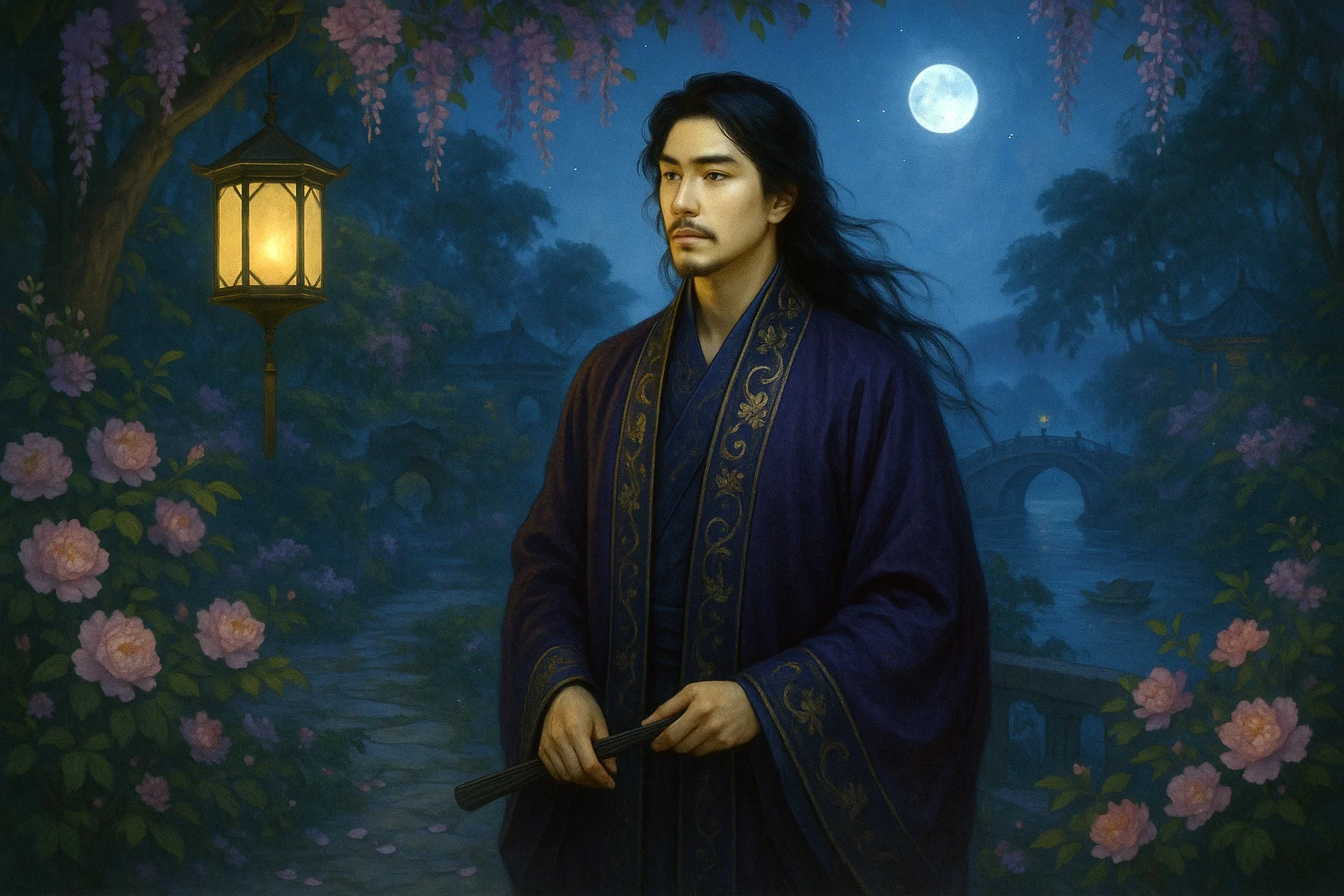
Li Shangyin (李商隐), 813 - 858 AD, was a great poet of the late Tang Dynasty. His poems were on a par with those of Du Mu, and he was known as "Little Li Du". Li Shangyin was a native of Qinyang, Jiaozuo City, Henan Province. When he was a teenager, he lost his father at the age of nine, and was called "Zheshui East and West, half a century of wandering".