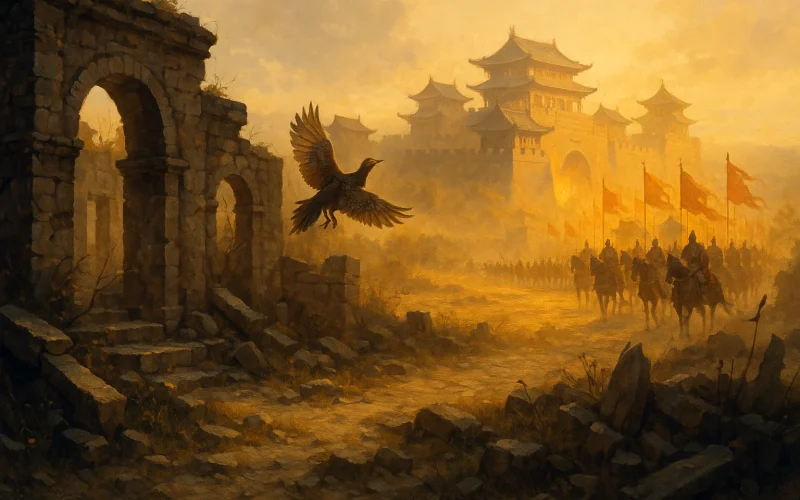
You said you'd come but you have gone and left no trace;
I hear in the moonlit tower the fifth watch bell.
In dream my cry could not call you back from distant place;
In haste with ink unthickened I cannot write well.

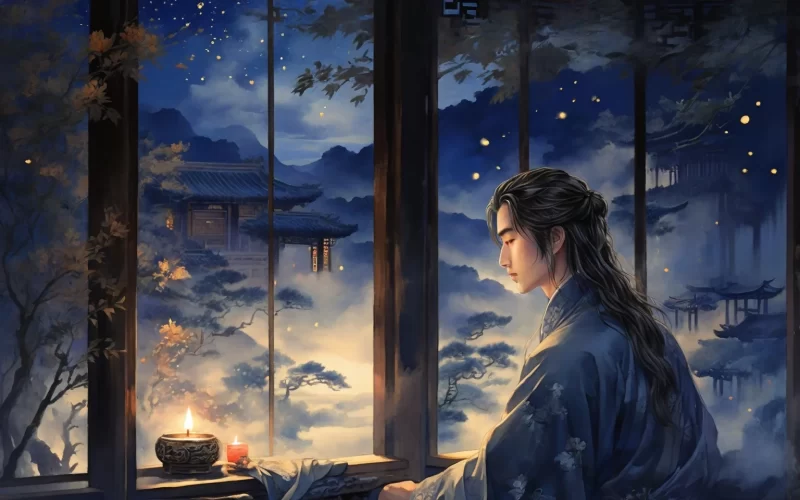
The candlelight illuminates half our broidered bed;
The smell of musk still faintly sweetens lotus screen.
Beyond my reach the far-off fairy mountains spread;
But you're still farther off than fairy mountains green.
Original Poem
「无题四首 · 其一」
李商隐
来是空言去绝踪,月斜楼上五更钟。
梦为远别啼难唤,书被催成墨未浓。
蜡照半笼金翡翠,麝熏微度绣芙蓉。
刘郎已恨蓬山远,更隔蓬山一万重!
Interpretation
This poem is the first of Li Shangyin's "Four Untitled Poems." The series presents the poet's profound meditations on fate, emotional struggles, and spiritual longing. This particular piece focuses intensely on the psychological reality of the moment of awakening from a dream. Through a sequence of images—"vain promises and vanished traces," "futile weeping in a dream of parting," "a letter penned with ink yet pale," "candlelit, perfumed silks in quiet grandeur"—it dissects the state of a heart torn repeatedly between hope and despair. The ultimate lament, "Penglai lies beyond ten thousand folds," points not only to a specific emotional chasm but also metaphorically to the eternal distance between life's ideals and reality. It reflects Li Shangyin's profound understanding of "the impossibility of arrival," forged through political turmoil and personal sorrow.
First Couplet: 来是空言去绝踪,月斜楼上五更钟。
Lái shì kōng yán qù jué zōng, yuè xié lóu shàng wǔ gēng zhōng.
Your coming was a promise vain; you left, no vestige to be found.
The waning moon slants on the tower; the fifth-watch bell tolls its sound.
Explication: The poem opens with a stark, declarative statement that declares all expectation void. "Your coming was a promise vain" is a complete negation of the past—the promise was empty. "You left, no vestige to be found" is a desperate confirmation of the present—the presence is gone. Time is fixed at the "fifth-watch," the fragile threshold between night and dawn, the moment of撕裂 severance between dream and waking, illusion and truth. The "waning moon" (a visual image of decline) and the "tolling bell" (an auditory signal of time's pressure) together evoke the sleepless solitude and painful clarity that follow a broken dream. The contrast between vow and trace points to a fundamental rupture between word and reality.
Second Couplet: 梦为远别啼难唤,书被催成墨未浓。
Mèng wéi yuǎn bié tí nán huàn, shū bèi cuī chéng mò wèi nóng.
In dreams, a distant parting made me weep; my cries could not recall.
I seized the brush, the ink still thin, to write a hurried scrawl.
Explication: This couplet delves into the heart of the dream and the immediate, desperate reaction upon waking, revealing the futility and haste of the search. "In dreams, a distant parting…" shows that even the dream, this last refuge, is governed by separation; not even there can a joyful reunion be found. "My cries could not recall" illustrates the utter ineffectiveness of action within the dream. "I seized the brush, the ink still thin…" displays the frantic, flawed nature of action after waking: the letter is a frantic attempt to counteract the "vain promise," to pursue the "vanished trace." Yet the act itself is premature and "unfinished" (ink still thin), symbolizing that all efforts at communication are, from their inception, flawed and rushed, doomed to fail in their purpose. Both the internal world of the dream and the external act of writing are failed endeavors.
Third Couplet: 蜡照半笼金翡翠,麝熏微度绣芙蓉。
Là zhào bàn lóng jīn fěi cuì, shè xūn wēi dù xiù fú róng.
Candle-glimmer, half-veiling kingfisher-gilt drapes, softly glows;
A lingering of musk, where broidered lotus flowers doze.
Explication: The focus shifts abruptly to a meticulous depiction of the luxurious chamber. This is the poem's most characteristically Li Shangyin touch of "opulent beauty," yet it serves to underscore the deepest solitude. "Half-veiling" and "lingering" describe a朦胧, hazy light and a faint, drifting scent—a scene of extreme richness rendered utterly desolate. The ornate imagery of "kingfisher-gilt" and "broidered lotus" (traditional symbols of love and intimacy) here becomes the sumptuous backdrop and ironic counterpoint to a profound "absence." They are reminders of the shared intimacy this space was meant for, now highlighting only the poet's solitude before a dying candle. The opulence of the surroundings and the emptiness of human presence create a stark, painful contrast.
Final Couplet: 刘郎已恨蓬山远,更隔蓬山一万重!
Liú láng yǐ hèn Péng shān yuǎn, gèng gé Péng shān yī wàn chóng!
Young Liu already grieved Penglai's vast, unattainable remove;
For me, ten thousand-fold those mountains stand, my love!
Explication: The final couplet lands with crushing finality, using literary allusion and hyperbolic exaggeration to push separation into infinity. "Young Liu" alludes to Liu Chen of the Han dynasty legend, who found and then lost immortal maidens on a celestial mountain; his grief over distant Penglai is the classic symbol of the unbridgeable gap between mortal and immortal. Upon this established symbol of despair, the poet imposes a staggering multiplier: "ten thousand-fold those mountains stand!" This is not simple comparison but a desperate, exponential increase of impossibility. "Ten thousand-fold" is an ultimate expression of infinite, immeasurable distance, utterly annihilating any possibility of "arrival." From "vain promise" to "vanished trace," to "dreams that cannot recall," to "mountains ten thousand-fold," the barrier is relentlessly reasserted and magnified, cementing the poem's emotion into a state of eternal, absolute impasse.
Holistic Appreciation
This is a "poem of thwarted quest," its structure a descent into despair, its emotion like wax dripping from a candle in the cold night. The poem traces a clear arc: "shattering (vain promise, vanished trace) — striving (dream and letter) — suspension (opulent emptiness) — impasse (mountains ten-thousand-fold)." Each couplet attempts a different strategy to confront "absence" (recalling the promise, dreaming, writing, observing the surroundings, invoking myth), yet each effort, in its execution or outcome, instead proves the absoluteness of that 'absence' and the vanity of the 'quest.' Ultimately, all paths lead to the infinite distance of the final line, as if every action existed only to confirm this ultimate conclusion of nothingness.
Li Shangyin's profundity lies in his writing not merely of longing, but of how longing itself becomes a logical process of relentless self-negation. The speaker is like a lucid experimenter in the cold aftermath of a dream, repeatedly using his own actions (memory, dreaming, writing, observation, allusion) to verify the fact of "loss." The implied past intimacy or ideal scene suggested by the luxurious silks acts like lavish equipment in a laboratory, serving only to make the experimental result of "loss" more glaring. Thus, the poem is not merely an emotional lament but a dispassionate analysis and stark presentation of the existential condition of "loss."
Artistic Merits
- Precision of Temporal and Psychological Focus: The poem focuses on the specific, vulnerable moment of the "fifth-watch," expanding infinitely the first unit of consciousness after awakening, capturing the most acute and painful fluctuations as the mind falls from illusion into reality.
- Cold Rendering of Opulent Imagery: The third couplet achieves great beauty yet conveys no warmth. The poet describes these sumptuous objects with a sculptor's detached precision, draining them of emotional temperature, making them the cold ornaments and evidence of "absence" itself—a masterful technique.
- Ineffectual Action and Emotional Crescendo: "My cries could not recall" (in the dream) and "the ink still thin" (upon waking) are two aborted, ineffectual actions. They are not outlets for emotion, but the very forms of obstructed feeling, perfectly capturing a state of urgent powerlessness.
- Layered Allusion and Exponential Space: The final couplet's use of allusion is not simple comparison but a despairing act of "incremental calculation." Upon the existing cultural topos of despair (Young Liu's grief), it imposes an overwhelming multiplier (ten thousand fold), granting the personal anguish a weight that transcends its moment and an immeasurable, timeless depth.
Insights
This work is an ancient parable for the modern sense of "existential lack" and the "impossibility of communication." It reveals that humanity's deepest pain may lie not in "loss" itself, but in the discovery that after loss, all attempts to mend, connect, or retrace (through words, dreams, writing, memory) become, in turn, fresh proof of that loss's absoluteness. This paradox of the quest mirrors many modern existential dilemmas.
In an age of information overload yet spiritual isolation, of instant connection yet impoverished understanding, the poem's "ten thousand-fold mountains" take on new resonance. It reminds us that the true barriers may lie not in physical distance, but in the erosion of meaning, the hollowness of promises, the silence of response, and the loss of shared ground. When all "letters" are penned with "ink still thin," and all "dreams" are soliloquies where "cries cannot recall," what we face may indeed be "mountains ten-thousand-fold" in every meaningful sense. Therefore, Li Shangyin's poem is not merely an elegy for a lost love, but an enduring testament to the fundamental human difficulty of bridging divides and truly reaching the other.
Poem translator
Xu Yuanchong (许渊冲)
About the poet
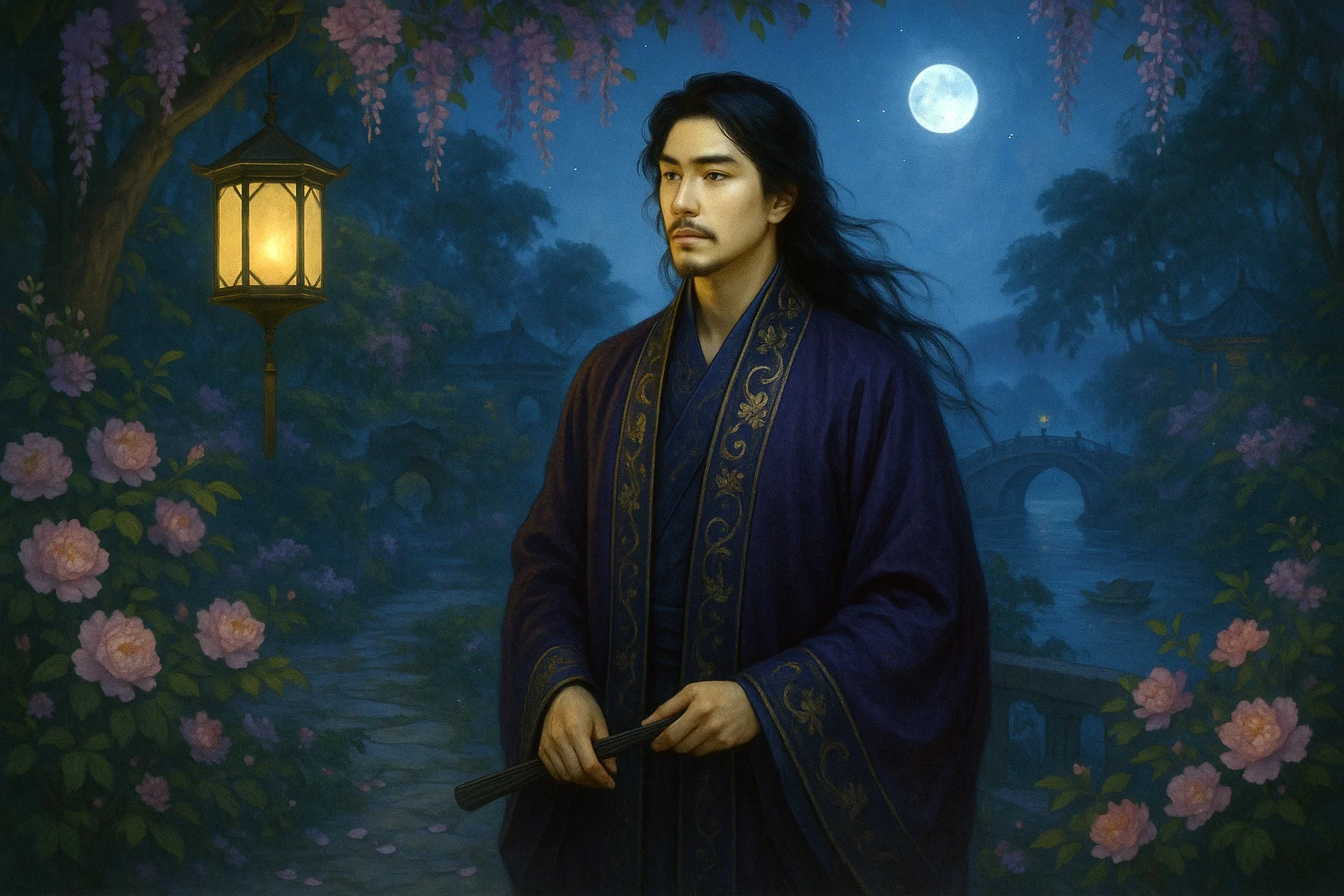
Li Shangyin (李商隐), 813 - 858 AD, was a great poet of the late Tang Dynasty. His poems were on a par with those of Du Mu, and he was known as "Little Li Du". Li Shangyin was a native of Qinyang, Jiaozuo City, Henan Province. When he was a teenager, he lost his father at the age of nine, and was called "Zheshui East and West, half a century of wandering".