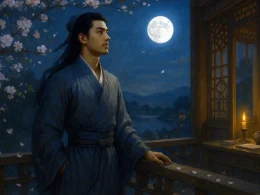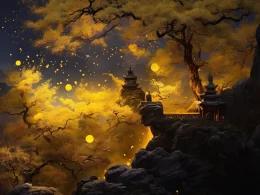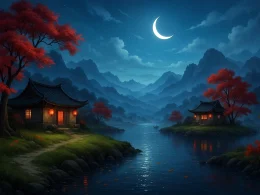



The stars of last night and the wind of last night
Are west of the Painted Chamber and east of Cinnamon Hall.
...Though I have for my body no wings like those of the bright-coloured phoenix,
Yet I feel the harmonious heart-beat of the Sacred Unicorn.

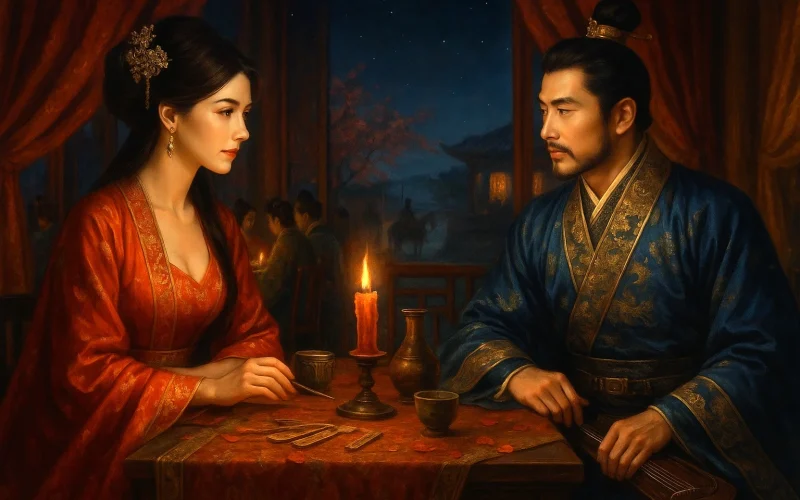
Across the spring-wine, while it warms me, I prompt you how to bet
Where, group by group, we are throwing dice in the light of a crimson lamp;
Till the rolling of a drum, alas, calls me to my duties
And I mount my horse and ride away, like a water-plant cut adrift.
Original Poem
「无题二首 · 其一」
李商隐
昨夜星辰昨夜风,画楼西畔桂堂东。
身无彩凤双飞翼,心有灵犀一点通。
隔座送钩春酒暖,分曹射覆蜡灯红。
嗟余听鼓应官去,走马兰台类转蓬。
Interpretation
This poem was written during Li Shangyin's service at the Secretariat (around 839 AD) and stands as one of his most dramatically tense and temporally complex "Untitled" poems. As a young official newly embarked on his career at the heart of Tang political and cultural life, the poet regularly attended aristocratic evening banquets, experiencing firsthand the stark contrast between the nocturnal revelry of the scholar-official class and the rigid formality of the morning court.
The revelry of "last night" and the hasty compliance of "hearing the drum, off to duty" in the poem are not merely expressions of personal feeling; they represent a vivid slice of life for mid-level Tang officials. Through the memory of a specific banquet, Li Shangyin captures a schism普遍存在 in the lives of scholars of his time: the night belonged to private sentiment and social freedom, while dawn demanded a return to the mechanistic rhythm of bureaucracy. This experience of living a dual existence between night and day is crucial for understanding the poem's emotional depth.
Notably, the iconic couplet, "In body no phoenix wings we share; / Heart to heart, the rhinoceros horn laid bare," is not a simple romantic declaration. It is, rather, a poetic distillation of an ideal of human connection, born from a specific social milieu—how to achieve a transcendent meeting of minds within physical constraints. This elevates the poem beyond conventional love poetry into a philosophical exploration of enduring themes: freedom and restraint, body and spirit, the private and the public.
First Couplet: 昨夜星辰昨夜风,画楼西畔桂堂东。
Zuó yè xīngchén zuó yè fēng, huà lóu xī pàn guì táng dōng.
Last night's stars, last night's breeze—
West of the painted tower, east of the laurel hall, where memories won't leave.
Explication: The opening establishes a unique temporal rhythm through the repetition of "last night," signaling this is no ordinary recollection but a mental moment ceaselessly revisited and savored. The ethereal natural images of "stars" and "breeze" are juxtaposed with the exquisite man-made structures of "painted tower" and "laurel hall," creating a poetic space both expansive and intimate, eternal yet fleeting. The precise directional markers "west" and "east" ironically heighten the memory's irreplicable nature.
Second Couplet: 身无彩凤双飞翼,心有灵犀一点通。
Shēn wú cǎi fèng shuāng fēi yì, xīn yǒu líng xī yī diǎn tōng.
In body no phoenix wings we share;
Heart to heart, the rhinoceros horn laid bare.
Explication: This couplet achieves profound unity through stark opposition, becoming a classic expression of spiritual communion. "In body no…" is a candid acknowledgment of physical limitation; "Heart to heart…" is a miraculous affirmation of the spiritual realm. "Phoenix wings" symbolize the worldly ideal of perfect union (inseparable, flying side by side), while "the rhinoceros horn" (an ancient symbol of sympathetic resonance) represents a higher-order connection—a profound, wordless understanding that transcends form. These lines endure because they articulate an ultimate human longing: achieving absolute spiritual kinship within the reality of physical separation.
Third Couplet: 隔座送钩春酒暖,分曹射覆蜡灯红。
Gé zuò sòng gōu chūn jiǔ nuǎn, fēn cáo shè fù là dēng hóng.
Across seats, the hook passed unseen—spring wine warmed the air;
Divided teams, the covered cup guessed—candle-glow flushed everywhere.
Explication: With vivid, close-up detail, the poet recreates the banquet scene. "Across seats" implies physical distance, yet "the hook passed unseen" describes an intimate party game; "divided teams" separates the crowd, yet "the covered cup guessed" is a game of mental connection. The brilliance lies in depicting the subtle art of forging private understanding within a public, rule-bound setting. The sensory details "spring wine warmed" and "candle-glow flushed" not only evoke atmosphere but symbolize the clandestine flow of feeling within social confines.
Fourth Couplet: 嗟余听鼓应官去,走马兰台类转蓬。
Jiē yú tīng gǔ yìng guān qù, zǒu mǎ lán tái lèi zhuǎn péng.
Alas, I hear the dawn drum—to duty I must go.
Galloping to Orchid Tower, a tumbleweed in morning's flow.
The revelry of "last night" and the hasty compliance of "hearing the drum, off to duty" in the poem are not merely expressions of personal feeling; they represent a vivid slice of life for mid-level Tang officials. Through the memory of a specific banquet, Li Shangyin captures a schism commonly found in the lives of scholars of his time: the night belonged to private sentiment and social freedom, while dawn demanded a return to the mechanistic rhythm of bureaucracy. This experience of living a dual existence between night and day is crucial for understanding the poem's emotional depth.
Holistic Appreciation
This is a masterful study in "eternalizing the ephemeral." The core tension lies in how a night of festivity, inevitably fleeting ("last night"), is transformed into a permanent "now" within consciousness. Li Shangyin's method is to construct a framework of layered contrasts: the constancy of stars versus the transience of the breeze; the lack of mythical wings versus the possession of spiritual resonance; the warm conviviality of the banquet versus the cold summons of the bureaucratic dawn.
The dialectic of "In body no…" and "Heart to heart…" reveals the depth of Li Shangyin's vision: True connection may not require physical union but spiritual confirmation; true freedom may not mean unfettered action but inner clarity. The banquet games ("hook passed," "cup guessed") are memorable not merely for their gaiety but because, within their formal, rule-bound structure, a wordless understanding that existed beyond the rules was forged.
The poem's structure follows a perfect arc of "immersion—transcendence—return—rupture": the first couplet immerses us in the remembered scene; the second transcends it into a universal principle; the third returns to vivid specifics; the fourth ruptures the illusion with dawn's call. This mimics the psychological process of treasuring experience: we distill meaning from beauty ("Heart to heart"), only to have its preciousness confirmed by its end ("hear the dawn drum").
Artistic Merits
- The Layering of Time and Space: The repetition of "last night" is not merely rhetorical but an enactment of psychological time—the first instance marks a moment, the second carries its emotional weight. The poet thus transforms clock time into felt time.
- Navigation Between Public and Private Realms: The poem moves between the public space of the "painted tower" and the private communion of "Heart to heart"; between the social ritual of party games and the solitary fate of "a tumbleweed." This constant shifting between societal engagement and inner life showcases Li Shangyin's nuanced narrative skill.
- The Symbolic Charge of Sensuous Detail: "Spring wine warmed" conveys psychological comfort as much as physical warmth; "candle-glow flushed" suggests emotional intensity alongside visual hue; "hear the dawn drum" signifies institutional authority, not just a sound. Li Shangyin elevates sensory experience into existential statement.
Insights
The poem's profound insight is this: Genuine spiritual depth often emerges within defined boundaries. From the physical limitation of having "no phoenix wings," Li Shangyin forges the transcendent truth of "Heart to heart." This principle of "depth through constraint" reveals a facet of human connection: Barriers are not merely obstacles; they can be the necessary conditions for profound understanding.
The described banquet games are particularly telling: When all action occurs within a shared, formal framework, the glances and understandings that transcend that framework become uniquely intimate and memorable. Modern life, in removing many such formal structures, may have lost some of the passion and insight required to create private meaning within shared codes. Li Shangyin implies that the art of feeling lies not in the absence of barriers, but in the creation of meaning within and across them.
The jarring transition at "hear the dawn drum" exposes a fundamental condition: Our most profound private experiences are, by necessity, carved from the interstices of public time. This is not an ancient official's peculiar plight but a modern universal—our inner selves breathe in the cracks of scheduled lives. The poem's greatness lies in not denying this fracture but making poetry from it: "last night" gains its luminous intensity precisely because of the impending "dawn drum," much as a pearl forms around an irritant.
Ultimately, the poem advocates for an ethic of memory: What matters is not merely what happens to us, but how we transform happenings into inner events that sustain us. Li Shangyin, through poetry, alchemizes a single night into a lasting inner landscape—a capability ever more vital in an age of relentless stimulus, where we must learn to anchor certain "last nights" as guiding stars within.
In this light, Li Shangyin's practice offers a mode of being: To use language's permanence against experience's flux; to balance the body's limitations ("no wings") with the spirit's capacities ("heart to heart"). This is more than a poetic technique; it is an art of living for fluid times—in a world of passing moments, learning to forge a few into enduring coordinates of the heart.
Poem translator
Kiang Kanghu
About the poet
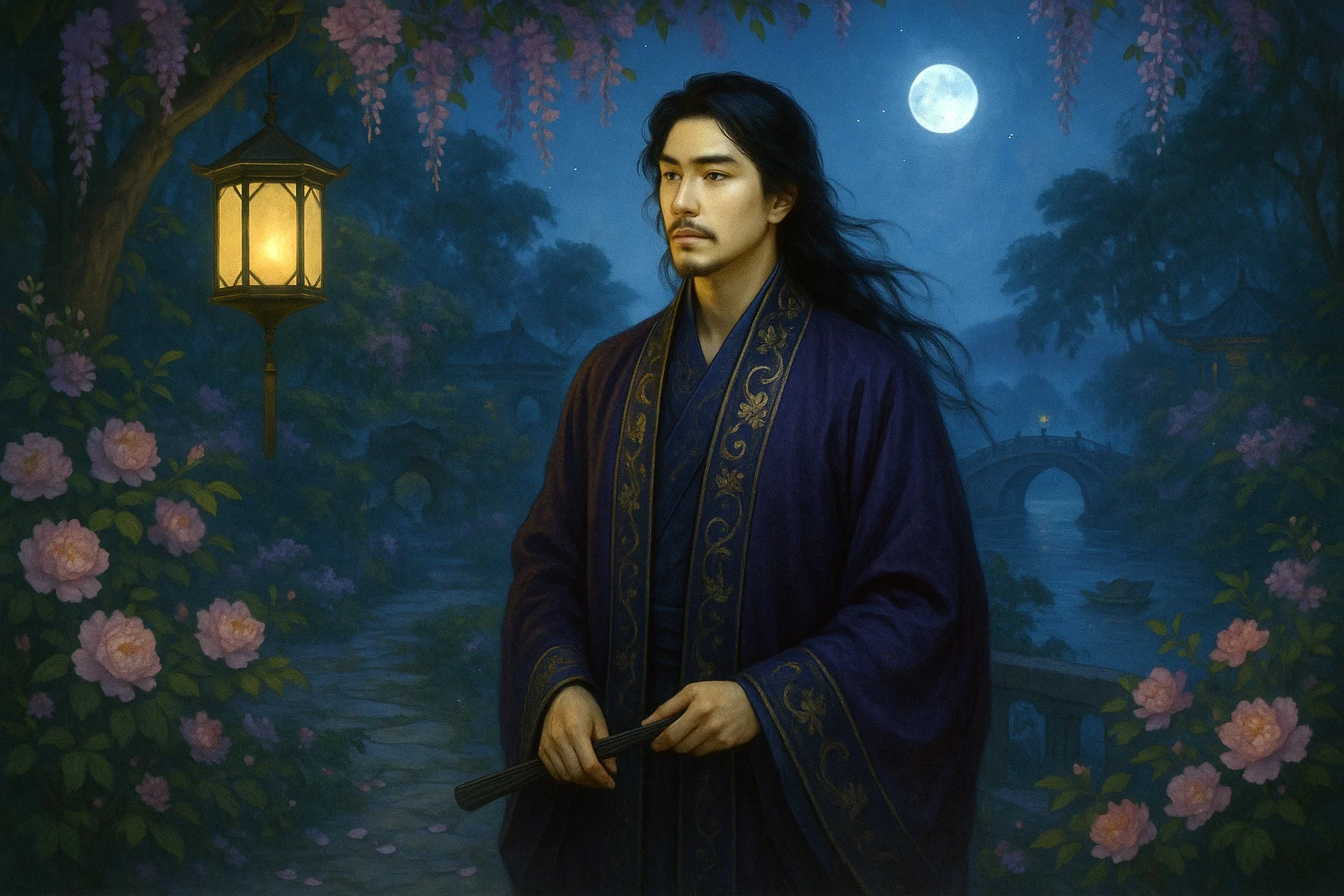
Li Shangyin (李商隐), 813 - 858 AD, was a great poet of the late Tang Dynasty. His poems were on a par with those of Du Mu, and he was known as "Little Li Du". Li Shangyin was a native of Qinyang, Jiaozuo City, Henan Province. When he was a teenager, he lost his father at the age of nine, and was called "Zheshui East and West, half a century of wandering".