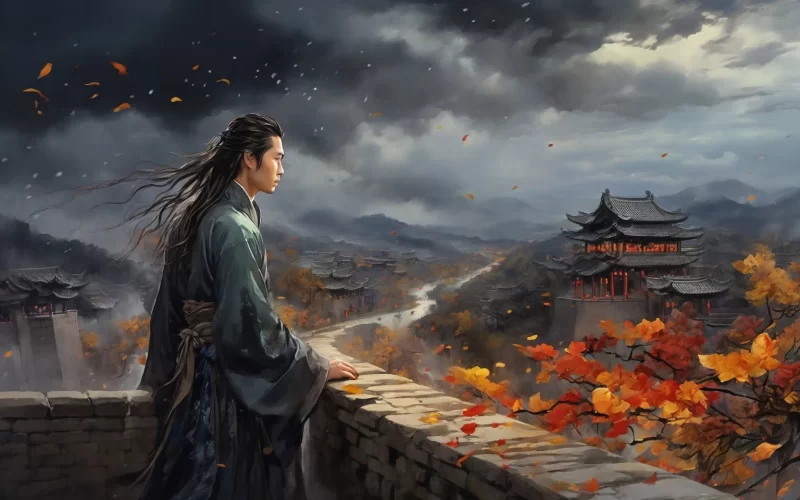





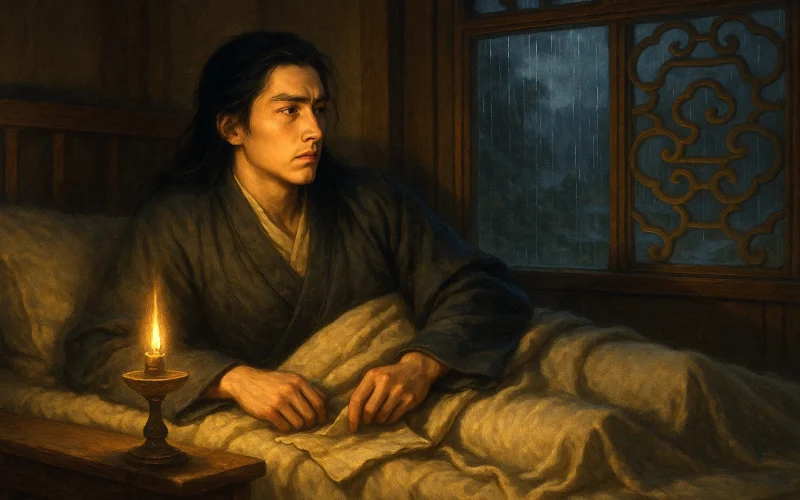
The dying lamp, flame gone, casts flickering shadows tall;
This night I hear you’re banished to Jiujiang, beyond recall.
In my mortal illness, shocked, I sit up straight in bed;
The gloomy wind blows rain in through my window, cold and dread.
Original Poem
「闻乐天授江州司马」
元稹
残灯无焰影幢幢,此夕闻君谪九江。
垂死病中惊坐起,暗风吹雨入寒窗。
Interpretation
This poem is a timeless masterpiece of response by the Mid-Tang poet Yuan Zhen to Bai Juyi, composed in the tenth year of Emperor Xianzong's Yuanhe period (815 AD). Yuan Zhen and Bai Juyi passed the imperial examination in the same year, shared similar ideals and interests, and jointly advocated the New Yuefu Movement; together they are known as "Yuan-Bai." Their friendship was profound, with numerous poetic exchanges and responses, especially the poems sent during their respective exiles, which are the most moving.
In the tenth year of Yuanhe, the political situation changed abruptly. Chancellor Wu Yuanheng was assassinated. Bai Juyi, for submitting a memorial requesting the capture of the assassins, was accused by powerful ministers of "exceeding his authority in commenting on state affairs" and was demoted to the post of Marshal of Jiangzhou. At this time, Yuan Zhen, having also offended the eunuchs, had already been demoted to Tongzhou (present-day Dazhou, Sichuan) and was suffering from malaria, severely ill. One in Jiangzhou, the other in Tongzhou, at opposite ends of the earth, both were fallen men at the world's end. When the news arrived, Yuan Zhen, shocked, rose from his sickbed. A myriad of sorrows and indignation surged in his heart, and he then wrote this poem. The dimness of "The dying lamp" and the flickering of "flickering shadows" are the actual scenes he saw in his illness, and also a reflection of the desolation in his heart. The shock of "I start from a sickbed" is his instinctive reaction to the plight of his close friend. The desolate chill of "Dark wind is blowing rain into windows adown" is the wind and rain of nature, and even more, the chill of the human world. The entire poem begins with a scene and concludes with a scene, fusing the loneliness of illness, the worry for a friend, and the sorrowful indignation towards the times into twenty-eight characters. It is one of the most sorrowful and moving chapters in the poetic exchanges of Yuan and Bai.
First Couplet: "残灯无焰影幢幢,此夕闻君谪九江。"
Cán dēng wú yàn yǐng chuáng chuáng, Cǐ xī wén jūn zhé Jiǔ jiāng.
The dying lamp sheds flickering shadows around; I hear you're banished to Jiujiang.
The poem opens with a scene of dimness and desolation. "残灯无焰" (The dying lamp)—four characters describe the state of the lamp about to go out, its light about to die—not a bright lamp, not a lonely lamp, but a "dying lamp," a lamp about to burn out. The "无焰" (without flame) indicates both the faintness of the lamplight and the dimness of vitality in the poet's heart. The next phrase, "影幢幢" (flickering shadows), describes the flickering instability of the lamp's shadow—as the lamp is about to go out, the shadow wavers, brightening and dimming with the flicker, uncertain, just like the poet's own restless state of mind at this moment. Within this dim lamplight, amid these flickering shadows, the dire news arrives: "此夕闻君谪九江" (I hear you're banished to Jiujiang). The two characters "此夕" (I hear) freeze the time to this night, making this moment an eternal wound. Within this couplet, the dimness of the scene and the desolation of the emotion are already fused as one.
Second Couplet: "垂死病中惊坐起,暗风吹雨入寒窗。"
Chuí sǐ bìng zhōng jīng zuò qǐ, Àn fēng chuī yǔ rù hán chuāng.
I start from a sickbed, haggard and down; Dark wind is blowing rain into windows adown.
This couplet is the soul of the entire poem, pushing shock and indignation to the extreme. "垂死病中" (from a sickbed, haggard and down)—four characters describe the poet's own predicament—demoted to Tongzhou, suffering from malaria, in dire straits, near death. Yet, at this moment of severe illness, he "惊坐起" (start from a sickbed)—the character "惊" (shocked) expresses the instinctive reaction upon hearing the dire news; the action of "坐起" (start) expresses the intensity of the shock, to the point that his ailing body is disregarded. These three characters, "惊坐起" (start from a sickbed), are like a thunderclap piercing the sky, instantly solidifying the poet's inner shock, becoming a classic image recited through the ages. The next line, "暗风吹雨入寒窗" (Dark wind is blowing rain into windows adown), concludes the emotion with a scene, leaving a lasting resonance. The "暗风" (Dark wind) is the night wind, and also the sinister wind of the world. The "雨" (rain) is cold rain, and also the chilling rain of the human world. The "寒窗" (windows adown) is the window by his sickbed, and also the poet's ice-cold heart at this moment. The wind brings in the rain, blowing into the window; the chill penetrates not only the ailing body but also the soul. The poet does not directly write of the sorrow in his heart; he only presents the scene of "Dark wind is blowing rain into windows adown" before the reader's eyes, and the endless indignation and helplessness are already fully contained within.
Holistic Appreciation
This is a divine work among Yuan Zhen's reply poems. The entire poem consists of four lines and twenty-eight characters. Using the news of Bai Juyi's demotion as a starting point, it merges the loneliness of illness, worry for a friend, and sorrowful indignation towards the times, showcasing the unwavering, life-and-death deep affection between Yuan and Bai.
Structurally, the poem presents a progression from scene to emotion, from internal to external. The first couplet begins with the dim scene of "The dying lamp sheds flickering shadows around," setting the desolate tone for the entire poem, and uses "I hear you're banished to Jiujiang" to indicate the dire news. The second couplet continues with the shocked reaction of "I start from a sickbed, haggard and down," pushing the inner shock to a climax, and then concludes the whole piece with the desolate, cold scene of "Dark wind is blowing rain into windows adown." Between the two lines, the poem moves from scene to emotion, from internal to external, each layer deepening, forming a seamless whole.
Thematically, the core of this poem lies in the echo between the word "惊" (shocked) and the word "寒" (adown). The "惊" in "惊坐起" (start from a sickbed) is the most instinctive reaction upon hearing the dire news, a direct manifestation of the depth of friendship and the intensity of concern. The "寒" in "入寒窗" (into windows adown) is the cold of wind and rain, and even more, the chill of the human heart—the injustice felt for the friend's plight, the sorrowful indignation towards the unfairness of the world, all contained within this word "寒" (cold/adown). Between this "惊" (shocked) and "寒" (cold) lies the poet's deepest concern for his friend, and also the poet's deepest disappointment with this world.
Artistically, the poem's most moving aspect lies in the skillful use of "using scene to express emotion, using action to depict shock." The first two lines use "残灯" (dying lamp) and "影幢幢" (flickering shadows) to depict the loneliness and dimness of illness, paving the background for "惊坐起" (start from a sickbed). The last two lines use "惊坐起" to depict the moment of shock, and then use "暗风吹雨入寒窗" (Dark wind is blowing rain into windows adown) to externalize the state of mind after the shock into a desolate, cold picture. That instant of "惊坐起" is the freeze-frame of an action, and also the eruption of emotion; that desolate chill of "暗风吹雨" is the description of a scene, and also the reflection of a state of mind. This technique of using scene to express emotion and using action to depict shock is precisely the highest realm of Chinese classical poetry's "fusion of scene and emotion."
Artistic Merits
- Fusion of Scene and Emotion, Using Scene to Express Emotion: Using dim, desolate, cold scenes like "The dying lamp", "flickering shadows", and "Dark wind is blowing rain into windows adown" to externalize the poet's inner desolation, shock, and indignation into a perceptible picture.
- Vivid Details, Using Action to Depict Shock: The line "I start from a sickbed, haggard and down", uses the instantaneous action of "惊坐起" (start from a sickbed) to depict the intensity of the shock as if before one's eyes, becoming a timeless famous line.
- Concise Language, Intense Emotion: The entire poem lacks any ornate or flowery phrases, yet every word flows from the heart, using the simplest language to write the most sincere emotion.
- Concluding Emotion with Scene, Enduring Resonance: The second couplet concludes with "Dark wind is blowing rain into windows adown", entrusting the endless indignation and helplessness to the desolate, cold natural scene, the words end but the meaning is inexhaustible.
Insights
This poem, through a shocked rising from a sickbed, speaks to an eternal theme—True friendship is being shocked and pained by a friend's plight even when one is in dire straits oneself.
First, it lets us see "concern within hardship." Yuan Zhen himself was already "from a sickbed, haggard and down" (垂死病中), yet he "start from a sickbed" (惊坐起) because of Bai Juyi's demotion. This concern is not the politeness of adding flowers to brocade, but the sincere heart of sending charcoal in snowy weather. It tells us: True friends are not those who surround you in your glory, but those who still ache for you in your downfall.
On a deeper level, this poem makes us contemplate the power of "惊坐起" (start from a sickbed). Those three characters, "惊坐起" (start from a sickbed), are shock, heartache, indignation, and helplessness. This instantaneous reaction is more powerful than any words, more sincere than any comfort. It makes us understand: The deepest emotions are often not spoken, but reside in this instinctive "shock."
And what is most touching is that feeling of "both are fallen men at the world's end" in the poem. Yuan Zhen himself was also in exile, severely ill, in dire straits. Yet, he disregarded his own illness and pain, but was shocked and pained by Bai Juyi's plight. This sorrowful feeling of "fellow sufferers sympathize with each other" makes this friendship deeper and more moving. It lets us see: True friendship becomes firmer in each other's suffering, more precious in shared downfall.
This poem writes of a demotion in the Mid-Tang, yet allows everyone who, while in hardship themselves, still cares for a friend, to find resonance within it. The dimness of "The dying lamp" is the world in the eyes of everyone in dire straits. That instant of "start from a sickbed" is the shared reaction of everyone whose heart aches for a friend. The desolate chill of "Dark wind is blowing rain into windows adown" is the chill in the heart of everyone disappointed in the ways of the world. This is the vitality of poetry: it writes of the friendship between Yuan Zhen and Bai Juyi, but one reads of people in all eras who, in hardship, still care for each other.
About the Poet
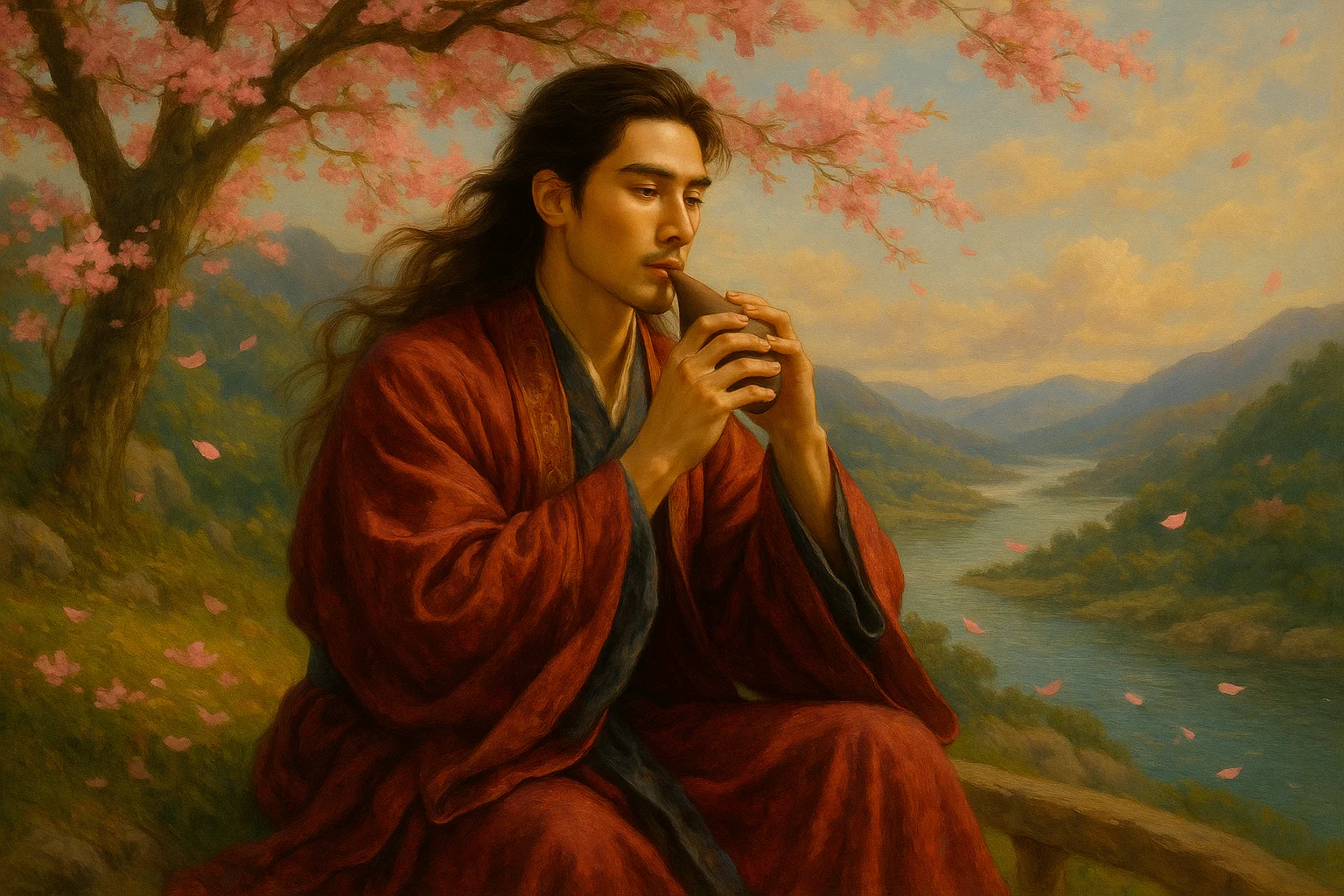
Yuan Zhen (元稹 779 - 831), a native of Luoyang, Henan Province, was a descendant of the Northern Wei imperial family and a renowned poet and statesman of the Mid-Tang Dynasty. As an important figure in Tang literary history, Yuan Zhen co-advocated the New Yuefu Movement with Bai Juyi. His poetic achievements are most distinguished in the yuefu (Music Bureau) style and erotic poetry. His romantic relationship with a woman named Yingying inspired the legendary tale The Story of Yingying. Yuan Zhen’s poetic style is characterized by its accessible clarity, occasionally interspersed with bold and striking expressions. During the transition from the Mid-Tang to the Late Tang, his accessible style exerted a profound influence, laying the foundation for the Yuan-Bai Poetic School.