


Throughout this dynasty no one had painted horses
Like the master-spirit, Prince Jiangdu --
And then to General Cao through his thirty years of fame
The world's gaze turned, for royal steeds.
He painted the late Emperor's luminous white horse.
For ten days the thunder flew over Dragon Lake,
And a pink-agate plate was sent him from the palace-
The talk of the court-ladies, the marvel of all eyes.
The General danced, receiving it in his honoured home

After this rare gift, followed rapidly fine silks
From many of the nobles, requesting that his art
Lend a new lustre to their screens.
...First came the curly-maned horse of Emperor Taizong,
Then, for the Guos, a lion-spotted horse....
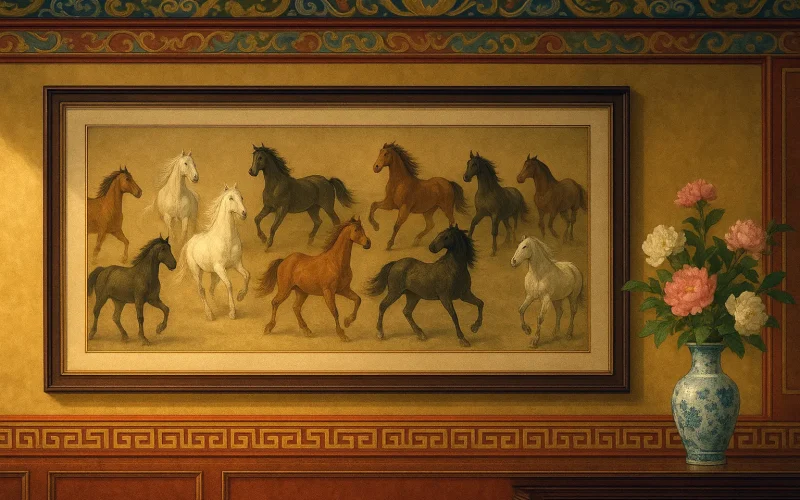
But now in this painting I see two horses,
A sobering sight for whosoever knew them.
They are war- horses. Either could face ten thousand.
They make the white silk stretch away into a vast desert.

And the seven others with them are almost as noble
Mist and snow are moving across a cold sky,
And hoofs are cleaving snow-drifts under great trees-
With here a group of officers and there a group of servants.
See how these nine horses all vie with one another-
The high clear glance, the deep firm breath.

...Who understands distinction? Who really cares for art?
You, Wei Feng, have followed Cao; Zhidun preceded him.
...I remember when the late Emperor came toward his Summer Palace,
The procession, in green-feathered rows, swept from the eastern sky --
Thirty thousand horses, prancing, galloping,
Fashioned, every one of them, like the horses in this picture....

But now the Imperial Ghost receives secret jade from the River God,
For the Emperor hunts crocodiles no longer by the streams.
Where you see his Great Gold Tomb, you may hear among the pines
A bird grieving in the wind that the Emperor's horses are gone.
Original Poem
「韦讽录事宅观曹将军画马图」
国初以来画鞍马, 神妙独数江都王。
将军得名三十载, 人间又见真乘黄。
曾貌先帝照夜白, 龙池十日飞霹雳,
内府殷红玛瑙盘, 婕妤传诏才人索。
盘赐将军拜舞归, 轻纨细绮相追飞;
贵戚权门得笔迹, 始觉屏障生光辉。昔日太宗拳毛騧, 近时郭家狮子花。
今之新图有二马, 复令识者久叹嗟,
此皆骑战一敌万, 缟素漠漠开风沙。
其余七匹亦殊绝, 迥若寒空杂烟雪;
霜蹄蹴踏长楸间, 马官厮养森成列。
可怜九马争神骏, 顾视清高气深稳。借问苦心爱者谁? 后有韦讽前支盾。
忆昔巡幸新丰宫, 翠花拂天来向东;
腾骧磊落三万匹, 皆与此图筋骨同。自从献宝朝河宗, 无复射蛟江水中。
杜甫
君不见,金粟堆前松柏里,龙媒去尽鸟呼风。
Interpretation
This poem was composed in 767 CE, during Du Fu's residence in Chengdu. Cao Ba was the most celebrated painter of horses during the Kaiyuan and Tianbao eras, once favored by Emperor Xuanzong but later reduced to poverty and wandering after the An Lushan Rebellion. Viewing Cao Ba's painting Nine Steeds at the home of his friend Wei Feng, Du Fu was deeply moved. The divine vigor of the painted horses intertwined with the painter's personal fate—and indeed, the fate of an entire era—triggering the poet's profound reflections on past glory and present decline. More than a mere inscription on a painting, this poem uses a single artwork to sketch a visual epic spanning from the prosperity of the Kaiyuan era to the decline of the Dali period, embodying deep contemplation on art, talent, and the destiny of a nation.
Opening Section
国初以来画鞍马,神妙独数江都王。将军得名三十载,人间又见真乘黄。曾貌先帝照夜白,龙池十日飞霹雳,内府殷红玛瑙盘,婕妤传诏才人索。盘赐将军拜舞归,轻纨细绮相追飞;贵戚权门得笔迹,始觉屏障生光辉。
Guó chū yǐlái huà ānmǎ, shénmiào dú shǔ Jiāngdū wáng. Jiāngjūn démíng sānshí zài, rénjiān yòu jiàn zhēn chéng huáng. Céng mào xiāndì zhào yè bái, lóngchí shí rì fēi pīlì, nèifǔ yānhóng mǎnǎo pán, jiéyú chuán zhào cáirén suǒ. Pán cì jiāngjūn bài wǔ guī, qīng wán xì qǐ xiāng zhuī fēi; guìqī quán mén dé bǐjì, shǐ jué píngzhàng shēng guānghuī.
Since early Tang, for painting steeds with masterly skill, / None matched the Prince of Jiangdu’s godly hand and will. / For thirty years the General’s fame has held its sway; / A true "celestial steed" appears once more today. / He once portrayed the late Emperor’s "Shining Night White"; / Ten days of thunder roared o'er Dragon Pool at the sight. / The inner palace gave an agate plate, blood-red; / Court ladies brought imperial edicts, urgently sped. / The General bowed, received the plate, and left the throne; / In silks and gossamer, admirers followed him home. / When nobles and the mighty gained a stroke of his art, / Their finest screens at once took on a gleaming part.
The poem begins by establishing Cao Ba's historical standing in the world of painting. "Celestial steed" refers to a mythical heavenly horse, implying the transcendent quality of his painted steeds. The legend that his depiction of "Shining Night White" caused ten days of thunder over Dragon Pool hyperbolically suggests his artistry possessed a divine power. The material rewards like the "blood-red agate plate" and the eager pursuit by those in "silks and gossamer" vividly depict his illustrious fame during the Kaiyuan zenith, foreshadowing the decline that follows.
Central Section
昔日太宗拳毛騧,近时郭家狮子花。今之新图有二马,复令识者久叹嗟,此皆骑战一敌万,缟素漠漠开风沙。其余七匹亦殊绝,迥若寒空杂烟雪;霜蹄蹴踏长楸间,马官厮养森成列。可怜九马争神骏,顾视清高气深稳。
Xīrì Tàizōng quán máo guā, jìn shí Guō jiā shīzi huā. Jīn zhī xīn tú yǒu èr mǎ, fù lìng shí zhě jiǔ tàn jiē, Cǐ jiē qí zhàn yī dí wàn, gǎo sù mò mò kāi fēngshā. Qí yú qī pǐ yì shū jué, jiǒng ruò hán kōng zá yān xuě; Shuāng tí cù tà zhǎng qiū jiān, mǎ guān sī yǎng sēn chéng liè. Kělián jiǔ mǎ zhēng shén jùn, gù shì qīnggāo qì shēn wěn.
In days of old, Taizong's famed steed "Curly Mane" was known; / In recent times, the Guo clan’s "Lion-Flower" has shown. / Within this new-scroll, two such horses stand in view, / Making the knowing sigh with wonder, long and true. / Both are chargers facing ten thousand foes in fight; / They seem to charge through dusty storms across the plain’s white. / The other seven steeds are also rare, unique— / Like smoke and snow commingling in a cold sky, bleak. / Their frosty hooves seem stamping under tall trees’ rows; / Grooms, stablemen stand ranked in stern and strict repose. / How wondrous, these nine steeds vying in noble might, / Their gaze serene and proud, their spirit deep and bright.
This core section shifts from historical horses to the painting itself. Rather than describing their forms directly, the poet conveys their divine prowess through "facing ten thousand foes," their dynamic motion through "charge through dusty storms," and their ethereal color and spirit through "Like smoke and snow commingling in a cold sky." He transforms a static image into a poetic realm filled with the grandeur of the battlefield and vibrant life. "Their gaze serene and proud, their spirit deep and bright" penetrates outward form to capture the inner dignity and profound, steady bearing of these noble creatures.
Transition
借问苦心爱者谁?后有韦讽前支盾。忆昔巡幸新丰宫,翠花拂天来向东;腾骧磊落三万匹,皆与此图筋骨同。
Jiè wèn kǔxīn ài zhě shuí? Hòu yǒu Wéi Fěng qián Zhī Dùn. Yì xī xúnxìng Xīnfēng gōng, cuì huā fú tiān lái xiàng dōng; Téng xiāng lěiluò sān wàn pǐ, jiē yǔ cǐ tú jīngǔ tóng.
Who loves this work with such devoted, earnest care? / Wei Feng today, and in the past, the monk Zhi Dun rare. / I recall imperial tours to Xinfeng’s halls of state, / When jade-green banners swept the skies, proceeding east in state. / Thirty thousand steeds, majestic, galloping free, / All shared the selfsame bone and spirit shown in this painting’s spree.
Shifting from the painting to its connoisseurs, the poet compares the contemporary collector Wei Feng to the legendary horse-loving monk Zhi Dun, elevating Wei’s discernment. His gaze then sweeps back to recall the magnificent scene of "Thirty thousand steeds, majestic, galloping free" during Emperor Xuanzong’s processions. The assertion that these steeds "shared the selfsame bone and spirit" as those in the painting not only praises the artwork's lifelike vitality but also connects it to the very essence of a glorious era.
Concluding Section
自从献宝朝河宗,无复射蛟江水中。君不见,金粟堆前松柏里,龙媒去尽鸟呼风。
Zì cóng xiàn bǎo cháo hé zōng, wú fù shè jiāo jiāng shuǐ zhōng. Jūn bú jiàn, jīn sù duī qián sōng bǎi lǐ, lóng méi qù jìn niǎo hū fēng.
Since precious jade was offered to the River God deep, / None shoots the water-dragon in the river’s keep. / Do you not see, before the Golden-Millet Mound, / 'Mid pines and cypresses, no dragon-steeds are found, / Only birds calling in the wind, a desolate sound?
The conclusion marks a sharp emotional turn. The allusion "precious jade was offered to the River God" (symbolizing the death of Emperor Xuanzong) declares the end of the golden age. "None shoots the water-dragon" symbolizes the loss of imperial prowess and the spirit of that era. The final focus rests on the desolate scene at Xuanzong’s tomb: the "dragon-steeds" (imperial horses) are gone, leaving only birds crying in the wind. The vibrant energy of the painted horses stands in stark, poignant contrast to the bleak stillness before the imperial mausoleum.
Holistic Appreciation
This poem is a masterpiece of Du Fu’s long, irregular verse (gēxíng), showcasing his grand narrative power of "using poetry as historical witness." Centered on Cao Ba's Nine Steeds, the poem unfolds a dialogue across three temporal layers: the immortal vigor of the painted horses (the eternity of art), the dramatic rise and fall of the painter's life (personal destiny), and the trajectory of the Great Tang from Kaiyuan prosperity to Dali decline (the shifts of national fortune). These three strands intertwine, ultimately converging in a lament before the Golden-Millet Mound.
Its artistic brilliance lies in this: inspired by the painting, yet not confined by it; depicting horses, yet pointing beyond them. Through lines like "They seem to charge through dusty storms," the poet transforms a two-dimensional artwork into a vast battlefield shrouded in historical dust. Through the connection "shared the selfsame bone and spirit," the nine horses become the spiritual epitome of the thirty thousand steeds of a prosperous age. Finally, all this splendor is gathered into the desolate image of "birds calling in the wind." The more brilliant the painting, the more it underscores the bleakness of reality; the more divine the horses, the more they highlight the powerlessness of the age.
Artistic Merits
- Sprawling Structure, Interwoven Temporalities
The poem unfolds from the artwork but ranges freely across time—from the early history of Tang painting to the present scroll, from Kaiyuan imperial tours to the contemporary tomb. It constructs multiple, interwoven layers of historical time and space, demonstrating Du Fu’s extraordinary command of grand themes. - Translating Image into Verse, Animating the Still
The poet successfully animates static visual art into a poetic realm pulsating with rhythm and tension through dynamic imagery and vigorous language—"thunder roared," "charge through dusty storms," "Like smoke and snow commingling," "frosty hooves seem stamping." It is a model not only of "painting within poetry" but of "motion within poetry." - Stark Juxtapositions, Profound Implications
The poem is rich in contrasts: the painter’s past favor versus present obscurity; the divine energy of the painted steeds versus the现实 absence of "dragon-steeds"; the clamor of the past "thirty thousand steeds" versus the desolate "birds calling in the wind." Within these powerful past-present juxtapositions lies boundless lament for the fate of talent and the vicissitudes of a nation. - Rhythmic Language, Somber and Vigorous Spirit
As a long heptasyllabic ancient-style poem, its line lengths vary, and its rhythm rises and falls. The narrative flows expansively (e.g., the reward scene), the description is vivid and concise (e.g., "Their gaze serene and proud"), and the抒情 is somber and mournful (the conclusion). The overall spirit is somber, vigorous, sorrowful, and deeply resonant, perfectly mirroring the sense of historical desolation it conveys.
Insights
This work demonstrates how a great artwork can become a vessel for an era’s memory and a symbol of its spirit. Through this painting, Du Fu accomplishes not merely a tribute to a gifted artist, but an elegy and meditation for a lost age. It reveals that the value of art lies not only in its technical mastery, but in its capacity to bridge historical memory and present life, and to safeguard, amidst the ruins of time, those glories and dignities that must not be forgotten.
Simultaneously, the poem illustrates the fragility and resilience of individual fate within history’s torrent. Cao Ba’s brush could preserve the spirit of "Shining Night White" and the soul of an empire’s steeds, yet it could not reverse his own and his era’s decline. This contradiction is the shared plight of countless talents throughout history. What Du Fu records with his poetic brush is precisely this unremitting effort—to grasp the eternal within the transient, to remember the radiance within the decline. This, perhaps, is the faint glimmer by which human civilization endures.
Poem translator
Kiang Kanghu
About the poet
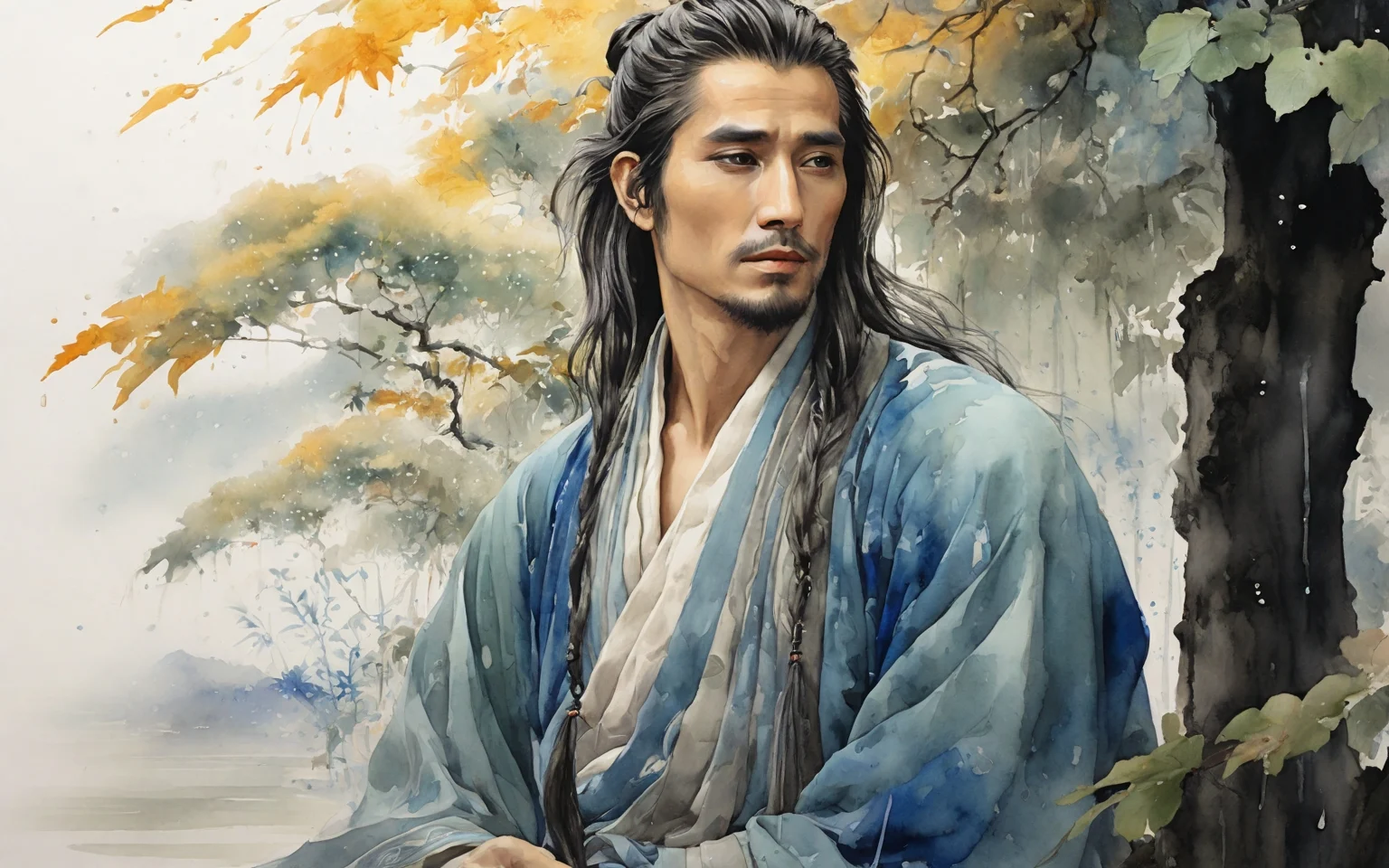
Du Fu (杜甫), 712 - 770 AD, was a great poet of the Tang Dynasty, known as the "Sage of Poetry". Born into a declining bureaucratic family, Du Fu had a rough life, and his turbulent and dislocated life made him keenly aware of the plight of the masses. Therefore, his poems were always closely related to the current affairs, reflecting the social life of that era in a more comprehensive way, with profound thoughts and a broad realm. In his poetic art, he was able to combine many styles, forming a unique style of "profound and thick", and becoming a great realist poet in the history of China.