


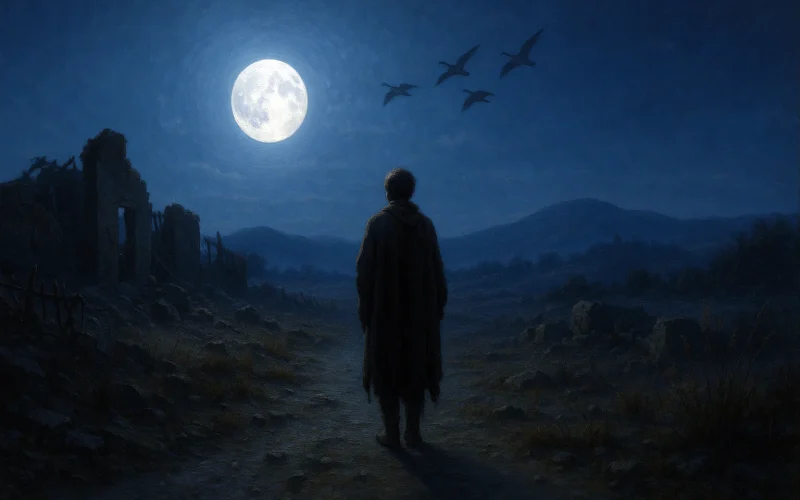
Hard times with famine spread ruins in our home town;
My brothers go their way east or west, up and down.
Battles have left the fields and gardens desolate;
By roadside wander families wars separate.

Like far-off wild geese over lonely shadows we weep,
As scattered rootless tumbleweed in autumn deep.
We should shed yearning tears to view the moon apart;
Though in five places, we have the same homesick heart.
Original Poem
「望月有感」
白居易
时难年荒世业空,弟兄羁旅各西东。
田园寥落干戈后,骨肉流离道路中。
吊影分为千里雁,辞根散作九秋蓬。
共看明月应垂泪,一夜乡心五处同。
Interpretation
Bai Juyi appended a note to this poem: "Since the turmoil in Henan, and the famine blocking the passes within, my brothers have been scattered, each in a different place. Moved by the sight of the moon, I set down my thoughts to send to my eldest brother in Fuliang, my seventh brother in Yuqian, my fifteenth brother in Wujiang, and also for my younger siblings in Fuli and Xiagui." It was composed between the autumn of 799 CE and the following spring. That year, rebellions by military governors swept through Henan, while the Guanzhong region was stricken by severe drought and famine. The young Bai Juyi, fleeing the chaos and seeking livelihood, had become a wanderer. This poem is his profound reckoning with his family's scattered fate, a masterpiece often hailed as the most universally poignant lament of family separation in Tang wartime poetry.
First Couplet: 时难年荒世业空,弟兄羁旅各西东。
Shínàn niánhuāng shìyè kōng, dìxiōng jīlǚ gè xīdōng.
In these hard times, these barren years, our patrimony’s gone; / We brothers, wayfarers, are scattered west and east, each one.
The opening lines employ a historian’s concision to summarize the dual calamity of the age and the family. "Hard times" signifies war; "barren years" denotes famine—together they outline a cruel epoch. "Our patrimony’s gone" carries profound weight, marking the loss not only of material wealth but of the stable, inherited order of family life. Against this backdrop, the specific tragedy of "We brothers, wayfarers, are scattered" unfolds inevitably. The word "wayfarers" conveys a forced, rootless state, while "west and east" emphasizes a complete, disordered dispersal. These lines move from the general historical crisis to the particular family tragedy, from the loss of foundation to the scattering of kin, establishing the poem’s somber and plaintive tone.
Second Couplet: 田园寥落干戈后,骨肉流离道路中。
Tiányuán liáoluò gāngē hòu, gǔròu liúlí dàolù zhōng.
Fields and gardens lie deserted in the war’s grim wake; / Our own flesh and blood are cast adrift, for road and hardship’s sake.
This couplet elaborates on the desolation announced above. "Fields and gardens lie deserted" presents a static image of ruin, the final state of the homeland. "Our own flesh and blood are cast adrift" offers a dynamic picture of survival, the ongoing process of exile. One image is still, the other in motion; one shows the effect, the other the cause. Together, they depict war’s systematic destruction of an ordinary household. The phrases "in the war’s grim wake" and "for road and hardship’s sake" fix the tragedy firmly within its historical moment.
Third Couplet: 吊影分为千里雁,辞根散作九秋蓬。
Diàoyǐng fēn wéi qiānlǐ yàn, cí gēn sàn zuò jiǔ qiū péng.
*We mourn our lonely shadows, like wild geese cleft by a thousand *li; / Torn from our root, we’re autumn thistles scattered heedlessly.
The focus turns inward, rendering emotion concrete through a pair of masterful metaphors. The image of "wild geese cleft by a thousand li" conveys both intense loneliness ("mourn our lonely shadows") and vast distance, while the geese’s natural formation ironically highlights the chaos of human separation. The figure of "autumn thistles scattered" expresses a rootless, drifting existence. "Torn from our root" connects back to the lost patrimony, articulating a fundamental deracination, and "autumn thistles" underscores the bleak season and the involuntary nature of their fate. One metaphor emphasizes the pain of spatial separation, the other the sorrow of lost anchorage; together, they capture the existential and psychological state of the exile with piercing depth.
Fourth Couplet: 共看明月应垂泪,一夜乡心五处同。
Gòng kàn míngyuè yīng chuí lèi, yī yè xiāng xīn wǔ chù tóng.
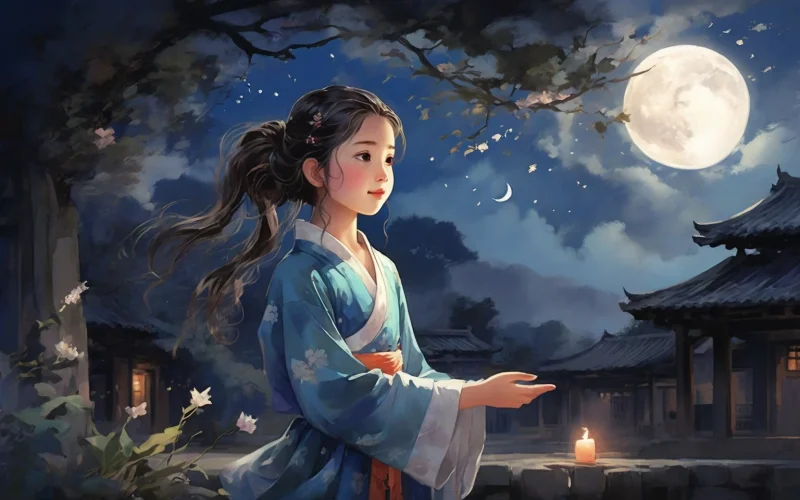
Gazing at this bright moon as one, surely our tears will start; / This single night, in five far places, beats one homesick heart.
The final couplet achieves the poem’s emotional climax and resolution, brilliantly transforming physical separation into spiritual unity. "Gazing at this bright moon as one" is an act of imagination and an article of faith. The moon becomes the sole, shared medium connecting the separated kin. "Surely our tears will start" expresses profound empathy and a certainty of shared feeling. The concluding line, "in five far places, beats one homesick heart," reveals the poem’s core insight: the more complete the physical dispersal (five places), the more absolute the spiritual unison (one heart). The individual’s longing is thus universalized, becoming the shared emotion of all displaced people in a fractured age.
Holistic Appreciation
This poem is a paradigm of Bai Juyi’s early realist style, perfectly embodying his dictum to "write for the age, and compose poetry for events." Its structure is masterfully clear: the first couplet summarizes the historical and familial disaster; the second depicts its concrete devastation; the third uses metaphor to plumb the depths of inner wounding; the fourth employs the moon to achieve emotional transcendence and reunion. The poet sets his family’s plight squarely within the context of "hard times" and "barren years," lending personal sorrow a representative, epochal significance. Classical images—the wild goose, the thistle, the moon—are renewed within this specific, harrowing circumstance. The conception of the final line, using the number of locations to express the unity of feeling, carves out a realm of spiritual resonance from the very fact of separation, uniting artistic form and profound thought.
Artistic Merits
- Potent Realistic Condensation: The line "In these hard times, these barren years, our patrimony’s gone" functions with a historian’s force, compactly summarizing the mid-Tang’s social crises and their catastrophic impact on family life.
- Classical Metaphor, Freshly Applied: Images like the separated goose and the rootless thistle are traditional, but verbs like "cleft" and "scattered" bind them dynamically to the immediate situation. The formulation "in five far places, beats one… heart" is strikingly original, quantifying emotion to powerful effect.
- Emotional Movement from Division to Unity: The first six lines meticulously document the reality of separation and the pain of exile. The final couplet shifts to the abstract, shared act of moon-gazing, transforming the "division" of five locations into the "unity" of a single yearning, achieving a masterful emotional and conceptual resolution.
- Unadorned Diction, Natural Parallelism: The language is plain, almost conversational, yet carries immense emotional gravity. The parallel couplets are balanced and apt—"Fields and gardens lie deserted" with "Our own flesh and blood are cast adrift"—integrating formal elegance seamlessly with somber content.
Insights
The poem’s enduring value lies in its transcendence of personal grief to create a "poetic history" of a family’s, and a generation’s, fate. It reveals that in the face of vast historical disaster, families are as helpless as "autumn thistles" in the wind. Yet it also asserts that human bonds and shared feeling can, even amidst extreme separation, forge a spiritual communion that defies physical space.
Its message resonates deeply today. In an age of global movement and frequent dislocation, though the causes differ from war and famine, the experience of separation is common. The vision of "one homesick heart" beating in "five far places" reminds us that true kinship and belonging can be sustained not by physical proximity but by shared memory, mutual understanding, and conscious acts of common reflection—like gazing at the same moon. It teaches how to preserve connection across distance and find unity within dispersal. This wisdom, born of ancient hardship, remains a potent antidote to the alienations of modern life.
Poem translator
Xu Yuanchong (许渊冲)
About the Poet
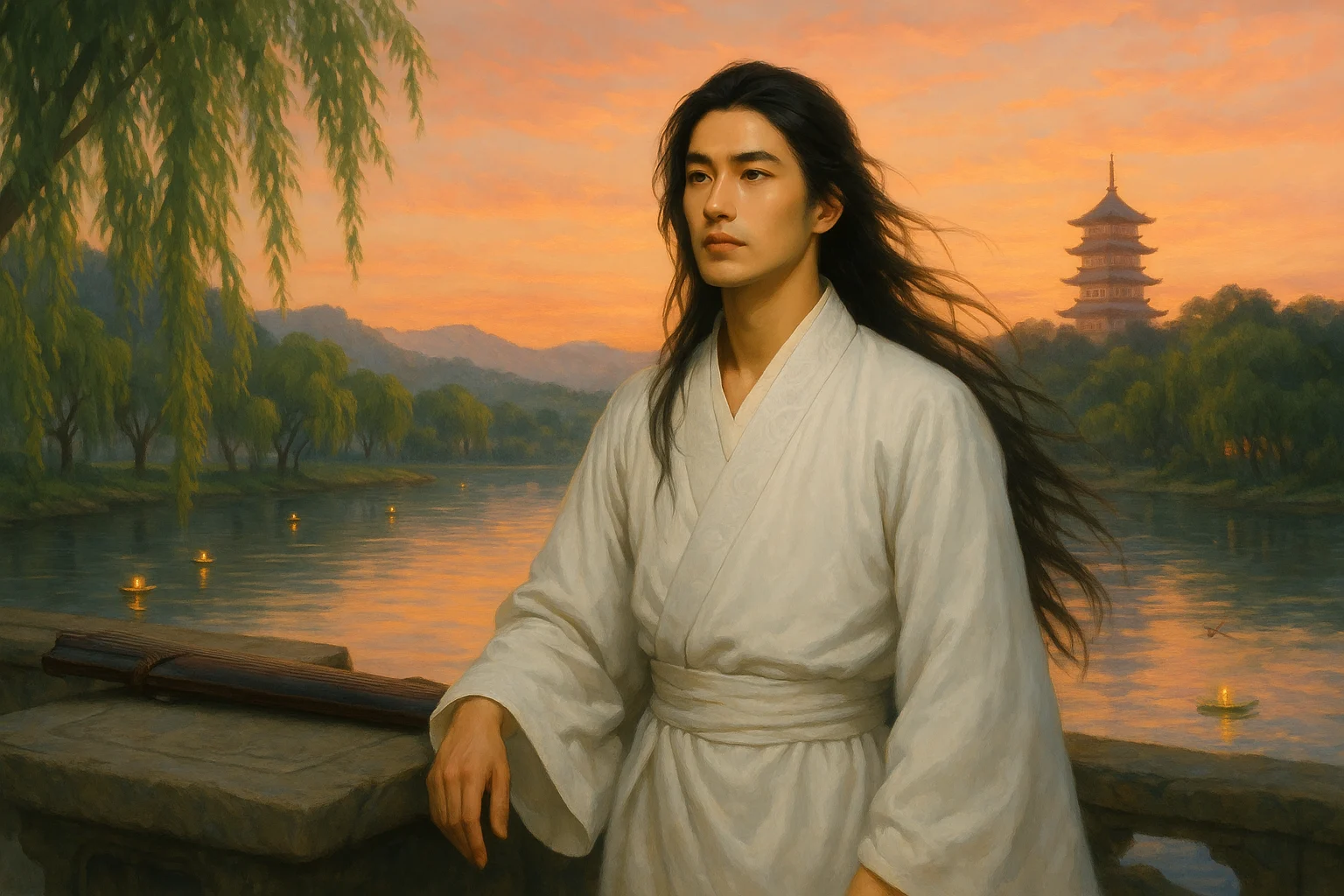
Bai Juyi (白居易), 772 - 846 AD, was originally from Taiyuan, then moved to Weinan in Shaanxi. Bai Juyi was the most prolific poet of the Tang Dynasty, with poems in the categories of satirical oracles, idleness, sentimentality, and miscellaneous rhythms, and the most influential poet after Li Bai Du Fu.