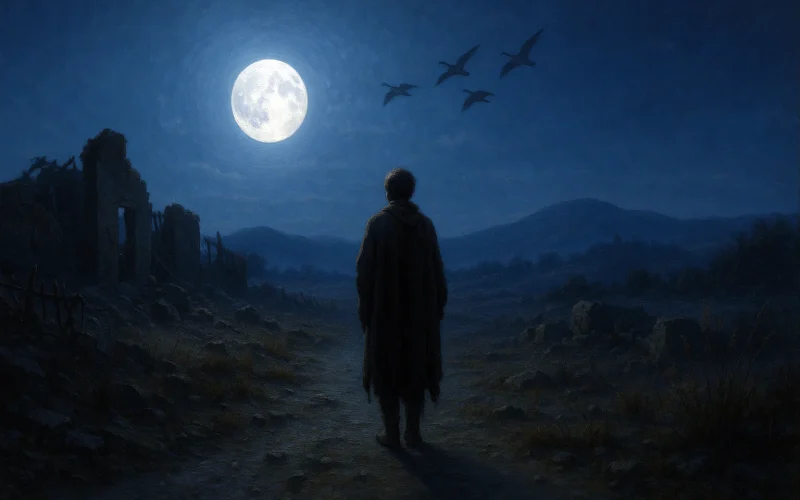



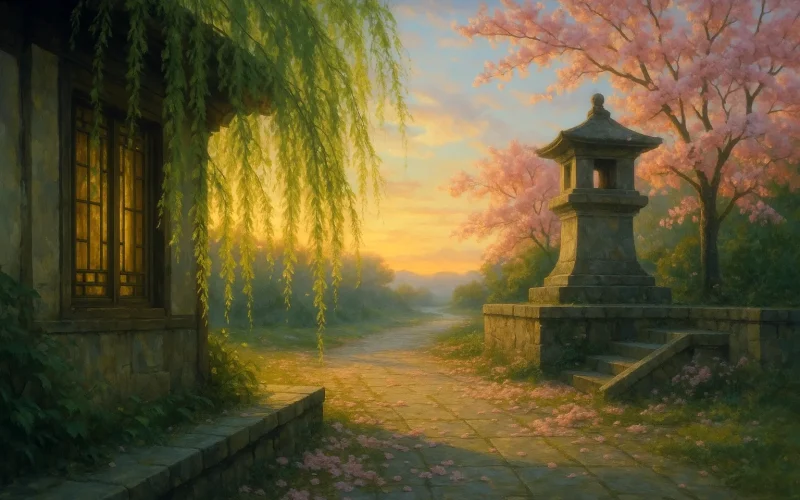
Your wife gazes at yellowing willows at home;
You on flowers falling on the ground while you roam.
Spring comes to end in two places on the same day;
You think of home and she of you far, far away.
Original Poem
「望驿台」
白居易
靖安宅里当窗柳,望驿台前扑地花。
两处春光同日尽,居人思客客思家。
Interpretation
This poem was composed in the third lunar month of spring, 809 CE. It is a distinctive poetic reply. The original verse was written by Bai Juyi’s close friend Yuan Zhen. While traveling on official duty as an Investigating Censor to Dongchuan in eastern Sichuan, Yuan Zhen longed for his family in Chang’an and wrote “Gazing at the Courier Station” to express his feelings. Deeply moved upon reading it, Bai Juyi composed this matching poem using the same title and rhyme scheme. It serves both as a profound resonance with his friend’s travel-worn sentiments and as a cool, penetrating structural analysis of the eternal theme of “longing,” showcasing Bai Juyi’s exceptional skill in capturing emotion and crafting poetic form.
First Couplet: 靖安宅里当窗柳,望驿台前扑地花。
Jìng'ān zhái lǐ dāng chuāng liǔ, Wàng yì tái qián pū dì huā.
In Jing’an Lodge, the willow by the window thrives; / Before Gazing Courier Tower, spent blossom falls and dives.
The opening couplet uses precise parallelism to juxtapose two distant places and two scenes of spring, establishing the poem’s lyrical framework. “Jing’an Lodge” was Yuan Zhen’s home in the capital, representing domesticity. “Gazing Courier Tower” was his place of temporary sojourn, representing his official travels. “The willow by the window” is a still, domestic image. The drooping willow fronds symbolize spring and, more importantly, act as the focal point for the one at home (Yuan Zhen’s wife, Wei Cong) gazing out with longing for the distant traveler. “Spent blossom falls” is a dynamic scene at the wayside station. The scattered petals depict the late spring of Sichuan but also externalize the traveler’s (Yuan Zhen’s) melancholy heart, stirred by the blossoms to lament the passing of time and joy. Not a word speaks directly of “missing,” yet the feeling saturates the two contrasting images of spring.
Second Couplet: 两处春光同日尽,居人思客客思家。
Liǎng chù chūnguāng tóng rì jìn, jūrén sī kè kè sī jiā.
Spring’s aspect in two places ends upon the single, selfsame day; / The one at home thinks of the traveler, the traveler thinks of home straightway.
This couplet is the soul of the poem. Building upon the concrete imagery of the first, it offers a philosophical summation and reveals the underlying emotional logic. The first line, “Spring’s aspect in two places ends upon the single, selfsame day,” is a striking poetic assertion. In terms of the natural calendar, spring in two distant places likely did not fade on the exact same day. The poet insists on the synchronicity of their psychological time: in the subjective world of those who long, all springtime is rendered meaningless by absence, becoming equivalently “ended.” This is the conquest and unification of objective time by shared emotion. The second line, “The one at home thinks of the traveler, the traveler thinks of home,” states the nature of mutual longing in plain, almost syllogistic terms. It is no longer a one-sided complaint but a complete, closed emotional circuit: the longing of the “one at home” is directed at the “traveler,” whose longing is directed at “home,” the emotional center of which is the “one at home.” This circular phrasing perfectly mimics the endless, reverberating exchange of feeling between the two locations, revealing the pain of separation as a shared and symmetrical state.
Holistic Appreciation
This heptasyllabic quatrain is a work of “the geometry of longing” and “the symmetry of feeling.” Its structure is masterfully conceived: the first couplet presents a horizontal juxtaposition of space (Lodge / Tower); the second couplet presents a vertical cycle of emotion and a psychological unification of time (two places ending as one / mutual longing). The first two lines imply feeling through imagery, subtle and suggestive; the last two articulate its principle directly, clear and penetrating. Moving from the concrete to the abstract, from description to summation, it completes a leap from the phenomenon of emotion to its essence. Transcending mere personal expression, it uses a dispassionate tone to reveal a universal emotional structure: longing is a bidirectional current across distance, and the sense of time’s passage is experienced and intensified in synchrony by both parties in the bond.
Artistic Merits
- Precision in Parallel Structure and Juxtaposition: The parallelism of the first couplet is not merely formal. It involves a deliberate contrast of space (home/road), implied action (static by the window / dynamic falling), and imagery (enduring willow / perishing flowers), establishing connection through difference and laying a solid foundation for the conceptual discussion of “two places” and “homebody-traveler” that follows.
- The Poetic Invention of Psychological Time: “Spring’s aspect… ends upon the single, selfsame day” is poetic hyperbole and profound psychological truth. It captures the subjective experience where shared emotion overrides and unifies objective chronology, a brilliant feat of poetic imagination.
- The Logical Elegance of Circular Phrasing: The line “The one at home thinks of the traveler, the traveler thinks of home” uses a linked, circular syntax. The words are interlocked, the meaning recursive, visually representing the bidirectional, closed-loop nature of mutual longing. Form and content achieve a unified, concise, and philosophical expression.
- Emotional Depth and Objective Perspective in a Poetic Reply: As a matching poem, it deeply empathizes with the friend’s specific situation (via the named places) while also achieving a detached, universal perspective on the nature of “longing” itself. It perfectly blends personal consolation with philosophical contemplation.
Insights
The poem’s power lies in its clear, balanced, almost analytical revelation of an emotional truth. It shows that genuine longing is never a solitary lament but a silent resonance and dialogue across space; the pain of separation gains a strange solace and dignity in the confirmed knowledge that the other shares the same ache.
The poem offers profound insight for modern relationships. In an age where communication is instant, geographical distance is often bridged, yet emotional “Courier Towers” can still rise unnoticed in daily life. Bai Juyi’s poem reminds us that sustaining connection depends not just on exchanging messages but on the synchronized perception and imaginative sharing of each other’s “spring aspect”—their life’s season and state of mind. “Spring’s aspect in two places ends upon the single, selfsame day”—when we can share the same poignant or joyful recognition with a distant loved one, that constitutes the deepest force against separation.
It asks us: in our partings, do we strive to see the “willow” by the other’s window and the “fallen blossoms” before their tower? Do we believe in and nurture that shared psychological time? This poem is a gentle urging for mutual emotional awareness and an enduring tribute to the human capacity to transcend physical distance through the communion of feeling.
Poem translator
Xu Yuanchong (许渊冲)
About the Poet
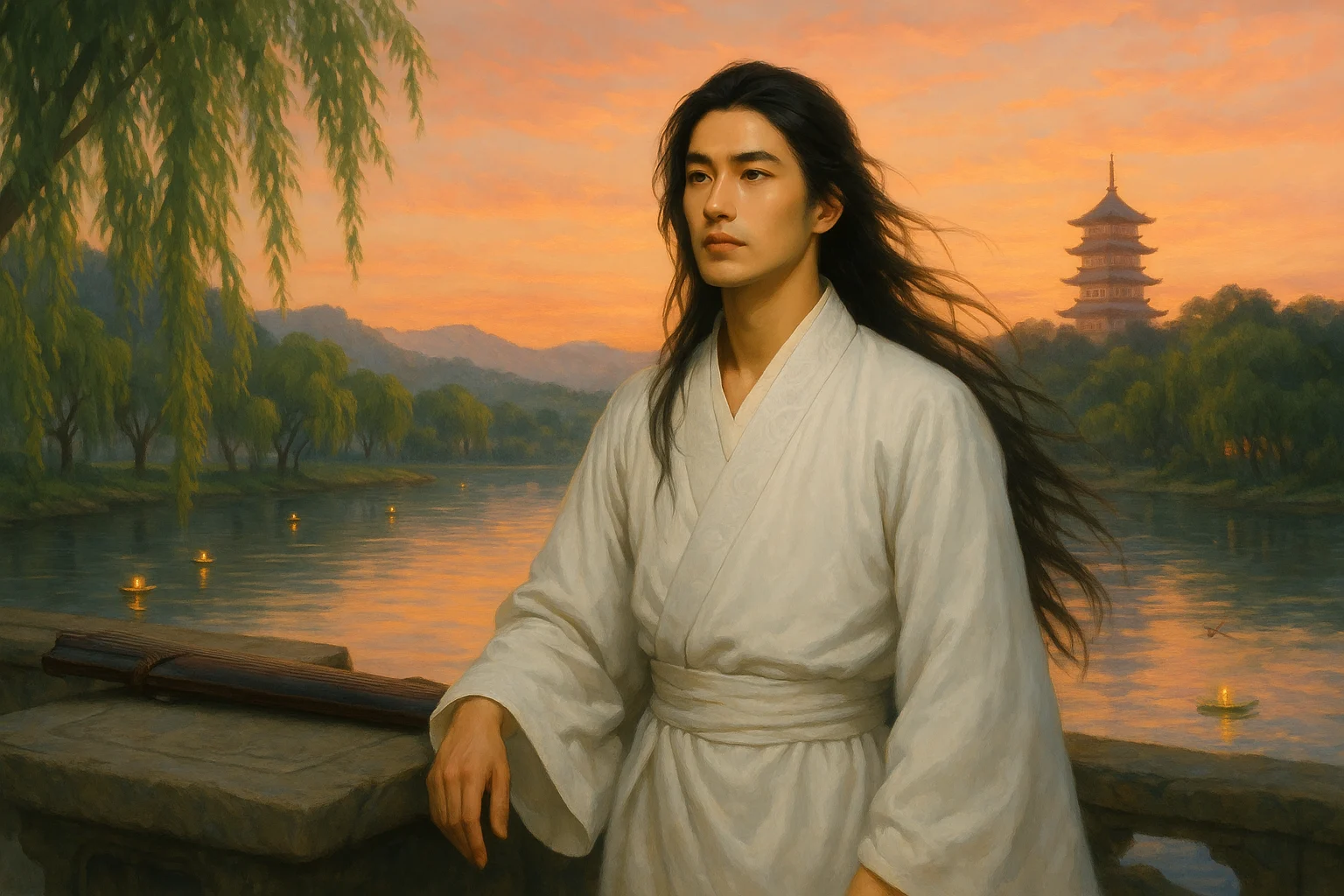
Bai Juyi (白居易), 772 - 846 AD, was originally from Taiyuan, then moved to Weinan in Shaanxi. Bai Juyi was the most prolific poet of the Tang Dynasty, with poems in the categories of satirical oracles, idleness, sentimentality, and miscellaneous rhythms, and the most influential poet after Li Bai Du Fu.