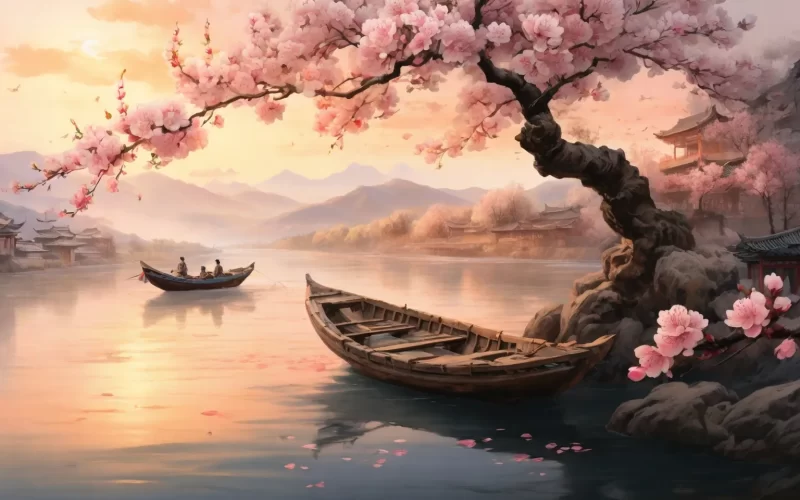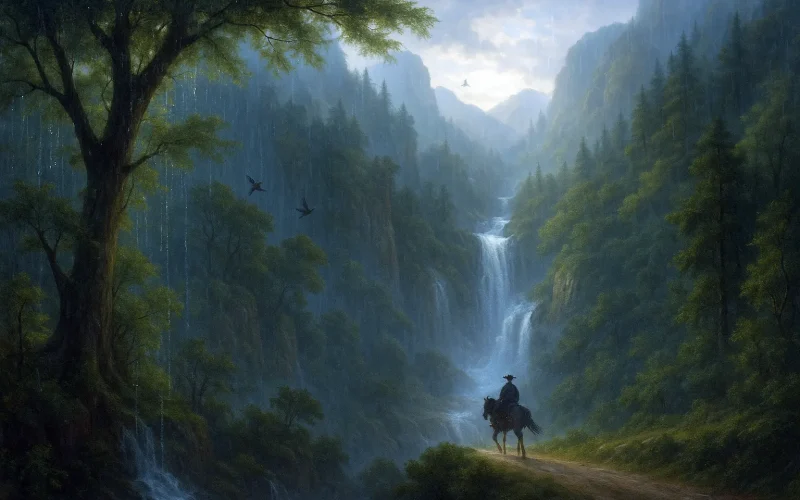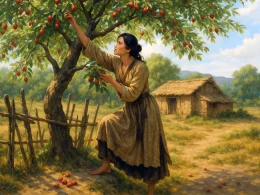



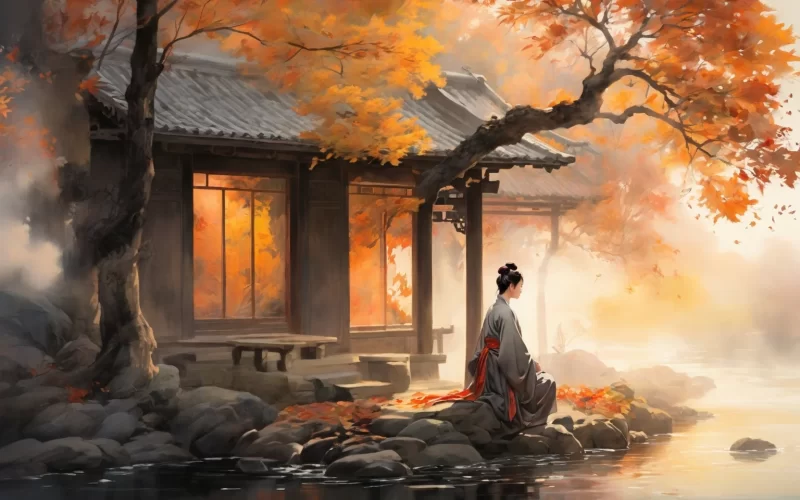
The cold hills take on a greener hue;
The autumn stream murmurs the whole day through.
Leaning on my staff by the wicket door,
I listen to cicadas at dusk as of yore.

The sun slants o’er the ferry, lingering still;
From village kitchens rises smoke at will.
…Oh, when shall I see my hermit friend next time
And sing wild songs as in our golden prime?
Original Poem
「辋川闲居赠裴秀才迪」
王维
寒山转苍翠,秋水日潺湲。
倚杖柴门外,临风听暮蝉。
渡头余落日,墟里上孤烟。
复值接舆醉,狂歌五柳前。
Interpretation
This poem is a gem among Wang Wei’s later reclusive verses and an elegant crystallization of his spiritual dialogue with his close friend Pei Di. Composed at his Wang River estate during a period of semi-retirement, it represents a lucid phase where the poet’s body and mind were wholly attuned to nature. Using serene and expansive scenery to depict a solitary soul, and historical allusions to reflect a friendship of genuine understanding, the poem, within the strict form of the five-character regulated verse, unfolds a long scroll of autumn reclusion where man and scene merge, and mind and object share one structure. It stands as a paradigm of the High Tang landscape and pastoral poetry’s quaternary aesthetic unity of "poetry, painting, zen, and friendship."
First Couplet: 寒山转苍翠,秋水日潺湲。
Hán shān zhuǎn cāngcuì, qiū shuǐ rì chányuán.
The cold hills take on deeper green and blue; / The autumn stream runs on with murmurings all day.
The opening sets the tone with a grand sense of time and space. "Cold hills" fixes the season, lending the scene a crisp texture; "take on deeper green and blue" captures the subtle deepening of the autumn mountains’ hues under changing light and the poet’s inner state. The word "take on" conveys the visual marvel born of time’s flow and the mind’s projection. "The autumn stream runs on with murmurings all day" contrasts constant flow ("all day") with the mountain colors’ gradual change ("take on"). Together, stillness and movement, color and sound, construct the foundational atmosphere of the Wang River autumn—both timeless and ever-changing. This is not merely scenery but an objectified reflection of the poet’s lucid state of mind.
Second Couplet: 倚杖柴门外,临风听暮蝉。
Yǐ zhàng chái mén wài, lín fēng tīng mù chán.
Leaning on my staff outside my wicket gate, / I face the breeze and listen to cicadas in late day.
The focus draws closer as the poet’s own figure quietly enters the picture. "Leaning on my staff" is the classic posture of the recluse, conveying ease and serenity; "outside my wicket gate" marks the boundary between home and nature, symbolizing the threshold where the spirit departs the worldly clamor. "I face the breeze and listen to cicadas in late day" is a fully immersive sensory experience: the breeze is touch, the cicadas’ chorus is sound, the dusk is sight and sense of time. The poet does not speak of "thinking" but of "listening," uniting inner contemplation with the faint sounds outside, embodying a Zhuangzi- or Zen-like observation of "listening with the vital breath." Here, the man has himself become part of the scene.
Third Couplet: 渡头余落日,墟里上孤烟。
Dù tóu yú luòrì, xū lǐ shàng gū yān.
At the crossing, the last rays of the setting sun linger; / Over the village, a single column of smoke rises.
The gaze extends from near to far, then from far to near, outlining the two most poetic silhouettes of the twilight countryside. "At the crossing, the last rays of the setting sun linger" depicts the magnificent, horizontal fading of light, warm yet desolate. "Over the village, a single column of smoke rises" shows the tranquil, vertical ascent of life, intimate yet aloof. The words "linger" and "rises" are painterly in their precision, imbuing the scene with a gentle dynamism and the breath of life. The couplet is perfectly balanced, with exquisite contrasts in color (the warm afterglow and the faint smoke), line (horizontal and vertical), and mood (vast solitude and secluded stillness), masterfully capturing pictorial principles.
Fourth Couplet: 复值接舆醉,狂歌五柳前。
Fù zhí Jiē Yú zuì, kuáng gē wǔ liǔ qián.
And then I meet again my tipsy friend like Jieyu of old, / Singing wildly before the gate of Five Willows, bold.
The closing couplet introduces the friend, employing allusions with exquisite skill to elevate the poem’s artistic conception to its climax. "Meet again" indicates this is not a chance encounter but the joyful, frequent gathering of like-minded souls. "Tipsy friend like Jieyu" alludes to the Chu hermit Jieyu, known for his defiance, comparing Pei Di’s untrammeled nature; "singing wildly" is the natural outpouring of his authentic self. "Before the gate of Five Willows" refers to the poet’s own abode, alluding to Tao Yuanming (who styled himself "Master of Five Willows"), thereby proclaiming the poet’s own pursuit of a persona indifferent to fame and true to itself. A drunken, singing guest before a recluse’s gate creates not discord but a perfect harmony that transcends formalities, a meeting of hearts and minds. The scene grows more vivid with this joyful human encounter; the men appear more transcendent within the serene scenery.
Holistic Appreciation
This poem is a poetic construct structured like a perfect symphony. It follows an alternating, progressive pattern of "scene (distant) — person (solitary) — scene (distant/near) — person (shared)": the first couplet is scenery without people, establishing a serene tone; the second couplet is the solitary man, merging into contemplative stillness; the third couplet returns to expansive scenery, broadening the poetic space; the final couplet concludes with the friend’s wild song, infusing it with life’s warmth and spiritual resonance. The four couplets are like a four-panel screen, each a complete picture yet forming a seamless whole.
In this poem, Wang Wei achieves the consummate poetic fusion of the self and the world. The solitary speaker ("I")—leaning on his staff, listening to the evening cicadas—and the surrounding scene (the cold hills deepening to emerald, the ceaseless murmur of the autumn stream, the last glow of sunset at the ferry, a lone thread of smoke rising from the village) enter into a state of profound interpenetration: the poet's inner world imbues the landscape with contemplative warmth, while the essential qualities of the landscape mirror his own serene being. The arrival of his friend Pei Di does not rupture this tranquility. Instead, embodied in the contrasting modes of "drunken abandon" and "unrestrained song," it demonstrates that profound stillness can encompass ardent feeling, and that solitude longs for the communion of a kindred spirit. Together, they attain the sublime realm of "harmony without uniformity." Thus, the poem transcends mere depiction of a moment; it becomes a lyrical embodiment of the ideal recluse and of perfect friendship.
Artistic Merits
- Subtle Orchestration of Color and Light: The "deeper green and blue" captures the deepening of mountain hues; the "last rays" hold the lingering warmth of light; the "lone smoke" is a faint trace against the dusk. Through the delicate rendering and contrast of color and light, the poet builds the rich yet tranquil visual layers of an autumn evening, achieving a distinctly painterly quality.
- Precision of Verbs and Generation of Poetic Meaning: Verbs like "take on" (suggesting gradual change in color), "listen" (implying deep immersion), "linger" (evoking a sense of time suspended), "rises" (conveying gentle ascent), "meet" (denoting a fortunate encounter), and "singing" (bursting with heartfelt expression) act as the vitalizing final strokes in a painting. They animate stillness with life and open up realms of artistic conception within realistically depicted scenes.
- The Philosophy of Space within Parallelism: The parallelism in the second couplet ("Leaning on my staff" with "I face the breeze") reveals the interaction between man and nature. The third ("At the crossing" with "Over the village") maps spaces of distance and proximity. The fourth ("tipsy friend like Jieyu" with "before the gate of Five Willows") enacts a convergence of historical allusion and the present moment. This balanced structure is not a rigid constraint but a linguistic reflection of the world's inherent symmetry and harmony.
- Personification and Sense of Presence in Allusion: Alluding to Pei Di as the tipsy hermit Jieyu and to himself as the recluse of "Five Willows" (Tao Yuanming) does more than lend elegance. It instantly lifts the simple scene of rustic leisure and merry-making into a spiritual dialogue with lofty figures from the past, thereby investing an ordinary occasion with profound cultural resonance and personal significance.
Insights
This work is like a clear spring, reflecting the classical literati’s highest ideal of poetic dwelling. It reveals that true peace is not dead silence but perceiving the breath of all things within contemplation ("listen to cicadas in late day"); true abundance is not possession but witnessing the splendor of existence within simplicity ("a single column of smoke rises"); true friendship is not constant companionship but independent growth within each other’s spiritual worlds, meeting joyfully in moments of "meet again" in one’s most authentic state ("tipsy" and "singing").
In the modern world, where human interaction grows increasingly utilitarian and personal space is constantly encroached upon, this poem offers a precious paradigm for living: finding anchorage for the self in nature, enriching the inner life in solitude, and attracting and accepting equally authentic souls with one’s genuine nature. The "Wang River days" shared by Wang Wei and Pei Di are not merely a historical anecdote but an invitation across the millennia—to cultivate a "Wang River" within our hearts, where we too can "lean on my staff outside my wicket gate" and joyfully encounter a kindred spirit who comes "singing wildly before the gate of Five Willows," jointly preserving that tranquility and joy which springs from nature and returns to the soul.
Poem translator
Kiang Kanghu
About the poet
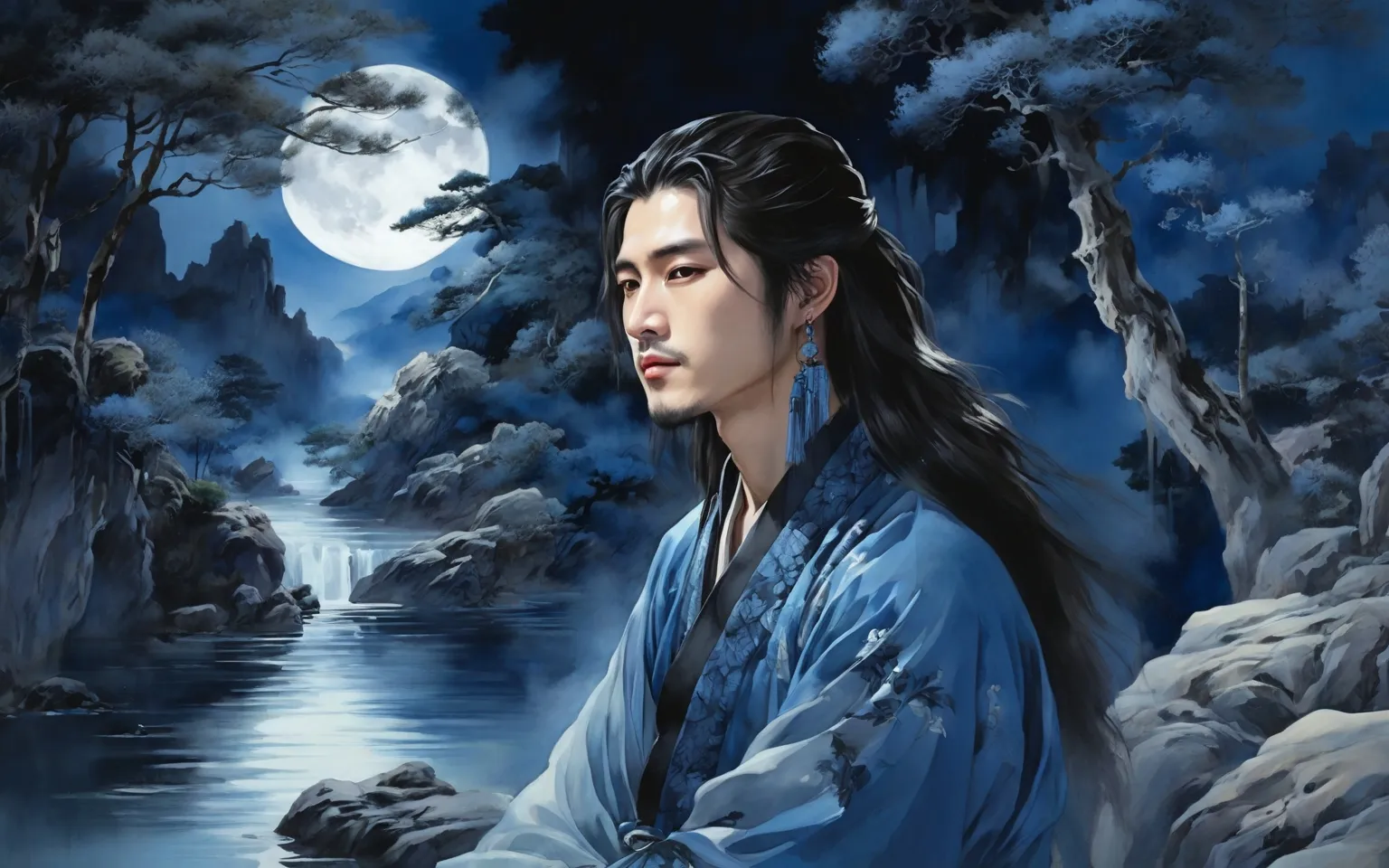
Wang Wei (王维), 701 - 761 A.D., was a native of Yuncheng, Shanxi Province. Wang Wei was a poet of landscape and idylls. His poems of landscape and idylls, with far-reaching images and mysterious meanings, were widely loved by readers in later generations, but Wang Wei never really became a man of landscape and idylls.