


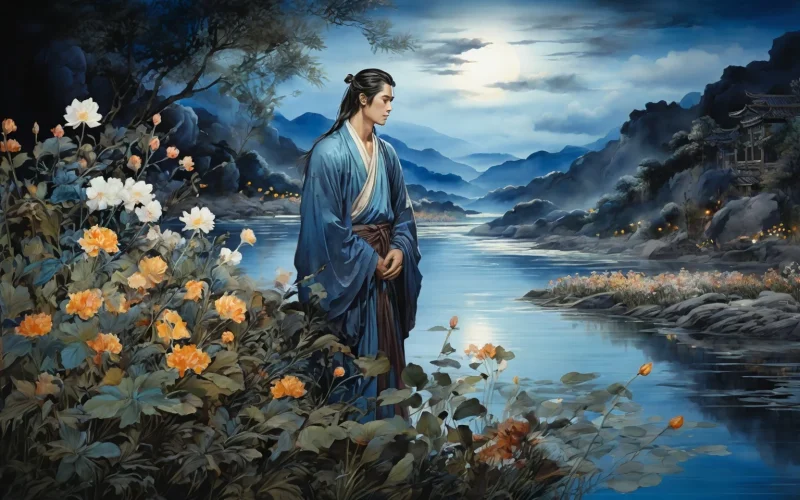
While lying idly in the southern bower,
I drew the curtain to watch the rising moon.
Its clear rays brighten water, trees and flower,
And ripple like a stream into my room.

How oft has it waxed and waned in endless flight!
How oft will it shine anew on men long gone!
By riverside you're steeped in its pure light
And croon nostalgic songs the whole night long.

Though you're a thousand miles away, O peer,
The orchid's fragrance wafts e'en to me here.
Original Poem
「同从弟南斋玩月忆山阴崔少府」
王昌龄
高卧南斋时,开帷月初吐。
清辉淡水木,演漾在窗户。
苒苒几盈虚,澄澄变今古。
美人清江畔,是夜越吟苦。
千里其如何,微风吹兰杜。
Interpretation
This poem was composed during Wang Changling's tenure as Magistrate of Jiangning, roughly between 740 AD and the Tianbao era. By this time, he had found some stability after the early turbulence of his life marked by "not guarding petty conduct, repeatedly demoted," serving in the Jiangnan region and living a relatively calm official life. "Cousin" in the title refers to a younger male cousin. "Secretary Cui of Shanyin" refers to Cui Guofu, the County Captain of Shanyin, a poetic friend of Wang Changling. On a moonlit night, the poet and his cousin were admiring the moon in the Southern Study. Facing the pure moonlight, he suddenly thought of his distant friend in Shanyin. Thus, he wrote this poem to express his longing.
Wang Changling is famous for his frontier-style poetry, characterized by a vigorous and heroic style. Yet this poem has a clear, beautiful tone and gentle, subtle emotion, showcasing another side of his character—the poet sitting quietly on a moonlit night, missing a friend, is actually the same person as the poet singing heroically of the frontier. Tenderness and heroism have always been connected.
First Couplet: "高卧南斋时,开帷月初吐。"
Gāo wò nán zhāi shí, kāi wéi yuè chū tǔ.
When I lay on my couch in the southern study,
And drew aside the curtain, I saw the new moon shining.
The opening uses a leisurely posture to describe the scene of the moon rising. "Lay on my couch" conveys the poet's leisure and composure, also hinting at a private, undisturbed time. "Drew aside the curtain, I saw the new moon shining"—drawing aside the curtain, the moon is just rising. The word "shining" is exquisite, personifying the moon as if it is slowly emanating its pure light, and as if the poet's longing is slowly emanating with the moonlight.
This couplet includes time, place, person, action, and scene, yet feels not the least bit cluttered, only naturally fluent. With the most minimal strokes, the poet draws the reader into that moonlit night, that Southern Study, that moment of drawing the curtain to gaze at the moon.
Second Couplet: "清辉淡水木,演漾在窗户。"
Qīng huī dàn shuǐ mù, yǎn yàng zài chuāng hù.
Its clear beams grew and faded on the forest and the water,
And played on the window, wavering.
This couplet finely depicts the scene under moonlight. "Clear beams" describes the texture of moonlight—cool, limpid; "on the forest and the water" describes its projection—the water is pale, the woods are pale, everything is washed faint by the moonlight. "Played on the window, wavering"—the light and shadow are not static; they ripple and flow across the window, moved by the night breeze, by the water's waves.
These two lines describe moonlight, and even more, a state of mind. That "wavering" light and shadow is precisely a reflection of the poet's inner thoughts—longing ripples out like water waves, unable to be calmed. Scene and emotion merge quietly here.
Third Couplet: "苒苒几盈虚,澄澄变今古。"
Rǎn rǎn jǐ yíng xū, chéng chéng biàn jīn gǔ.
The moon has waned and waxed for ages, clear and bright;
Its pure, eternal light has seen the ancient and the new.
This couplet shifts from description to philosophical reflection. "For ages" suggests the slow passage of time; "waned and waxed" refers to the moon's cycles. Gazing at the bright moon, the poet thinks of it waxing and waning, waning and waxing, time and again, while the time of the human world quietly passes in the moon's cycles.
"Clear and bright; Its pure, eternal light has seen the ancient and the new"—that pure, limpid moonlight shines upon everything ancient and new. The moon is still that moon, but those gazing upon it have changed generation after generation. The contrast between "change" and "eternity" provokes the poet's deep reflection on life, on friendship. Before eternal nature, an individual's life is so brief, making brief friendship all the more precious.
Fourth Couplet: "美人清江畔,是夜越吟苦。"
Měi rén qīng jiāng pàn, shì yè yuè yín kǔ.
My friend, virtuous as the jade, is by the clear river tonight,
Singing a homesick song, in memory of the southern shore.
This couplet shifts from reflection to imaginative projection. "My friend, virtuous as the jade" in ancient poetry often refers to a virtuous scholar; here it refers to Secretary Cui. The poet pictures: at this moment, his friend must also be by the clear river, thinking of distant ones under the moon, right? "Singing a homesick song"—"Yue song" is an allusion. It refers to Zhuang Xi, who, though serving in the state of Chu, in illness still sang the songs of his native Yue, a metaphor for the pain of homesickness. Projecting his own feelings, the poet imagines his friend also singing sadly tonight, also longing for his distant self.
This couplet transforms one-directional longing into two-directional resonance. It is not just that I miss you, but that we both miss each other; it is not that I alone am lonely, but that we both endure this loneliness. This imaginative projection of "simultaneity" makes the longing deeper, the friendship more moving.
Fifth Couplet: "千里其如何,微风吹兰杜。"
Qiān lǐ qí rú hé, wēi fēng chuī lán dù.
What is a thousand miles, after all, to a heart that is one?
The breeze has brought me the fragrance of the orchid and sweet grass.
The final couplet answers with a question, writes the real with the imaginary. "What is a thousand miles, after all, to a heart that is one?"—This is a rhetorical question, and also an answer to oneself: distance cannot change anything; true friendship can transcend distance.
"The breeze has brought me the fragrance of the orchid and sweet grass"—"orchid" and "sweet grass" are two fragrant plants, metaphorically referring to the friend's noble character and fragrant, elegant words. The poet says, in the breeze, I seem to smell your scent, seem to feel your presence. This, of course, is not truly "smelling," but a kind of spiritual perception—true friends, even separated by a thousand miles, can still feel each other's presence, can still find traces the other has left in the wind, in the moonlight, anywhere.
Holistic Appreciation
This poem takes "enjoying the moonlight" as its thread, unfolding emotion and philosophical reflection layer by layer within the depiction of scenery. The first couplet describes the moon's rise, with the word "shining" as the eye; the second couplet describes the scene under moonlight, with "wavering" describing light, shadow, and thought; the third couplet draws life's sentiments from the moon's waxing and waning, the reflection deep; the fourth couplet pictures the friend from afar, with "singing a homesick song" expressing shared feeling; the final couplet concludes with "the breeze has brought me the fragrance," sublimating longing into spiritual resonance.
The entire poem is naturally structured, with genuine emotion. Moving from near to far (Southern Study → the clear river's shore), from concrete to abstract (moonlight → reflection → imagination → spirit), it advances layer by layer, step by step. The language is clear and beautiful, unadorned, yet the artistic conception is deep and profound, the lingering charm long-lasting. Compared to Wang Changling's vigorous, heroic frontier poems, this one is more subtle and restrained, yet equally moving. It lets us see that the poet who sang heroically of the frontier also had such tender moments; the poet who wrote of timeless frontier moons also sat quietly on a moonlit night missing distant friends. This combination of tenderness and heroism is the totality of Wang Changling.
Artistic Merits
- Using the Moon as a Thread, Fusing Scene and Feeling: The entire poem unfolds around the "moon." Moonlight is both scene and feeling, and also reflection; scene contains feeling, feeling contains reflection, forming a seamless whole.
- Natural Allusion, Deep Meaning: "Singing a homesick song" alludes to Zhuang Xi's longing for home, seamlessly deepening the theme of longing.
- Clear, Beautiful Language, Gentle Rhythm: Four-character and five-character lines alternate, the rhythm rich in variation, the韵律 harmonious, reading like flowing moonlight.
- Clever Ending, Lingering Charm: "The breeze has brought me the fragrance" concludes with an olfactory image, sublimating longing into spiritual resonance, leaving endless aftertaste.
Insights
This poem first illuminates for us how to achieve spiritual communion within longing. Wang Changling and Secretary Cui were separated by a thousand miles, unable to meet. But through imagination, he has his friend also "by the clear river," also "singing a homesick song," transforming longing from one-directional to two-directional, from loneliness to resonance. Even more wonderfully, the last line, "The breeze has brought me the fragrance"—he seems to smell his friend's scent in the breeze, to feel his friend's presence. This tells us: True longing is not one-directional concern, but spiritual resonance. When you long for someone, that person is also somewhere, in some way, longing for you. This imaginative projection of "simultaneity" is the most moving part of longing.
The philosophical reflection of "苒苒几盈虚,澄澄变今古" in the poem also leads us to consider the relationship between time and eternity. The moon waxes and wanes, time flows, yet moonlight remains pure. This contrast between "change" and "eternity" makes the poet aware of the brevity of life, and therefore cherish present friendship all the more. It reveals: Precisely because life is brief, we must cherish every true feeling; precisely because time easily passes, we must wholeheartedly feel every moonlit night, every longing.
The leisurely posture of "高卧南斋时" in the poem also leads us to consider how to create the time and space for longing. The poet does not think of his friend in a hurry, but in "laying on my couch," in the moment of "drawing aside the curtain," in quietly facing the moonlight, letting longing arise naturally. This tells us: Longing needs time, needs space, needs a calm state of mind. In the busyness of modern life, we often have no time to long, no space to sit quietly. Wang Changling's poem reminds us: Save some time for oneself, save some space for longing, let friendship grow in the moonlight.
Finally, the image of "微风吹兰杜" in the poem is especially moving. It is not actual smell, but spiritual perception. It tells us: Friendship deep enough can be felt with any sense—it can be seen in moonlight, smelled in the breeze, heard in the quiet night. When longing is deep enough, the whole world becomes the embodiment of a friend.
Poem translator
Xu Yuanchong (许渊冲)
About the poet
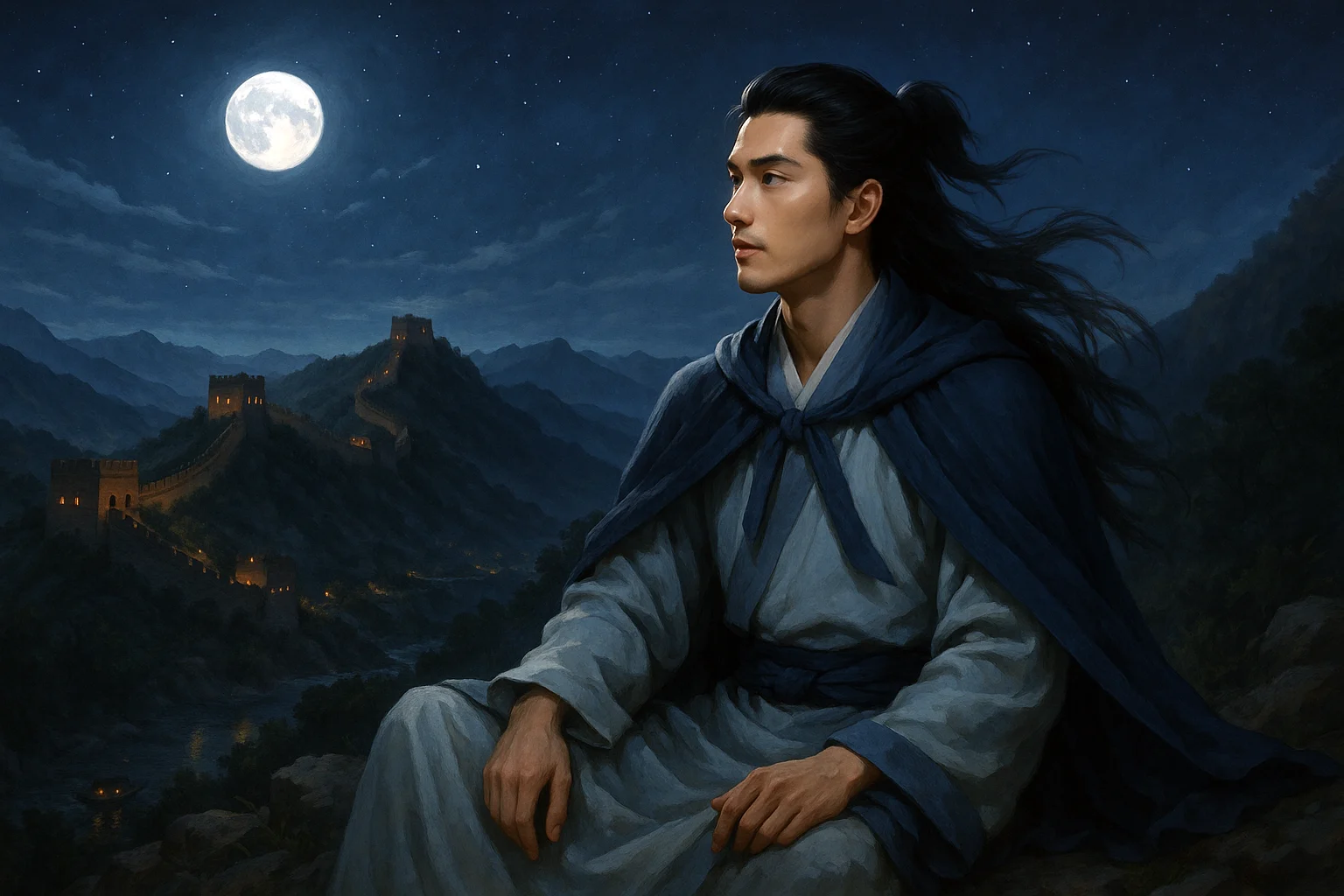
Wang Changling (王昌龄), circa A.D. 690 - 756, was a native of Xi'an, Shaanxi Province. Wang Changling's poems were mostly about the Border Places, love affairs and farewells, and he was well known during his lifetime. His seven poems are equal to those of Li Bai, and he is known as the “Master of seven lines”.