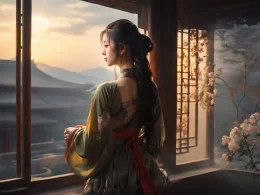




A lonely boat, a thin moon, toward the maple wood that grieves;
And to the stranger’s heart I give the sorrow of the strings it weaves.
Those ranges, fold on fold, are lost in veils of countless rain —
The broken string is gathered in where tear‑tracks have their stain.
Original Poem
「听流人水调子」
王昌龄
孤舟微月对枫林,分付鸣筝与客心。
岭色千重万重雨,断弦收与泪痕深。
Interpretation
This poem was composed during Wang Changling's late years, on his journey into exile to Qianyang. During the Tianbao era, he was demoted to the post of County Captain of Longbiao for "not being cautious in small matters" and traveled from Jiangning (present-day Nanjing) to take up his post in Qianyang (present-day Qianyang, Hunan), passing through the landscapes of the Xiang-Chu region. The term "流人" (exile) in the title refers to those who wander adrift—people banished due to offense, wandering in a foreign land; "水调子" refers to a popular melody of the time. On an autumn night, the poet's solitary boat moored by the riverside, a faint moon hung askew, maple groves stood silent. Suddenly, from afar came the sound of a lute—the player was also an "exile," sharing the poet's plight. The mournful melody touched the softest part of the poet's heart, and so he wrote this poem.
By this time, Wang Changling was in his twilight years, his official career fraught with setbacks, far from his homeland. The desolation of "孤舟微月对枫林" is precisely the reflection of his state of mind; the sorrow of "断弦收与泪痕深" is the condensation of his emotions. This poem is Wang Changling's lament for his own fate of a lifetime of wandering, and also a lament for the shared destiny of all "exiles."
First Couplet: "孤舟微月对枫林,分付鸣筝与客心。"
Gū zhōu wēi yuè duì fēng lín, fēnfù míng zhēng yǔ kè xīn.
My lone boat, the faint moon, face the maple grove;
I entrust my thoughts to the sounding lute and to the stranger's heart.
The opening sketches a desolate night mooring scene with three images. "Lone boat"—the boat is solitary, the person even more so; "faint moon"—the moonlight is dim, unable to illuminate the path ahead or warm the heart; "maple grove"—the maple leaves have reddened, autumn is deep, precisely the season that invites melancholy thoughts. Placing these three images side by side, without any embellishment, already creates a rich atmosphere of desolation.
"I entrust my thoughts to the sounding lute and to the stranger's heart"—"entrust" means to consign, to deliver. The poet says he entrusts his feelings to the faint sound of the lute. From where does this lute music come? From another "exile." Two souls sharing the same plight: one plays, one listens; one pours out his heart through the lute, the other resonates with it in his own heart. This line connects hearing with the soul, letting music become the vessel of emotion, a bridge between two lonely spirits.
Second Couplet: "岭色千重万重雨,断弦收与泪痕深。"
Lǐng sè qiān chóng wàn chóng yǔ, duàn xián shōu yǔ lèi hén shēn.
The colors of the mountains seem a thousand, ten thousand folds of rain;
The snapping string, breaking off, ends with the depth of a track of tears.
This couplet shifts from hearing the lute to an ultimate expression of inner feeling. "The colors of the mountains seem a thousand, ten thousand folds of rain"—this describes the scene, but also expresses emotion. Mountains upon mountains, night heavy and deep, as if enveloped in endless curtains of rain. This "rain" may not be real rain, but rather the poet's inner feeling—that thousandfold, ten-thousandfold sorrow, like this endless rain, surrounds and soaks him. "The snapping string, breaking off, ends with the depth of a track of tears"—the lute music suddenly stops, the string snaps. That snapping sound is like the breach of an emotional dam; that broken string seems to contain all the poet's sorrow. And the three words "depth of a track of tears" release all the emotion accumulated before—it is not falling tears, but "the depth of a track of tears," tears already dried, only the deep trace remains. This line fuses the breaking of sound with the outburst of emotion, making the "snapping string" the emotional explosion point of the entire poem.
Overall Appreciation
This poem uses "hearing a lute" as its thread, accomplishing a soliloquy of the soul within the description of scenery and expression of emotion. The first couplet uses the three scenes of "lone boat," "faint moon," and "maple grove" to create a desolate atmosphere, and uses "entrust" to introduce the lute music, bringing hearing into the poem. The second couplet uses "a thousand, ten thousand folds of rain" to describe the inner feeling, and uses "The snapping string, breaking off, ends with the depth of a track of tears" to conclude the poem, pushing the emotion to its climax.
The poem's language is refined, its imagery exquisite. The seven characters "孤舟微月对枫林" already form a complete picture of an autumn river night mooring; the seven characters "岭色千重万重雨" further tinge this picture with a misty melancholy. And the line "断弦收与泪痕深" is truly a stroke of genius—fusing hearing (the snapping string), sight (the track of tears), and emotion (depth) into one, creating a unique poetic effect.
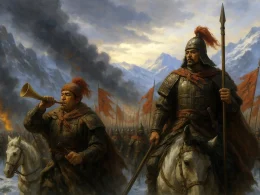
Compared to Wang Changling's impassioned frontier poems, this poem is more introspective, more somber. It lets us see that the poet who wrote "黄沙百战穿金甲" also had such tender moments; the poet who sang triumphantly "不破楼兰终不还" could also, in a solitary boat moored at night, be moved to tears by the sound of a lute. This unity of tenderness and heroic spirit constitutes the whole of Wang Changling.
Artistic Features
- Juxtaposition of Imagery, Profound Artistic Conception: The juxtaposition of the three images—"lone boat," "faint moon," "maple grove"—creates a rich atmosphere of desolation without embellishment.
- Hearing in Poetry, Connecting the Senses: The introduction of hearing through "the sounding lute" and its conclusion with "The snapping string" lets music become the primary vessel of emotion, connecting hearing and the soul.
- Exquisite Metaphor, Intense Emotion: "The colors of the mountains seem a thousand, ten thousand folds of rain" uses rain as a metaphor for sorrow, transforming intangible melancholy into a perceptible scene; "The snapping string, breaking off, ends with the depth of a track of tears" concretizes abstract emotion with novel creativity.
- Concise Ending, Lingering Resonance: The seven characters "断弦收与泪痕深" condense hearing, sight, and emotion into one point; the words end but the meaning is endless.
Insights
This poem first illuminates for us the profound connection between music and emotion. That lute music, originally intangible sound waves, could cause the poet to have "泪痕深". The power of music lies not in its volume, but in its resonance with the soul. When two "exiles," one playing, one listening, when that melody and that state of mind meet precisely, music becomes the deepest expression of emotion. It tells us: True resonance lies not in skill, but in the heart. Whether music, poetry, or any art form, only what touches the heart can move people.
The imagery of "断弦收与泪痕深" also prompts us to reflect on the ultimate expression of emotion. The string snaps, the tears flow, but that is not the end—after the string snaps, its lingering sound remains; after the tears flow, their tracks remain. This contrast between "断" (break/snap) and "深" (depth) gives emotion a thickness of time. It reveals: The deepest emotions are often not those that erupt in the moment, but the traces left after they settle. Those "泪痕" left in memory are more enduring, and more moving, than the tears themselves.
The artistic conception of "孤舟微月对枫林" also leads us to consider the aesthetic significance of solitude. The boat is solitary, the moon faint, the maple grove still—this is not a lively scene, yet it is the most moving picture. Solitude, in Wang Changling's writing, is not pitiable, but something that can be appreciated aesthetically; it is not something to flee, but something to immerse in. It reveals: Solitude is not frightening; what is frightening is the inability to be with solitude. When you can hear a lute melody within "孤舟微月对枫林", and see the tracks of your own tears, you have already made peace with solitude.
The figure of the "exile" listening to the lute on the solitary boat is especially moving. He is not a hero, not a sage, merely a demoted official, a wandering traveler, an ordinary person sharing the same plight as another "exile." His tear stains are not for some great cause, but for his own fate, for the sound of that snapping lute string. This sorrow of the ordinary person is more real, and more moving, than the tragedy of any hero. It teaches us: Acknowledging one's own sorrow, accepting one's own weakness, is also a kind of strength. For only real people shed tears; only living people can be moved by music.
About the poet
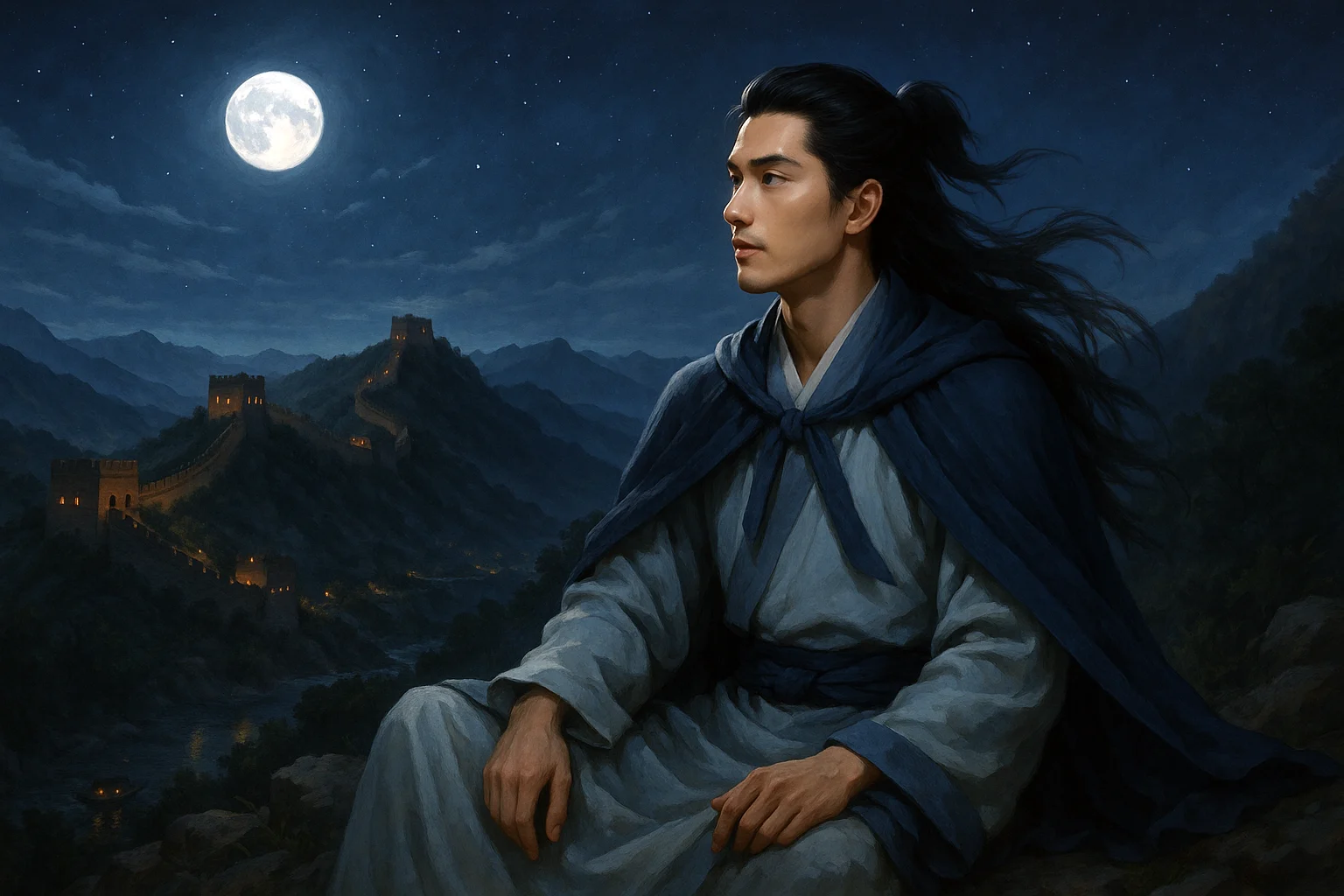
Wang Changling (王昌龄), circa A.D. 690 - 756, was a native of Xi'an, Shaanxi Province. Wang Changling's poems were mostly about the Border Places, love affairs and farewells, and he was well known during his lifetime. His seven poems are equal to those of Li Bai, and he is known as the “Master of seven lines”.