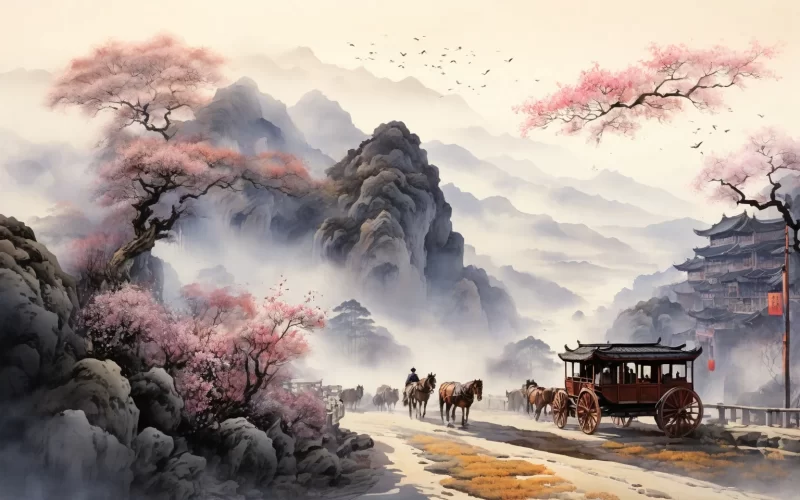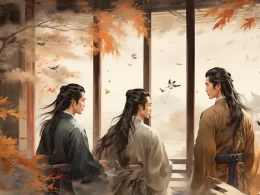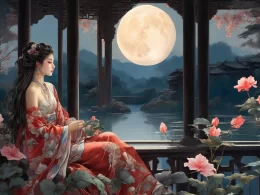



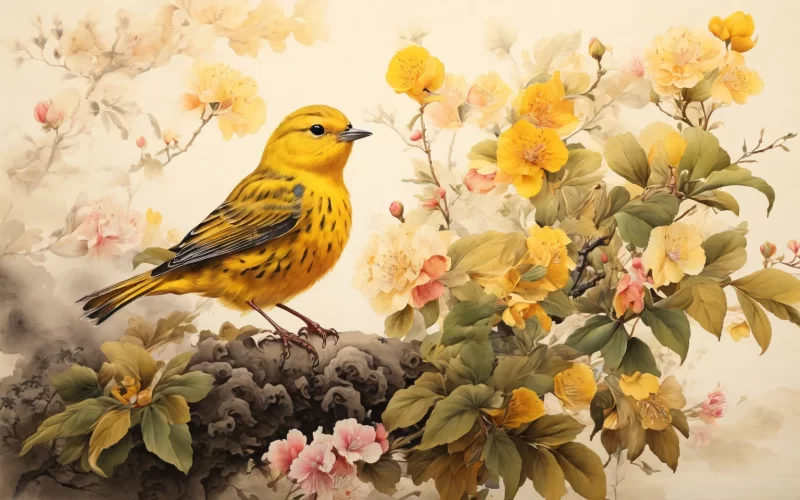
Spring is far, far away
Where the sun slants its ray.
If orioles have tear,
Wet highest flowers here!
Original Poem
「天涯」
李商隐
春日在天涯,天涯日又斜。
莺啼如有泪,为湿最高花。
Interpretation
This poem stands as a masterpiece of Li Shangyin’s later period, characterized by extreme conciseness and profound sorrow conveyed through deceptively simple language. Composed around 855 AD or later, it belongs to a time when the poet, after years of itinerant life as a secretary, the early death of his wife, and the complete collapse of his official prospects, had entered a late stage of existence marked by bone-deep desolation. The title "At the Ends of the Earth" signifies not just geographical remoteness, but a portrayal of boundless psychological and spiritual solitude.
By this time, Li Shangyin’s poetic craft had reached a state of sublimation, adept at using the most economical imagery to carry the richest emotions. In just four lines and twenty characters, the poem condenses the poet’s layered reflections on the passage of time, the solitude of life, and the fleeting nature of beauty. The layering and interplay of images—spring days, the world’s edge, the setting sun, the oriole’s cry, the topmost blossom—construct a poetic world of intense contrast between external brightness and internal desolation, showcasing the distinctive artistic power of his later work: "using joyful scenery to express sorrow, redoubling its poignancy."
First Couplet: 春日在天涯,天涯日又斜。
Chūn rì zài tiānyá, tiānyá rì yòu xié.
Spring days reach the ends of the earth,
Where once again the sun declines.
Explication: This couplet uses anadiplosis and the overlapping of time and space to create a dual sense of vast desolation. "Spring days," which should be bright and joyful, are immediately tinged with loneliness by their connection to "the ends of the earth." The reappearance of "the ends of the earth" with "the sun declines" describes both the actual scene (sunset) and subtly metaphors the twilight of life and the repeated slipping away of opportunity. The word "once again," plain yet startling, implies this feeling of wandering and lateness has become the常态.
Final Couplet: 莺啼如有泪,为湿最高花。
Yīng tí rú yǒu lèi, wèi shī zuì gāo huā.
If the oriole’s cry could but turn to tears,
They would fall upon the topmost blossom.
Explication: The poet pushes emotion to its limit through surreal imagination. The "oriole’s cry," a common sound of spring, is personified into a tearful lament. The "topmost blossom" refers literally to the last flower to bloom at the very tip of a branch, but also symbolizes that which is most beautiful, most fragile, and most difficult to attain in life. The phrase "would fall upon" implies a deliberate choice—tears shed nowhere else but solely upon that highest flower. This is both ultimate tenderness and a preemptive elegy for beauty doomed to fade.
Holistic Appreciation
This is a quintessential quatrain that achieves infinite desolation through extreme concision. In only twenty characters, it accomplishes multiple shifts and elevations: from the vast ("spring days at the world’s edge") to the minute ("the oriole’s cry, the topmost blossom"), from the objective ("sunset") to the subjective ("if… could turn to tears"), and from actual scene to imagination.
The poet projects his own loneliness in late life and anxiety about time onto a set of meticulously chosen natural images: the beauty of spring highlights the rootlessness of wandering; the vitality of the oriole’s cry contrasts with the sorrow of tears; the splendor of the topmost blossom foreshadows the inevitability of its fall. This combination of unified yet opposing imagery creates immense emotional tension within the poem’s tiny frame.
Particularly profound is the image of the "topmost blossom" in the final couplet—it is the flower most bathed in sunlight, closest to the sky, yet also the most exposed to wind and rain, the first to sense spring’s end. This image precisely metaphors the fate of the poet, and indeed of all gifted souls: the more sublime and beautiful, the more inescapable the destiny of loneliness and transience. With the imagination of an oriole’s tears watering the blossom, Li Shangyin completes a poetic prophecy and a deeply felt elegy for his own fate.
Artistic Merits
- Temporal and Spatial Expansion through Anadiplosis: The repetition and linkage of "the ends of the earth" cause space (the world’s edge) and time (sunset) to interpenetrate, creating a sense of wandering and passage without beginning or end.
- Subtle Shift from Objective to Subjective: The first two lines lean towards presenting an objective scene. The latter two, through phrases like "if… could but" and "would fall upon," naturally move into the projection of subjective emotion and imagination, seamlessly blending the real and the imagined.
- Precise Selection of Imagery and Density of Symbolism: Spring days, the world’s edge, the setting sun, the oriole’s cry, the topmost blossom—each image carries multiple layers of meaning and symbolic function, achieving maximum condensation of significance within an extremely concise form.
Insights
This work lays bare a universal human experience: feeling the deepest solitude in the most splendid season. It shows us that true loneliness often lies not in one’s location, but in the contrast between one’s state of mind and one’s surroundings—when spring spreads to the ends of the earth, the setting sun reminds you there is no place called home; when the oriole’s song is heard everywhere, you alone perceive within it the sound of tears.
The poem’s relevance for the contemporary reader lies here: in a highly mobile, seemingly hyper-connected modern society, the feeling of being "at the ends of the earth" may have become more internalized and widespread. We may not be geographically adrift, yet we often feel the urgency of the "setting sun" and the anxiety of fragility akin to the "topmost blossom." Li Shangyin’s profundity lies in acknowledging the validity of this loneliness and anxiety, and, through poetic transformation ("would fall upon the topmost blossom"), bestowing upon it a melancholy dignity.
Ultimately, this poem teaches us an attitude towards life’s limitations: since beauty is doomed to fade (the topmost blossom will fall) and loneliness is a constant companion (the sun sets once more at the world’s edge), we can, like the poet, witness it with all our sensitivity, cherish it with all our tenderness, and shed for it our imagined tears—this is perhaps the most poetic, and the most courageous, way to confront time and solitude.
Poem translator
Xu Yuanchong (许渊冲)
About the poet
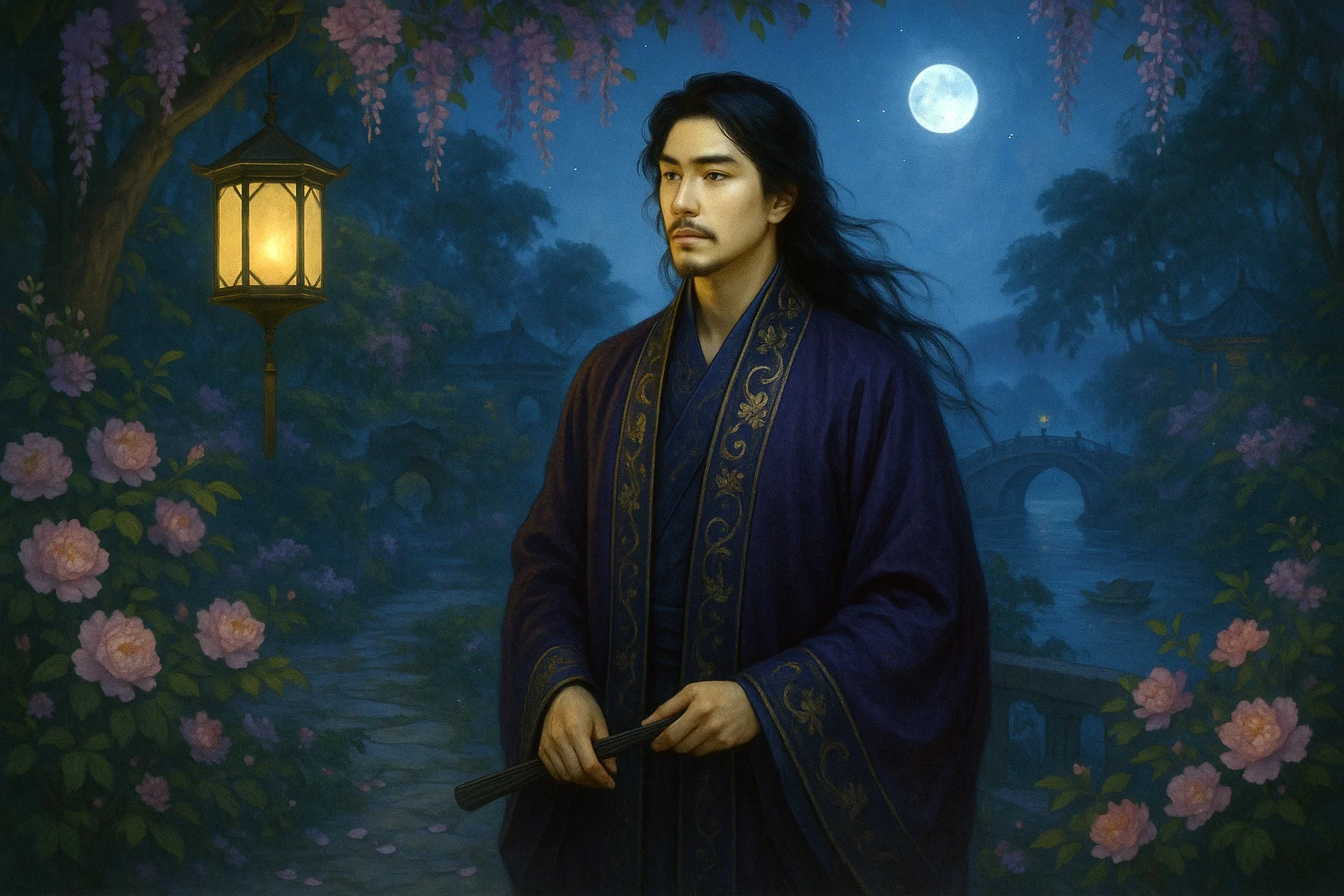
Li Shangyin (李商隐), 813 - 858 AD, was a great poet of the late Tang Dynasty. His poems were on a par with those of Du Mu, and he was known as "Little Li Du". Li Shangyin was a native of Qinyang, Jiaozuo City, Henan Province. When he was a teenager, he lost his father at the age of nine, and was called "Zheshui East and West, half a century of wandering".