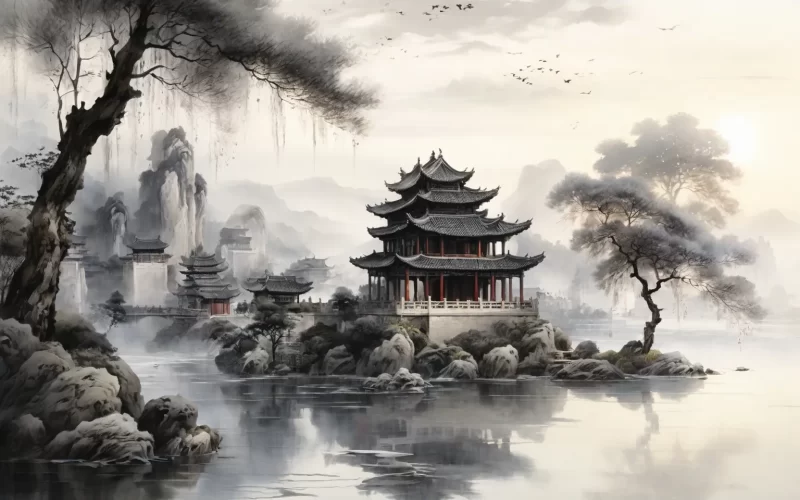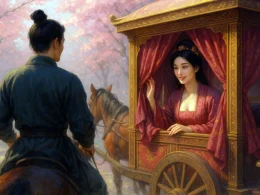



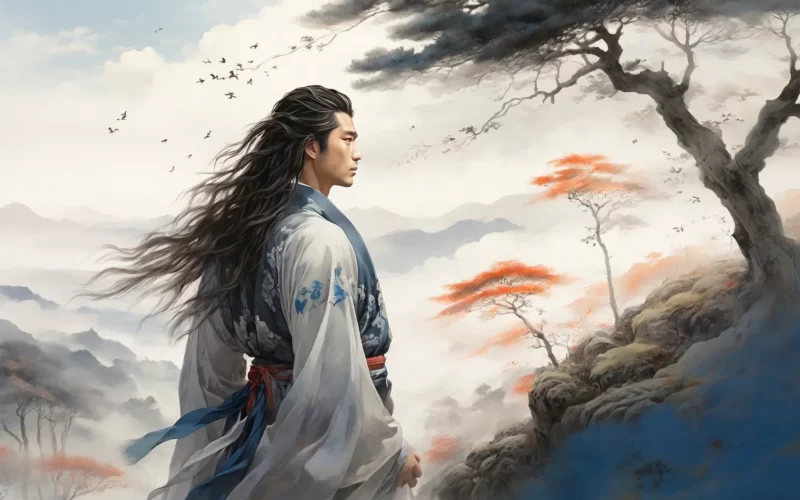
A cold wind blows from the far sky...
What are you thinking of, old friend?
The wildgeese never answer me.
Rivers and lakes are flooded with rain.
...A poet should beware of prosperity,
Yet demons can haunt a wanderer.
Ask an unhappy ghost, throw poems to him
Where he drowned himself in the Milo River.
Original Poem
「天末怀李白」
杜甫
凉风起天末,君子意如何。
鸿雁几时到,江湖秋水多。
文章憎命达,魑魅喜人过。
应共冤魂语,投诗赠汨罗。
Interpretation
This poem was composed in the autumn of 759 CE, the second year of the Qianyuan era under Emperor Suzong of the Tang dynasty, while Du Fu was living in exile in Qinzhou. The previous year, Li Bai had been convicted for joining the staff of Prince Yong, Li Lin, and was exiled to Yelang. In the spring of this year, Li Bai had been pardoned upon reaching Baidi City during his exile, but the news had not yet reached remote Qinzhou. Deeply anxious about his dear friend's safety, Du Fu, amidst the desolate autumn wind, blended his profound longing for Li Bai, his indignation at his friend's fate, and his deep insight into the shared tragedy of talented individuals throughout history. He forged this masterpiece of remembrance—a poem that transcends personal friendship to probe the very nature of fate.
First Couplet: 凉风起天末,君子意如何。
Liáng fēng qǐ tiān mò, jūn zǐ yì rú hé.
The cooling breeze rises from the sky's far end; / O friend, what thoughts and feelings now your spirit lend?
The opening line is like a long, deep sigh, establishing a lofty and desolate atmosphere. "The sky's far end" signifies not only geographical remoteness but also implies the unpredictability of fate and the elusiveness of news. The autumn wind is a natural phenomenon, yet in the poet's heart, it seems to originate from the "sky's far end" where Li Bai resides, carrying news of his friend and the breath of his destiny. The earnest inquiry, "what thoughts and feelings now your spirit lend?" surpasses everyday pleasantries; it expresses deep concern for the exiled friend's mental and emotional state, setting the poem's tone of profound affection and sorrow.
Second Couplet: 鸿雁几时到,江湖秋水多。
Hóng yàn jǐ shí dào, jiāng hú qiū shuǐ duō.
When will the messenger swan arrive, I pray? / On rivers and lakes autumn floods hold fearful sway.
The focus shifts from general concern to specific worry. The "messenger swan" carries the hope for news; "When… arrive" reveals the anxiety and hopelessness of waiting. "On rivers and lakes autumn floods hold fearful sway" is realistic—pointing out the dangers of the southern waterways Li Bai traveled during autumn floods—and symbolic, hinting at the perilous political climate and the hardships of life's journey. In five words, the poet conveys boundless worry for his friend's uncertain fate and treacherous path.
Third Couplet: 文章憎命达,魑魅喜人过。
Wén zhāng zèng mìng dá, chī mèi xǐ rén guò.
Great writing is the foe of a fair destiny; / Evil spirits wait for men of genius gleefully.
This couplet is the soul of the poem, elevating personal fate to the level of history and philosophy. "Great writing is the foe of a fair destiny" articulates a common plight of talented individuals throughout the ages: exceptional genius often seems accompanied by a troubled fate. This is not fatalism but a grievous indictment of an unjust world. "Evil spirits wait for men of genius gleefully" further exposes how petty, malevolent forces lie in wait to harm the upright. The two lines form a precise parallelism, with clear love and hate, placing Li Bai's personal tragedy within a broad vista of cultural history. The sense of grief and indignation is piercing.
Fourth Couplet: 应共冤魂语,投诗赠汨罗。
Yīng gòng yuān hún yǔ, tóu shī zèng Mì luó.
You, like the ancient poet-drowned, should share your woe / By casting verses into the Miluo's flow.
The poem concludes with a transcendent, imaginative leap across time and space, pushing the poetic realm into profound depth. "You, like the ancient poet-drowned, should share your woe" juxtaposes Li Bai with Qu Yuan, two of the greatest romantic poets in Chinese literary history: both of unparalleled genius, both loyal yet distrusted, both exiled. This is both the highest praise and the deepest compassion. "By casting verses into the Miluo's flow" imagines Li Bai engaging in dialogue with Qu Yuan's spirit through poetry, achieving spiritual understanding and transmission. This couplet elevates personal longing into cultural remembrance and spiritual resonance.
Holistic Appreciation
This poem is a timeless ode to mutual understanding that transcends time and space. Using extremely concise language, Du Fu constructs richly layered imagery: from immediate concern sparked by the autumn wind, to practical fear of the dangers of rivers and lakes, to the historical lament of "Great writing is the foe of a fair destiny," finally reaching the eternal plane of spiritual dialogue with Qu Yuan. The poem's emotion is deep yet restrained; its thought somber yet lofty.
Its unique value lies in the fact that Du Fu is not merely missing a friend; he is examining, through Li Bai's fate, an era's attitude toward genius, and even a tragic structural contradiction within civilization itself. The poem brims with two starkly opposite yet equally powerful emotions: tender concern for Li Bai the individual, and stern condemnation of the dark forces that persecute genius. This quality—the interweaving of public and private, emotion and reason—elevates the poem beyond ordinary friendship verses, transforming it into a profound allegory for the shared fate of intellectuals.
Artistic Merits
- Natural Evocation, Vast and Desolate Atmosphere
Beginning with the bleak autumn scene of "The cooling breeze rises from the sky's far end," it instantly immerses the reader in a desolate mood of separation and uncertainty, seamlessly blending scene and emotion. - Pithy Argumentation, Profound Insight
The couplet "Great writing is the foe of a fair destiny; / Evil spirits wait for men of genius gleefully" elevates a specific personal experience into a profound insight of universal historical significance. Its language is condensed like a proverb; its intellectual sharpness is brilliant, representing a concentrated expression of the rational depth in Du Fu's poetry. - Allusion Masterfully Integrated, Meaning Profoundly Extended
The allusion to Qu Yuan in the final couplet is seamless. It fits Li Bai's dual identity as poet and exile, and naturally connects personal misfortune with the tragic fate of loyal souls throughout history, greatly expanding the poem's historical depth and spiritual scope. - Concise Language, Somber Emotion
Not a single word is superfluous; the language is highly distilled. Within this concise form, however, lies a profound and somber emotion—anxiety for the friend's life, indignation at an unjust fate, belief in spiritual transmission—embodying the classic Du Fu style of "somberness, profundity, and rhythmic force."
Insights
This work reveals the highest form of friendship: not merely daily companionship, but deep spiritual understanding and mutual illumination within the journey of fate. In this poem, Du Fu accomplishes not only his concern for Li Bai but also an affirmation and defense of his friend's cultural value and historical stature.
The core insight this poem offers posterity is: how a society treats its geniuses measures the height of its civilization. The tragedy of "Great writing is the foe of a fair destiny" should not be an eternal law. True civilizational progress is reflected in whether it can provide space for exceptional souls to blossom, rather than allowing "evil spirits" to stifle talent. Furthermore, the profound understanding and support between poets—transcending life and death, reaching directly to the soul—demonstrates for us the sense of intellectual community that scholars should possess: recognizing one another in darkness, watching over each other in solitude, allowing the flame of spirit to traverse time and space, never to be extinguished.
Poem translator
Kiang Kanghu
About the poet
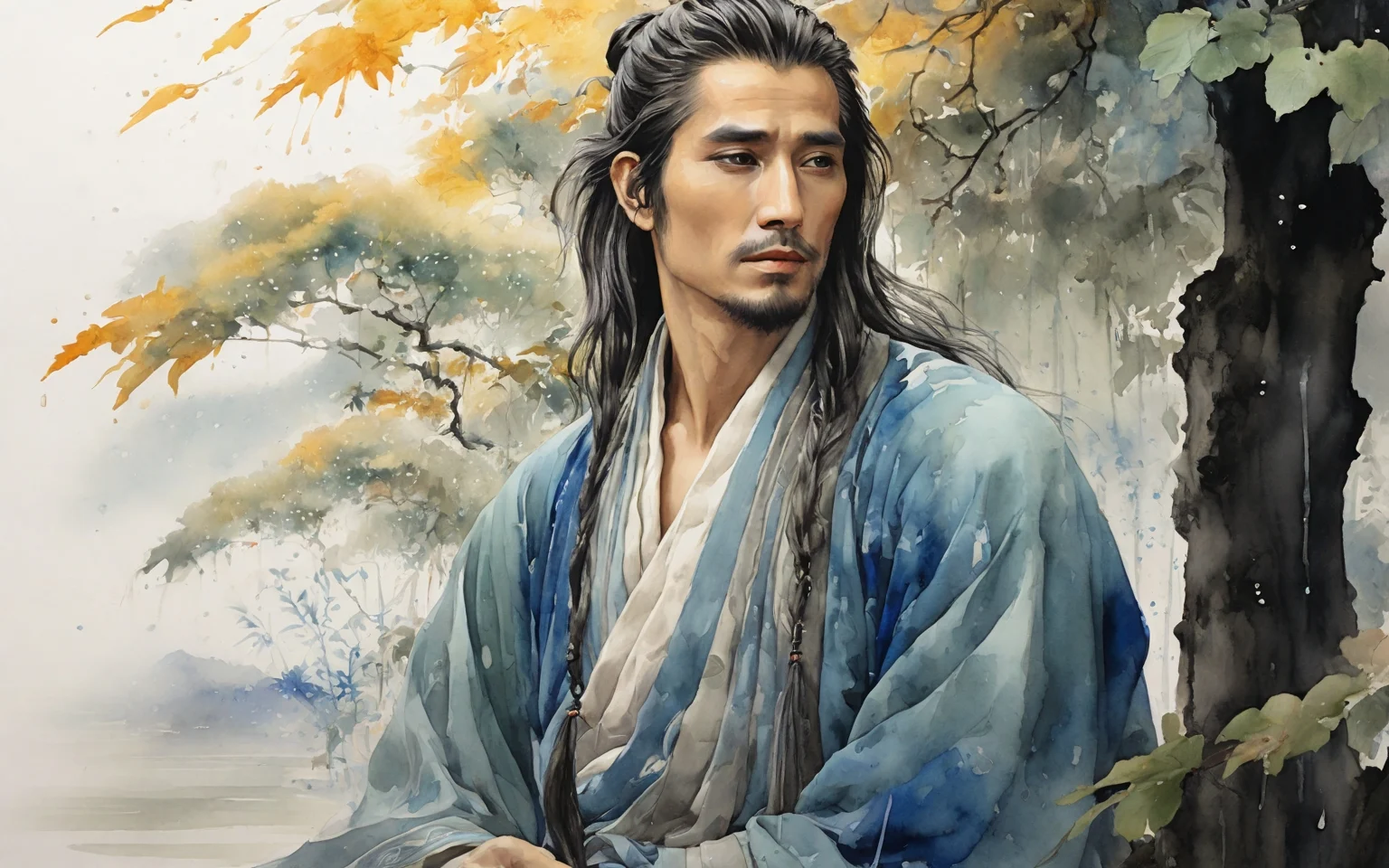
Du Fu (杜甫), 712 - 770 AD, was a great poet of the Tang Dynasty, known as the "Sage of Poetry". Born into a declining bureaucratic family, Du Fu had a rough life, and his turbulent and dislocated life made him keenly aware of the plight of the masses. Therefore, his poems were always closely related to the current affairs, reflecting the social life of that era in a more comprehensive way, with profound thoughts and a broad realm. In his poetic art, he was able to combine many styles, forming a unique style of "profound and thick", and becoming a great realist poet in the history of China.