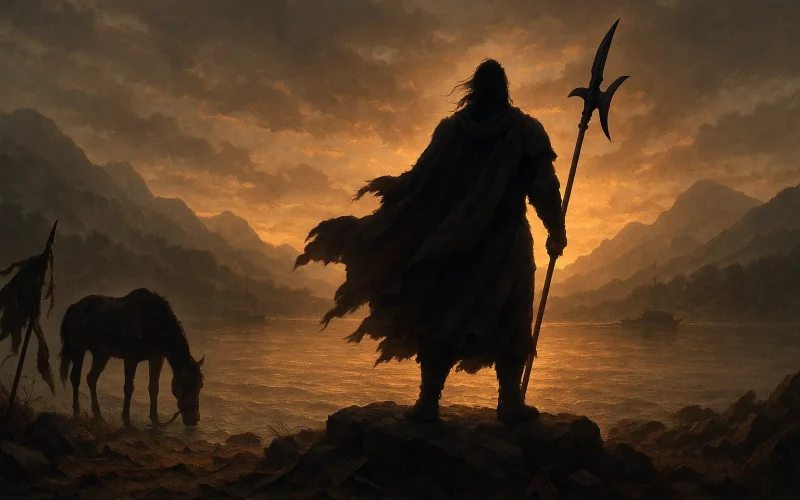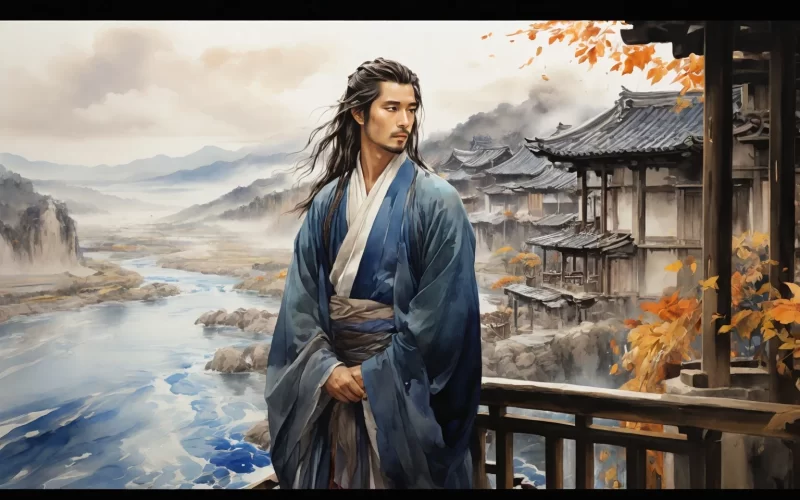
Rank grasses grow, six dynasties' splendors no more;
The sky is lightly blue and clouds free as of yore.
Birds come and go into the gloom of wooded hills,
And songs and wails alike merge in murmuring rills.

Like countless window curtains falls late autumn rain:
High towers steeped in sunset, wind and flute's refrain.
O how I miss the lakeside sage of bygone days!
I see but ancient trees loom rugged in the haze.
Original Poem
「题宣州开元寺水阁」
杜牧
六朝文物草连空,天淡云闲今古同。
鸟去鸟来山色里,人歌人哭水声中。
深秋帘幕千家雨,落日楼台一笛风。
惆怅无因见范蠡,参差烟树五湖东。
Interpretation
This poem was composed in the year 838 AD during the reign of Emperor Wenzong of Tang, when Du Mu was twenty-six years old, a period of youthful travel and broad engagement with social realities. That spring, Du Mu accepted an appointment from Cui Dan, the Observation Commissioner of Xuanzhou and Shezhou, and traveled south to serve as a Military Judge in Xuanzhou (modern Xuancheng, Anhui). Xuanzhou was a strategic stronghold since the Six Dynasties period, rich in cultural heritage and historic sites. Ascending the Water Pavilion of Kaiyuan Temple—a structure dating back to the Eastern Jin Dynasty and a witness to centuries of change—the poet beheld the vast, late autumn scenery of Jiangnan while his mind churned with dual reflections on historical depth and personal destiny. At this time, though Du Mu harbored ambitions to contribute to the world, he had already developed a keen sense of the political stagnation of the late Tang and the uncertainty of his own prospects. This ascent was thus not merely a survey of geographic space but a meditation traversing the tunnel of time. Consequently, the poem transcends conventional feelings evoked by climbing a height, ascending into a comprehensive inquiry into historical patterns, the meaning of life, and spiritual solace.
First Couplet: 六朝文物草连空,天淡云闲今古同。
Liù cháo wénwù cǎo lián kōng, tiān dàn yún xián jīngǔ tóng.
Relics of Six Dynasties splendors—grass joins with the void; Pale sky, idle clouds, in ancient times and now, unalloyed.
The opening lines establish the poem's tone with a stark visual and temporal contrast. "Relics" carry the memory and glory of civilization, while "grass joins with the void," with its untamed vitality, proclaims the ultimate destiny of all human achievement—to return to emptiness and desolation. The poet's gaze then sweeps upward to eternal nature: "Pale sky, idle clouds." This unchanging vista of the heavens forms a relentless counterpoint to the transient "relics" of human history, revealing that against the constancy of nature, the rise and fall of human history is but a momentary clamor. This couplet pairs the concrete with the abstract, the immediate with the infinite, examining human affairs from a grand cosmic perspective, evoking an overwhelming sense of vastness.
Second Couplet: 鸟去鸟来山色里,人歌人哭水声中。
Niǎo qù niǎo lái shānsè lǐ, rén gē rén kū shuǐ shēng zhōng.
Birds come, birds go, within the mountain's hue; Men's songs, men's weepings, in the water's sound ensue.
The poet's focus shifts from the historical firmament to the landscape before him, imbuing it with dynamic philosophical meaning. "Birds come, birds go" represents the cyclical recurrence of natural life, an eternal rhythm transcending individual birth and death. "Men's songs, men's weepings" signifies the brief efflorescence of human emotion, the joys and sorrows of concrete existence. Both are set against the eternal backdrop of "mountain's hue" and "water's sound"—one static and visual, the other dynamic and auditory. The brilliance of this couplet lies in transforming abstract historical sense (rise and fall) and human experience (joy and sorrow) into perceptible natural imagery, suggesting that the emotional vicissitudes of individual life and the dynastic shifts of history are, in the endless river of time, merely recurring sounds and shadows within this landscape of hills and streams.
Third Couplet: 深秋帘幕千家雨,落日楼台一笛风。
Shēnqiū liánmù qiān jiā yǔ, luòrì lóutái yī dí fēng.
Deep autumn: a curtain of rain shrouding a thousand homes; Setting sun: from tower and terrace, a single flute-wind roams.
This couplet is considered a stroke of genius in Du Mu's scene-painting, hailed as "the pinnacle of late Tang landscape poetry." "Deep autumn: a curtain of rain shrouding a thousand homes" uses a grand image to convey a diffuse sorrow: the densely woven rain, like a curtain, envelops the entire city in a hazy, chilly, pervasive melancholy, a panoramic rendering of space. "Setting sun: from tower and terrace, a single flute-wind roams" punctuates the vastness with a vivid detail: the setting sun melts into gold, towers and terraces stand silent, and the sound of a single flute arrives borne on the wind—clear and solitary. This "flute-wind" represents sound piercing silence, the faint yet tenacious proof of an individual's existence within immense time and space. One line is overcast, the other sunny; one diffuse, one precise; one expansive, one minute—together they weave a three-dimensional, emotionally charged portrait of an autumn evening in Xuanzhou.
Fourth Couplet: 惆怅无因见范蠡,参差烟树五湖东。
Chóuchàng wú yīn jiàn Fàn Lǐ, cēncī yān shù Wǔ Hú dōng.
Melancholy—no way to see Fan Li again, that mind at rest; East of the Five Lakes, mist-veiled trees rise ragged, crest on crest.
The final couplet moves from scene to persona, directly expressing the poet's heart and focusing the poem's sentiments on a specific historical paragon—Fan Li. "Melancholy" gathers all the vast reflections and hazy sorrows of the preceding six lines. "No way to see" expresses the gulf between ideal and reality—a barrier both temporal and situational. After helping King Goujian of Yue destroy Wu, Fan Li departed with the beauty Xi Shi, sailing the Five Lakes, achieving the perfect trajectory of success, retirement, and untrammeled freedom. Du Mu gazes toward the "mist-veiled trees rise ragged" in the direction of the Five Lakes; this misty scene is both a realistic description and a symbol of an admirable yet unreachable realm of life. This gaze responds to the opening couplet's lament over the Six Dynasties' splendors washed away, while also embodying the poet's complex feelings regarding official career versus reclusion, engagement versus transcendence.
Holistic Appreciation
This regulated verse (seven-character octet) represents the pinnacle of Du Mu's poetry on climbing heights and contemplating the past. Its success lies in constructing a multi-layered, three-dimensionally interwoven structure of time and space: vertically, it spans the antiquity of the Six Dynasties and the present; horizontally, it integrates distant sky, mountain hues, water sounds, rain curtains, towers, flute notes, and misty trees; thematically, it intertwines historical nihilism, nature's permanence, life's joys and sorrows, and spiritual yearning.
With superb skill, the poet condenses such vast spatiotemporal awareness and deep historical and existential reflection into eight lines of fifty-six characters. The poem begins with vastness (relics, grass, void), continues with flux (birds coming and going), turns to minute detail (rain curtain, flute-wind), and concludes with distant longing (misty trees, Five Lakes). The emotional trajectory moves from historical emptiness, to the clamor and quietude of human life, to inner melancholy, and finally settles on profound aspiration. It is like a grand yet exquisitely composed tone poem, combining the fine detail of meticulous brushwork (e.g., "curtain of rain") with the expansive freedom of impressionistic strokes (e.g., "Five Lakes"), fully embodying the unique style of Du Mu's poetry that merges "heroic vigor" with "subtle sensibility."
Artistic Merits
- A Grand Architecture of Spatiotemporal Juxtaposition: The poet deftly weaves together "Six Dynasties" (historical time), "ancient times and now" (eternal time), and "mountain's hue," "water's sound," "autumn rain," "setting sun" (present space) within the same canvas. This juxtaposition is not mere listing but creates a sustained dialogue and collision, deepening the timeless theme of "the brevity of life" through contrast.
- Atmosphere Creation Through Synesthesia: The poem densely employs rich sensory imagery. "Grass joins with the void" (visual vastness), "men's songs, men's weepings" (auditory mixture), "curtain of rain shrouding a thousand homes" (tactile-visual synesthesia), "a single flute-wind" (auditory-tactile fusion). These images are not isolated; they interpenetrate, collectively constructing a world of artistic conception that is both tangibly real and ethereally transcendent, making the reader feel present and empathize with its mood.
- Symbolic Use of the Concrete and Abstract: "Relics" are tangible historical remains yet point to an abstract end; "mist-veiled trees" of the Five Lakes are a real distant view yet symbolize an elusive ideal realm. This technique of using the concrete to depict the abstract, allowing the abstract to arise from the concrete, greatly expands the poem's imaginative space and philosophical depth.
- Masterful Control of Emotional Rhythm: The poem's emotional flow is exquisitely controlled. The first couplet opens grandly on the rise and fall of ages, vast and desolate; the second couplet focuses on immediate movement and stillness, meticulous and subtle; the third couplet expands again to encompass sky, earth, rain, and sun, majestic and sweeping; the final couplet resolves into personal sentiment, expressed with restrained depth. This rhythm of tension and release, alternation between expansiveness and intimacy, avoids the potential abstraction often found in poems reflecting on history, ensuring the reflections remain attached to concrete, fresh aesthetic imagery.
Insights
This poem transcends the common pattern of reflecting on the past to lament the present. It shows us a classic posture of the human spirit confronting vast time and space: on one hand, clearly recognizing that all monuments of civilization and personal joys and sorrows will ultimately pass away ("grass joins with the void," "men's songs, men's weepings"); on the other hand, never abandoning the search for coordinates of meaning against the eternal backdrop, whether by investing in an aesthetic moment ("a single flute-wind") or yearning for an ideal persona ("to see Fan Li").
It suggests that the value of life may not lie in resisting the passage of time or pursuing immortal achievement, but in being able to contemplate with lucidity the rise and fall of "relics" against the eternal backdrop of "pale sky, idle clouds," to experience with nuanced sensitivity the genuine emotions within "men's songs and weepings," and ultimately to preserve within the heart a transcendent spiritual longing akin to the "mist-veiled trees of the Five Lakes." This combination of lucid awareness, deep feeling, and aspiration is precisely what distinguishes humanity from grass and trees and establishes its own mode of being within the long river of history.
Poem translator
Xu Yuanchong (许渊冲)
About the poet
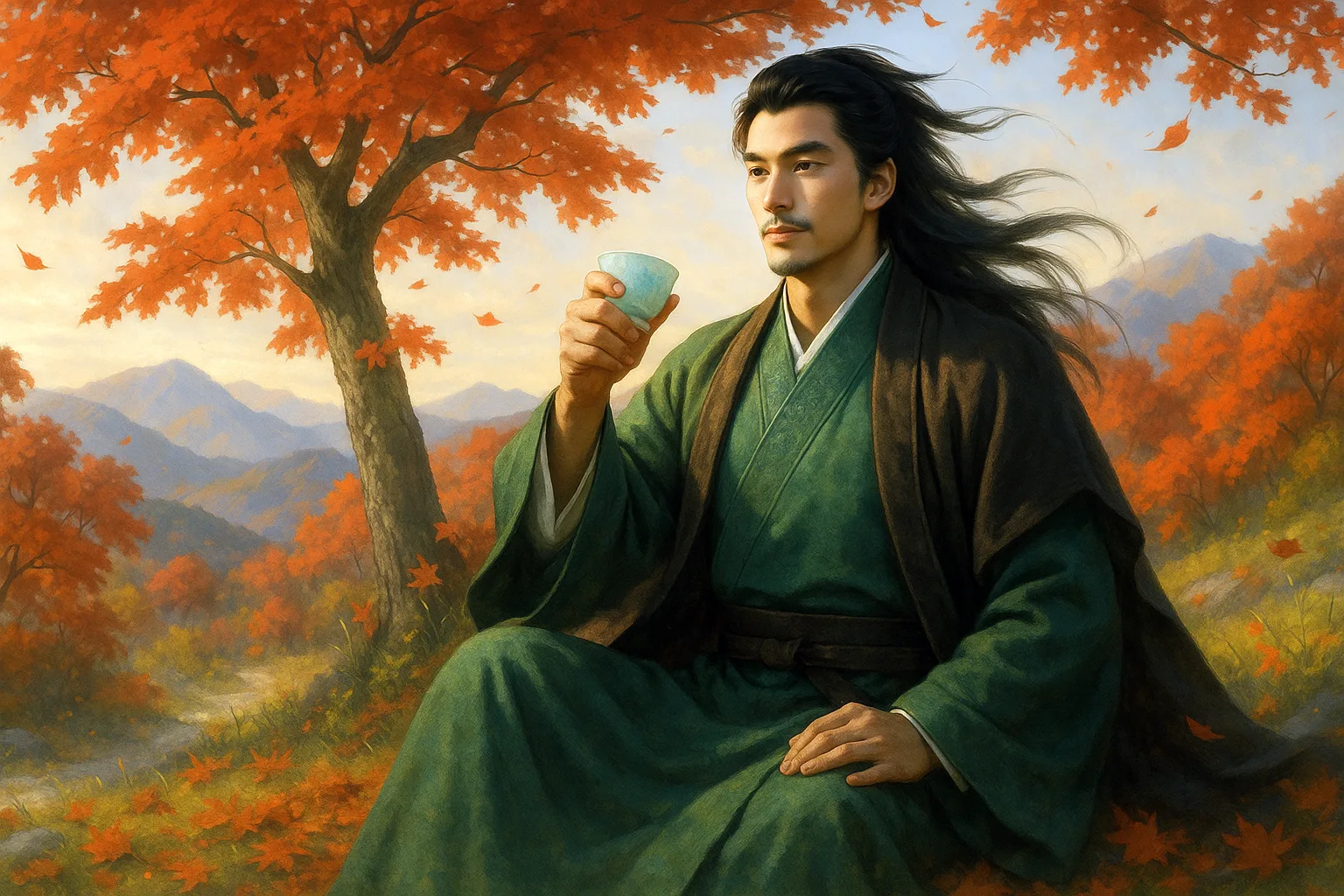
Du Mu (杜牧), 803-853 AD, was a native of Xi'an, Shaanxi Province. Among the poets of the Late Tang Dynasty, he was one of those who had his own characteristics, and later people called Li Shangyin and Du Mu as "Little Li and Du". His poems are bright and colorful.