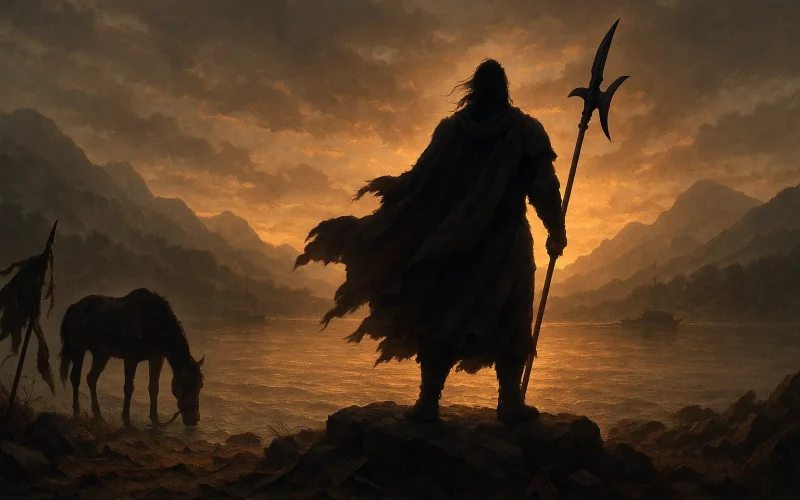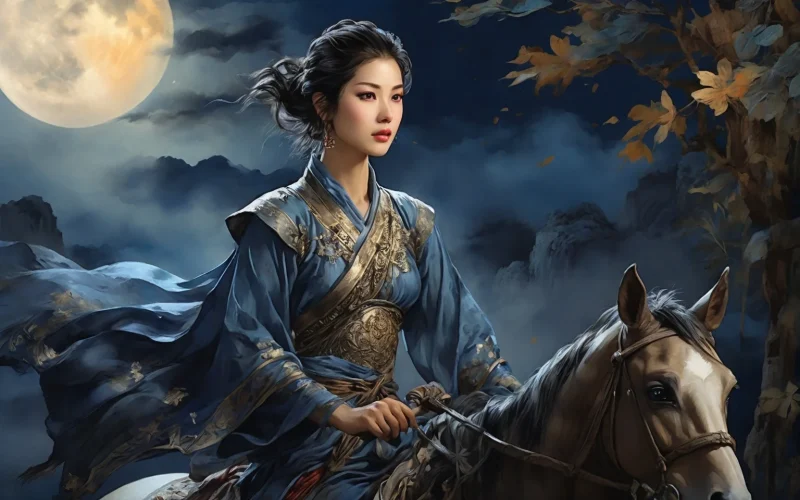
She played the role of a man bending his bow,
But she dreamed of penciling her eyebrow.

How many times, homesick, wine cup in hand,
Would she bless the princess of her homeland?
Original Poem
「题木兰庙」
杜牧
弯弓征战作男儿,梦里曾经与画眉。
几度思归还把酒,拂云堆上祝明妃。
Interpretation
This poem was composed during Du Mu's tenure as Prefect of Huangzhou (842-844 AD). Serving in a regional post at the time, the poet demonstrated a sensitivity that transcended his era regarding frontier issues and women's destinies. The story of Mulan was still in its folkloric infancy during the Tang (the "Ballad of Mulan" was first anthologized in the Song dynasty's Collection of Music Bureau Poems). Du Mu's uniqueness lies in being among the first to introduce this unofficial female heroine into the literati poetic tradition. Situated in the Jiang-Huai region, Huangzhou offered views north toward the frontier and evoked thoughts of the southern homeland, a geography that fostered the poet's deep resonance with themes of "campaigning" and "longing for home."
Noteworthy is the political context of Du Mu's composition: during the Huichang reign, the Tang was engaged in frequent border conflicts with northern tribes like the Uighurs. By invoking the figure of Mulan, the poet was not only recalling ancient battlefields but also expressing a concern, however implicit, for the living conditions of contemporary frontier soldiers (including the few female participants). The cross-temporal dialogue with "Mingfei" (Consort Ming) further reveals Du Mu's rare historical consciousness regarding women—he juxtaposes Wang Zhaojun of the Han (peace through marriage alliance) with Mulan of the Northern Dynasties (warfare through disguised service), constructing a nascent genealogy of female heroes in Chinese literary history.
First Couplet: 弯弓征战作男儿,梦里曾经与画眉。
Wān gōng zhēngzhàn zuò nán'ér, mènglǐ céngjīng yǔ huà méi.
Bending the bow, she went to war, passing as a man; Yet in her dreams, she once would trace her eyebrows' span.
Explication: "Bending the bow, she went to war" sketches Mulan's iconic image with sculptural clarity. However, the word "passing" in "passing as a man" reveals the artifice: this is not a change in essence but a social performance of role-playing. The second line, "Yet in her dreams, she once would," forms the poem's interpretive key—dreams belong to the realm of the subconscious, where, at night, with the masculine daytime mask removed, authentic gender consciousness quietly surfaces. The choice of detail, "trace her eyebrows' span," is masterful: eyebrow tracing was part of a woman's daily grooming and, in the Tang, carried connotations of romance and marriage (alluding to the典故 of Zhang Chang painting his wife's eyebrows). This intimate act, appearing "in her dreams," suggests feminine traits and emotional needs suppressed by war, flowing like an underground stream through the landscape of dreams.
Final Couplet: 几度思归还把酒,拂云堆上祝明妃。
Jǐ dù sī guī huán bǎ jiǔ, fú yún duī shàng zhù míng fēi.
How many times, yearning for home, she'd raise the cup, On Mound Touching Clouds, to Mingfei offering up.
Explication: This couplet achieves a leap from personal emotion to historical dialogue. "How many times, yearning for home" reveals war's fragmentation of individual time—not a single moment of homesickness, but a recurring cycle of mental torment. The act of "raise the cup" continues the frontier poetry tradition (e.g., Wang Wei's "I would ask you to drink one more cup of wine") while introducing the unconventional image of a woman drinking, highlighting the uniqueness of Mulan's situation. "Mound Touching Clouds," a Tang frontier fortress (west of modern Baotou, Inner Mongolia) at the forefront of Han-Hu conflicts, lends multiple layers of symbolism to "to Mingfei offering up": it is a frontier guard's tribute to a female predecessor who also journeyed to the distant frontier, and it implies a juxtaposed reflection on two models of female destiny (warrior and peace bride). When Mulan pours a libation for Mingfei, Du Mu effectively orchestrates a silent dialogue between two women across time, conducted on the margins of the male-written history of war.
Holistic Appreciation
This is a fugue on a female heroine that deconstructs myths of gender and war. Du Mu's brilliance lies not in simply retelling the "Ballad of Mulan" but in seizing upon the psychological fissure of "dreams" to allow the feminine self concealed beneath armor to quietly emerge. The poem constructs a precise double chronology: day/reality (bending the bow, war) versus night/dreams (once tracing eyebrows); present/frontier (Mound Touching Clouds) versus past/Han palace (Mingfei). These opposing temporal and spatial frameworks are connected through Mulan's subjective consciousness, forming a polyphonic exploration of identity.
The poem's emotional structure spirals upward: from external action (war) to internal awareness (dreaming of tracing eyebrows), to emotional state (homesick, raising a cup), finally arriving at historical reflection (offering to Mingfei). In this process, the figure of Mulan undergoes three sublimations: from warrior (bending bow) to woman (tracing eyebrows) to homesick soul (raising cup) to historical interlocutor (offering to Mingfei). Through this fourfold layering of identities, Du Mu grants a folkloric figure a psychological depth and historical weight comparable to figures from official histories.
Particularly noteworthy is the ritualistic weight of the word "offering." Within the male-dominated tradition of war sacrifices (to the God of War, to fallen soldiers), Du Mu deliberately arranges a woman's offering to a woman. This seemingly minor detail contains a latent challenge to the power of historical writing: if the history of war must record women like Mulan, who should perform their spiritual rites? By making Mulan herself the officiant and Mingfei the recipient, Du Mu attempts, poetically, to elevate women from objects of history to subjects of history.
Artistic Merits
- The Gender Politics of Dream Writing: Through the four words "Yet in her dreams, she once," the poem carves out a private psychological space within the war narrative. The dream becomes a refuge for suppressed gender consciousness; the act of tracing eyebrows, a classic feminine symbol, forms a stark contrast with the daytime bow. This portrayal of split identity between day and night possesses greater psychological penetration than a direct account of military hardship.
- The Commemorative Ritual of Superimposed Time and Space: "Mound Touching Clouds," an actual Tang frontier site (documented in the Yuanhe Junxian Tuzhi), and "Mingfei," representing Han dynasty history of peace marriages, are folded together through Mulan's act of "offering." This technique of bringing women from different eras together in a symbolic scene constructs a community of female destiny that transcends dynastic changes.
- The Chain of Verbs Mapping Identity Transformation: "Bending" (display of strength)—"passing" (role-playing)—"dreaming" (subconscious emergence)—"tracing" (gender performance)—"yearning" (emotional return)—"raising" (ritual preparation)—"offering" (historical dialogue). These seven verbs completely trace Mulan's arduous journey from social role to authentic self.
Insights
This work reveals a deep paradox of hero narratives: the celebrated heroic posture often comes at the cost of suppressing one's authentic gender. Mulan must "pass as a man" to achieve heroic deeds, but her feminine consciousness can only surface in dreams through faint symbols like "tracing eyebrows." The lesson for all eras is this: when we admire heroes, do we consider the gender costs concealed by the title? Do we hear the suppressed "dreams of tracing eyebrows" beneath the armor?
The cross-temporal dialogue in "to Mingfei offering up" deserves particular attention from a contemporary feminist perspective. In the 9th century, Du Mu facilitated a spiritual exchange between two women caught in the male war system—one participating in war by disguising herself as a man, the other used as a female body for political marriage alliance. This suggests: although women's historical experiences are fragmented in mainstream histories, they may be reconnected in literary imagination. Mulan's offering to Mingfei is, in essence, an act of understanding and empathy from all women forced into male domains toward the fates of their predecessors.
Ultimately, this poem offers not merely a rediscovery of Mulan but a methodology for writing the history of the marginalized. Through the fissure of "dreams," Du Mu glimpses the feminine self concealed beneath armor; through the ritual of "offering," he connects the destinies of women isolated by history. In this sense, this is more than a historical poem; it is a key—reminding us that genuine historical insight often begins with gazing upon and remembering those subtle moments, like "tracing eyebrows" in dreams, that lie beneath the surface of "bending the bow, going to war."
Poem translator
Xu Yuanchong (许渊冲)
About the poet
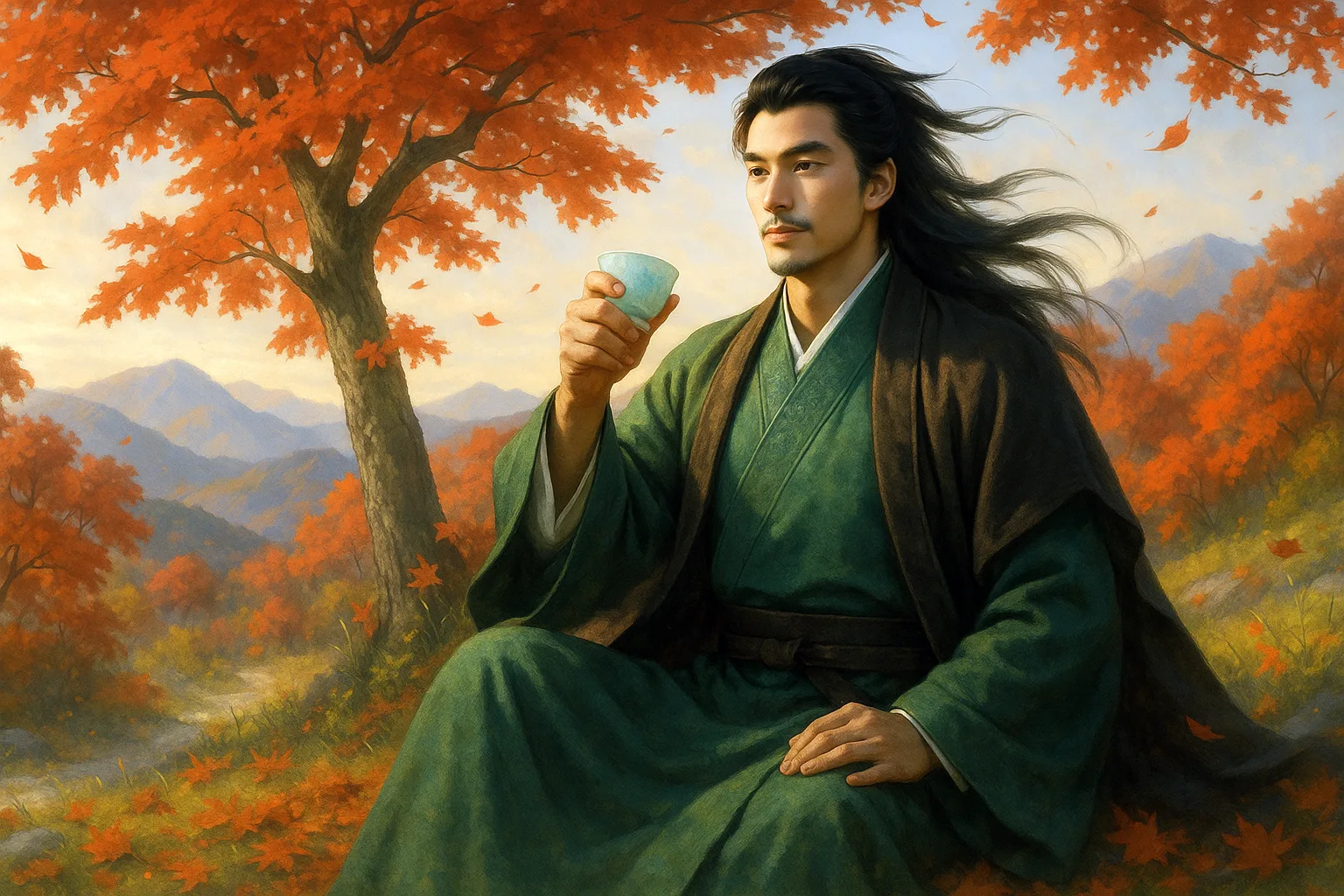
Du Mu (杜牧), 803-853 AD, was a native of Xi'an, Shaanxi Province. Among the poets of the Late Tang Dynasty, he was one of those who had his own characteristics, and later people called Li Shangyin and Du Mu as "Little Li and Du". His poems are bright and colorful.