


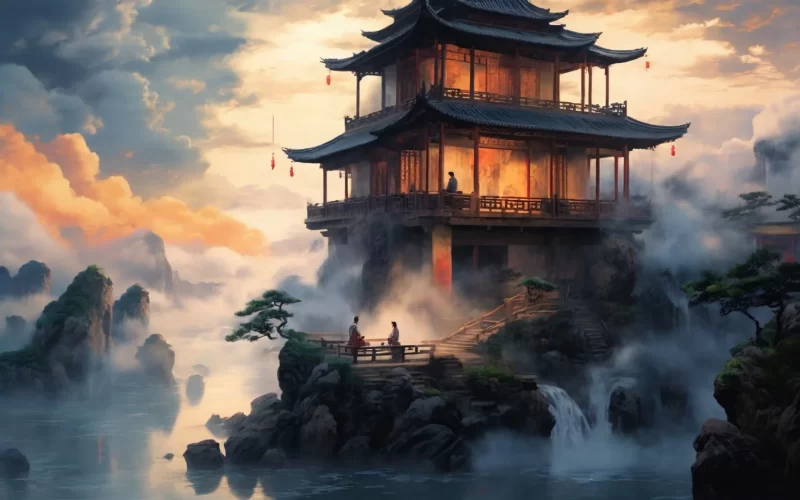
High on the river‑bank the Prince’s Tower is set;
The jade‑girt dance, the phoenix‑song, are hushed — and yet,

At dawn, its painted beams take flight with southern cloud;
At eve, its pearl‑strung blinds draw down the rain’s wet shroud.

Clouds idly mirrored in the pool, daylong, daythrough —
How many autumns since the stars their courses drew?

Where is the prince who in these chambers held his state?
The Long River, past the sill, flows on, insensate.
Original Poem
「滕王阁诗」
王勃
滕王高阁临江渚,佩玉鸣鸾罢歌舞。
画栋朝飞南浦云,珠帘暮卷西山雨。
闲云潭影日悠悠,物换星移几度秋。
阁中帝子今何在?槛外长江空自流。
Interpretation
This poem is a timeless masterpiece by the Early Tang poet Wang Bo, composed in the third year of the Shangyuan era of Emperor Gaozong of Tang (676 CE). Twenty-six years old at the time, Wang Bo, convicted for killing a government slave—a crime that led to his father's distant banishment to Jiaozhi (in present-day Vietnam)—was on his way to visit his father. Passing through Hongzhou (present-day Nanchang, Jiangxi), he happened upon a grand banquet hosted by Governor Yan at the newly renovated Pavilion of Prince Teng. During the feast, Governor Yan, intending to show off his son-in-law's talent, ostensibly invited the guests to compose a preface. Unexpectedly, Wang Bo did not decline but took up the brush and immediately wrote the Preface to the Pavilion of Prince Teng, appending this poem. One preface, radiant and magnificent; one poem, condensed through the ages—the two complement each other, together forming the pinnacle of Early Tang literature.
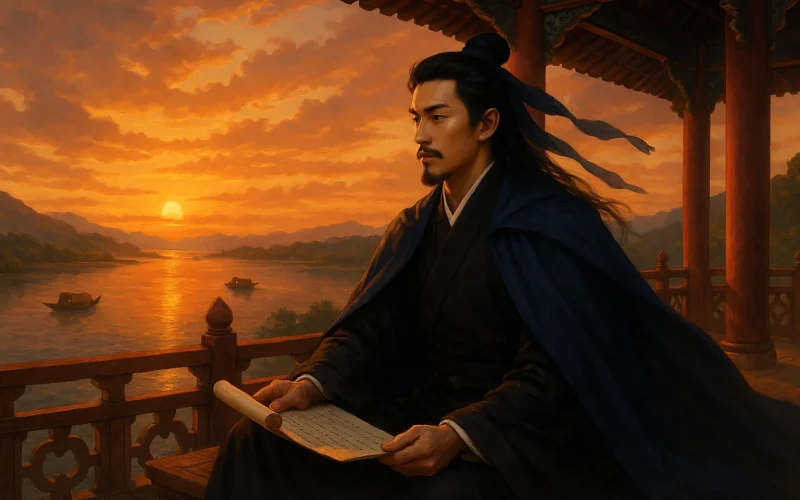
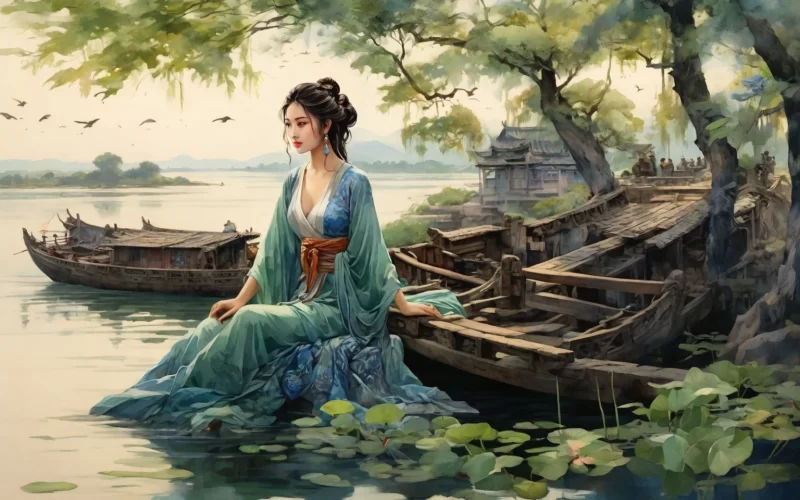
The Pavilion of Prince Teng was built by Li Yuanying, Prince of Teng, son of Tang Gaozu Li Yuan. Having passed through the reigns of Taizong and Gaozong, the pavilion remained, but its people and affairs were long gone. As Wang Bo ascended this pavilion, before his eyes was the desolate scene of "painted beams greeting morning clouds from southern shores, pearl blinds at dusk rolled up with rain from western hills"; in his heart was the lament of rise and fall, where "the jade pendants and phoenix bells have ceased their song and dance". He thought of Prince Teng's bygone splendor, now like mist and clouds; he thought of his own fate—great talent yet ill fortune, drifting to the ends of the earth. Gazing further at the endless Yangtze flowing eastward beyond the railings, all his myriad emotions about the shifts of prosperity and decline throughout history, the brevity of life, and the eternity of the cosmos were poured into these fifty-six characters. The poem's query, "Where is the prince within the pavilion now?" asks not only of Prince Teng but also of himself, and indeed of all life that passes in haste within the vast heavens and earth. The sigh of "Beyond the rails, the Long River emptily flows on" uses the river's eternity to reflect the transience of human affairs, elevating the lament of rise and fall into eternal philosophical contemplation, leaving one lost in thought.
First Couplet: "滕王高阁临江渚,佩玉鸣鸾罢歌舞。"
Téng wáng gāo gé lín jiāng zhǔ, pèi yù míng luán bà gē wǔ.
The lofty pavilion of Prince Teng overlooks the river's isle;
The song and dance with jade pendants and phoenix bells have ceased a while.
The poem opens with a grand spatial perspective, setting the tone for the entire work. "滕王高阁临江渚" (Téng wáng gāo gé lín jiāng zhǔ, Prince Teng, lofty, pavilion, overlooks, river, isle): the word "高" (gāo, lofty) describes its majesty, the word "临" (lín, overlooks) describes its commanding position—the pavilion's imposing posture overlooking the river appears before our eyes. The next line, "佩玉鸣鸾罢歌舞" (pèi yù míng luán bà gē wǔ, wear, jade, ring, phoenix-bells, cease, song, dance), sharply shifts the brushstroke from space to time, from the immediate scene to recollection of the past. "佩玉鸣鸾" (pèi yù míng luán, jade pendants, ringing phoenix bells) depicts the grand occasion of Prince Teng's banquet—guests like clouds, fragrant robes and coiffed hair, the tinkling of jade pendants, the harmonious ringing of phoenix bells. "罢歌舞" (bà gē wǔ, cease, song and dance), three words that exhaustively describe the loneliness after all splendor has ended. This contrast between "lofty" and "ceased"—spatial grandeur versus temporal oblivion—creates a powerful juxtaposition; the sense of prosperity and decline is already implied without being stated.
Second Couplet: "画栋朝飞南浦云,珠帘暮卷西山雨。"
Huà dòng zhāo fēi nán pǔ yún, zhū lián mù juǎn xī shān yǔ.
At dawn, from southern shores, clouds fly to painted beams;
At dusk, from western hills, rain is rolled in by pearl screens' gleams.
This couplet is purely scenic description, yet it captures the desolation and lofty remoteness of the Pavilion of Prince Teng with miraculous vividness. "画栋朝飞南浦云" (huà dòng zhāo fēi nán pǔ yún, painted, beams, morning, fly, southern, shore, clouds) describes the morning scene—amidst the painted beams and carved pillars, clouds and mist linger, as if the clouds have flown from the southern shores to perch within the pavilion. "珠帘暮卷西山雨" (zhū lián mù juǎn xī shān yǔ, pearl, blinds, dusk, roll up, western, hills, rain) describes the dusk—as the pearl blinds are rolled up, the fine rain from the western hills drifts in with the wind, as if the rain is being gathered in by the blinds. The words "飞" (fēi, to fly) and "卷" (juǎn, to roll up) are extremely dynamic, making the static pavilion alive with flying clouds and swirling rain, a scene of magnificent splendor. Yet, amidst these flying clouds and rolling rain, there is not a soul—the guests with their jade pendants and phoenix bells from bygone days have long since dispersed; what now accompanies this lofty pavilion is only the morning clouds and evening rain, year after year.
Third Couplet: "闲云潭影日悠悠,物换星移几度秋。"
Xián yún tán yǐng rì yōu yōu, wù huàn xīng yí jǐ dù qiū.
Idle clouds, pond reflections, days pass slow and long;
Things change, stars shift, how many autumns have now gone?
This couplet shifts from space to time, from scenery to philosophical reflection. "闲云潭影日悠悠" (xián yún tán yǐng rì yōu yōu, idle, clouds, pond, reflections, sun, slow and long) describes the clouds' shadows and the sky's light, the same day after day, as if time stands still. "物换星移几度秋" (wù huàn xīng yí jǐ dù qiū, things, change, stars, shift, how many, measure, autumn) then turns the brush, pointing out the passage of time—all things under heaven change, the stars in the sky shift, and unknowingly, how many autumns have passed. The juxtaposition of "日悠悠" (rì yōu yōu, days slow and long) and "几度秋" (jǐ dù qiū, how many autumns) places the "unchanging" and the "changing" side by side: the cloud shadows drift slowly, seemingly eternal; things change and stars shift, revealing transience. Standing in the pavilion, gazing at the cloud shadows and pond's light, thinking of the vicissitudes of time, the poet's heart is stirred by deep emotions about the eternity of the cosmos and the brevity of human life.
Final Couplet: "阁中帝子今何在?槛外长江空自流。"
Gé zhōng dì zǐ jīn hé zài? Jiàn wài cháng jiāng kōng zì liú.
Where is the prince within the pavilion now?
Beyond the rails, the Long River emptily flows on.
The final couplet concludes the entire piece with a question and an answer, elevating the poem's lament of rise and decline to its climax. "阁中帝子今何在" (Gé zhōng dì zǐ jīn hé zài?, Pavilion, within, prince, now, where, is?): this question is asked with vast desolation, asked with profound sorrow—how noble, how luxurious Prince Teng was in his day, where is he now? The next line, "槛外长江空自流" (Jiàn wài cháng jiāng kōng zì liú, railings, outside, Long River, emptily, self, flow), answers with a scene, yet the answer is not to the question. This word "空" (kōng, emptily/vainly) is the "poetic eye" of the entire poem: the river flows emptily because human affairs are now empty; the scenery remains the same because the people are no more. That endless flowing river witnessed the splendor of the past, witnesses the desolation of the present, and will witness countless future rises and declines. With its eternal flow, it mirrors the transience of human life; with its heartless eastward course, it contrasts with the sighs of the sentient. Between this question and answer, the sorrows of history, life, and the cosmos are all entrusted, words end but meaning is endless.
Holistic Appreciation
This is Wang Bo's monumental work, using a historical site to express his reflections on life. The entire poem, eight lines and fifty-six characters, takes the Pavilion of Prince Teng as its entry point, merging the spatial grandeur and temporal remoteness, the present desolation and past splendor, the river's eternity and life's transience, revealing the poet's profound philosophical contemplation on the impermanence of prosperity and the brevity of life.
Structurally, the poem unfolds in progressive layers, moving from concrete to abstract, from scene to sentiment, from present to past. The first couplet opens with "the lofty pavilion overlooking the river" and introduces the past through "罢歌舞" , establishing a mood of contrast between prosperity and decline. The second couplet follows with the imagery of "painted beams" and "pearl blinds" , using "flying clouds" and "rolling rain" to evoke the pavilion's emptiness—a concretization of the first couplet's contrast. The third couplet shifts from scene to principle, juxtaposing "idle clouds, pond reflections" with "things change, stars shift" , setting spatial eternity against temporal flux and pinpointing the poem's philosophical core. The final couplet concludes with the query "Where is the prince?" and the scenic line "the Long River emptily flows" , releasing the emotion accumulated in the preceding six lines. Between the four couplets, the movement from concrete to abstract, present to past, scene to principle deepens layer by layer, forming a seamless whole.
Thematically, the poem's core lies in the word "空" (kōng, empty/vain). That "cease" in "佩玉鸣鸾罢歌舞" is the emptiness of human affairs; that "fly" in "画栋朝飞南浦云" is the emptiness of the pavilion; that "change" in "物换星移几度秋" is the emptiness of time; that "emptily" in "槛外长江空自流" is the emptiness of the cosmos. This word "empty" runs through the entire poem, concentrating within it the triple lament of impermanent prosperity, brief life, and eternal cosmos. The poet uses the river's eternity to contrast life's transience, nature's heartlessness to contrast the sighs of the sentient, allowing this poem to transcend mere historical reflection and possess an eternal philosophical charm.
Artistically, the poem's greatest power lies in its grand architecture—interweaving time and space, letting scene carry feeling. Within eight lines, the poet fuses spatial grandeur with temporal distance, present desolation with past splendor, the river's eternity with life's transience, creating a vast and boundless world of meaning. The final couplet closes with "the Long River emptily flows on" , entrusting infinite emotion to the eastward current, allowing us to glimpse, beyond the frame, the poet's solitary figure standing long in silent gaze. This—to lodge the infinite in the finite—is the highest achievement of classical Chinese poetry: "words end, but meaning remains inexhaustible."
Artistic Merits
- Time and Space Interwoven, Structure Grand (shíkōng jiāozhī, jiégòu hóngdà): Juxtaposing spatial grandeur with temporal remoteness, unfolding a boundless scroll of time and space within limited poetic lines.
- Real and Unreal Intertwined, Present and Past Contrasted (xūshí xiāngshēng, jīn xī duìzhào): Using "jade pendants and phoenix bells" to describe past splendor, "painted beams and pearl blinds" to describe present desolation. Unreal and real brushstrokes interweave, present and past contrast, making the sense of prosperity and decline leap from the page.
- Exquisite Wordcraft, Vivid Imagery (liànzì jīngmiào, yìxiàng shēngdòng): The word "飞" (fēi, fly) captures the cloud's dynamism; "卷" (juǎn, roll) captures the rain's lightness; "空" (kōng, empty/vain) captures the river's heartlessness. Each word carries immense weight; the imagery is vivid and alive.
- Concluding Feeling with Scene, Resonance Lingers (yǐ jǐng jié qíng, yúyùn yōucháng): The final couplet concludes with "槛外长江空自流", entrusting endless emotion to the endless flowing river—words end but meaning is endless.
Insights
With the rise and fall of a single pavilion, this poem speaks to an eternal theme—"人世几回伤往事,山形依旧枕寒流" (rénshì jǐ huí shāng wǎngshì, shān xíng yījiù zhěn hán liú, How many times have men grieved over things past? The mountain's shape still pillows the cold stream as of old.).
First, it lets us see the "vanity of splendor." How magnificent Prince Teng was in his day, with jade pendants and phoenix bells, song and dance in full swing—where is he now? Those painted beams and pearl blinds still greet morning clouds from southern shores and roll up evening rain from western hills, yet no one ascends to feast anymore. It reminds us: all splendor will eventually conclude, all bustle will eventually return to silence. In this life, one need not be troubled by momentary gain or loss, for looking across the long river of history, everything will turn to mist and clouds.
Deeper still, this poem prompts us to contemplate the relationship between "eternity and transience." That "Long River beyond the rails" has flowed from Prince Teng's time to today, from Wang Bo's time to today, and will continue flowing into the future. With its eternal flow, it mirrors the transience of human life; with its heartless eastward course, it contrasts the sighs of the sentient. Faced with this eternal river, the joys and sorrows of the individual seem so minute; yet it is precisely this minute life that can feel, can contemplate, can utter the query, "Where is the prince within the pavilion now?"—this query is humanity's dignity, transcending the river.
And most resonant is the broad-mindedness that follows the "emptiness" in the poem. The poet does not drown in sorrow, does not lament the unfairness of fate; he simply gazes quietly at the river and writes these eight lines. That "空" (kōng, empty/vain) in "emptily flows on" is both helplessness and transcendence—since all will ultimately become empty, why cling? True wisdom is not passivity after seeing through worldly illusions, but rather serenity after seeing through the ways of the world.
This poem writes of an Early Tang pavilion, yet allows everyone standing by the riverbank of time to find resonance within it. That figure of "the lofty pavilion overlooking the river" is the perspective of everyone who climbs high and looks afar; that sigh of "things change, stars shift" is the contemplation of everyone facing history; that picture of "the Long River emptily flows on" is the shared melancholy of everyone who gazes upon eternity. This is the vitality of poetry: it writes of one poet's reflections, yet speaks to the heart of all.
About the Poet
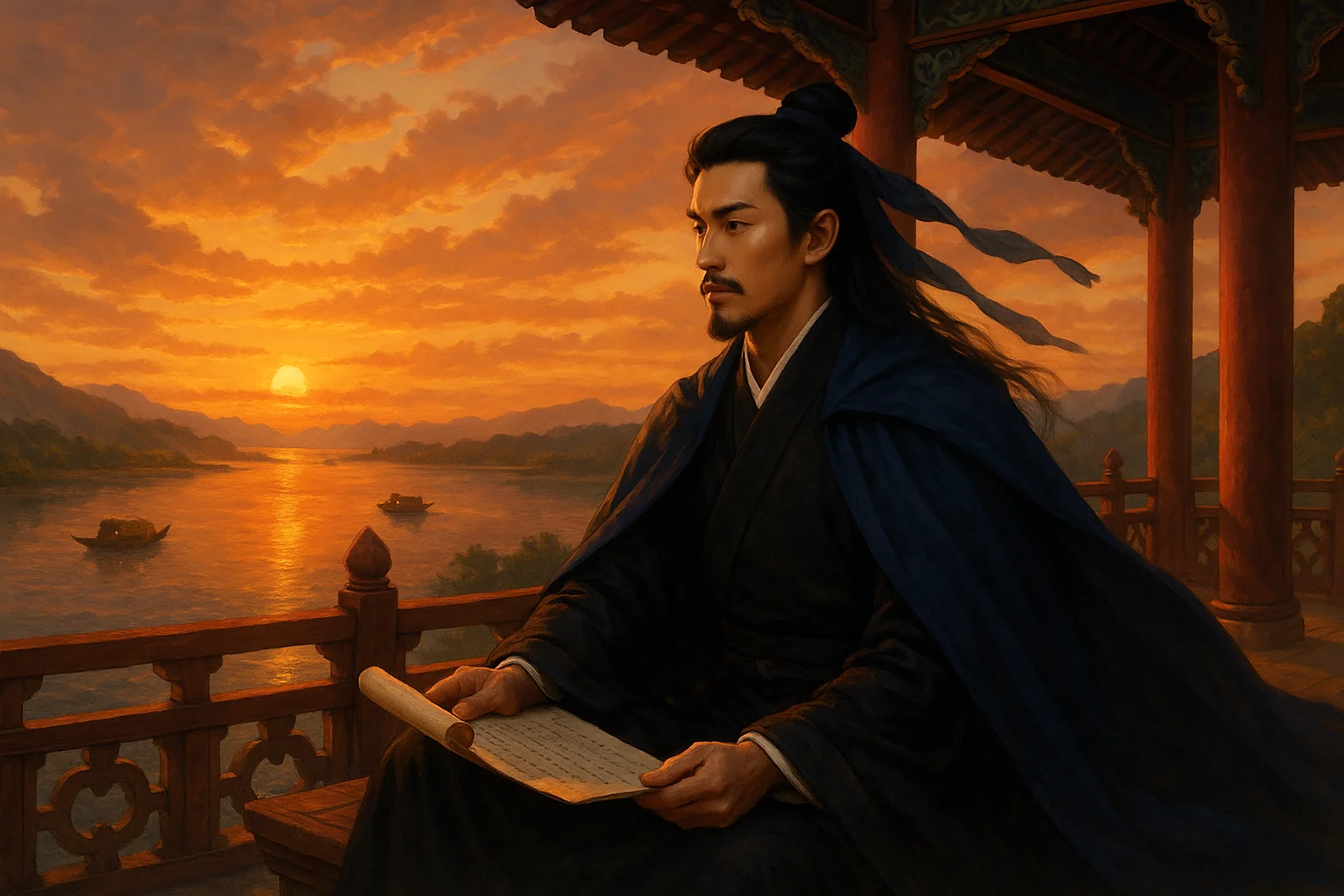
Wang Bo (王勃 c. 650 – 676), a native of Hejin, Shanxi Province, was a renowned writer of the Early Tang Dynasty and the foremost of the "Four Elites of the Early Tang." Exceptionally gifted from childhood, he could compose literary works at the age of six and passed the special imperial examination at sixteen, earning him the position of Gentleman for Court Service. Later, due to an incident, he was dismissed from office. In the third year of the Shangyuan era (676 AD), while crossing the sea to visit relatives, he fell into the water and died of fright at the young age of twenty-seven. His poetry and prose are celebrated for their abundant talent and grand vision. Wang Bo occupies a crucial position in the literary history of the Tang Dynasty. Together with Yang Jiong, Lu Zhaolin, and Luo Binwang, he collectively reversed the ornate and decadent literary style that had prevailed since the Qi and Liang dynasties, heralding the dawn of the resounding voice of the High Tang.