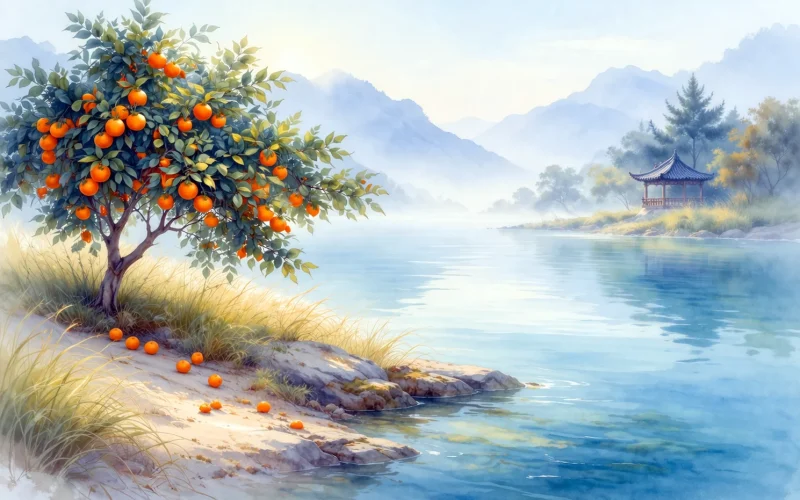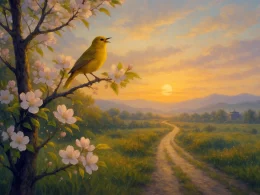



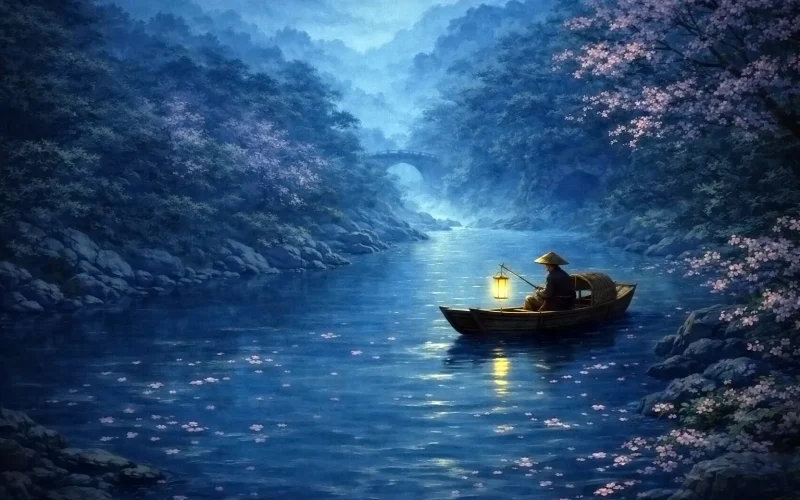
A bridge flies away through a wild mist,
Yet here are the rocks and the fisherman's boat.

Oh, if only this river of floating peach-petals
Might lead me at last to the mythical cave!
Original Poem
「桃花溪」
张旭
隐隐飞桥隔野烟,石矶西畔问渔船。
桃花尽日随流水,洞在清溪何处边。
Interpretation
This poem is a famous landscape work by the High Tang poet Zhang Xu. Zhang Xu was renowned for his wild cursive script (caoshu) and is historically called the "Sage of Cursive Script." He was a heavy drinker, often writing furiously after getting drunk, sometimes even using his hair dipped in ink to write. Upon sobering, he would regard his work as divinely aided, and his contemporaries called him "Mad Zhang." His calligraphy is known for its unrestrained momentum, unusual forms, and continuous, swirling strokes. His official career was undistinguished, serving in minor posts such as County Defender of Changshu and Chief of the Imperial Guard. In his later years, he resigned from office, retired to nature, and amused himself with poetry and wine.
This poem was likely written while Zhang Xu was wandering the regions south of the Yangtze River. The Peach Blossom Stream is located in Taoyuan County, Hunan, precisely the setting of Tao Yuanming's Record of the Peach Blossom Spring. The poet, passing by this place, saw a bridge dimly visible across the stream, wild mist curling, a fishing boat moored quietly by a rocky bank, and peach blossoms drifting with the water. He couldn't help but think of the ancient story of the fisherman of Wuling who by chance entered the Peach Blossom Spring. The act of "ask a fisherman" is the poet's search for the Peach Blossom Spring; the question of "I know not where the cave is" is the poet's inquiry into the ideal world. He is not looking for a real cave, but pursuing a spiritual refuge—that reclusive realm far from worldly clamor, peaceful and carefree.
In classical poetry, those writing on the theme of the Peach Blossom Spring often directly use the allusion, either chanting about the event or sighing over the realm. Zhang Xu's poem, however, is uniquely conceived, blending the allusion of Record of the Peach Blossom Spring into the actual scene before his eyes. He uses the hazy realm of "A bridge is dimly seen ’mid rising smoke" to subtly correspond to the bewildered feeling of the Wuling man first entering the Peach Blossom Spring; he uses the drifting scene of "Peach petals fallen on running water all day long" to echo the dreamlike picture of "falling petals in colorful profusion." Viewing the landscape with a calligrapher's eye and writing poetry with the temperament of "Mad Zhang," he thus gave the ordinary stream, bridge, and wild mist an extraordinary longing for the Peach Blossom Spring. That search of "ask a fisherman" and that questioning of "I know not where the cave is" conceal within these twenty-eight characters the poet's yearning for a reclusive life and his pursuit of an ideal world. The entire poem blends reality and illusion, creating an ethereal artistic conception. It is a poetic expression of the High Tang literati's transcendent, broad-minded spirit of entrusting their feelings to mountains and rivers.
First Couplet: "隐隐飞桥隔野烟,石矶西畔问渔船。"
Yǐn yǐn fēi qiáo gé yě yān, shí jī xī pàn wèn yú chuán.
A bridge is dimly seen ’mid rising smoke o’er the stream; West of the rock I ask a fisherman in his boat.
The poem opens with the two words "隐隐" (dimly seen) creating a hazy, dreamlike artistic conception. "隐隐飞桥" (A bridge is dimly seen) writes of the bridge faintly visible amidst mist and vapor, as if it is not of this world. "隔野烟" ('mid rising smoke) uses the word "隔" (amid) to indicate obscured vision, also subtly corresponding to the bewildered feeling of the Wuling man who, upon first entering the Peach Blossom Spring, "forgot how far he had traveled." The next line, "石矶西畔问渔船" (West of the rock I ask a fisherman in his boat), shifts from far to near, from scene to action. The three words "问渔船" (ask a fisherman) are the first "key" of the entire poem: he is not appreciating the scenery, but seeking; he is not a passerby, but a seeker. The fishing boat is both the actual scene before his eyes and a symbol of the Wuling fisherman from Record of the Peach Blossom Spring. The poet inquires of the fishing boat, asking not only for directions, but also about that legendary Peach Blossom Spring. In this couplet, the poet interweaves the real landscape with the ideal illusion, placing himself in the role of the Wuling fisherman, beginning his spiritual search for the Peach Blossom Spring.
Second Couplet: "桃花尽日随流水,洞在清溪何处边?"
Táo huā jìn rì suí liú shuǐ, dòng zài qīng xī hé chù biān?
Peach petals fallen on running water all day long, I know not where the cave is in the blue hills remote.
This couplet is the soul of the entire poem, concluding with a "question" that elevates the feeling of the search to its climax. "桃花尽日随流水" (Peach petals fallen on running water all day long) writes of peach blossoms falling and drifting with the stream's flow, precisely a reappearance of "falling petals in colorful profusion" from Record of the Peach Blossom Spring. The two words "尽日" (all day long) convey the passage of time and also the poet's posture of standing for a long time, gazing intently. The next line, "洞在清溪何处边" (I know not where the cave is in the blue hills remote), concludes the entire piece with a question. The two words "何处" (where) are the second "key" of the entire poem: he is not asking for directions, but probing; it is not a geographical exploration, but a spiritual quest. That "洞" (cave) is the entrance to the Peach Blossom Spring, and also a symbol of the ideal world; that "何处" (where) is the poet's yearning for a reclusive life, and also his inquiry into a place of spiritual repose. This question has no answer, nor does it need an answer—because that Peach Blossom Spring exists within each person's heart; the location of that "cave" lies within each person's pursuit.
Holistic Appreciation
This is a masterpiece among Zhang Xu's landscape poems. The entire poem consists of four lines and twenty-eight characters. Using the Peach Blossom Stream as the actual scene and the Peach Blossom Spring as the illusory realm, it blends the real landscape with the ideal illusion, showcasing the poet's yearning for a reclusive life and his quest for a spiritual refuge.
Structurally, the poem presents a progressive layering moving from reality to illusion, from scene to feeling, from search to question. The first couplet begins with "A bridge is dimly seen ’mid rising smoke", writing of the hazy scene before the eyes, subtly corresponding to the elusive realm of the Peach Blossom Spring. It engages in action with "West of the rock I ask a fisherman in his boat", placing the poet in the role of the Wuling fisherman. The second couplet continues with "Peach petals fallen on running water all day long", writing of the drifting peach blossoms and the flowing stream, echoing the classic image of "falling petals in colorful profusion." It concludes with "I know not where the cave is in the blue hills remote", condensing the feeling of the search into a single question. Between the four lines, it moves from scene to action, from action to feeling, from feeling to question, deepening layer by layer, forming a seamless whole.
Thematically, the core of this poem lies in the word "问" (ask/question). That "问" in "ask a fisherman" is the poet's active search; that "问" in "I know not where the cave is" is the poet's deep inquiry. This word "问" runs through the entire poem, expressing the poet's yearning for a reclusive life, his pursuit of an ideal world, and his longing for spiritual repose. He is not looking for a real cave, but pursuing a spiritual refuge—that Peach Blossom Spring far from worldly clamor, peaceful and carefree; that "blue hills remote" where the soul can perch.
Artistically, the poem's most moving aspect lies in the clever conception of "blending reality and illusion, using allusions without a trace." The poet does not directly write about the Peach Blossom Spring, but only writes of the scene before his eyes—the flying bridge, wild smoke, rocky bank, fishing boat, peach blossoms, flowing water—yet everywhere subtly corresponds to the classic imagery of Record of the Peach Blossom Spring. The haziness of "A bridge is dimly seen ’mid rising smoke" is the elusive nature of the Peach Blossom Spring's entrance. The search of "West of the rock I ask a fisherman in his boat" is the posture of the Wuling fisherman. The drifting of "Peach petals fallen on running water all day long" is a reappearance of "falling petals in colorful profusion." The inquiry of "I know not where the cave is in the blue hills remote" is the shared inquiry of all ages into the ideal world. This technique of blending allusions into actual scenes, hiding ideals within reality, is precisely the highest realm of Chinese classical poetry where "not a single word is used directly, yet its essence is fully captured."
Artistic Merits
- Blending Reality and Illusion, Ethereal Artistic Conception: Using real scenes to write an illusory realm, letting the scene before the eyes subtly correspond to the allusion of the Peach Blossom Spring. Reality contains illusion, illusion contains reality; the artistic conception is ethereal and far-reaching.
- Using Allusions Without a Trace, Natural and Artless: Alluding to Record of the Peach Blossom Spring without leaving a trace. The allusion blends with the scene, the allusion harmonizes with the feeling; like salt dissolving in water, it is invisible yet its flavor is present.
- Fresh, Beautiful Language, Subtle and Profound: Phrases like "dimly seen", "rising smoke", "all day long", and "where" use extremely understated brushstrokes to write extremely deep emotion, where words end but meaning is inexhaustible.
- Concluding with a Question, Enduring Resonance: The second couplet concludes with the question "I know not where the cave is in the blue hills remote", answering without answering, speaking without speaking, allowing the reader to personally contemplate the location of that Peach Blossom Spring within the inquiry.
Insights
This poem, through a search for the Peach Blossom Spring, speaks to an eternal theme—The ideal world is not elsewhere, but within each person's pursuit; the spiritual refuge is not far away, but within each person's heart.
First, it lets us see "the meaning of pursuit." Knowing well that the Peach Blossom Spring is a legend, the poet still "ask a fisherman", still seeks for the "cave". This pursuit of "knowing it cannot be done, yet doing it nonetheless" is not futile, but deep affection; it is not foolishness, but faith. It tells us: True ideals are not for realizing, but for pursuing; the true Peach Blossom Spring is not a destination to be reached, but the scenery along the way.
On a deeper level, this poem makes us contemplate the value of "questioning." "I know not where the cave is in the blue hills remote"—this question asks about the path, and also the heart; it asks about geography, and also the spirit. It makes us understand: The meaning of life often lies not in the answer, but in the questioning; the spiritual refuge often lies not upon arrival, but on the path of seeking.
And what is most lingering is the poem's poetic quality of "transforming reality into ideal." The Peach Blossom Stream was originally ordinary landscape, yet because of Zhang Xu's brush, it became the entrance to the Peach Blossom Spring. The act of "ask a fisherman" was originally an ordinary inquiry for directions, yet became an inquiry into the ideal world. This power of "transforming reality through poetry" is precisely the most moving aspect of poetry.
This poem writes of a search during the High Tang, yet allows everyone pursuing ideals in reality, everyone yearning for peace amidst clamor, to find resonance within it. The haziness of "A bridge is dimly seen ’mid rising smoke" is the scenery in the eyes of every seeker. The posture of "West of the rock I ask a fisherman in his boat" is the common stance of every inquirer. The drifting of "Peach petals fallen on running water all day long" is the poetry in the heart of every idealist. The questioning of "I know not where the cave is in the blue hills remote" is the deepest echo in the hearts of everyone longing for a refuge. This is the vitality of poetry: it writes of Zhang Xu's Peach Blossom Stream, but one reads of people in all eras who, between reality and ideal, between clamor and peace, constantly seek.
Poem translator
Kiang Kanghu
About the poet
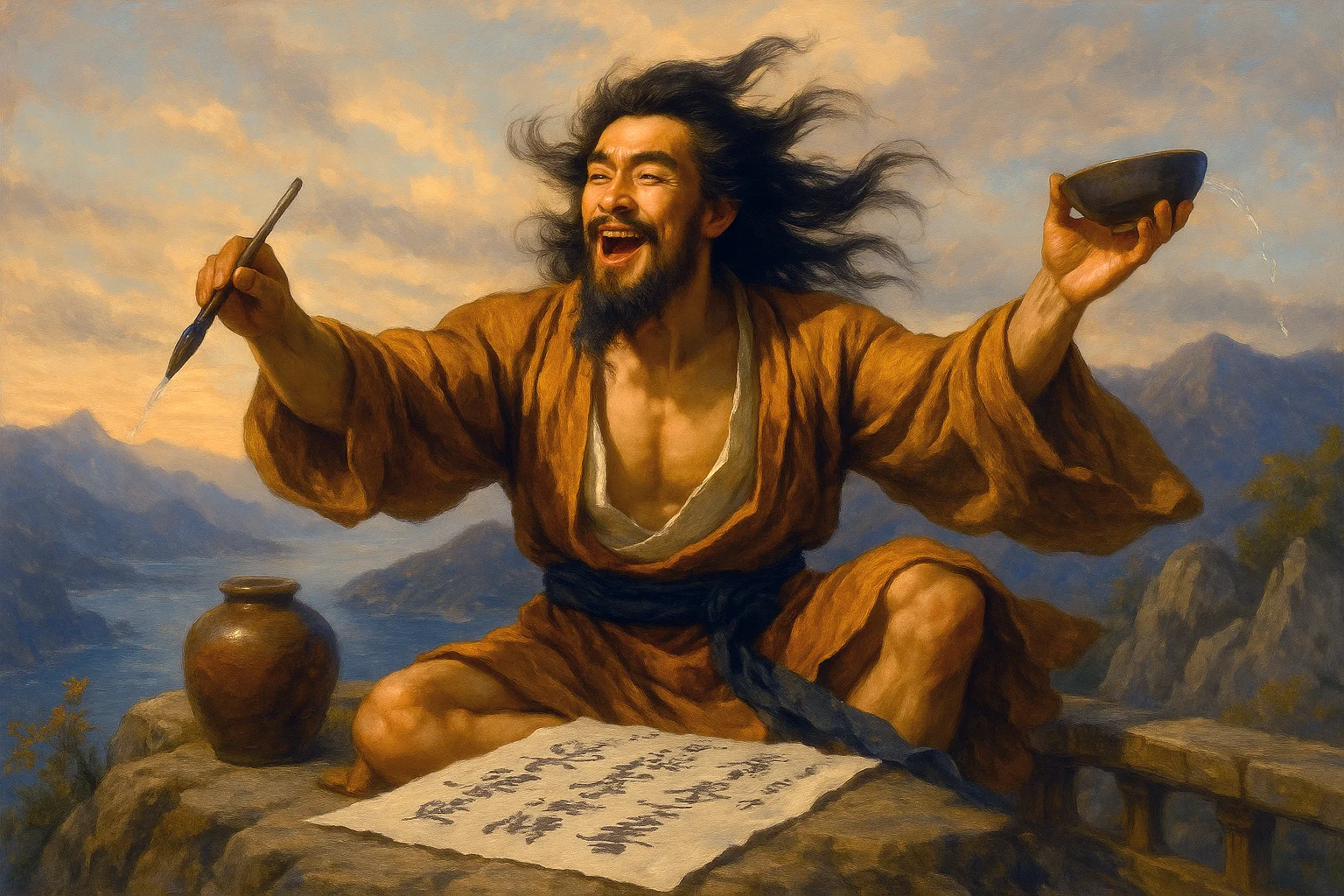
Zhang Xu (张旭 c. 675 - c. 750), a native of Suzhou, Jiangsu Province, was a renowned calligrapher and poet of the High Tang period. Born in the Early Tang but active during the High Tang, he was unrivaled in cursive calligraphy. His personality was wild and unrestrained, and he was famously addicted to wine. He often wielded his brush with great speed after drinking, sometimes even dipping his hair in ink. His contemporaries called him “Madman Zhang,” and Du Fu listed him as one of the “Eight Immortal Drinkers.” Although his poetic achievements were overshadowed by his fame in calligraphy, his poetry still embodies the spirit of the High Tang. His artistic hallmark lies in the “unity of calligraphy and poetry,” both distinguished by a seamless flow of energy and an untrammeled natural elegance.