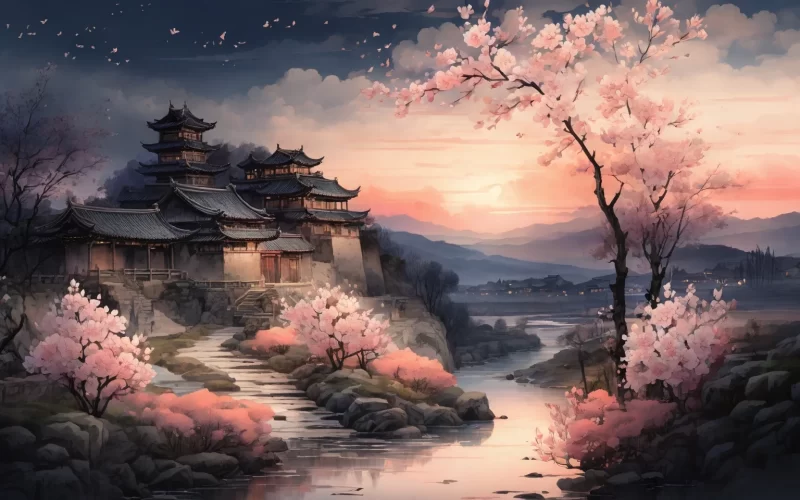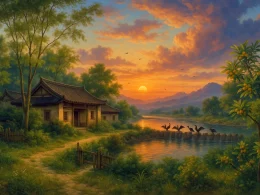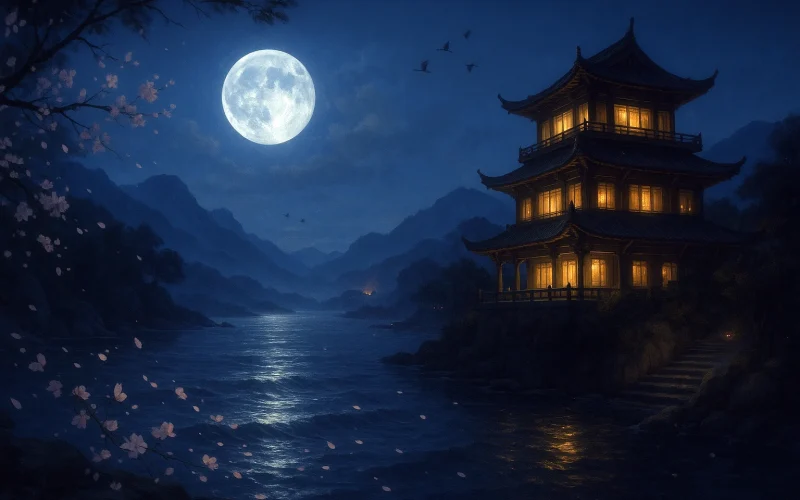
At dusk along the pathway crawls the gloomy hue;
My riverside tower’s close to waters blue.
Clouds stay by cliffs like a thin veil;
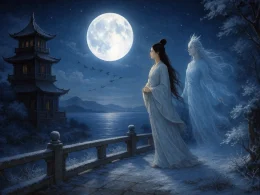
The lonely moon turns over on the billow pale.

In silent flight the cranes are seen;
The wolves o’er prey cry e’er so keen.
Awake, I’m grieved by warfare’s fright;
I cannot put the world aright!
Original Poem
「宿江边阁」
杜甫
暝色延山径,高斋次水门。
薄云岩际宿,孤月浪中翻。
鹳鹤追飞静,豺狼得食喧。
不眠忧战伐,无力正乾坤。
Interpretation
This work was composed in the autumn of 766 CE, the first year of the Dali era under Emperor Daizong, while Du Fu was residing in the West Pavilion of Kuizhou (present-day Fengjie, Chongqing). A wanderer arriving in this place, the poet had taken lodging in a riverside pavilion high in the hills. Although the An Lushan Rebellion had been quelled, warfare continued unabated in the provinces. Regional warlords maintained their separatist power, Tibetan forces harassed the borders, and the nation knew no peace. Personally, he was worn down by illness and advancing age, his great ambitions come to nothing; the state was unstable, its future uncertain. This poem is a masterpiece of regulated verse forged on a single sleepless night, fusing the sights before his eyes, the sounds in his ears, and the profound anxieties of his heart. It stands as a concentrated portrait of both the consummate artistry and the inner emotional world of Du Fu’s final years.
First Couplet: “暝色延山径,高斋次水门。”
Míng sè yán shān jìng, gāo zhāi cì shuǐ mén.
The gloom of twilight stretches down the mountain trail; / This lofted lodge of mine stands near the river-gate, so pale.
The opening delineates the spatial and temporal setting with measured strokes. In "The gloom of twilight stretches down," the verb "stretches" lends the encroaching darkness a palpable, advancing quality, as if dusk were seeping up the path. This describes the scene while also evoking the dual pressures of time’s passage and the gathering weight upon the poet’s spirit. "This lofted lodge of mine stands near the river-gate" establishes the dwelling’s perilous elevation and strategic position (the "river-gate" being the entrance to the Qutang Gorge). The poet seems stationed at a confluence point—of heaven and earth, mountain and river, of the relentless flow of history itself—establishing the poem’s tone of solitary grandeur and profound existential exposure.
Second Couplet: “薄云岩际宿,孤月浪中翻。”
Bó yún yán jì sù, gū yuè làng zhōng fān.
Where rock and cliff-edge merge, thin clouds find their nightly bed; / Upon the churning waves, a lonely moon is tossed and sped.
This couplet represents the pinnacle of Du Fu’s descriptive art—condensed yet powerfully resonant. "Thin clouds find their nightly bed" presents a still, suspended moment; the clouds seeming to lodge or "bed" against the cliff face captures the merged, indistinct state of rock and mist in the deep night and the heavy, inert atmosphere of the mountains after dark. "A lonely moon is tossed and sped" seizes a scene of violent motion. The moon "is tossed" upon the waves, vividly rendering the turbulent river and the fractured, fleeing reflection. More importantly, it places the "lonely moon" within the unstable, tumultuous "churning waves," making it a perfect symbol for the poet’s own isolated fate and the turbulent condition of his age. One line captures stillness, the other motion; one "beds," the other is "tossed"—the artistic conception is profound and far-reaching.
Third Couplet: “鹳鹤追飞静,豺狼得食喧。”
Guàn hè zhuī fēi jìng, chái láng dé shí xuān.
Storks and herons chase no more, in stillness bound; / While wolves and jackals feast, and fill the night with sound.
The poet’s attention turns from the distant sky to the nearer wilderness, selecting two sets of starkly antithetical images. "Storks and herons chase no more, in stillness bound" describes noble creatures fallen silent, symbolizing the withdrawal or impotence of all that is graceful, pure, and orderly. "While wolves and jackals feast, and fill the night with sound" depicts savage beasts grown raucous over their spoils, serving as a metaphor for the rampant, triumphant clamor of the violent and predatory in a time of strife. This contrast between "stillness" and "sound" constitutes a pointed allegory for that chaotic era where the strong devoured the weak and right was overturned. The voices of the natural world directly mirror the cruel realities of the human one.
Fourth Couplet: “不眠忧战伐,无力正乾坤。”
Bù mián yōu zhàn fá, wú lì zhèng qián kūn.
Sleepless, I brood on war, its ceaseless, bitter cost; / Powerless to set this ravaged world aright, and lost.
Following the layered, accumulating pressure of the first three couplets, the poet speaks directly, naming the root cause of his insomnia and his deepest anguish. "Brood on war" is the object—his profound and enduring concern for the fate of his country and people. "Powerless to set this ravaged world aright" is the feeling—the acute sense of defeat and self-recrimination of an idealist confronting an immense and implacable reality. These ten words fall with the finality of a judge’s gavel. They are both a tragic summation of a personal life and an articulation of the shared dilemma and profound grief of all conscientious souls in an age of chaos. The emotional weight is immense.
Holistic Appreciation
This work is a concentrated expression of the deeply somber, powerfully controlled style that defines Du Fu’s late regulated verse. The poem’s structure is rigorous, following a clear, progressive sequence: external setting (twilight, mountain lodge) → natural phenomena (clouds, moon) → allegory for the human world (storks, wolves) → innermost confession (anxiety over war, powerlessness). It moves deliberately from the outer to the inner, from scene to feeling, ultimately elevating a personal, sleepless vigil into a profound apprehension of an era’s suffering and a philosophical reckoning with the human condition within it.
The poem’s most devastating power springs from the fierce collision within the poet’s soul between "ultimate stillness" and "ultimate turbulence." The scenes depicted—the stretching twilight, clouds bedding on cliffs, storks held in stillness—create an atmosphere of isolated, oppressive quiet. Yet the lonely moon tossed on waves, the clamor of feasting beasts, and the unending warfare represent a realm of disruptive, threatening motion. The poet exists at the vortex of this stillness and tumult; his "sleepless" state is the physical and psychological signature of this unresolved conflict. The concluding sigh of "powerless" is not defeatism but a form of heroic soliloquy, heavy with immense responsibility and tragic awareness, born of a clear-eyed recognition of individual limitation.
Artistic Merits
- Exquisite Parallelism Charged with Meaning: The parallelism in the two central couplets is crafted with supreme skill. "Thin clouds" parallels "lonely moon"; "find their nightly bed" parallels "is tossed and sped"—a perfect mirroring of spatial and kinetic states. "Storks and herons" parallels "wolves and jackals"; "in stillness bound" parallels "fill the night with sound"—a sharp contrast of imagery and moral atmosphere. This formal balance provides aesthetic pleasure while intensifying the poem’s internal tension and depth of critique.
- The Potent Precision of Verbs and the Creation of Poetic Foci: Verbs like "stretches," "stands near," "find their nightly bed," "is tossed," "in stillness bound," "fill the night with sound" are selected with uncanny precision. Particularly, "is tossed" for the moon and "fill the night with sound" for the wolves are worth their weight in gold—vivid and evocative, describing not only scenery but the very state of the poet’s mind and world.
- The Deliberate Construction of a Metaphorical System: "A lonely moon is tossed and sped" serves as a metaphor for the individual adrift in the torrent of the times. "Storks and herons… in stillness" versus "wolves and jackals… with sound" constructs a symbolic representation of a social order where the way of the noble is in retreat and the base prevail. The natural imagery is thoroughly saturated with the poet’s emotion and intellect, becoming the vessel for his troubled consciousness.
- The Blunt Force and Immense Gravity of the Conclusion: After the indirect, suggestive layering of scenery and symbol in the preceding lines, the final couplet breaks forth in language of utter directness and stark confession, like a long-contained pressure finally released. This shift from "implied meaning" to "direct statement" generates a powerful emotional impact, driving the poem’s grief-stricken and indignant mood to its climax.
Insights
This work poses an enduring question: When an individual, facing the vast, chaotic suffering of an age, feels profoundly "powerless to set this ravaged world aright," where then can meaning and value reside for that life?
Du Fu’s answer is contained within the poem itself: meaning lies in remaining "sleepless" and "brood[ing] on war"—in never relinquishing care and anxious concern for the fate of nation and people. Value resides in transforming this very sense of powerlessness and pain into artistic expression as distilled and enduring as the "lonely moon tossed upon the churning waves."
The poem reveals that true moral courage and commitment may not always manifest as the triumph of turning the tide, but can appear as maintaining clear-eyed, "sleepless" vigilance through the long night, sustaining a critique of the "sound" made by "wolves and jackals" at their feast, and daring to confront and articulate the authentic pain of feeling "powerless." Du Fu’s greatness lies precisely in the fact that he never ceased his anxious "brood[ing]" because of his personal "powerlessness." His poetry stands as the most potent, most immortal form of resistance possible from a spirit that acknowledged its limits. This poem thus becomes a source of eternal resonance for all souls who cling to conscience amidst adversity and persist in gazing toward the light, even from within the deepest dark.
About the poet
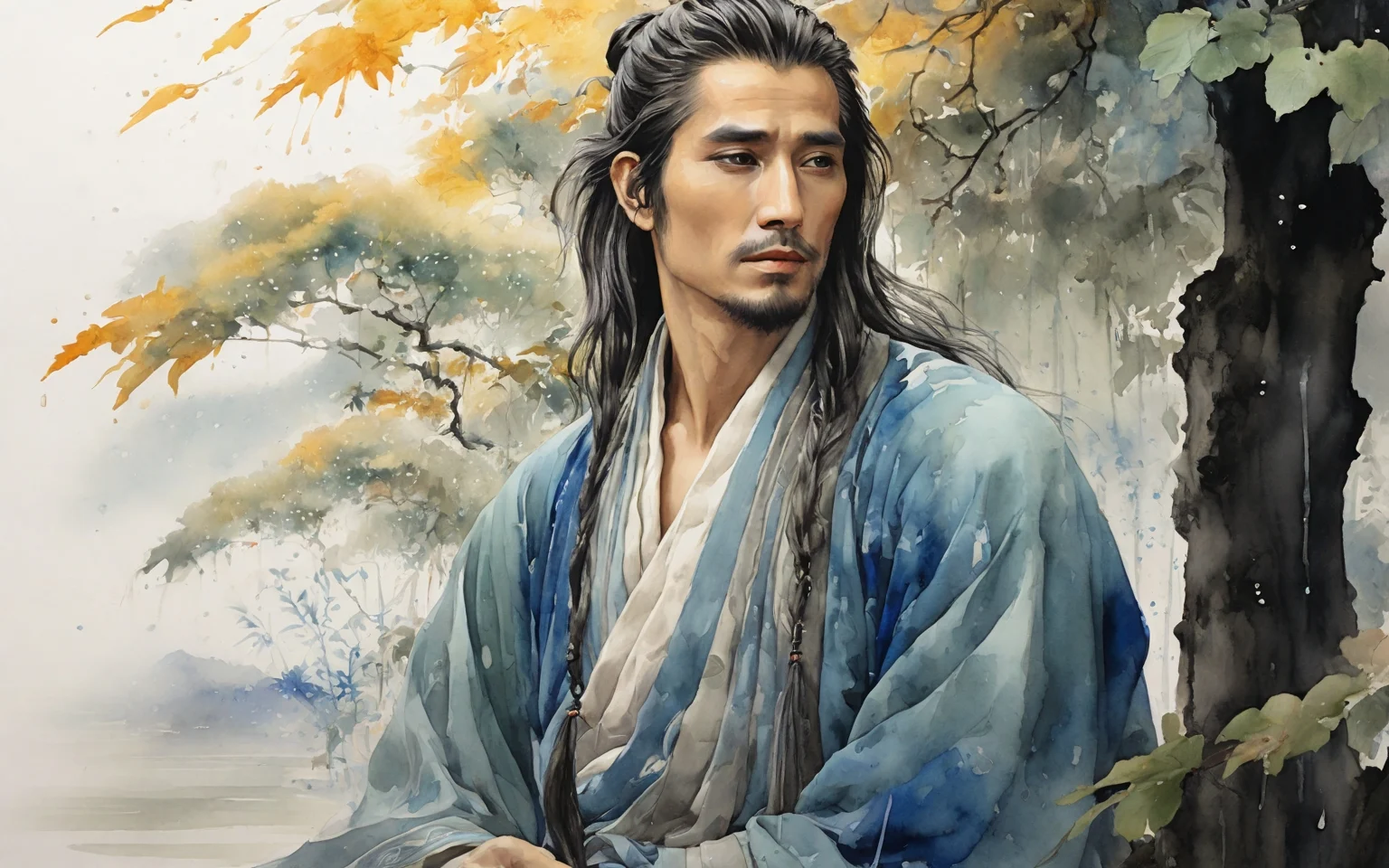
Du Fu (杜甫), 712 - 770 AD, was a great poet of the Tang Dynasty, known as the "Sage of Poetry". Born into a declining bureaucratic family, Du Fu had a rough life, and his turbulent and dislocated life made him keenly aware of the plight of the masses. Therefore, his poems were always closely related to the current affairs, reflecting the social life of that era in a more comprehensive way, with profound thoughts and a broad realm. In his poetic art, he was able to combine many styles, forming a unique style of "profound and thick", and becoming a great realist poet in the history of China.