


The autumn night is clear and cold in the lakka-trees of this courtyard.
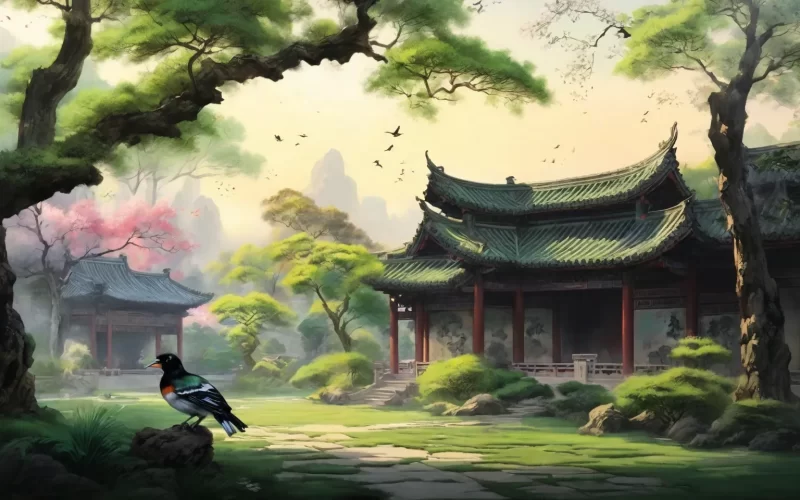
I am lying forlorn in the river-town. I watch my guttering candle.
I hear the lonely notes of a bugle sounding through the dark.
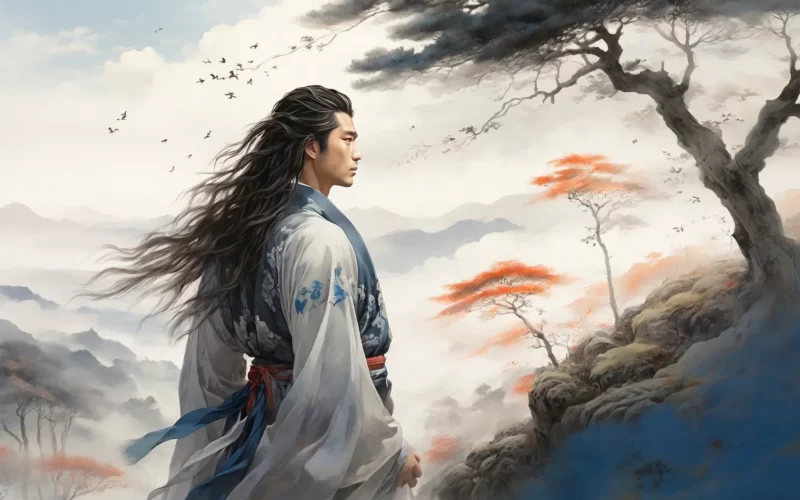
The moon is in mid-heaven, but there's no one to share it with me.
My messengers are scattered by whirls of rain and sand.
City-gates are closed to a traveller; mountains are walls in my way --
Yet, I who have borne ten years of pitiable existence,
Find here a perch, a little branch, and am safe for this one night.
Original Poem
「宿府」
杜甫
清秋幕府井梧寒,独宿江城蜡炬残。
永夜角声悲自语,中天月色好谁看?
风尘荏苒音书绝,关塞萧条行陆难。
已忍伶俜十年事,强移栖息一枝安。
Interpretation
This poem was composed in the autumn of 764 CE, the second year of the Guangde era under Emperor Daizong of the Tang dynasty, while Du Fu was residing in Chengdu. Through the recommendation of his friend Yan Wu, he had joined the staff of the military governor of Jiannan as an advisor and held the titular office of Vice Director of the Ministry of Works, thus securing temporary shelter. However, the life of a staff officer was wearisome, bound by routine paperwork and inevitably entangled in petty disputes, all of which clashed with the poet's free-spirited nature. Composed during a night watch at the headquarters, this poem intertwines the chill of clear autumn, the solitude of the long night, and memories of years of wandering. It portrays the profound loneliness, self-reflection, and unyielding spirit of a great poet who, for the sake of livelihood in a chaotic age, reluctantly submitted to the life of a minor official.
First Couplet: 清秋幕府井梧寒,独宿江城蜡炬残。
Qīng qiū mù fǔ jǐng wú hán, dú sù jiāng chéng là jù cán.
In the clear autumn chill, by the well-side plane tree at headquarters I stay; / Alone in the riverside town, I lodge as the candle burns low, its light wasting away.
The opening immediately establishes a solitary and desolate atmosphere. "Clear autumn chill" and "well-side plane tree" specify the season and scene, evoking a sense of bleakness. "Headquarters" represents the poet's present, awkward refuge, implying a feeling of confinement. "Alone… I lodge" is the emotional core of the entire poem, directly stating his solitude. The detail "the candle burns low" is highly expressive: it indicates the late, quiet hour and symbolizes the gradual depletion of the poet's spiritual energy and the quiet passage of life. The chill of the environment and the loneliness of his heart are fused from the very first line.
Second Couplet: 永夜角声悲自语,中天月色好谁看?
Yǒng yè jiǎo shēng bēi zì yǔ, zhōng tiān yuè sè hǎo shuí kàn?
Through the endless night, the bugle's mournful note seems to grieve alone; / The lovely moon hangs at the sky's zenith—for whom does it brightly shone?
This couplet uses the contrast between sound (the bugle) and sight (the moonlight) to fully convey the solitude of a sleepless night. "The bugle's mournful note seems to grieve alone": the bugle is a sound peculiar to the military camp, cold and severe. Yet the poet hears its "mournful" quality and personifies it with "seems to grieve alone," effectively externalizing his own inner desolation and loneliness. "For whom does it brightly shone?" is a rhetorical question expecting no answer. The bright moon, normally a vehicle for shared sentiment, in this state of isolation only serves to highlight the solitude. This line elevates individual loneliness to an existential level, possessing a powerful poignancy.
Third Couplet: 风尘荏苒音书绝,关塞萧条行路难。
Fēng chén rěn rǎn yīn shū jué, guān sài xiāo tiáo xíng lù nán.
As war's dust drifts through passing years, news from kin and friends has ceased; / The frontier passes lie desolate, the journey home sorely diseased.
His thoughts shift from the nocturnal scene before him to broader reflections on time and human affairs. "As war's dust drifts through passing years" is saturated with the vicissitudes of wartime displacement and the slow erosion of time. "News… has ceased" and "the journey home sorely diseased" concretely depict the isolation from family and old friends caused by war, reflecting the era's suffering projected onto personal life. The focus expands from his own "Alone… I lodge" to isolation from and obstruction by the entire external world, encompassing anxiety for the nation and sorrow for his personal lot.
Fourth Couplet: 已忍伶俜十年事,强移栖息一枝安。
Yǐ rěn líng pīng shí nián shì, qiǎng yí qī xī yī zhī ān.
These ten long years of lonely wandering I have endured with pain; / Like a bird, I perch on any branch that offers respite, though in vain.
The poem concludes with painful self-analysis and self-mockery. "Lonely wandering" describes a state of solitary drifting; "ten long years" summarizes the entire period of suffering since the outbreak of the An Lushan Rebellion. "I have endured with pain" speaks volumes of the endless hardships and resilience within that time. The final line, "I perch on any branch that offers respite, though in vain," alludes to Zhuangzi's saying: "The wren nesting in the deep forest occupies but a single branch." Superficially, it means his temporary staff post is like a bird finding a branch to perch on, but in reality, it is clear-eyed self-mockery and a sigh of resignation. "I perch" indicates it is not his true wish; the word "offers respite" is particularly ironic—when has his body and mind found any real peace? The poet's acute awareness and profound helplessness regarding his situation are fully contained within this line.
Holistic Appreciation
This poem stands as one of Du Fu's seven-character regulated verses that most intensively and profoundly develops the motif of "solitude." Using "solitary lodging" as its central theme, the poem's emotion deepens layer by layer: the first couplet uses scenery to convey solitude, establishing the tone; the second uses sound and sight to contrast and deepen the sense of solitude, enriching the poetic atmosphere; the third expands from personal solitude to the isolation imposed by the era, broadening the scope; the fourth concludes with the solitude of a decade of wandering, highlighting the reluctant and helpless nature of his current predicament.
Its artistic power lies in how the poet elevates the mundane duty of a night watch at headquarters into a profound meditation on the state of existential loneliness and a philosophical inquiry into life's meaning. The "solitude" in the poem is not merely physical isolation in space, but also spiritual severance from loved ones, alienation from beauty ("for whom does it brightly shone?"), and the profound loneliness of an individual whose fate is not his own in a turbulent age ("I perch on any branch"). With his utterly sincere soul, Du Fu renders this sense of loneliness so concretely and universally that it becomes a shared spiritual imprint for all sensitive hearts in a troubled time.
Artistic Merits
- Desolate Atmosphere, Somber Emotion
The poem revolves around words like "chill," "burns low," "mournful," "ceased," "diseased," and "lonely wandering" to construct a poetic realm that is bleak, cold, somber, and mournful, accurately conveying the poet's lonely state of mind and feeling of rootless drifting during his solitary vigil. - Exquisite Parallelism, Profound and Suggestive
The two middle couplets exhibit masterful parallelism. "Endless night" contrasts with "sky's zenith," time with space; "bugle's note" with "moon," sound with sight; "seems to grieve alone" with "for whom does it brightly shone?" personification with rhetorical question. Within the polished form lies intense contrast and emotional tension born of solitude. - Precise and Arresting Diction, Vivid Detail
The word "burns low" describes both the object's state and the mind's condition; "seems to grieve alone" personifies the bugle's sound, highlighting its wordless sorrow; "I perch" incisively conveys the humiliation and helplessness of reluctantly depending on others. - Tight Structure, Progressive Layers
From the immediate scene (autumn chill at headquarters) to the sound in his ears (the all-night bugle), then to the matters on his mind (ceased news, desolate frontiers), finally culminating in his ten-year personal history and current plight—the progression moves from external to internal, from near to far. The emotional logic is clear, the structure tightly woven.
Insights
Du Fu's work reveals that even in a moment of seeming "stability" (a staff officer's post), a great soul can still feel bone-deep loneliness and profound "unease." Du Fu shows us that true peace never resides in an external place of refuge, but in whether the heart finds harmony with its own nature, its ideals, and the world.
This poem also lays bare the eternal dilemma of the intellectual, caught between the pressing demands of material existence and the longing for spiritual freedom. One may “perch on any branch” for survival, yet remain acutely conscious of the temporariness and compromise inherent in this “respite,” and maintain within poetry a critical scrutiny of this condition. This stance of “retaining clarity amidst compromise, persisting in writing amidst hardship” is a vital spiritual legacy Du Fu bequeaths to later intellectuals—even if the body perches on “a branch,” the heart belongs to the boundless cosmos and the eternal moon.
Poem translator
Kiang Kanghu
About the poet

Du Fu (杜甫), 712 - 770 AD, was a great poet of the Tang Dynasty, known as the "Sage of Poetry". Born into a declining bureaucratic family, Du Fu had a rough life, and his turbulent and dislocated life made him keenly aware of the plight of the masses. Therefore, his poems were always closely related to the current affairs, reflecting the social life of that era in a more comprehensive way, with profound thoughts and a broad realm. In his poetic art, he was able to combine many styles, forming a unique style of "profound and thick", and becoming a great realist poet in the history of China.